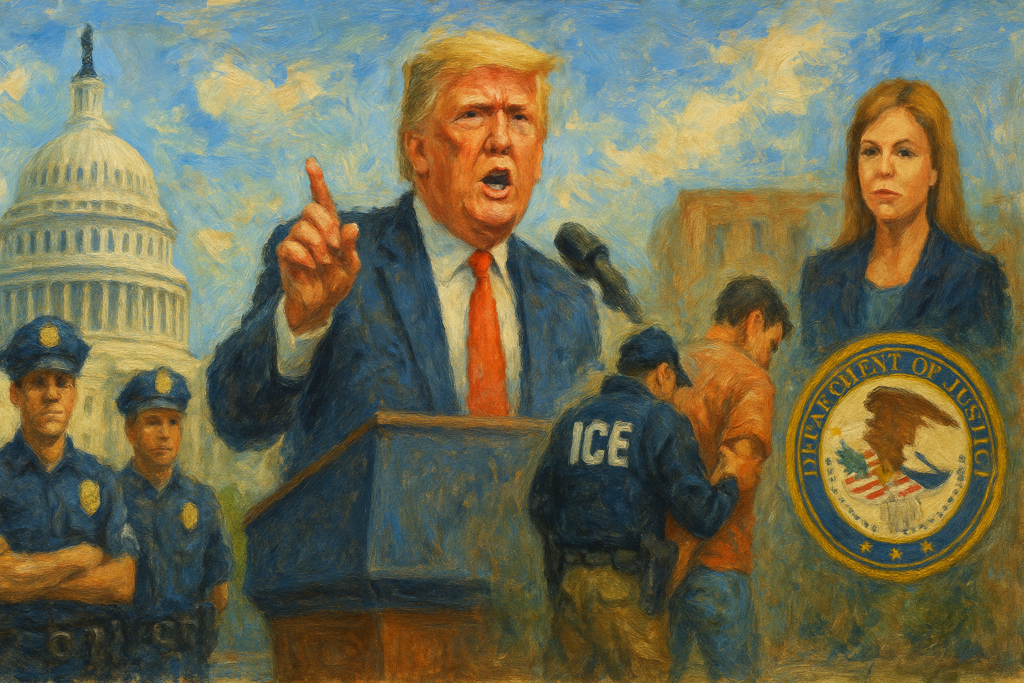
This week’s throughlines
- Federal control over Washington, D.C. escalated, then met resistance — Weekend threats against homeless residents and D.C. home rule turned into a Monday emergency order, federal policing takeover, and troop deployment. By midweek Trump sought to make the arrangement longer-lasting, before lawsuits, congressional action, and negotiations forced a partial retreat on Friday.
- Immigration enforcement widened from detention and legal pressure to coercion of cities and visible force — The week linked individual detentions, sanctions against immigration lawyers, blocked oversight of detention sites, new detention capacity, threats to sanctuary jurisdictions, and a deadly raid in Los Angeles into one expanding enforcement campaign.
- Control over institutions and official narratives tightened — The administration and its allies moved across several fronts: partisan justice appointments, pressure on prosecutors, a purge and replacement at the Bureau of Labor Statistics, pressure on the Smithsonian, and symbolic interventions by the Pentagon and White House that blurred governance with ideological and personal branding.
- Representation fights spread beyond Texas — Texas Republicans advanced a new congressional map and kept special sessions going, while legal threats targeted Beto O’Rourke and California leaders warned they would answer with their own redistricting moves if the effort continued.
The week opened with a sharp test of how far the federal government could reach into local governance and individual lives. From Washington, D.C., to sanctuary cities and state redistricting fights, the administration pressed its authority into policing, immigration, and electoral maps, while courts, state officials, and civil society tried to draw lines. At the same time, the White House moved to reshape the information Americans receive—from economic statistics to museum exhibits—while Christian nationalist ideas gained visible influence over defense policy.
Over the weekend, the administration signaled its willingness to stretch both foreign and domestic power. Abroad, Trump announced plans to meet Vladimir Putin in Alaska to discuss a deal that could force Ukraine to cede occupied territory, even as his administration moved to open most of the National Petroleum Reserve–Alaska to oil and gas drilling. Pairing a controversial summit with a major Arctic drilling push tied together questions of territorial integrity overseas and control of public lands at home. The drilling move shifted vast federal acreage toward extractive interests, while the proposed summit suggested a readiness to legitimize territorial conquest despite Putin’s war‑crimes indictment.
Courts, however, reminded the executive branch that some boundaries are set in statute. A federal appeals court ordered the restoration of a public spending apportionment database, reinforcing that transparency in how money is allocated is not optional. In Hawaii, a judge reinstated a ban on commercial fishing in a Pacific marine monument, reversing a Trump‑era rollback that had bypassed required public process. Together, these rulings underscored that environmental protections and budget openness are governed by law, not presidential preference alone.
Inside the national security apparatus, the weekend also showed how loyalty was being prioritized over expertise. Trump nominated Tammy Bruce, a former Fox commentator and current State Department spokesperson with limited diplomatic experience and a record of inflammatory remarks, to be deputy U.S. representative to the United Nations. At the same time, Director of National Intelligence Tulsi Gabbard, with Trump’s backing, declassified a highly sensitive report on Russia’s 2016 election interference. The timing and selectivity of that declassification raised questions about whether intelligence was being used to advance a political storyline rather than to foster accountability.
On immigration, individual cases illustrated the human stakes of enforcement policy. ICE arrested Roland Mehrez Beainy, a Trump‑themed restaurant owner, for overstaying a visa; detained Will Kim, a long‑time resident and doctoral student, over a 14‑year‑old marijuana offense; and held DACA recipient and organizer Catalina “Xochitl” Santiago. These actions showed how minor or old infractions can trigger life‑altering deportation proceedings, and that enforcement can reach politically sympathetic figures and community leaders as readily as anyone else. Advocates mobilized around the cases, but the decisions rested with federal immigration authorities.
In Washington, Trump used the weekend to target another vulnerable group: the city’s homeless residents. Speaking from his golf club, he ordered homeless people to leave the capital under threat of federal enforcement and directed lawyers to explore legislation overturning the D.C. Home Rule Act, which grants residents local self‑government. That move foreshadowed a broader confrontation over who controls policing and policy in the nation’s capital. At the Pentagon, Defense Secretary Pete Hegseth reposted and endorsed a video by Christian nationalist pastors opposing women’s right to vote, signaling elite openness to revisiting core democratic rights. His intervention linked religious ideology to questions of suffrage and civil equality.
The weekend also brought signs of structural shifts in economic governance. Nvidia and AMD agreed to give the U.S. government 15 percent of revenues from chip sales in China in exchange for export licenses, an unusual revenue‑sharing deal negotiated directly with the White House. By extracting quasi‑tax payments outside normal legislative processes, the executive branch expanded its leverage over strategic industries, blurring the line between public regulation and bespoke financial arrangements.
By Monday, the clash over D.C. governance moved from rhetoric to formal action. After publicly attacking Mayor Muriel Bowser and announcing a press conference, Trump issued an executive order declaring a crime emergency in the District of Columbia. Despite declining violent crime, the order authorized the attorney general to direct the city’s police for federal purposes. This step effectively commandeered a local police department in the name of public safety, raising concerns about chilling protest and undermining local self‑rule in the capital.
Elsewhere in the federal system, courts again acted as a counterweight. A federal judge ordered the administration to release $95 million to the National Endowment for Democracy, ruling that the White House could not unilaterally freeze congressionally appropriated funds. In a separate case, Judge Paul Engelmayer rejected a bid to unseal Ghislaine Maxwell grand jury transcripts, describing it as a diversionary transparency ploy. These rulings reinforced that the executive cannot simply impound money or manipulate high‑profile cases for political theater without judicial scrutiny.
Inside domestic agencies, the administration continued to reshape institutions. At the Department of Veterans Affairs, internal moves to reduce staff and terminate labor agreements with health‑care unions coincided with House advancement of a bill to expand veterans’ access to private care. The combination of staffing cuts and privatization pressures suggested a structural shift away from public provision of veterans’ health services. At the FBI, leadership aligned with Trump reassigned thousands of agents and sharply reduced investigations into right‑wing extremist groups, even as experts continued to warn that such groups pose a leading domestic security risk. These decisions redirected federal law‑enforcement focus in ways that could embolden paramilitary actors.
The courts also began probing the administration’s use of military forces in domestic contexts. In San Francisco, a federal judge heard evidence on whether deploying National Guard soldiers and Marines to Los Angeles immigration protests without the governor’s consent violated the Posse Comitatus Act. The case went to the heart of civil‑military boundaries: how far a president can go in using troops for law enforcement over state objections. Meanwhile, Hegseth formalized his culture‑war agenda inside the Pentagon by banning transgender individuals from military service and ordering the reinstallation of a Confederate memorial at Arlington National Cemetery. These decisions rolled back inclusion and used official commemoration to elevate a revisionist narrative of the Civil War, tying defense policy to Christian nationalist themes he had already endorsed.
The administration’s reach into the information infrastructure deepened as well. Trump fired Bureau of Labor Statistics commissioner Erika McEntarfer after an unfavorable jobs report he labeled “rigged” and nominated Heritage Foundation economist E.J. Antoni to replace her. Reporting later in the week would describe statistical agencies as being staffed with loyalists expected to massage data. On Monday, the firing itself signaled a willingness to punish independent economic analysis. Civil society groups responded on other fronts: the Democracy Forward Foundation sued the Justice Department and FBI to compel responses to a Freedom of Information Act request for Epstein‑related files, using FOIA litigation to pry loose information in a politically sensitive case. In the background, agencies such as the DEA, EPA, FCC, OSHA, and CDC issued a series of technical notices on controlled substances, pesticides, telecom data, and lab preparedness, and Trump extended a suspension of additional tariffs on Chinese imports. These regulatory actions reflected the ongoing machinery of governance rather than a targeted political project.
On Tuesday, legal tools were deployed more overtly as instruments of political struggle. In Texas, Attorney General Ken Paxton asked a judge to jail Beto O’Rourke for allegedly violating a court order restricting fundraising tied to Democrats’ quorum‑breaking walkout over a GOP‑drawn congressional map. The request, lodged in state court, underscored how “lawfare” can be used to constrain opposition organizing around electoral rules. At the same time, California’s governor and attorney general sued the Justice Department over the deployment of thousands of National Guard troops and Marines to Los Angeles immigration protests without state consent, arguing in federal court that the move violated the Posse Comitatus Act and blurred military and police roles.
Immigration enforcement remained a central arena of conflict between branches and levels of government. A federal judge ordered ICE to improve food, medical access, and legal visits at a New York City detention facility, enforcing minimum standards for people in federal custody. In parallel, the Justice Department sought financial sanctions against immigration attorney Joshua Schroeder for his efforts to block a Hmong client’s deportation, citing a Trump directive to punish “frivolous” suits. The combination of court‑ordered improvements and executive attempts to deter aggressive legal defense illustrated a tug‑of‑war over due process in immigration cases.
Domestic social policy also tightened. Trump signed a law broadening work requirements for the Supplemental Nutrition Assistance Program to include parents of dependent children, older adults, veterans, homeless people, and former foster youth. The Congressional Budget Office projected that 2.4 million fewer people would receive food assistance as a result. This legislative change tied basic aid more tightly to work or training, with likely consequences for people facing unstable jobs, health issues, or caregiving burdens. In higher education, the Justice Department accused George Washington University of being “deliberately indifferent” to antisemitism during 2024 pro‑Palestinian protests and offered a voluntary resolution agreement, giving the university a deadline to respond. Federal civil‑rights enforcement thus became a key factor in how universities navigate campus speech and discrimination amid polarized debates over Israel‑Palestine.
The administration’s media strategy continued to blur the line between mainstream and fringe. The White House hosted right‑wing podcaster Benny Johnson, known for conspiracy theories and plagiarism and linked to a Russia‑connected media company, at a press briefing. Granting official access to such a figure helped normalize disinformation‑driven outlets and further marginalized independent journalism. Outside government, analysts like Greg Ip argued that Trump’s growing control over firms such as U.S. Steel and bespoke deals with trading partners resembled state capitalism, even as other research challenged claims of mass job loss from AI and widespread Chinese tariff evasion via third countries. These assessments suggested that U.S. economic policy was moving toward more direct political control over markets, while some popular economic fears were overstated. Academic research also found that exposure to AI‑generated misinformation could increase concern and engagement with trustworthy news, complicating assumptions about how false information spreads. In Baltimore, the arrest of former youth pastor Thomas Pinkerton on multiple abuse charges underscored the ongoing need for accountability in powerful institutions like churches.
By Wednesday, the administration was extending coercive tools beyond U.S. borders while tightening control over narratives at home. In Latin America, it designated Venezuelan gang Tren de Aragua as a terrorist organization and used that label to invoke the Alien Enemies Act to expel alleged members. The Justice Department doubled the bounty on Venezuelan President Nicolás Maduro to $50 million, and Trump ordered the Pentagon to use military force against certain drug cartels. These steps blended criminal law, immigration powers, and military force in ways that could destabilize the region and entangle foreign policy with domestic political narratives about crime and migration.
Domestically, the White House moved to police national memory. A letter to Smithsonian Secretary Lonnie Bunch signaled plans to review museum exhibitions and curatorial processes to ensure they celebrated American exceptionalism and avoided “divisive” narratives. Combined with Hegseth’s push to reinstall a Confederate memorial at Arlington, the move suggested an executive effort to shape how history is presented in public institutions. Reporting also indicated that Trump had replaced personnel in U.S. statistical agencies with political loyalists expected to massage data to present favorable economic and manufacturing outcomes. If official statistics are manipulated for political gain, citizens and lawmakers lose a key tool for evaluating policy and holding government accountable.
Oversight of immigration detention became another flashpoint between Congress and the executive. Democratic lawmakers reported being repeatedly denied entry to ICE detention facilities under a Department of Homeland Security policy requiring a week’s notice. They responded by filing suit, arguing that the rule unconstitutionally restricted congressional oversight. Limiting unannounced inspections weakened the legislative branch’s ability to monitor conditions and check executive power. At the VA, an inspector general report found that 94 percent of facilities faced severe doctor shortages and 79 percent lacked enough nurses, a 50 percent increase in shortages after thousands of core staff left under the Trump administration. The findings quantified how earlier staffing and labor decisions were straining a critical public health system for veterans.
Local decisions also reflected the expansion of immigration enforcement infrastructure. Officials in Mason, Tennessee, voted to convert a shuttered prison into an ICE detention facility run by private company CoreCivic, promising jobs but drawing protests over immigrant treatment and local impact. The move deepened reliance on for‑profit incarceration to manage migration. In Washington, Trump announced plans to ask Congress for long‑term control over D.C.’s police department and a new crime bill targeting the city, extending Monday’s emergency order into a bid for permanent federal authority over local policing. On the West Coast, California Governor Gavin Newsom publicly warned Trump to stop trying to influence redistricting in GOP‑run states or face legal and mapping countermeasures, signaling that states were prepared to respond in kind to perceived federal meddling. Federal courts, meanwhile, allowed Trump to cut billions in USAID foreign aid previously allocated by Congress, shifting power over foreign assistance toward the executive, even as another court ordered improvements at a New York immigration facility after reports of squalid conditions. Abroad, roughly 100 protesters in Charlbury, Oxfordshire, greeted Vice President JD Vance with a “not welcome” demonstration, criticizing his stance on Ukraine and environmental policy and showing that U.S. domestic choices were provoking organized dissent overseas.
Thursday’s developments brought the immigration and redistricting conflicts into sharper focus. In Florida, Governor Ron DeSantis announced a new 1,300‑bed immigration detention facility at a former prison in Sanderson, branding it a “deportation depot.” At the same time, Attorney General Pam Bondi sent letters to leaders in 32 cities and several counties threatening prosecution and loss of federal funds if they maintained sanctuary policies. These actions by state and federal officials expanded detention capacity and threatened to criminalize local policy choices, deepening the federal‑local clash over immigration and raising civil‑rights concerns.
In the realm of industrial and environmental policy, Trump signed an executive order and circulated a draft directive to largely exempt space launches from environmental review under the National Environmental Policy Act and related laws, building on an earlier order to promote competition in the commercial space industry. The changes benefited companies like SpaceX and Blue Origin by weakening environmental oversight in the name of national security and innovation. In the courts, a federal judge barred the administration from cutting federal funds to schools and universities that maintain diversity, equity, and inclusion programs, defending campus autonomy against executive attempts to reshape higher‑education policy. Another lawsuit in Louisiana alleged that ICE unlawfully deported two mothers and their four U.S.‑citizen children, including a boy with cancer, to Honduras, testing whether immigration authorities had respected due process and citizenship rights in extreme cases.
Redistricting battles between Texas and California moved from rhetoric to formal strategies. Newsom announced a conditional plan to redraw California’s congressional map and hold a November 4 special election if Texas or other red states proceeded with mid‑decade partisan redistricting. Texas Democrats, having previously broken quorum to block a GOP map, prepared to return to the legislature expecting Governor Greg Abbott to call another special session. These tit‑for‑tat strategies showed how control of congressional maps had become a nationalized power struggle, with states using their own maps to counter perceived manipulation elsewhere. Inside the military, reports detailed how Hegseth had moved to remove thousands of transgender troops and senior women and officers of color, while using Pentagon recruitment ads and social media to promote ultra‑conservative Christian messages. The pattern deepened concerns about politicization and sectarianism in the armed forces, a core state institution historically expected to remain broadly neutral.
In the background, routine regulatory work continued. The Transportation Security Administration revised its passenger survey to replace the term “gender” with “sex” under an executive order, a technical change with implications for how identity is recorded. The EPA approved or adjusted multiple state air‑quality plans and permit decisions in Iowa, New York, Oregon, Missouri, Utah, and Texas. Congress enacted the PRO Veterans Act and the ACES Act, and the Census Bureau sought comment on extending a key wholesale trade survey. These actions, while less visible, shaped how pollution is regulated and how economic and veterans’ data are collected, illustrating that not every regulatory notice was part of a broader political project.
By Friday, the week’s conflicts over policing, immigration, and redistricting converged with visible pushback from courts, states, and civil society. In Washington, D.C., the attorney general sued to block the federal takeover of the Metropolitan Police Department, and Democratic lawmakers introduced a joint resolution in Congress to end it. Under this combined legal and legislative pressure, White House officials and D.C. attorneys reached an agreement keeping Chief Pamela Smith in charge while still allowing federal use of local police in emergencies. The compromise showed that other branches and local officials could constrain executive overreach, but it also left expanded federal leverage over the city’s policing intact.
On the West Coast, the human cost of aggressive immigration enforcement became starkly visible. During an unannounced ICE raid at a Home Depot in Los Angeles County, a man fleeing the operation was struck and killed by a vehicle, while ten others were detained. Local officials said they had not been informed of the raid, which was part of a series targeting similar locations. The death deepened tensions between federal agents and local governments in sanctuary jurisdictions. At a separate event in Los Angeles, armed Border Patrol agents, some carrying rifles, were deployed to the Japanese American National Museum during Governor Newsom’s announcement on redistricting. Newsom interpreted the visible federal presence as an attempt to intimidate state officials, raising questions about whether law‑enforcement deployments were being used in ways perceived as political.
In the financial regulatory sphere, a federal appeals court ruled that a lower court lacked jurisdiction to block Trump’s plan to fire 1,500 employees at the Consumer Financial Protection Bureau, clearing the way for mass layoffs. Weakening the CFPB’s staff undermined a key watchdog that has returned billions to consumers, shifting the balance of power toward financial industry interests. In Texas, Abbott called a second special session to push through a Republican‑favored congressional map after Democrats’ walkout, while Representative Gene Wu and other Democrats organized resistance to what they described as Trump‑backed map rigging. California, in parallel, advanced plans for a special election on temporary redistricting if Texas proceeded. The standoff illustrated how control of congressional maps had become a multi‑state chess match with national implications for representation and party power.
Civil society actors responded on multiple fronts. The DC Peace Team offered active bystander training for ICE encounters, equipping residents with nonviolent tools to intervene during enforcement actions. Activists launched a campaign to pressure Avelo Airlines over its ICE contract, using consumer pressure to challenge corporate participation in deportations. In North Carolina, Moral Monday organizers planned a protest with symbolic caskets against a Republican health bill, linking public health policy to moral claims. Indivisible announced a Truth Brigade campaign to counter disinformation, reflecting a recognition that information integrity itself had become a battleground. In remarks tied to California’s redistricting plans, Newsom called for a national response to what he described as Trump’s attacks on democratic institutions, knowledge, and public health, framing the week’s conflicts as part of a broader struggle over the country’s direction.
Even as these high‑profile clashes played out, courts and regulators continued to adjust criminal, environmental, and health rules in more routine ways. A judge dismissed domestic terrorism charges against a “Cop City” protester for due‑process violations, checking prosecutorial overreach in a contentious protest case. New Orleans Mayor LaToya Cantrell was indicted on corruption charges, showing that local officials remained subject to criminal accountability. Agencies including the EPA, FDA, and CDC issued findings on new chemicals, emission deadlines, biosimilar regulation, cruise‑ship sanitation fees, and pesticide tolerances. Analysts published work linking crime rates, urban density, and transit, noting New York’s relatively low homicide rate and the regulatory and political barriers that prevent other U.S. cities from building subways and dense housing. These debates and decisions, while less dramatic, shaped long‑term choices about urban form, safety, and climate‑friendly infrastructure.
Taken together, the week offered a clear view of how executive power is being tested and contested across American democracy. The federal government asserted new authority over local policing in the capital, expanded immigration enforcement and detention while threatening sanctuary jurisdictions, and moved to influence how data, history, and even military culture are produced and remembered. In response, federal and state courts, governors, city officials, and organized citizens used lawsuits, legislation, oversight, protest, and research to push back. The resulting landscape is one of ongoing negotiation rather than settled norms, with the balance between national power and local autonomy, between security and rights, and between propaganda and public knowledge still very much in flux.