This week’s throughlines
- Economic bad news was met with pressure on independent institutions — The weak jobs report set off a chain of actions aimed at institutions that produce or interpret economic reality, from the firing of the labor statistics chief to public pressure on the Fed and a weeklong tariff escalation.
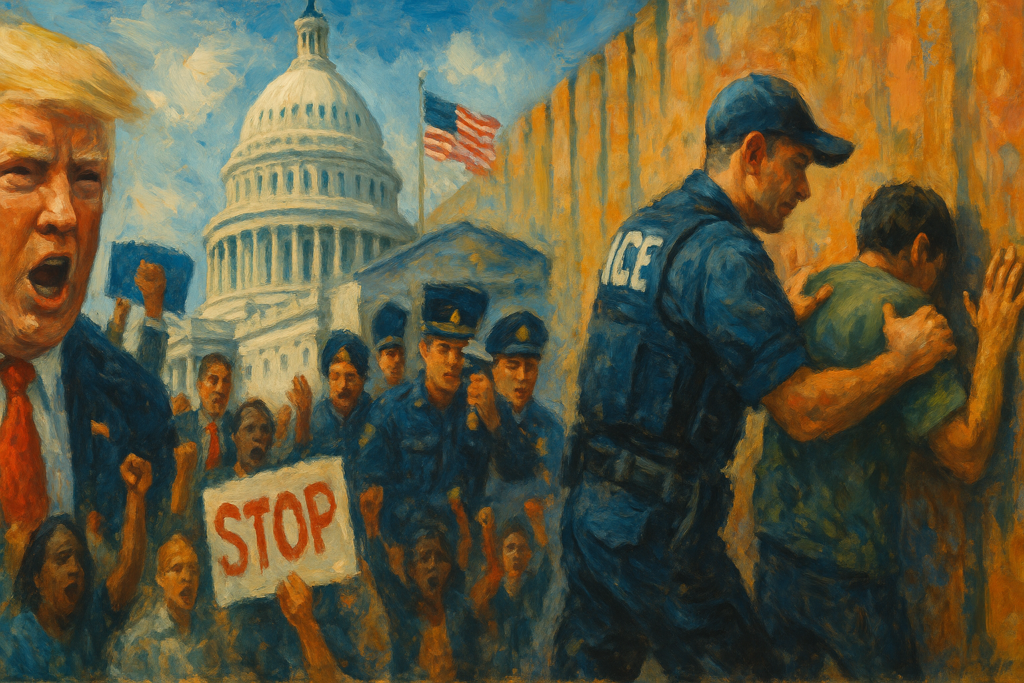
- Immigration enforcement expanded in money, manpower, detention space, and public messaging — The administration widened immigration enforcement through new funding, local-police partnerships, detention expansion, recruitment campaigns, and raids that pushed against judicial limits, while reports of abuse and secrecy mounted.
- Redistricting fights escalated from procedural conflict to interstate confrontation — Texas Democrats used quorum-breaking to block a new map, and state Republicans answered with threats, fines, arrest orders, and warrants, while the conflict spread to other states through counter-mapping talk, protests, and direct pressure on Indiana Republicans.
- Federal leverage over universities hardened into settlements and compliance demands — What had been a broader campaign against higher education turned this week into concrete concessions: settlements at Brown and Columbia, continued pressure on UCLA, new admissions-data demands, and Harvard’s court challenge.
- The Epstein matter became a wider struggle over records, oversight, and narrative control — Congress issued subpoenas, courts weighed unsealing records, watchdogs sued for files, and the White House and Trump used legal and political tactics to manage fallout and pressure media coverage.
The week opened with a direct clash over who controls the nation’s basic facts. After a weak July jobs report showed only 73,000 new jobs and downward revisions to earlier months, President Trump fired Bureau of Labor Statistics commissioner Erika McEntarfer and publicly accused the agency of manipulating data. He renewed pressure on Federal Reserve Chair Jerome Powell to resign for not cutting interest rates, signaling that both economic statistics and central banking were expected to align with the White House’s political narrative. Economists and former officials warned that firing the chief labor statistician over unfavorable numbers, and publicly browbeating the Fed, threatened the independence of institutions that anchor economic policy and public trust.
Around the same time, Trump moved to reshape the physical and symbolic center of executive power. He announced plans for a $200 million donor‑funded ballroom off the East Wing, one of the largest alterations to the White House in a century. The project was exempted from historic‑preservation review, and the “patriot donors” underwriting it were not named. By the end of the weekend, public tours were paused to accommodate construction planning, underscoring how a public building was being reconfigured as a venue for private patronage and presidential branding.
The weekend also brought signs of a more militarized approach to immigration and foreign policy. An internal Department of Homeland Security memo proposed deeper Defense Department involvement in domestic immigration enforcement, including potential use of military resources in cities. Separately, Trump ordered the Pentagon to prepare for possible military action against Latin American drug cartels, newly labeled as terrorist organizations. Both moves blurred the traditional line between civilian law enforcement and military force, raising questions about when and how armed power could be deployed at home and abroad.
In Texas, the fight over political representation escalated quickly. At Trump’s urging, state Republicans launched a mid‑decade redistricting effort aimed at flipping up to five Democratic U.S. House seats. Dozens of Democratic state representatives left Texas for other states to deny a quorum, reviving a tactic used in earlier legislative standoffs. Governor Greg Abbott and Attorney General Ken Paxton responded with threats of daily fines, civil arrest, felony charges, and even removal from office for the absent lawmakers. Tools normally reserved for enforcing legislative attendance were turned into weapons in a partisan struggle over the map itself.
Questions about how the justice system handles powerful figures surfaced in parallel. Media outlets and a reporter pressed an appeal after the FBI withheld more than 10,000 pages of records related to Jeffrey Epstein, while a federal appeals court ordered a lower court to reconsider unsealing documents in Virginia Giuffre’s case against Ghislaine Maxwell. At the same time, Attorney General Pam Bondi’s Justice Department opened a grand jury investigation into Obama‑era officials over debunked 2016 “treason” claims, even as annex material from the Durham investigation undercut conspiracy narratives promoted by current intelligence leaders. The same grand jury machinery was thus being used both to pursue transparency in a notorious abuse case and to relitigate old political grievances.
The weekend closed with further strain on judicial and diplomatic norms. The Senate confirmed former Fox host and Trump ally Jeanine Pirro as U.S. Attorney for the District of Columbia, despite her history of inflammatory rhetoric about the FBI, the Justice Department, and elections. Trump also claimed he had ordered two nuclear submarines into position in response to Russian statements, a dramatic assertion widely seen as a domestic distraction from bad economic news, and threatened tariffs on India over its Russian oil imports. Alongside leaked drafts showing the State Department softening human‑rights criticism of favored governments and Michigan’s governor replacing a clean‑energy advocate on the utilities commission with an industry‑aligned appointee, the weekend sketched a pattern: key legal, diplomatic, and regulatory posts and reports were being aligned more closely with political and corporate priorities.
By Monday, the use of executive power to shape markets and maps became more explicit. Trump signed an executive order adjusting tariff rates for dozens of countries, despite warnings that higher tariffs could weaken U.S. growth. The order expanded unilateral trade tools just as the economy was showing signs of strain. In Texas, the redistricting standoff hardened: Democratic lawmakers’ flight drew daily $500 fines and renewed threats of arrest and expulsion from Abbott and Paxton, while Illinois’ governor pledged to protect them. The same day the White House widened its trade leverage, state leaders intensified legal pressure on opposition lawmakers, illustrating how executive and state powers were being used in parallel to structure both economic and political landscapes.
The administration also moved to narrow veterans’ health care. It filed paperwork to roll back a Biden‑era policy that had allowed limited abortion services at Veterans Affairs facilities, including in cases of rape, incest, or serious health threats. The proposed rule, now open for public comment, would bar VA hospitals from providing abortions or counseling even to veterans in medical crisis. In health policy more broadly, the Centers for Medicare and Medicaid Services delayed a Biden‑era rule that would have restricted Medicare coverage for expensive skin‑substitute products lacking strong evidence, after a company benefiting from the status quo donated $5 million to Trump’s super PAC. A new proposal capped payments but kept coverage open to many unproven products, preserving a lucrative revenue stream. Together, these moves showed how executive authority and donor influence could reshape who receives care and which treatments taxpayers fund.
Not all federal levers moved in the same direction. After backlash, the administration reversed a policy that had tied certain disaster‑preparedness funds to state and local pledges not to sever commercial ties with Israeli companies, saying it would instead rely on existing anti‑discrimination laws. Routine regulatory housekeeping also continued: the Federal Communications Commission updated internal delegations and removed obsolete telecom rules, the Federal Election Commission set filing dates for a Tennessee special election, a Louisiana judge ordered seized devices wiped and returned in a local obscenity case, and procurement regulators eased continuous registration requirements for small contractors. These quieter actions showed the machinery of governance still turning beneath the headline conflicts.
On Tuesday, the White House extended its reach into emerging technologies and economic data. It announced an “AI action plan” rolling back Biden‑era safeguards on artificial intelligence, emphasizing rapid deployment over regulation in areas from publishing to intellectual property. The same day, Trump again moved against the head of labor statistics after weak economic data, reinforcing a pattern that official numbers were expected to match political messaging. Looser AI rules and politicized firings at the statistics agency both shifted complex, high‑impact domains—algorithms and economic indicators—away from neutral oversight and toward executive preference.
Congress and immigration authorities moved in opposite directions on transparency and enforcement. The House Oversight Committee used a procedural maneuver to issue subpoenas to Bill and Hillary Clinton and a roster of former attorneys general and FBI directors for depositions on Epstein, seeking more information about how the case had been handled. At the same time, ICE and DHS advanced plans for new state‑run migrant detention centers modeled on the massive “Alligator Alcatraz” facility in Florida’s Everglades, and ICE launched a large recruitment and public‑relations campaign targeting former officers and young people. The agency aimed for tens of millions of impressions across social media, streaming platforms, and campuses to fill thousands of new positions. While Congress sought to pry open the record of elite wrongdoing, the enforcement side of government was quietly building out detention capacity and workforce, embedding a more punitive immigration system.
The Texas redistricting fight deepened its entanglement with federal law enforcement. Senator John Cornyn asked the FBI to help locate and arrest Democratic legislators who had fled the state, and Governor Abbott filed an emergency petition to remove one of their leaders from office. These requests came even as Senator Jon Ossoff’s office released a report documenting hundreds of alleged human‑rights abuses in ICE detention centers and DHS obstruction of oversight. Inviting federal agents into a state legislative dispute, while federal reports described abuses by the same enforcement apparatus, underscored how policing power could be stretched in some arenas and resisted in others. That same day, Trump filed a $10 billion defamation lawsuit against Dow Jones over Wall Street Journal reporting on his appearance in an Epstein birthday album and sought an early deposition of Rupert Murdoch, citing his age and health. The suit, alongside a separate revelation that Trump would be exempt from divestment provisions in a stock‑trading ban bill marketed as cleaning up conflicts of interest, highlighted how legal tools and legislative design could be used to shield the president while pressuring the press.
Wednesday brought a sharp turn in health and trade policy. Under Secretary Robert F. Kennedy Jr., the Department of Health and Human Services announced the termination or wind‑down of 22 federal contracts and awards for mRNA‑based vaccines, worth nearly $500 million and affecting projects with major pharmaceutical companies and academic partners. Officials cited doubts about mRNA effectiveness for respiratory infections, while public‑health experts warned the move would undermine preparedness for future outbreaks and slow innovation, including in cancer research. On the trade front, Trump issued an executive order imposing a 25 percent duty on imports from India in response to its continued purchases of Russian oil, tying tariffs directly to another country’s energy policy outside multilateral frameworks.
Immigration enforcement continued to push against legal limits. Border Patrol agents carried out “Operation Trojan Horse,” an unmarked‑truck raid outside a Los Angeles Home Depot that arrested 16 undocumented workers, despite a federal order halting indiscriminate raids in the region. ICE expanded detention capacity by 1,000 beds at Indiana’s “Speedway Slammer,” while Ossoff’s report detailed deaths, assaults, and denial of medical care in ICE facilities. Separate reporting described the expansion of Alligator Alcatraz, where more than 57,000 people—most without criminal records—were held, and ICE’s recruitment of officers directly from local 287(g) law‑enforcement partners, straining local departments. These developments, combined with the Fort Bliss contract that would emerge later in the week, showed how detention and deportation infrastructure was being scaled up through a mix of federal contracts and local partnerships, even as abuses and court orders mounted.
Voting rights and public safety data also came to the fore. Senator Raphael Warnock and colleagues reintroduced the John R. Lewis Voting Rights Advancement Act to restore and expand federal oversight of discriminatory election laws, while the Supreme Court heard a challenge to Louisiana’s remedial map with two majority‑Black districts. The outcome of both efforts will shape how much protection minority voters have against dilution and whether federal oversight of state election rules is rebuilt or further weakened. Meanwhile, the FBI released its 2024 crime statistics, showing a 4.5 percent national drop in violent crime, a 19 percent murder decline in the largest cities, and overall rates at levels not seen since the 1960s, even as assaults on officers hit a 10‑year high. Major outlets gave the report limited coverage, and Trump continued to describe a crime wave to justify federal crackdowns. The gap between official data and political rhetoric, and the uneven media attention to it, set the stage for later calls for a federal crime crackdown in Washington, D.C.
Economic strain on vulnerable households deepened in the background. A new spending law cut basic food assistance for an estimated 22.3 million families while preserving tax cuts for the wealthy. In New York City, utility Con Edison disconnected power to more than 88,000 households in the first half of 2025 while seeking an 11 percent rate hike, leaving many without electricity during extreme weather. At the same time, the National Archives invited public comment on records‑disposition schedules that will determine which federal records are preserved or destroyed, and sections of the Constitution Annotated website briefly disappeared due to a coding error before being restored. These smaller incidents underscored how both material conditions and digital access to legal texts shape citizens’ ability to participate fully in civic life.
On Thursday, Trump issued a cluster of sweeping executive orders that reached from city streets to retirement accounts. One directive instructed states and cities to crack down on public camping, loitering, and substance use and to move unhoused people into long‑term institutions, while restricting federal support for harm‑reduction programs. Other orders targeted alleged political “debanking” and opened 401(k) plans more widely to crypto, private equity, and real estate, instructing regulators to ease litigation risks for plan sponsors. The combined effect was to push a more punitive approach to visible poverty while shifting financial risk onto ordinary savers, using executive power to redirect both social policy and retirement security.
Higher education came under intensified federal pressure. Brown and Columbia reached costly settlements to restore frozen federal funds, agreeing to adopt administration‑favored definitions of sex and antisemitism, pay large sums to outside entities, and accept government monitors and curriculum reviews. UCLA settled a lawsuit over its handling of pro‑Palestinian protests but still saw more than $300 million in funding frozen. Trump ordered colleges to submit detailed admissions data to prove they do not consider race, and Harvard sued over $2.6 billion in cuts and the loss of international‑student eligibility. By tying federal money and visa access to ideological conditions and intrusive oversight, the administration was reshaping who can study, what can be taught, and how universities govern themselves.
The expansion and privatization of immigration enforcement became even clearer. The administration awarded a $231.8 million contract to Acquisition Logistics LLC to build and operate a 5,000‑bed ICE facility at Fort Bliss, with operations to begin at 1,000 beds and expand over time. The GEO Group, a major private‑prison company, reported better‑than‑expected earnings driven partly by two ICE contracts expected to generate $145 million annually and announced a $300 million stock buyback. A federal judge temporarily halted new construction at Alligator Alcatraz over environmental concerns, though the jail could keep operating, while a divided appeals court vacated a contempt finding against the administration for deporting Venezuelans to an El Salvador prison in violation of a prior order. The ruling limited a district judge’s ability to enforce compliance, narrowing one of the judiciary’s key tools for checking unlawful deportations.
Redistricting battles spread beyond Texas. Vice President JD Vance met with Indiana Republicans to encourage a new congressional map favoring the GOP, prompting protests at the Statehouse. In Washington, Republican Representatives Kevin Kiley and Blake Moore publicly opposed Texas’s mid‑decade gerrymander and backed a bill to ban such mid‑cycle redistricting nationwide, revealing internal party divisions over how aggressively to redraw lines. Meanwhile, the Texas House authorized arrest warrants for Democrats who had fled the state and filed those warrants in Illinois, seeking civil arrests and cooperation from local authorities. FBI Director Kash Patel approved assistance to state and local law enforcement in locating the lawmakers, even though no federal charges existed, and a bomb threat forced evacuation of the Democrats’ Illinois hotel. The use of interstate warrants and federal investigative resources against state legislators over a map dispute, amid threats to their safety, marked a new stage in the use of law enforcement within partisan conflict.
The justice system’s internal tensions were also on display. The Justice Department appointed Ed Martin, a withdrawn Trump nominee for D.C. U.S. Attorney, as special counsel to investigate New York Attorney General Letitia James over her civil suits against Trump and the NRA, and issued subpoenas to her office. At the same time, Democrats on House Oversight forced subpoenas for DOJ Epstein files, and advocacy groups prepared litigation to pry loose more records. Federal investigative power was being turned on a state official who had successfully pursued Trump, even as Congress and civil society sought more transparency about how the government had handled Epstein’s case. In the realm of symbols and recruitment, the U.S. Army announced plans to restore a Confederate memorial at Arlington National Cemetery less than two years after its removal, and DHS posted a recruitment message urging citizens to “Serve your country! Defend your culture!”, language critics compared to authoritarian propaganda. Choices about monuments and official slogans were reshaping how the state presented its history and mission.
By Friday, the economic consequences of the week’s trade decisions became more concrete. A broad set of Trump tariffs—at least 10 percent on many imports and higher on others—took effect, covering goods from more than 60 countries. Average U.S. tariff rates rose to about 18 percent, the highest in nearly a century. Retailers warned of higher prices on everyday items like back‑to‑school supplies, and reports noted slowing growth, stagnant job creation, and shrinking manufacturing. Sustained high tariffs functioned as a broad tax on consumers and small businesses, reshaping trade relationships while disproportionately burdening those least able to absorb higher prices.
Trump also doubled down on a plan to redefine who counts in the nation’s most fundamental tally. Using social media, he reiterated that he had instructed the Commerce Department to begin work on a new census that would exclude undocumented immigrants from the count used for congressional apportionment and federal funding. Legal experts noted that this conflicted with the Constitution’s requirement to count “whole persons” and with prior court rulings blocking similar efforts. Excluding undocumented residents from the apportionment base would systematically reduce House seats and electoral votes for immigrant‑rich states and cities and shift billions in federal funds away from those communities, entrenching unequal representation and resources for years.
The struggle over Epstein records and executive accountability intensified. Following House subpoenas earlier in the week, the legal group Democracy Forward sued the Justice Department and the FBI for failing to produce records on the Epstein investigation, including communications involving senior officials and any correspondence between Epstein and Trump. The suit came after Republicans on Oversight had previously tried to block Democratic efforts to force release of the files. At the same time, the appeals court ruling that vacated the contempt finding over unlawful deportations was celebrated by the attorney general and underscored how judges’ ability to enforce their own orders in immigration cases was being narrowed. These legal battles were less about relitigating Epstein’s crimes or individual deportations than about whether Congress, courts, and the public could see how powerful actors and agencies had used their authority.
Public resistance to these shifts remained visible, even as authorities responded with arrests. In Indiana, protesters filled the Statehouse to oppose redistricting efforts during JD Vance’s visit. In New York City, activists with the 50501 movement were arrested outside the federal immigration court at 26 Federal Plaza while alleging that ICE was operating a covert detention facility inside and demanding access. Elsewhere, the administration approved a billion‑dollar merger between Paramount and Skydance Media shortly after CBS canceled Stephen Colbert’s Late Show, which had criticized a Trump settlement, and Con Edison’s mass disconnections in New York continued to draw criticism as the utility pursued its rate hike. Leaked drafts of the State Department’s human‑rights report indicated it would state there were “no credible reports of significant human rights abuses” in El Salvador and soften criticism of Israel and Russia, despite prior findings of government‑sanctioned killings and torture.
Taken together, the week’s events traced a consistent pattern: efforts to control or redefine the measurements and mechanisms that structure democratic life. From repeated firings at the Bureau of Labor Statistics and a proposed census excluding undocumented immigrants, to tariffs that reshaped the economy and crime narratives that diverged from FBI data, the administration sought to align official facts with political needs. Redistricting fights in Texas and Indiana showed how far state and federal authorities were willing to go—up to and including interstate warrants and FBI assistance—to secure favorable maps. At the same time, immigration enforcement expanded through long‑term private contracts and recruitment drives, universities were pressed to accept ideological conditions in exchange for funding, and courts both checked and enabled executive actions. In this landscape, the contest over democracy was less about a single dramatic break than about the steady reconfiguration of who is counted, who is detained, who is heard, and which institutions retain the capacity to say no.