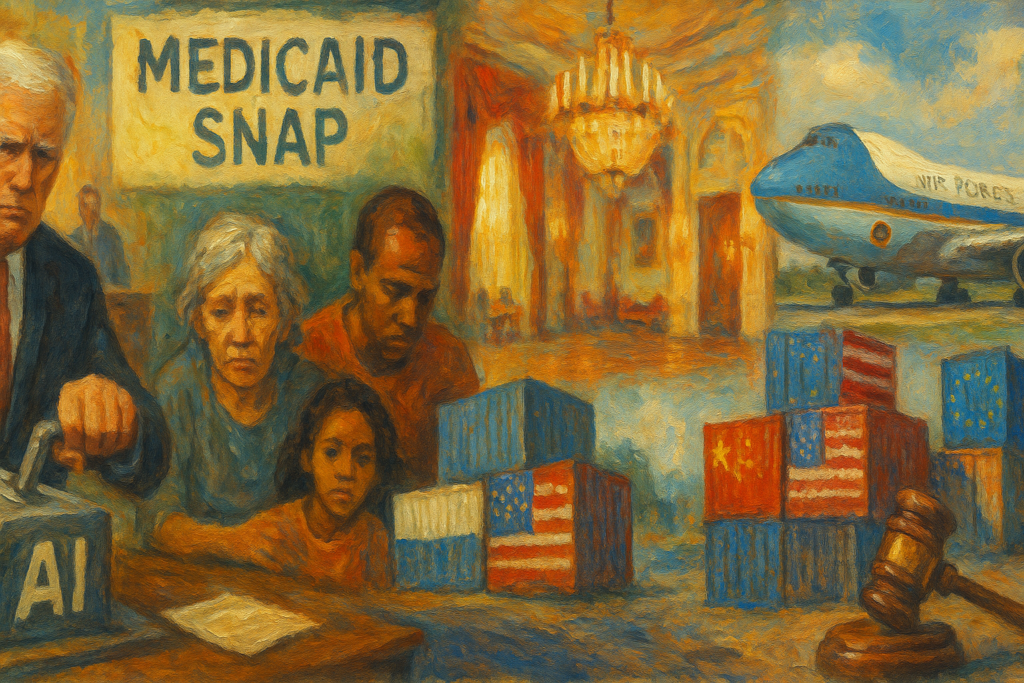
This week’s throughlines
- Executive control over money and policy widened — The week moved from rescissions and withheld education funds to talk of pocket rescissions, broader impoundment criticism, and funding leverage over universities and social programs.
- Immigration enforcement expanded while due process protections came under strain — New detention funding, legal-status rollbacks, self-deportation pressure, and harsh detention conditions were matched by lawsuits, court challenges, and oversight fights over access and legality.
- Federal pressure on universities hardened from investigation to coercive settlement — What began with investigations into Duke and scrutiny of campus governance escalated into a major funding freeze at Duke and a costly settlement with Columbia tied to hiring and governance changes.
- Pressure on courts, media, and public information intensified — The administration and its allies challenged judges, pushed politicized appointments, threatened broadcasters, and faced new scrutiny over secrecy and record handling in the Epstein matter.
- Tariff policy became a central instrument of unilateral rule — Court arguments over tariff authority unfolded alongside a rapid succession of new tariff orders, country-specific deals, and emergency-framed trade actions affecting major allies and rivals alike.
Across this week, three threads ran through national life. The White House leaned heavily on emergency trade powers to rewrite tariff policy with little input from Congress. It advanced deep cuts and structural changes to Medicaid, food assistance, and retirement security. And it hardened immigration enforcement and detention, from new funding streams to alleged legal black holes. Around these moves, courts, state officials, and journalists mounted partial checks, while universities, media outlets, and statistical agencies came under new political pressure.
Over the weekend, the administration’s ambitions for the federal regulatory state came into clearer view. Inside the newly created Department of Government Efficiency, staff began using an internal system called the “DOGE AI Deregulation Decision Tool” to generate lists of rules to eliminate. The stated goal was to wipe out up to half of all federal regulations by January. Housing and financial regulators at HUD and the Consumer Financial Protection Bureau were already using the tool to drive decisions, even though its criteria were not public and there was no clear process for outside comment. In effect, a large share of the rulebook that governs housing safety, consumer finance, health, and environmental protections was being triaged by an opaque algorithm inside the executive branch, sidestepping the usual notice-and-comment process that gives affected communities a voice.
Health policy also moved further away from expert guidance. Health and Human Services Secretary Robert F. Kennedy Jr. removed all 16 members of a key preventive health task force, following earlier purges of vaccine advisory panels. At the same time, the administration’s omnibus “One Big Beautiful Bill Act” locked in more than a trillion dollars in Medicaid cuts. Analysts projected that 10 to 12 million people could lose coverage, with rural hospitals facing heightened risk of closure as reimbursements shrank. Together, the personnel changes and budget cuts signaled a shift from evidence-based public health toward ideologically driven decision-making, with the poorest and sickest Americans bearing the brunt.
The weekend also brought fresh tests of Congress’s constitutional power over federal spending. President Trump signed a rescissions package clawing back previously appropriated funds, including money for education. Budget director Russell Vought floated the idea of “pocket rescissions,” in which the administration would simply let funds expire late in the fiscal year rather than spend them as Congress had directed. Reports surfaced that the National Institutes of Health had seen some grants impounded and then restored. These maneuvers raised the question of whether a president could effectively cancel parts of spending laws by delay and non-execution, weakening the legislature’s control over the purse.
On immigration and policing, the federal government began building out new detention infrastructure. FEMA launched a $608 million “detention support grant program” to help states construct temporary migrant detention facilities. On the ground, a Florida Highway Patrol stop escalated when troopers violently removed an undocumented passenger from a vehicle. Kenny Laynez‑Ambrosio, a U.S. citizen who recorded the incident, was arrested and later convicted, underscoring how aggressive immigration enforcement can spill over into civil liberties concerns for citizens as well as non-citizens. These developments foreshadowed the week’s later revelations about detention conditions and due process.
Even as the executive branch pressed its advantage, federal courts over the weekend acted as a counterweight in key areas. A judge maintained a nationwide block on Trump’s order restricting birthright citizenship, and an appeals court rejected the administration’s challenge, preserving the long-standing interpretation of the Fourteenth Amendment. In separate litigation, Judge Indira Talwani ordered the administration to continue Medicaid reimbursements to Planned Parenthood, and another court blocked a tax-bill provision that would have cut Medicaid payments to abortion providers. These rulings did not halt broader efforts to reshape immigration and reproductive policy, but they showed the judiciary enforcing constitutional baselines and statutory limits.
In Congress, transparency and secrecy collided around the legacy of Jeffrey Epstein. House Speaker Mike Johnson abruptly adjourned the chamber to avoid a vote on releasing Epstein-related files, citing concerns about uncorroborated information. In response, House and Senate Democrats pursued subpoenas and formal demands for materials, including Steve Bannon’s interview tapes and Justice Department records on Ghislaine Maxwell. How far lawmakers would go in compelling disclosure remained unclear, but the episode highlighted the uneven application of transparency norms when powerful figures might be implicated.
The weekend closed with the president escalating his attacks on the press and prominent Black public figures. On his social media platform, Trump labeled NBC and ABC “an arm of the Democrat Party” and urged that their broadcast licenses be revoked. In a separate post, he demanded prosecution of Kamala Harris, Beyoncé, Oprah Winfrey, and Al Sharpton over baseless allegations tied to 2024 endorsements, singling out only Black figures. While these were statements rather than formal actions, they reinforced a climate in which media independence and equal protection under the law were openly questioned from the top.
By Monday, the administration was moving to reshape the culture inside federal workplaces and public institutions. New guidance and an Office of Personnel Management memo told federal employees they could discuss, promote, and recruit others to their religious views at work, including through public prayer. Officials framed the change as protecting religious freedom, but the documents offered little detail on how subordinates or employees from minority faiths would be shielded from pressure. The move blurred the line between personal belief and official space, raising church–state concerns in offices that serve a religiously diverse public.
An earlier executive order titled “Ending Crime and Disorder on America’s Streets” drew renewed scrutiny as analysts highlighted provisions that could allow the arrest and camp-style detention of homeless people under broad public safety claims. Treating homelessness primarily as a criminal matter, rather than a housing and services challenge, would expand coercive state power over a vulnerable population and dovetail with the week’s broader expansion of detention capacity.
States and civil rights lawyers began to push back against the expanding surveillance and detention apparatus. A coalition of 21 states and the District of Columbia sued the Department of Agriculture over a directive demanding detailed data on applicants for SNAP food assistance, arguing that the order violated privacy and exceeded statutory authority. In Florida, civil rights attorneys asked a court to halt detentions at the “Alligator Alcatraz” camp in the Everglades, describing detainees held without charges, denied attorneys, and cut off from bond hearings. These early filings set the stage for later class actions and underscored how quickly emergency enforcement measures can slide into alleged rights violations.
Universities and diversity programs came under coordinated federal pressure. The administration opened an investigation into Duke University and its law journal over alleged race-based preferences, sent a Justice Department memo urging federally funded entities to ban diversity, equity, and inclusion programs, and later froze $108 million in Duke research funding over affirmative action concerns. DOJ also demanded records from George Mason University about a resolution supporting its president’s diversity policies. By tying investigations and funding to ideological objections, the federal government signaled that research dollars and regulatory scrutiny would be used as levers to reshape campus hiring and speech on race and equity.
At the same time, national identity and history were being recast in official rhetoric. Vice President J.D. Vance argued that Americans whose ancestors fought in the Civil War had a stronger claim to the country than others, rejecting a purely civic definition of citizenship. The Department of Homeland Security posted the 19th-century painting “American Progress” with a caption celebrating “Heritage” and a “Homeland worth Defending,” and separately repurposed a contemporary religious painting without the artist’s consent to evoke nationalist themes. These messages elevated an ancestry-based vision of belonging and revived imagery that historically justified expansion and exclusion.
Questions about the neutrality of the justice system surfaced as well. In New Jersey, a defendant challenged the legality of acting U.S. attorney Alina Habba’s appointment, and the New York Times reported that federal proceedings there had been canceled over doubts about her authority. Meanwhile, the Justice Department and Attorney General Pam Bondi filed misconduct complaints against Judge James Boasberg for public comments about the administration. Contested appointments and retaliation against judges for speaking about executive actions threatened to erode confidence in the courts’ independence.
In North Carolina, advocates warned that the legislature planned to override the governor’s vetoes on a slate of bills targeting DEI programs, immigrants, gun rules, and environmental protections. House leaders quietly rescheduled a Judiciary I hearing on HB 958, a voter suppression bill, to a time likely to limit public attendance. These procedural maneuvers showed how control over calendars and hearings can shape who is heard on measures that affect voting rights and civil liberties.
On Tuesday, immigration enforcement moved to the center of the national story. The White House moved to terminate the CHNV parole program that had allowed Cubans, Haitians, Nicaraguans, and Venezuelans to enter legally, and ramped up arrest operations with a stated goal of 3,000 arrests per day. Officials urged recipients of Deferred Action for Childhood Arrivals to “self-deport,” even though no formal rule change had been issued. At San Francisco airport, a South Korean PhD researcher with a green card was detained without access to counsel. These steps destabilized the lives of legally present immigrants and mixed-status families, illustrating how informal pressure and enforcement priorities can erode protections without new statutes.
The Senate, meanwhile, confirmed Emil Bove to a lifetime seat on the federal appeals court. Bove, a former Trump defense lawyer and senior Justice Department official, faced whistleblower allegations that he had urged colleagues to ignore court orders and misled Congress about dropping corruption charges against New York City’s mayor. Despite unified Democratic opposition and some Republican defections, the Republican majority pressed ahead. Installing a judge under such a cloud raised the prospect that norms of deference to court orders and political neutrality could be weakened from within the judiciary itself.
Questions about the use of public resources for presidential prestige deepened with new reporting on Air Force One. ABC News revealed that the administration had formally accepted a $400 million luxury jumbo jet from Qatar as the new presidential aircraft, with no requirement to donate it later. Renovation costs—nearly $934 million—were being covered by transferring funds from a program intended to modernize ground-based nuclear missiles. Accepting and refitting a foreign-gifted aircraft, financed through opaque budget shifts, raised emoluments and national security concerns and illustrated how executive control over classified programs can be used to fund symbolic projects.
State-level fights over representation escalated. In North Carolina, the legislature overrode the governor’s vetoes on eight bills, including an anti-immigrant measure, a law restricting recognition of gender identities, and a statute granting Duke Energy broad environmental leeway. In Texas, Republicans unveiled a new congressional map projected to give them five additional seats by concentrating Democratic and minority voters. Civil-rights groups prepared immediate legal challenges, arguing racial gerrymandering. These moves showed how redistricting and policy changes in key states could reshape the balance of power in Congress for years.
The information environment remained contested. Axios founders published a highly favorable account of Trump’s second term that leaned heavily on administration talking points and conservative funders’ interests. Senator Markwayne Mullin falsely blamed the Obama administration for Jeffrey Epstein’s plea deal, and Trump again called for prosecuting Beyoncé and Kamala Harris over a campaign event despite fact-checks showing no law was broken. At the same time, the House committee on administration doubled spending limits for members’ personal security, several states removed lawmakers’ home addresses from public websites, and Minnesota agreed to cover enhanced home security for any legislator who requested it. The FBI charged a caller who made racist, violent threats to Representative Eric Swalwell’s office. These steps reflected a political climate in which threats and misinformation were serious enough to alter norms around transparency and accessibility.
By Wednesday, emergency trade powers were at the forefront. Trump signed an executive order declaring a national emergency over Brazil’s actions, citing interference with U.S. companies and the treatment of former president Jair Bolsonaro, and imposed an additional 40 percent duty on certain Brazilian imports. A separate order suspended duty-free “de minimis” treatment for low-value imports from all countries, subjecting small shipments to full duties and fees. Courts heard challenges to his use of emergency authorities for “reciprocal” tariffs, probing the limits of statutes like the International Emergency Economic Powers Act, which allows presidents to declare national emergencies and restrict trade but was not designed for broad, long-term tariff policy. The litigation underscored a central question of the week: how far a president can go in reshaping the global trading system by proclamation before judicial checks intervene.
The administration also intensified its use of financial leverage over universities. It froze $108 million in National Institutes of Health research funding to Duke over affirmative action concerns and reached a settlement with Columbia University requiring a $221 million payment and a pledge not to consider race, color, sex, or national origin in hiring in order to restore $1.3 billion in withheld funds. At the same time, it mandated antisemitism trainings at universities, designed by pro-Israel groups and criticized for equating anti-Zionism with antisemitism. By conditioning massive research and operating funds on specific hiring and training policies, the federal government gained powerful tools to shape campus governance and speech.
Symbolic architecture joined the list of presidential projects. The White House announced plans for a 90,000-square-foot event space and ballroom on the grounds, replacing the East Wing. Estimated at $200 million and funded by Trump and private donors, the project was billed as necessary for larger events and slated for completion before 2029. Transforming a core part of the White House into a donor-funded event venue blurred the line between public institution and personal brand, raising questions about access, influence, and the long-term symbolism of the executive mansion.
Contests over elections continued. Texas Republicans formally released their congressional map, expected to net them five additional seats, prompting accusations of racial gerrymandering and planned lawsuits. In North Carolina, activists and members of a Legislative Response Team attended a Judiciary I committee meeting to protest HB 958, a bill seen as undermining fair elections, and delivered public comments despite the late scheduling. These actions showed citizens trying to insert themselves into processes that often unfold in technical hearings and map rooms far from public view.
Senator Ron Wyden added another dimension to the enforcement debate by calling for a Department of Homeland Security inspector general investigation into reports that agents had been reassigned from investigating crimes like child exploitation to focus on immigration enforcement. If confirmed, such shifts would reflect policy priorities rather than public safety needs, potentially leaving vulnerable populations less protected. Meanwhile, the Federal Reserve’s preferred inflation gauge rose 0.3 percent in June, and Chair Jerome Powell announced that interest rates would not be cut, citing tariffs as a factor. Trump publicly blamed Powell as “too late” and “too political,” even as new tariffs on copper and other imports threatened to push prices higher. The clash highlighted how trade shocks were feeding domestic economic strain and how the president was seeking to shape the narrative around those consequences.
On Thursday, the detention system came under intense scrutiny. A class action lawsuit alleged that hundreds of detainees at the Alligator Alcatraz camp in the Florida Everglades were being held without charges, denied access to attorneys, and told that federal courts lacked jurisdiction over their cases. Separate reporting described maggot-infested food, overflowing toilets, extreme heat, and detainees drinking from toilet spigots. In parallel, the administration’s use of the Alien Enemies Act to deport more than 200 Venezuelans without hearings was challenged in the conservative Fifth Circuit. If courts accepted the government’s position, a class of people could be held or expelled with habeas corpus and access to counsel effectively suspended, marking a profound departure from traditional due process norms.
Tariff escalation widened to close allies. Trump issued an order increasing tariffs on Canadian goods from 25 percent to 35 percent, citing drug trafficking and Canada’s recognition of Palestine, and threatened a 35 percent tariff on other Canadian imports not covered by the USMCA trade agreement. Another order adjusted reciprocal tariff rates on multiple partners, and a separate announcement detailed new tariffs ranging from 10 to 41 percent on a wide array of countries, prompting alarm from foreign officials. Rapid, wide-ranging tariff changes tied to unrelated political disputes risked disrupting supply chains, raising consumer prices, and straining alliances.
Economic data became another front in the struggle over institutions. The July jobs report showed only 73,000 new jobs and a rise in unemployment to 4.2 percent, with prior months revised downward. Trump denounced the report as rigged and announced he would fire the Commissioner of Labor Statistics, Erika McEntarfer, replacing her with a political appointee. Politicizing the agency that produces core economic data threatened the credibility of statistics that markets, policymakers, and voters rely on to assess performance and make decisions.
Safety-net policy continued to shift. At a Breitbart event, Treasury Secretary Scott Bessent described new “Trump accounts” created by budget reconciliation as a “backdoor for privatizing Social Security,” signaling an intent to move retirement security toward market-based accounts. In media policy, the Federal Communications Commission approved an $8 billion merger between CBS parent Paramount and Skydance Media on the condition that Skydance avoid civil-rights programs and implement a political bias monitor for news coverage. Commissioner Anna Gomez warned that the administration was weaponizing licensing power, saying that self-censorship under government pressure violated the First Amendment. In education, Oklahoma Schools Chief Ryan Walters announced that teachers moving from liberal-leaning states would have to pass a “MAGA Exam,” developed with PragerU, testing “America First” versions of history and civics as a condition of certification. And at the Stewart Detention Center in Georgia, Liberian-born detainee Rodney Taylor, who uses electronic prosthetic legs, was placed in solitary confinement for three days after refusing to enter a flooded area that could damage his prosthetics, without access to water or charging for his legs. These developments showed how licensing, accreditation, and detention practices were being used to enforce ideological and disciplinary lines.
Friday closed the week with major moves on food assistance and trade, alongside visible clashes over protest and information. The administration unveiled significant changes to the Supplemental Nutrition Assistance Program, shifting 75 percent of administrative costs to states by 2027 and requiring states to begin covering part of benefit costs from 2028. It expanded work reporting requirements and tightened eligibility for non-citizens. Experts warned that the changes would increase poverty and hunger among low-income workers and immigrant families, especially in states with limited fiscal capacity. By making food assistance harder to access and more expensive for states, the policy pushed responsibility for basic nutrition down the federal system and risked widening regional inequalities.
On trade, Trump moved to lock in new global tariff baselines just hours before a self-imposed deadline and while courts were still weighing his authority. He announced new base rates: 10 percent on countries where the United States exports more than it imports and 15 percent where imports exceed exports. The move followed a week of country-specific hikes, including a fresh order raising Canadian tariffs to 35 percent and imposing a 40 percent levy on transshipped goods. Setting broad tariff floors by executive action underscored how far the presidency could move economic policy before judicial and legislative checks caught up.
Civil liberties and protest policing came into focus in New York, where dozens of pro-Palestinian protesters, including city council member Tiffany Cabán and state representative Claire Valdez, were arrested outside Senator Chuck Schumer’s office during a demonstration organized by Jewish Voice for Peace. Protesters banged pots and pans, demanding an end to bombing and more aid to Gaza, as similar actions took place in other cities. Arresting local elected officials and activists at a peaceful protest raised questions about how authorities were handling dissent on foreign-policy issues.
Even amid these pressures, investigative journalism demonstrated its capacity to force reversals and accountability. Reporting by Popular Information led the Social Security Administration to cancel a plan to sharply limit phone service that would have overwhelmed field offices. Earlier investigations helped restore 29 wrongly invalidated ballots in a North Carolina Supreme Court race, changing the outcome, and exposed Tennessee House Speaker Cameron Sexton’s secret Nashville home and improper per diem claims, prompting calls for investigation. Another Popular Information report revealed that Eugene Ramirez, lead anchor of Sinclair’s national evening news, had resigned over concerns about the accuracy and right-wing bias of centrally produced content, detailing how headquarters pushed propaganda-like scripts to local affiliates. These stories showed that, even as some media outlets echoed partisan narratives, independent reporting could still correct specific abuses.
Finally, the week’s redistricting battles rippled across state lines. California Governor Gavin Newsom announced he might call a November special election to begin changing the state’s independent redistricting commission rules, aiming to counterbalance Texas’s new Republican-favored map and preserve Democratic representation in the U.S. House. In international diplomacy, Trump told U.K. Prime Minister Keir Starmer that he had “ended six wars” and touted economic deals with Japan and Europe that economists and officials said lacked binding commitments and were overstated. These claims illustrated how foreign-policy storytelling from the White House could depart sharply from the record, potentially misleading both domestic and international audiences.
Taken together, the week offered a clear picture of an executive branch testing the outer edges of its authority across multiple fronts. Emergency trade powers and national security statutes were used to rewire tariff policy; budget tools and reconciliation were deployed to shrink Medicaid, SNAP, and Social Security’s traditional guarantees; and detention regimes expanded into spaces where access to courts and counsel was contested. At the same time, courts, state coalitions, regulators, and journalists carved out pockets of resistance—blocking some orders, exposing abuses, and forcing targeted reversals. The struggle over who controls information, from university funding and media licensing to economic statistics and historical narratives, ran through it all. For democratic governance, the week underscored that the balance between executive initiative and institutional constraint is being renegotiated in real time, with lasting consequences for rights, representation, and public trust.