This week’s throughlines
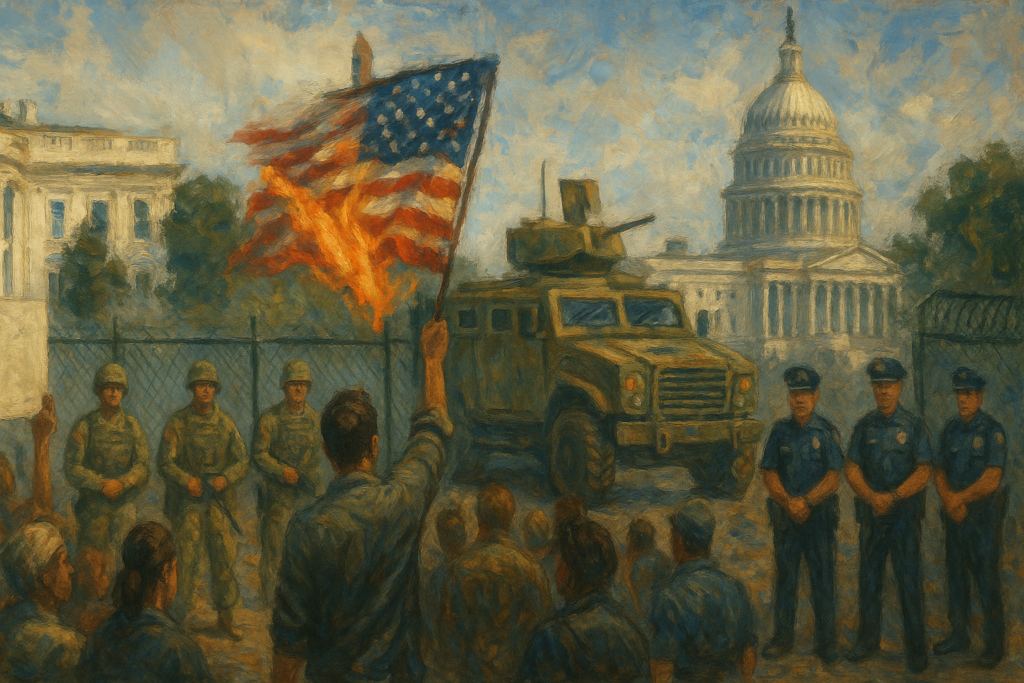
- Federal power pressed into local governance — The administration moved from armed deployments and emergency claims in Washington toward threatened or planned troop use in Chicago and Baltimore, while also using funding threats and federal control tools to pressure cities and states.
- Law enforcement and legal process were used against critics and rivals — Investigations, raids, threats, and data-driven inquiries hit political opponents, former officials, and critics, while the administration also pushed legal theories that challenged due process and protected speech.
- Independent institutions faced direct political pressure — Trump and his allies challenged the independence of the Federal Reserve and the CDC, while whistleblowers and dissenting civil servants at FEMA and elsewhere faced retaliation or pressure.
- Courts repeatedly checked executive or partisan overreach — Judges blocked funding coercion against sanctuary cities, halted deportation efforts, dismissed the administration's suit against Maryland judges, and ordered Utah's congressional maps redrawn.
- Control over information, memory, and public narrative widened — The week included threats against broadcasters, false public claims, a major Social Security data-security allegation, a federal architecture order, and the restoration of Confederate imagery at West Point.
The week opened with a rapid series of moves that reshaped the legal terrain for protest, criminal justice, and local control in the nation’s capital, even as longer-running battles over elections, immigration, and economic power intensified. By week’s end, those early steps were joined by a purge of public health leadership, sweeping rollbacks of labor protections, and new efforts to lock in partisan advantages in Congress, leaving courts, governors, and civil society scrambling to respond.
Over the weekend, the administration signaled how aggressively it was prepared to wield executive power. In the energy sector, it ordered work stopped on the nearly complete Revolution Wind project off Rhode Island and Connecticut, citing national security concerns. The decision jeopardized a project expected to power hundreds of thousands of homes and underscored the president’s broader hostility to wind power, which Environmental Protection Agency leaders publicly defended. Coming after years of planning and investment, the halt showed that even near-finished clean energy projects could be reversed by fiat, with climate and regional economic implications.
At the same time, Texas lawmakers approved, and Governor Greg Abbott signed, a new congressional map projected to give Republicans as many as five additional U.S. House seats. Civil rights groups immediately prepared lawsuits, arguing that the map diluted the voting strength of Black and Latino communities in violation of the Voting Rights Act. In a fast-growing, diverse state, the map promised to shape national political power for a decade and set the stage for a week in which redistricting fights in multiple states would become a central front in the struggle over representation.
The Justice Department also turned its attention to some of the president’s most prominent critics. Federal investigators opened probes into former FBI Director James Comey and former CIA Director John Brennan over their testimony about Russian interference, while Attorney General Pam Bondi launched mortgage-fraud investigations into figures including Representative Adam Schiff and New York Attorney General Letitia James. An early-morning FBI raid on former national security adviser John Bolton’s home and office departed from the negotiated procedures typically used for former senior officials. Together, these actions blurred the line between neutral law enforcement and political retaliation, especially when viewed alongside the administration’s use of mortgage data and other tools against perceived opponents.
Courts, however, were not passive. A federal judge expanded an order blocking the administration from cutting funds to 34 sanctuary jurisdictions, reinforcing limits on using federal grants to coerce local immigration policy. Another judge ordered the closure of Florida’s remote “Alligator Alcatraz” detention facility over environmental and human rights violations, while yet another temporarily halted the deportation of Kilmar Ábrego García and demanded testimony on government conduct. These rulings showed the judiciary acting as a counterweight to executive efforts to punish sanctuary policies and to use detention and deportation in ways that skirted due process.
The weekend also brought direct challenges to independent economic and judicial institutions. The president threatened to fire Federal Reserve Governor Lisa Cook over unproven mortgage allegations, an extraordinary intervention in central bank independence. He criticized the Senate’s “blue slip” tradition, which allows home-state senators to block judicial nominees, signaling a desire to weaken one of the chamber’s informal checks on appointments. At the same time, he announced that the federal government now owned 10 percent of Intel after personally demanding the stake from the company’s CEO, and he floated a broader plan to take equity in major federal contractors. These moves pointed toward a model in which the executive branch would hold direct ownership stakes in key firms while exerting greater influence over the courts.
Election rules and political speech were also pulled into the orbit of executive power. The president revealed that lawyers were drafting an executive order to eliminate mail-in balloting nationwide, citing a conversation with Vladimir Putin in which the Russian leader allegedly claimed mail voting had cost him the 2020 election. Mail ballots are used by roughly a third of U.S. voters and have not been credibly linked to widespread fraud; ending them by executive order would sharply restrict access to the ballot and bypass Congress in rewriting core election rules. In parallel, the president escalated attacks on critical media outlets, calling on the Federal Communications Commission to revoke ABC and NBC broadcast licenses as supposed threats to democracy. He threatened to investigate former New Jersey Governor Chris Christie after public criticism and began laying rhetorical groundwork for criminalizing flag burning as unpatriotic incitement, framing dissenting speech as a danger to the nation.
By Monday, those rhetorical threats had been translated into formal directives. The president signed multiple overlapping executive orders instructing the Justice Department to pursue criminal charges against people who burn the American flag, despite Supreme Court precedent protecting such acts as speech. The orders encouraged prosecutors to use public order, environmental, and immigration laws to punish flag desecration, with the president touting a one-year prison term and immigration consequences for noncitizens. Using executive orders to criminalize a form of political expression already deemed protected tested constitutional limits and signaled a willingness to chill protest through prosecutorial pressure.
The same day, two more executive orders targeted criminal justice policy. One moved to end cashless bail nationally by directing the Justice Department to identify jurisdictions that had reduced or eliminated cash bail and threatening to cut federal funds if they did not reverse course. A separate order required that more arrestees in Washington, D.C. be held in federal custody before trial. Framed as crime control, these steps were likely to increase pretrial detention for poor defendants and used federal funding as leverage over local bail practices, deepening the administration’s influence over local criminal justice systems.
In Washington, D.C., the declared “crime emergency” became the basis for a deeper federal takeover of local policing. A new order expanded federal control over the city’s law enforcement, mandating more U.S. Park Police and federal prosecutors, specialized National Guard units, and federal review of D.C. police policies. Representative Andy Biggs introduced legislation to make extended federal takeovers the default in future emergencies. For a city without full statehood, the normalization of emergency powers to justify federal control over policing raised questions about home rule and the ease with which armed forces could be deployed against protests in the capital.
Even as the administration consolidated power, courts and advocates pushed back on other fronts. A Utah state judge invalidated the state’s Republican-drawn congressional maps for violating a voter-approved independent redistricting initiative and ordered new maps by late September, potentially making at least one seat more competitive. In Texas, the NAACP and allied groups filed suit against the new congressional map, alleging it stripped Black voters of political power in violation of the Voting Rights Act. These cases showed courts and civil rights groups using state law and federal voting protections to resist partisan and racial gerrymanders that skew representation.
Judges also continued to rein in irregular appointments and deportations. A federal court ruled that Alina Habba was not lawfully serving as U.S. attorney for New Jersey, underscoring limits on interim appointments to powerful prosecutorial posts. In immigration cases, Judge Paula Xinis extended orders blocking the deportation of Kilmar Ábrego García and required that he remain within reach of the Maryland court, reflecting skepticism about the government’s conduct. Meanwhile, the administration’s economic nationalism deepened: beyond the Intel stake, officials floated a broader policy of taking equity in private firms heavily reliant on federal contracts, arguing that taxpayers deserved ownership. Critics warned that such moves blurred the line between government and business, especially as the White House announced cancellation of CHIPS Act-funded solar and wind projects in favor of fossil fuels.
Other institutions also clashed with federal power. The House Oversight Committee subpoenaed extensive records from Jeffrey Epstein’s estate, including his “Black Book,” while the Justice Department responded to a separate subpoena with a largely redundant document dump. In another election-adjacent case, DOJ filed new allegations that a Smartmatic executive had used funds from a Los Angeles voting machine contract to feed slush funds tied to foreign bribery, highlighting the risk that election technology contracts could be tainted by corruption. At the same time, governors Gavin Newsom of California, J.B. Pritzker of Illinois, and Wes Moore of Maryland publicly criticized the militarization of cities and threats to deploy troops, framing them as unlawful power grabs. Inside FEMA, more than 180 employees warned Congress that staffing cuts and mismanagement risked a Katrina-level disaster; around 30 signatories were later placed on leave, suggesting retaliation against internal critics.
On Tuesday, the confrontation between the executive and the judiciary sharpened. A federal judge dismissed the administration’s extraordinary lawsuit against all 15 judges of Maryland’s federal district court, which had challenged a chief judge’s order briefly pausing deportations when detainees filed legal challenges. The ruling reaffirmed absolute judicial immunity and criticized the administration for bypassing normal appeals, defending the principle that the executive cannot sue judges en masse for issuing rulings it dislikes.
Illinois escalated its resistance to federal militarization. Governor Pritzker condemned the president’s plan to send armed military personnel to Chicago as an unprecedented overreach and vowed to sue if the deployment proceeded, arguing there was no emergency to justify it. He also pointed out that the administration had cut hundreds of millions in crime-prevention grants while claiming to prioritize public safety. His stance framed domestic troop deployments as a constitutional crisis over federalism and civil-military boundaries, adding state-level pushback to the institutional checks emerging in the courts.
Redistricting battles continued as civil rights groups formally sued Texas over its new congressional map, arguing it was a racial gerrymander that stripped Black voters of political power and violated Section 2 of the Voting Rights Act. The suit sought to block use of the map before upcoming elections, testing how far courts would go to enforce minority voting protections against aggressive partisan line-drawing. On the economic front, the administration’s removal of the de minimis tariff exemption for imports under $800 took effect, prompting postal services in nearly 30 countries to suspend deliveries to the United States as they adjusted to new tariff rules. The change, later formalized in an executive order, was expected to add billions in costs and delays for consumers and small businesses reliant on low-value imports.
The administration also doubled down on its campaign against protest speech. The president publicly ordered the Justice Department to prosecute flag burning with a mandatory one-year sentence, reiterating his intent to override existing First Amendment protections and reinforcing the previous day’s executive orders. Direct presidential pressure on prosecutors to pursue constitutionally protected expression raised serious rule-of-law concerns. In immigration enforcement, reports emerged that ICE had transferred 18-year-old Benjamin Guerrero-Cruz from California to Arizona without notifying his family, nearly sending him to Louisiana for deportation, prompting proposed legislation to require family notification. Separately, Venezuelan detainee Luis Manuel Rivas Velásquez was quietly moved from “Alligator Alcatraz” to Fort Bliss, Texas, in what his lawyer described as retaliation for complaining about conditions. These opaque transfers and alleged reprisals made it harder for families and lawyers to protect detainees’ rights.
Data security also came under scrutiny. Whistleblower Charles Borges reported that a former senior official at the Department of Government Efficiency had copied Social Security data for over 300 million Americans to an unsecured cloud server, in violation of law. The disclosure raised questions about internal controls and whether politically connected officials would face consequences for mishandling sensitive information. In the background, agencies continued routine regulatory housekeeping—adjusting environmental rules, correcting communications regulations, and updating health data frameworks—reminding that even amid high-profile clashes, the machinery of governance continued to shape markets, data, and protections in quieter ways.
Wednesday marked a turning point in public health governance. CDC Director Susan Monarez was removed after refusing to endorse what she viewed as reckless, unscientific vaccine directives from Health Secretary Robert F. Kennedy Jr. Her lawyers argued that only the president could legally fire her, raising procedural questions about the dismissal. In protest, four top CDC officials, including leaders in infectious disease and injury prevention, resigned, citing data manipulation and political interference. The loss of a Senate-confirmed director and multiple senior scientists in the midst of an ongoing pandemic undermined the agency’s independence and capacity, and it foreshadowed the confusing vaccine policies that would follow.
Courts again intervened in immigration enforcement. Judge Paula Xinis extended her order preventing the deportation of Kilmar Ábrego García and required administration officials to testify about efforts to re-deport him, signaling concern about potential retaliation or disregard for court orders. The earlier order to close “Alligator Alcatraz” began to take effect, with detainees being relocated despite state appeals. These rulings suggested that judges were scrutinizing not just individual deportations but broader patterns of conduct in detention and removal practices.
Election administration remained contested at the local level. In Georgia, a judge fined the Fulton County Commission $10,000 per day for refusing to appoint two Republicans—both tied to election denialism—to the county election board, ruling that the commission had acted in bad faith. The decision highlighted the tension between legal mandates and local discretion over who runs elections. In Utah, Judge Dianna Gibson’s earlier order requiring new congressional maps before 2026 underscored judicial willingness to enforce voter-approved redistricting standards against legislative resistance. In Washington, a D.C. grand jury declined to indict Sean Charles Dunn, accused of throwing a sandwich at a federal agent during protests against troop deployments. The refusal was widely seen as a symbolic rebuke of the administration’s heavy-handed response to demonstrations.
Inside the federal bureaucracy, dissent carried risks. Following the “Katrina Declaration” letter signed by 182 FEMA employees warning that staffing cuts and mismanagement could lead to catastrophic failures, around 30 staffers were placed on administrative leave. The suspensions were widely interpreted as retaliation against whistleblowers, discouraging internal criticism at an agency central to disaster response. Meanwhile, the U.S. Election Assistance Commission scheduled a public meeting of its Technical Guidelines Development Committee to discuss updated voting system standards, and the Census Bureau advanced a national survey of registered nurses—technical steps aimed at improving the reliability of elections and health workforce planning, even as more visible conflicts dominated headlines.
On Thursday, the turmoil at the CDC translated into policy confusion. In the wake of Monarez’s ouster and the senior resignations, Health Secretary Kennedy announced new Covid vaccine restrictions that left eligibility and availability unclear, with contradictory statements about who qualified. The changes raised fears that high-risk groups could lose access and that vaccine policy was being driven more by politics than by science. Confusing and politicized guidance threatened to erode public trust and leave vulnerable populations unprotected.
Federal control over Washington, D.C. deepened further. Transportation Secretary Sean Duffy announced a federal takeover of Union Station, framed as part of a “beautification” program but also increasing visible federal presence in the capital’s central transit hub. Separately, the president issued an order excluding additional agencies and subdivisions from the federal labor-management relations program, limiting collective bargaining rights in the name of national security. These moves extended executive influence over key infrastructure and weakened labor protections for security-related workers, consolidating control in the capital.
Cultural policy also shifted. The president signed an executive order titled “Making Federal Architecture Beautiful Again,” directing that new federal buildings, especially in Washington, favor classical and traditional styles. The General Services Administration revised its Art-in-Architecture program data collection to prioritize works depicting historically significant Americans and events, aligning cultural spending with the administration’s aesthetic and historical preferences. At the same time, new reporting underscored that a $1.1 billion cut to the Corporation for Public Broadcasting was degrading rural access to severe weather alerts and civic information. At the Pentagon, officials prepared to reinstall a portrait of Confederate General Robert E. Lee at West Point’s library, despite a law requiring removal of Confederate tributes from military installations. Together, these steps used design, art, and funding decisions to privilege certain narratives and weaken noncommercial information channels.
Immigration enforcement intersected with public safety in new ways. During a wildfire in Washington state, border agents arrested two firefighters from a contract crew after lining up workers to check IDs, prompting outrage over the impact on emergency response. In a separate case, ICE’s transfer of Benjamin Guerrero-Cruz across states without notifying his family spurred a congressional proposal to require notification within 24 hours of transfers. These incidents highlighted how enforcement priorities could undermine firefighting efforts and family rights. In the background, agencies advanced data and transparency rules: the National Archives convened a FOIA Advisory Committee meeting on vexatious requests, the FCC sought comment on accessibility and registration-related information collections, and the EPA, FDA, and GSA moved forward with projects on air quality, patient experience, and federal customer service, shaping how accessible government information would be and how public input would be incorporated into policy.
Friday capped the week with sweeping attacks on labor protections and social supports. Building on earlier moves to limit collective bargaining in security-related agencies, the administration proposed eliminating federal minimum wage and overtime protections for 3.7 million childcare and home care workers, rescinded a minimum wage requirement for disabled workers, and cut the minimum wage for federal contractors from $17.75 to $13.30. In a separate action, it attempted to rescind collective bargaining rights from about one million federal workers, which unions described as the largest single act of union busting in U.S. history. These changes shifted economic power toward employers, particularly in low-wage and care sectors, and weakened organized labor’s role in public service.
Reproductive rights for veterans came under new pressure. A proposed rule would bar Department of Veterans Affairs doctors from performing abortions except when a physician certified that the mother’s life was at risk, eliminating existing exceptions for rape and incest. Female veterans and advocacy groups, many representing survivors of sexual assault, condemned the move as a rollback of limited reproductive services restored in 2022. On trade, the president signed an executive order officially ending the de minimis tariff exemption for packages under $800, a change expected to add up to $13 billion in costs and delays for consumers and small businesses. The White House justified the move as protecting American manufacturers and addressing national security concerns tied to foreign e-commerce platforms, but the immediate impact would fall on small retailers and lower-income consumers who depend on affordable imports.
The week also saw personal security arrangements pulled into partisan conflict. The president issued a directive canceling the one-year extension of Secret Service protection for former Vice President Kamala Harris that had been granted by President Biden, effective September 1. California Governor Gavin Newsom and Los Angeles Mayor Karen Bass criticized the move as endangering Harris and driven by personal animus, raising concerns about the politicization of protective services for former officials. In Missouri, Governor Mike Kehoe called a special legislative session to redraw the state’s congressional districts with the explicit goal of gaining another Republican seat, following pressure from the president. The session would also consider changes to initiative petition rules that could make citizen-led ballot measures harder to pass, extending the week’s pattern of using redistricting and procedural changes to entrench partisan control and weaken direct democracy tools.
Immigration and historical memory remained contested. A federal judge’s earlier order to close “Alligator Alcatraz” moved forward as a motion to stay was denied, while the secret transfer of a Venezuelan detainee to Fort Bliss drew further scrutiny as possible retaliation. At the same time, the Pentagon’s plan to restore Robert E. Lee’s portrait at West Point sparked debate over compliance with laws removing Confederate tributes. Civil society groups began organizing responses to the week’s developments: Indivisible announced a September 6 march in Washington to demand withdrawal of federal troops from the District, framing deployments as racially targeted militarization, while in North Carolina, the Legislative Response Team prepared a Labor Day “die-in” to dramatize the human impact of a sweeping “One Big Ugly Bill” and the new anti-worker rules, under the banner #WorkersOverBillionaires. Historical retrospectives on the 1968 Chicano student walkouts, the 1970 Chicano Moratorium, and the killing of journalist Rubén Salazar resurfaced in public discourse, tracing how police violence and educational inequities had spurred earlier waves of organizing and providing context for current debates about race, protest, and state power.
Taken together, the week’s events traced a clear pattern: the executive branch moved to centralize authority over policing, elections, economic levers, and public health, often by executive order, while weakening protections for dissent, workers, immigrants, and vulnerable populations. Courts, governors, career officials, and grassroots groups responded with lawsuits, public letters, and planned protests, offering partial checks but also revealing the limits of institutional resistance when power is concentrated in the presidency. As redistricting battles, labor rollbacks, and public health purges unfolded side by side, the basic questions at stake were who gets represented, who is protected, and how far existing institutions can go in defending democratic norms under sustained pressure.