This week’s throughlines
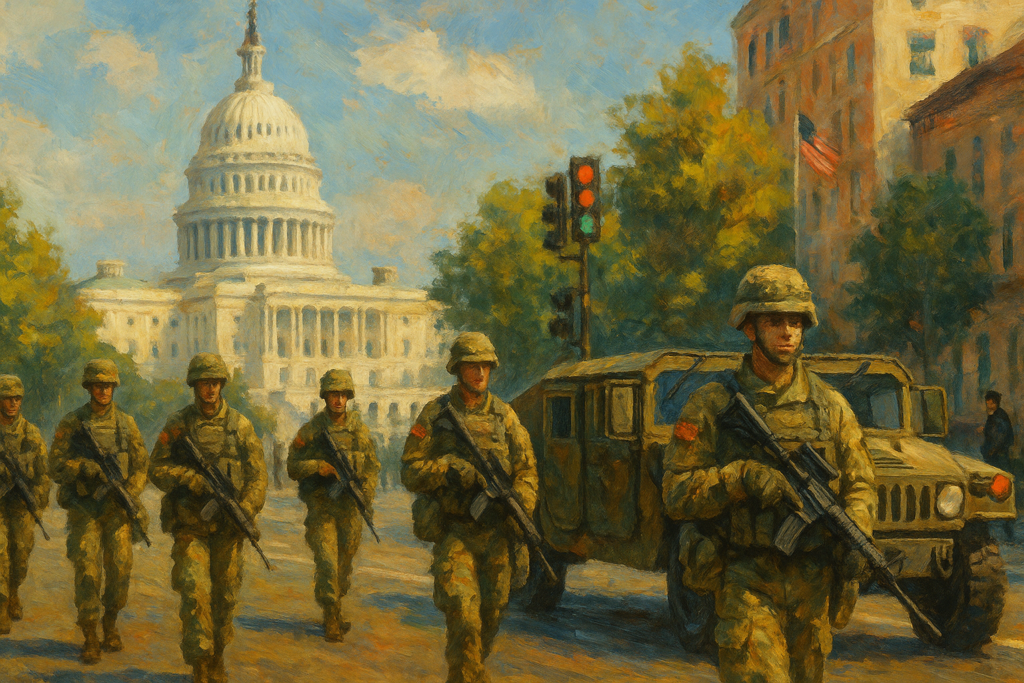
- Federal control of Washington escalated from deployment to normalization — What began as a troop and federal-agent deployment over the weekend became a broader assertion of federal control over D.C. policing, backed by crime-data investigations, political messaging, and by week's end the arming of Guard troops and hints of expansion to other cities.
- Redistricting became a multi-state power struggle — Texas Democrats first fled to block a quorum, then returned to face surveillance, confinement threats, and a map vote that advanced anyway. California then moved to counter with its own mid-decade redistricting plan, turning state mapmaking into a national partisan escalation.
- Immigration enforcement widened from detention and local pressure to mass vetting — The week linked humanitarian visa restrictions, threats against sanctuary jurisdictions, detention expansion in Florida, deportation-capacity planning, and new continuous vetting of millions of visa holders into a broader architecture of exclusion and surveillance.
- Control over information and institutions remained a parallel front — The administration and its allies pressured official data, public messaging, and historical narratives through the firing of the labor statistics chief, politicized appointments, selective document releases, and attacks on the Smithsonian and public-health authorities.
The week opened with the federal government asserting new forms of control over both the nation’s capital and the mechanics of elections, while states escalated their own battles over political maps. At the same time, immigration enforcement spread into more corners of daily life, and institutions once treated as neutral—courts, data agencies, museums, and international tribunals—came under sharper political pressure. Across these developments, the central questions were who directs coercive power, who counts in the political system, and which checks still function.
Over the weekend, the president issued sweeping pardons for roughly 1,500 people convicted of or charged with crimes related to the January 6 attack on the Capitol. The move erased legal consequences for an assault on the transfer of power and signaled that those who engaged in political violence on his behalf would be shielded. Inside the Justice Department, loyal appointees moved to sideline prosecutors and target investigators who had worked on those cases, reinforcing the message that accountability for the attack was now a matter of political loyalty rather than law. The pardons set the tone for later in the week, when the president would again lean on courts and prosecutors in election-related cases.
At the state level, the weekend also brought major developments in redistricting. In Florida, the state supreme court upheld Governor Ron DeSantis’s congressional map, which sharply reduced Black voting power despite a state constitutional ban on partisan and racial gerrymandering. In Texas, Democrats fled the state to try to block a mid-decade congressional map requested by the president that would add five Republican House seats. Their walkout prompted a judge to restrict Beto O’Rourke’s group from sending funds to out-of-state Democrats, illustrating how courts were being drawn into partisan struggles over representation. These moves in two large states foreshadowed a week in which political maps would be treated as instruments of national party strategy rather than routine decennial housekeeping.
At the same time, the administration began to transform Washington, D.C. into a showcase for federalized policing. Over the weekend, the president ordered 800 National Guard troops and hundreds of federal agents into the city, citing an “out of control” crime wave. Republican governors pledged additional Guard units. This came against a backdrop of earlier deployments of Marines and federalized California Guard to Los Angeles in response to immigration protests, which were already being challenged in court as potential violations of limits on domestic military use. The capital’s streets thus became an early test of how far the executive branch could go in using troops and federal agents for what had traditionally been local policing and protest management.
Abroad, the president’s posture toward Russia and Ukraine shifted further. After meeting European leaders, he reportedly backed a plan for Ukraine to cede the Donbas region to Russia, and then met Vladimir Putin in Alaska. The summit produced no ceasefire and a promise of no new sanctions on Russia. Around the same time, officials mishandled sensitive State Department documents, leaving summit materials and staff contact lists on a public hotel printer and then falsely describing them as a lunch menu. The combination of endorsing territorial concessions to an aggressor and lax handling of diplomatic records raised questions about both U.S. leverage and basic security practices.
Domestically, the weekend also saw a more punitive turn in immigration and homelessness policy. The State Department halted medical visas for children and other visitors from Gaza after pressure from a far-right influencer who had falsely labeled them security threats, suggesting that life-or-death decisions could be swayed by online campaigns rather than evidence. In Washington, D.C., the president ordered homeless people cleared from the streets under threat of fines or jail, framing the move as part of his crime crackdown. These actions linked social vulnerability—whether of migrants or unhoused residents—to criminal enforcement rather than social support.
By Monday, the administration was moving directly against the structure of elections. The president announced that lawyers were drafting an executive order to ban mail-in ballots and many voting machines nationwide, claiming without evidence that they enabled fraud. He described states as mere agents of the federal government in elections and signaled a broader plan to centralize election administration under executive control. While the order itself was still in preparation, the rhetoric marked a clear attempt to redefine long-standing state authority over voting rules and to narrow access to widely used voting methods.
The same day, the federal takeover of D.C. policing moved from symbolism to structure. Despite data showing violent crime at a 30-year low, the president declared a public safety emergency in the capital, placed the Metropolitan Police Department under federal control, and deployed hundreds more National Guard troops. Officials began reallocating FBI resources to build what they described as a national police force, and federal prosecutors opened investigations into alleged manipulation of D.C. crime statistics. The emergency framing allowed the administration to normalize extraordinary powers—federal control of local police, military presence on city streets—as routine tools of governance.
Monday also brought a series of moves to reshape science and data agencies around political narratives. At the Environmental Protection Agency, Trump loyalists advanced plans to rescind the 2009 greenhouse-gas endangerment finding, which underpins much of federal climate regulation. The president fired the Bureau of Labor Statistics commissioner after calling an unfavorable jobs report “rigged,” then nominated EJ Antoni, a Heritage Foundation economist and January 6 participant, to lead the agency. At the Department of Health and Human Services, Secretary Robert F. Kennedy Jr. canceled 22 mRNA vaccine projects worth $500 million, aligning federal research with his long-standing skepticism of vaccines. While policy disagreements over climate or vaccines are not new, the combination of firing a statistics chief over a single report, elevating a political loyalist with a history in election protests, and cutting off a major line of vaccine research signaled a broader effort to subordinate neutral expertise to ideological goals.
Courts and states, however, showed some capacity to resist aspects of the administration’s immigration agenda. A coalition of more than 20 Democratic-led states and D.C. sued the Justice Department over a policy tying crime-victim funds to cooperation with federal immigration crackdowns, arguing that the federal government was using funding to coerce local law enforcement. In Florida, a federal judge issued a temporary restraining order blocking expansion of the “Alligator Alcatraz” immigration jail, while another judge dismissed some detainees’ constitutional claims but allowed others to proceed elsewhere. At the same time, the administration expanded policies that made it harder for noncitizens to study in the U.S., with international students facing halted or revoked visas, intensified social media screening, and arrests tied to pro-Palestinian activism. In California’s Monterey County, school officials warned that stepped-up ICE raids were scaring families into keeping children home, especially undocumented and homeless students. Together, these developments showed immigration enforcement spilling into classrooms and campuses even as courts tried to draw lines around funding and detention.
On Tuesday, the focus widened to economic and environmental policy, while the immigration enforcement apparatus continued to grow. The administration signed a spending megabill that repealed many Biden-era green energy incentives, contributing to higher household electricity bills. The Treasury Department followed by rewriting long-standing standards for how renewable projects qualify for tax credits, making it harder for many clean energy developments to receive support. These changes shifted investment back toward fossil fuels and slowed the transition to cleaner energy sources, with implications for both climate policy and energy costs.
Immigration enforcement, meanwhile, expanded in concrete ways. Florida announced a new federal immigration jail at a shuttered prison, adding capacity for 1,300 detainees. Reporting revealed that ICE had used a Sheraton hotel in Louisiana to detain a father and son before deportation, despite Marriott’s pledge not to host detentions. The State Department said it had revoked more than 6,000 student visas, claiming—without detailed evidence—that many involved crimes or terrorism support. These steps deepened the reach of detention and deportation, raised questions about corporate complicity, and highlighted the lack of transparency around mass visa revocations.
The redistricting battles that began over the weekend also evolved. Texas Democrats ended their two-week walkout and returned to the statehouse, aiming to build a legal record against the mid-decade congressional map they said was racially discriminatory. Their return acknowledged that, with Republicans controlling the legislature, the main arena for contesting the map would be the courts. In California, Republican legislators filed suit to block Governor Gavin Newsom’s fast-tracked redistricting plan, arguing that it violated state timing rules and undermined the independent redistricting commission. The dueling lawsuits in Texas and California underscored that both parties were now willing to use mid-decade maps and emergency procedures to shape congressional representation.
Courts continued to check some aspects of federal and state overreach. A federal judge dismissed the administration’s attempt to block Illinois’s workplace privacy law, preserving state limits on employer cooperation with immigration enforcement. Another judge issued a temporary restraining order halting expansion of Florida’s “Alligator Alcatraz” detention center, citing environmental and rights concerns. At the same time, pressure on independent national security and economic institutions intensified. Director of National Intelligence Tulsi Gabbard revoked security clearances for 37 current and former intelligence officials at the president’s direction, accusing them of politicizing intelligence and leaking, and announced plans to cut ODNI staff nearly in half, including units focused on foreign influence. The president’s public campaign against Federal Reserve Governor Lisa Cook coincided with a Justice Department mortgage-fraud investigation into her, raising questions about whether law enforcement was being used to target a central bank official he opposed.
By Wednesday, the federalization of D.C. policing had hardened into what critics described as an armed occupation. Defense Secretary Pete Hegseth ordered National Guard troops patrolling the city to carry their service weapons, reversing earlier assurances that they would remain unarmed. The administration detailed 20 Defense Department lawyers to serve as special assistant U.S. attorneys in the city, further blending military and civilian roles in law enforcement. Republican governors from multiple states sent additional Guard units, and reporting estimated the operation could cost over $1 million per day. The capital thus became a visible example of military resources being integrated into routine policing and prosecution.
Immigration enforcement also took on a more militarized and branded character. ICE conducted a surprise raid at a New Jersey warehouse, detaining dozens of immigrant workers in zip ties. The agency launched a social media campaign featuring militarized SUVs and a rap soundtrack, and planned to spend over $2.4 million on customized vehicles emblazoned with “DEFEND THE HOMELAND,” without open bidding. Homeland Security Secretary Kristi Noem urged ICE to buy its own fleet of planes, which former officials said could double monthly deportations. These moves were not just operational; they were designed to project an image of immigration enforcement as a quasi-military defense of the nation.
Courts issued mixed rulings on other fronts. A federal judge in Texas blocked a state law requiring the Ten Commandments to be displayed in every public school classroom, citing the First Amendment’s separation of church and state. In a separate case, a federal appeals court allowed the administration to move forward with ending Temporary Protected Status for more than 60,000 immigrants from Nicaragua, Honduras, and Nepal while litigation continues. The same day, the State Department announced sanctions on two International Criminal Court judges and two prosecutors involved in efforts to investigate U.S. and Israeli nationals, freezing any U.S.-held assets and labeling the court a national security threat. The ICC and United Nations condemned the move as an attack on judicial independence, while Israel welcomed it. In the cultural sphere, the president and the White House escalated attacks on Smithsonian museums for focusing on the history of slavery, race, trans identity, and immigration, and directed lawyers to review museum content. This extended earlier campaigns against universities into the realm of national historical institutions.
On Thursday, the redistricting arms race reached a new stage. Governor Newsom signed a redistricting package and called a November special election to let voters approve a temporary congressional map designed to add up to five Democratic-leaning U.S. House seats. The plan bypassed the state’s independent redistricting commission and was explicitly framed as a response to Texas’s GOP-engineered mid-decade map. Additional bills and proposed constitutional amendments set the legal framework for this one-off remap. By answering one partisan mid-decade map with another, California helped normalize emergency redistricting as a partisan tool, making House control more contingent on state-level power plays.
In Washington, the president visited an Anacostia police station and declared the federal takeover of the Metropolitan Police Department a success, crediting the deployment of Guard troops and federal units with reducing crime. The operation had integrated ICE agents into local patrols, leading to increased daily arrests of immigrants. Hegseth’s earlier order for Guard troops to carry weapons remained in effect, and the administration signaled plans to replicate similar “crime crackdowns” in other Democratic-led cities. The capital’s policing model thus became a template for combining militarized force with immigration enforcement under federal direction.
Immigration policy continued to extend beyond U.S. borders. The State Department confirmed that it was continuously vetting more than 55 million visa holders for overstays, crimes, and perceived threats, using social media and other data. It had already revoked thousands of student visas and was reviewing many more. Separately, Uganda announced a temporary agreement to accept some people deported from the U.S. as part of “third country” deportations. Under a June memorandum, the Pentagon began recruiting civilian Defense Department employees to volunteer for up to 180-day details supporting ICE and CBP operations, including data entry, planning, and logistics. A military “hotels to avoid” list in Los Angeles, created after protests targeted hotels hosting immigration agents, underscored how deeply the defense establishment was now intertwined with domestic deportation policy.
Courts pushed back on some politicized appointments even as the president continued to pressure the judiciary. A federal judge ruled that former Trump lawyer Alina Habba was unlawfully serving as U.S. Attorney for New Jersey, finding that the administration had used unconventional tactics to keep her in office without Senate confirmation. Separately, the president publicly demanded the release of Tina Peters, a former Colorado clerk convicted for breaching election systems, warning of “harsh measures” if she was not freed. These episodes highlighted both the importance of confirmation rules in preserving prosecutorial independence and the risks when a president openly intervenes in individual criminal cases tied to election security.
The administration also used financial levers to advance ideological goals. The president signed a tax bill that capped federal student borrowing, eliminated certain graduate loans, and narrowed repayment options, changes expected to hit lower-income and professional students hardest. Separately, the administration clawed back more than $12 million in federal grants from California’s public health program, accusing it of promoting “gender ideology” in pregnancy and STI prevention work. These moves tied access to education finance and health funding to ideological criteria, reshaping who could afford advanced study and which public health programs could survive. Meanwhile, the long-running saga of Jeffrey Epstein’s records took another turn: the House Oversight Committee received the first batch of documents from the Justice Department and announced plans for eventual release with victim identities protected, while DOJ released redacted transcripts of Ghislaine Maxwell interviews that largely supported the president’s efforts to distance himself from Epstein. Courts refused to unseal grand jury materials. The selective and curated nature of these disclosures raised questions about whether transparency was being managed to protect powerful figures.
On Friday, the administration moved to weaken labor protections inside the federal government. After a federal appeals court lifted an injunction, it implemented a March executive order canceling collective bargaining agreements for roughly 400,000 federal employees, including at the VA, EPA, and Agriculture Department. The White House justified the move on national security grounds, while unions launched new legal challenges. Stripping union protections from large segments of the civil service reduced workers’ ability to contest politicization, retaliation, or unsafe conditions, and concentrated more control in the hands of political appointees.
Access to disaster aid also became more contingent on technology. FEMA implemented a rule requiring disaster survivors to have an email address to apply for federal aid, coinciding with an earlier order ending paper-based payments and reductions in door-to-door canvassing and field offices. Advocates warned that elderly, disabled, and low-income people without reliable internet access could face delays or lose access to critical assistance. In the electoral arena, the president renewed his public campaign to abolish mail-in voting, calling on state legislatures to end it and switch to paper ballots, explicitly arguing that such changes would help Republicans gain more seats. His statement came as the Election Assistance Commission considered a petition to require documentary proof of citizenship for federal voter registration. While these changes were not yet law, the combination of presidential pressure and regulatory review further politicized election administration and risked disenfranchising eligible voters.
Courts delivered one of the week’s most significant checks on immigration infrastructure. A federal judge in Miami ordered the closure of Florida’s “Alligator Alcatraz” immigration detention center within 60 days, citing severe harm to the Everglades and harsh conditions that denied due process. The ruling barred new detainees and required parts of the facility to be dismantled. Florida quickly appealed to the 11th Circuit, setting up a high-stakes fight over environmental law and detention policy. Elsewhere, the Justice Department’s approach to investigations raised fresh concerns about retaliation. The FBI searched former National Security Adviser John Bolton’s home and office in Maryland, reportedly looking for mishandled classified documents. The raid came years after earlier civil and criminal cases against Bolton were closed and followed his outspoken criticism of the president. It was one of several investigations targeting figures named in a pro-Trump book that listed perceived enemies, suggesting that classification law might be used as a tool against political opponents.
The week closed with a reminder that climate policy battles were also moving into state courts. Fifteen young activists sued Wisconsin, arguing that state laws preventing regulators from considering pollution when permitting fossil-fuel plants and from requiring more carbon-free energy violated their constitutional rights to life and liberty. They sought to have the laws struck down as incompatible with a livable climate. By framing environmental policy as a rights issue, the case tested whether courts would compel states to consider long-term harms when setting energy rules.
Taken together, the week’s events traced a pattern of federal power tightening around key levers of democracy: policing in the nation’s capital, the rules of voting and representation, the treatment of immigrants and asylum seekers, and the independence of institutions that produce data, enforce law, and tell the nation’s history. Courts, state governments, unions, and activists still managed to draw some lines—blocking religious mandates in schools, ordering a detention center closed, rebuking an unlawful U.S. attorney, and challenging fossil-fuel laws. But the overall trajectory was one in which emergency powers, military resources, and administrative tools were increasingly used to centralize authority, reshape who has voice and protection, and test the resilience of democratic guardrails.