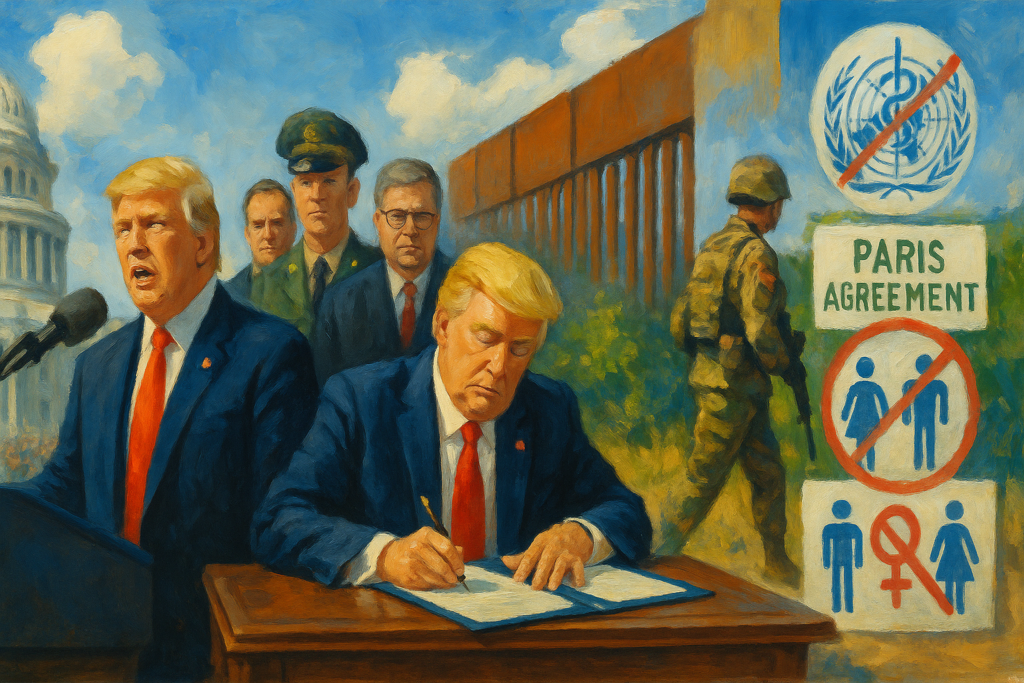
This week’s throughlines
- Immigration policy moved from campaign promise to immediate state action — The week began with emergency declarations, asylum restrictions, the end of CBP One, and a birthright citizenship order, then widened into expedited removal, pressure on sanctuary jurisdictions, and congressional passage of the Laken Riley Act.
- Accountability for January 6 was reversed and then politically reframed — Trump’s mass pardons and dropped cases were followed by public defenses of the move, criticism from judges and police groups, and House Republicans’ creation of a new panel to revisit the attack’s narrative.
- Federal institutions were brought under tighter political control — The administration moved quickly to reclassify civil servants, dismantle DEI offices, freeze civil-rights enforcement, restrict health-agency communications, and remove inspectors general, while new structures like DOGE raised transparency concerns.
- The administration paired policy rollback with symbolic and informational control — Orders on gender definitions, data removal, embassy flags, place names, and media pressure showed an effort to reshape not only rules but also official language, records, and public narrative.
- Courts and states began to push back, but mostly after the fact — The clearest institutional check came against the birthright citizenship order, with lawsuits from states and temporary blocks from federal judges, while other major actions remained in force as the week ended.
Donald Trump’s return to the presidency began with speed and scope. Over five days, the new administration used executive orders, emergency declarations, and internal directives to reshape immigration, citizenship, civil rights, the federal workforce, and America’s role abroad. Courts, states, unions, and advocacy groups moved almost immediately to challenge some of the most sweeping steps, but the first week still left a markedly different legal and institutional landscape than the one that existed on Inauguration morning.
The weekend before the transfer of power left little public trace in the official record. The story of the week begins on Monday, January 20, with Trump’s second inauguration and the decisions he made within hours of taking the oath.
On Monday, Trump was sworn in for a second term and delivered an indoor inaugural address that framed the day as “liberation day” from what he called a weaponized government. He repeated false claims about the 2020 election and portrayed immigration as an existential threat, signaling an aggressive “America First” agenda and open skepticism toward established institutions at home and abroad. That framing quickly became the justification for a rapid series of orders that followed.
Immigration and emergency powers were at the center of those first moves. Within hours, Trump declared a national emergency at the southern border, a legal tool that allows the president to unlock special authorities and redirect funds with limited congressional input. He authorized new troop deployments and wall construction, suspended entry at the border for many categories of migrants, and ordered agencies to expand “expedited removal” and create Homeland Security task forces in every state. Expedited removal is a process that allows immigration officers to deport certain non‑citizens quickly, without a full hearing before an immigration judge, if they cannot show sufficient ties to the United States. Trump paired these steps with a pledge to carry out the largest deportation program in US history and ordered reviews of visa programs to exclude people deemed “hostile,” moving immigration enforcement from campaign rhetoric into emergency rule.
At the same time, Trump signed an executive order aimed at ending birthright citizenship for many children born in the United States to non‑citizen parents. The Fourteenth Amendment, adopted after the Civil War, currently guarantees that “all persons born or naturalized in the United States, and subject to the jurisdiction thereof,” are citizens. Trump’s order instructed agencies to deny automatic citizenship to certain US‑born children and gave them 30 days to align their rules. Multiple draft versions circulated, but the common goal was to narrow who counts as a citizen at birth by presidential directive alone, setting up an immediate constitutional clash.
Clemency power was another tool Trump used on day one, this time to rewrite the legal and political meaning of January 6. He issued “full, complete and unconditional” pardons or commutations for more than 1,500 people convicted or charged in connection with the attack on the Capitol, including leaders convicted of seditious conspiracy. Full pardons erase convictions and restore civil rights; commutations shorten or end sentences without nullifying the underlying conviction. Trump also directed the Justice Department to drop pending January 6 cases and extended clemency to anti‑abortion activists convicted under federal clinic‑access laws. Law‑enforcement groups and judges criticized the move as undermining the rule of law and the deterrent effect of prosecutions for an assault on the transfer of power, while Trump publicly minimized the violence and cast many participants as victims.
Alongside these headline actions, Trump moved to reshape the machinery of government itself. He reinstated and expanded “Schedule F,” a job classification created late in his first term that allows the administration to reclassify thousands of policy‑influencing civil servants as at‑will employees who can be fired more easily. He revoked prior workforce protections and ordered agencies to identify positions for reclassification. He also created a new White House‑based Department of Government Efficiency, or DOGE, to drive technology and regulatory changes across agencies, and ordered independent regulators—bodies that traditionally operate at arm’s length from the president—to submit their priorities and budgets for presidential approval. Together, these steps aimed to centralize control over the federal bureaucracy and weaken the independence of career officials and watchdogs.
Civil rights and equality protections were another early target. On Monday, Trump terminated federal diversity, equity, inclusion, and accessibility programs, ordered DEI offices closed, and rescinded dozens of Biden‑era actions on racial equity and LGBTQ+ protections. A companion order redefined sex in federal policy as strictly male or female, determined at conception, and dissolved the White House Gender Policy Council. These moves narrowed the categories of people recognized in federal law and dismantled the infrastructure that had been built to address discrimination and inclusion inside agencies and among federal contractors.
In foreign and environmental policy, the administration declared a national energy emergency, directing agencies to fast‑track fossil fuel projects, roll back drilling limits in Alaska, and undo pauses on gas exports. Trump signed orders withdrawing the United States from the Paris climate agreement and revoking international climate finance plans, emphasizing domestic production over global climate commitments. He also ordered US withdrawal from the World Health Organization within 12 months, halted funding and personnel support, and cut funding to the UN agency for Palestinian refugees and the UN Human Rights Council, citing alleged mismanagement and bias. These steps signaled a renewed retreat from multilateral climate and health governance and reduced US leverage in international forums.
Other Monday actions showed how the administration intended to use, and sometimes sidestep, existing law. Trump ordered the Justice Department not to enforce a congressionally mandated TikTok divest‑or‑ban law for 75 days, despite a Supreme Court decision upholding it, effectively pausing a statute and court ruling through executive discretion. He reinstated the federal death penalty, reversing a moratorium, and directed DOJ to seek reversal of Supreme Court precedents that limit capital punishment, with an emphasis on cases involving law‑enforcement victims and undocumented defendants. He revoked security clearances for 50 former intelligence officials and former National Security Adviser John Bolton, citing their public criticism and alleged disclosures related to the 2020 election. And he shut down the national police misconduct database that had been designed to prevent officers with serious disciplinary histories from quietly moving between departments. Taken together, these moves pointed toward a more punitive federal criminal posture, a politicized approach to intelligence and dissent, and reduced transparency around law‑enforcement misconduct.
The outgoing administration’s final acts also shaped the backdrop. On his last day, Joe Biden commuted Indigenous activist Leonard Peltier’s life sentence to home confinement and issued protective pardons for family members, January 6 investigators, and officials such as former Joint Chiefs Chair Mark Milley and former NIAID Director Anthony Fauci, anticipating they might become targets of future prosecutions. In a separate symbolic move, Biden and Vice President Kamala Harris inaccurately declared the Equal Rights Amendment to be “the law of the land,” despite the amendment not having been fully ratified. That misstatement underscored how political leaders can overstate the legal status of rights in ways that may confuse the public.
By Tuesday, attention shifted from signing ceremonies to implementation and resistance. Agencies began identifying thousands of positions for reclassification under Schedule F, and the first legal challenges arrived. The National Treasury Employees Union sued to block the order, arguing that it stripped civil servants of due‑process rights and violated statutes governing the federal workforce. A public‑interest law firm filed suit over the new DOGE structure, claiming it functioned as an unregulated federal advisory committee that should be subject to transparency and balance requirements. In Congress, a House committee aligned with DOGE and chaired by Representative Marjorie Taylor Greene drew criticism for its stated aim of dismantling agencies and safety‑net programs, highlighting how legislative allies might reinforce the administration’s centralization agenda.
On the immigration front, the Department of Homeland Security moved to restart specific tools that had defined Trump’s first term. Officials prepared to reinstate the Migrant Protection Protocols, known as “Remain in Mexico,” which require many asylum seekers to wait in Mexico for their US immigration hearings. Internal directives also signaled plans to expand expedited removal nationwide, allowing migrants who could not prove two years’ residence to be detained without release and deported without full court proceedings. Early ICE operations, framed as the opening phase of the promised mass deportation program, disrupted work and school attendance in affected communities. Reports described racial profiling and even arrests of US citizens of Latino heritage, illustrating how broad enforcement sweeps can reach beyond their stated targets.
The narrative around January 6 also continued to shift. House Speaker Mike Johnson announced a new select subcommittee, chaired by Representative Barry Loudermilk, to re‑investigate the attack. Coming just after the mass pardons, the panel was positioned to challenge the prior bipartisan committee’s findings and present a more sympathetic account of Trump and his supporters. Because congressional inquiries help define the public record, the new panel raised the prospect of dueling narratives about an event that had already been extensively investigated and litigated.
Foreign policy leadership took shape as the Senate overwhelmingly confirmed Senator Marco Rubio as Secretary of State. Rubio, a long‑time Republican figure, was expected to help implement Trump’s “America First” approach, including withdrawals from climate and health agreements and a broad pause on foreign aid. Inside the national security apparatus, reports emerged that Trump had sidelined about 160 National Security Council staff and removed senior Justice Department national security and criminal division officials. These personnel moves, begun on day one, concentrated sensitive decision‑making in a smaller, more politically aligned circle and signaled internal resistance as career leaders were reassigned or frozen out.
By Wednesday, the first major judicial checks on the new administration’s agenda appeared. California, joined by a coalition of states and cities, sued to stop Trump’s birthright citizenship order, arguing that it violated the Fourteenth Amendment and long‑standing Supreme Court precedent that children born on US soil, with narrow exceptions, are citizens. Federal judges in Washington State and elsewhere issued temporary restraining orders, calling the order “blatantly unconstitutional” and preventing it from taking effect while litigation proceeds. The rapid response underscored that changes to the constitutional definition of citizenship cannot be made by executive order alone and highlighted the courts’ role as a counterweight to executive overreach.
Immigration enforcement widened in other ways. A Justice Department memo directed federal prosecutors to investigate and potentially charge state and local officials in “sanctuary” jurisdictions for harboring undocumented immigrants or withholding information from federal authorities. DOJ also created a working group to challenge sanctuary laws nationwide. These steps sought to criminalize local policy choices about cooperation with federal immigration enforcement, straining federal‑local relations and raising the stakes for cities and states that had adopted protective policies.
Inside DOJ, civil‑rights enforcement was effectively frozen. The Civil Rights Division was ordered to halt existing cases and stop filing new complaints, and a separate memo paused new police‑reform consent decrees—court‑enforced agreements used to correct patterns of unconstitutional policing. Together, these directives shifted responsibility for protecting voting rights, combating housing discrimination, and addressing police misconduct more heavily to states and localities, where capacity and political will vary widely.
Reproductive rights came under renewed pressure. Trump signed orders enforcing the Hyde Amendment’s ban on most federal funding for abortion across programs, revoking Biden‑era orders that had expanded access. He reinstated the “global gag rule,” cutting US aid to foreign organizations that provide or even discuss abortion services, and pardoned nearly two dozen anti‑abortion activists convicted under the FACE Act for obstructing clinics. These moves constrained reproductive health access domestically and abroad and signaled official sympathy for those who interfere with clinic operations.
Not all developments moved in the same direction. State‑level and labor actions showed other institutions still functioning and sometimes expanding protections. California’s new $20 minimum wage for fast‑food workers took effect, raising pay in a large low‑wage sector. Indiana lawmakers introduced a bill to revoke tax‑exempt status for non‑profit hospitals that overcharge patients, targeting perceived abuses in the health‑care system. The National Labor Relations Board approved a union election for 4,300 Amazon workers in North Carolina, and an earlier Teamsters strike authorization at Costco remained in play. These efforts suggested that, even as federal policy shifted, states and workers could still push for higher wages and stronger bargaining power.
The broader climate around immigration enforcement also inspired more extreme proposals. In Mississippi, a legislator introduced a bill to create an “Illegal Alien Certified Bounty Hunter Program,” offering $1,000 per deportation facilitated by registered bounty hunters. By paying civilians per deportation, the proposal blurred the line between state authority and vigilantism and invited abuse and racial profiling. In separate public remarks, Trump suggested that former President Biden could face prosecution and threatened to condition wildfire aid to California on the state’s adoption of voter ID laws and changes to water policy. He floated abolishing or sharply curtailing FEMA, arguing that states and private groups should handle disasters. These statements foreshadowed later moves to review and potentially politicize disaster aid.
On Thursday, the focus turned to information control and further dismantling of civil‑rights infrastructure. The Department of Health and Human Services imposed broad restrictions across its 13 agencies, including the CDC and FDA: bans on most travel, halts on new contracts and grants, and pauses on external communications, reports, and scientific meetings. A pending report on avian influenza was among the affected work. These steps coincided with the expected confirmation of a vaccine‑skeptic HHS secretary and limited the ability of health agencies to publish data and convene experts, potentially hampering preparedness and public understanding during ongoing and future health threats.
Building on Monday’s orders, Trump signed additional directives titled “Ending Illegal Discrimination and Restoring Merit-Based Opportunity.” These repealed Lyndon Johnson’s Executive Order 11246 and other long‑standing anti‑bias rules that had required federal contractors to take affirmative steps to prevent discrimination. Federal DEI offices were shut, staff placed on leave, and agencies were instructed to treat many equity initiatives as unlawful preferences. Removing these requirements weakened one of the main levers the federal government has used for decades to promote equal opportunity in large segments of the economy.
The White House also moved to pull science, artificial intelligence, and digital‑finance policy closer to the president. Trump created a new President’s Council of Advisors on Science and Technology and issued an order on “Strengthening American Leadership in Digital Financial Technology,” revoking prior digital‑asset guidance and banning a US central bank digital currency. A separate AI order directed agencies to remove what the administration described as regulatory barriers to American AI leadership. These structures will shape how scientific and financial expertise is filtered into policy and may favor industry and political allies over independent risk assessment.
Outside the executive branch, long‑running accountability efforts reached milestones. Purdue Pharma and the Sackler family agreed to a $7.4 billion settlement resolving thousands of lawsuits over their role in the opioid crisis. The deal requires the family to relinquish control of Purdue, which will be restructured under a new board, and directs funds to victims and governments for remediation. It followed a prior settlement the Supreme Court blocked over liability shields for the Sacklers and became a test of whether the legal system can hold powerful corporations and owners accountable for large‑scale public‑health harms.
Civil society networks also began to coordinate legal resistance to the week’s orders. Pro‑democracy organizations and advocacy groups, anticipating Trump’s moves, filed and organized lawsuits against key executive actions on immigration, civil rights, and birthright citizenship. They launched public education and mobilization campaigns in states such as North Carolina, where a Supreme Court election was being challenged, underscoring how non‑governmental actors can serve as a check when formal institutional balances are under strain. At the state level, Ohio enacted a law allowing police departments to charge up to $750 for access to body‑camera and other video records, a change added to an omnibus bill without hearings. Civil‑rights and media groups warned that such high fees would deter requests for critical evidence of police conduct, effectively limiting oversight even where records remain formally available.
Ethics and self‑enrichment concerns resurfaced as well. Watchdog reporting found that 168 new products had appeared on Trump’s online store since November, monetizing his second term with merchandise tied to his presidency. This came alongside his personal cryptocurrency launches and relaxed ethics statements at the Trump Organization, further blurring the line between public office and private business.
By Friday, the administration was consolidating its first‑week moves, particularly on immigration and emergency powers. A new DHS directive granted ICE sweeping authority to use expedited removal against immigrants who had entered legally under Biden‑era programs but had not applied for asylum, allowing deportations without full immigration‑court hearings. The order also confirmed nationwide use of expedited removal for those unable to prove two years’ residence, cementing earlier policy shifts. Entrenching this tool nationwide made it easier for the government to deport people quickly and increased the risk of wrongful removals without adequate review.
Disaster policy moved closer to the political arena. Trump signed an order establishing a FEMA Review Council to examine the agency’s structure and impartiality, giving it one year to recommend changes. This formal step followed his earlier public suggestions that FEMA should be pared back or abolished and that aid should be conditioned on state policy choices, including voter ID laws. Reworking FEMA under a politically charged review raised the prospect that disaster response could become a tool of partisan leverage rather than a neutral service based on need.
The military’s role in domestic policy also expanded. The Pentagon confirmed deployment orders for up to 1,500 active‑duty troops to the southern border, joining thousands of National Guard and Reserve personnel already there. Defense officials described the mission as supporting DHS in achieving “operational control,” even as illegal crossings were reported at multi‑year lows. Using active‑duty troops for immigration enforcement blurred civil‑military boundaries and normalized the use of emergency powers for what had been treated as a policy dispute.
The freezes at health agencies remained in place. Internal HHS memos indicated that restrictions on travel, grants, and communications would continue until new leadership and policy reviews were complete, keeping scientific meetings and external collaborations on hold. Prolonged freezes risked delaying research, surveillance, and guidance on emerging health threats, with knock‑on effects for states and international partners.
In the economic sphere, reports highlighted that the CHIPS Act and Inflation Reduction Act had already spurred hundreds of billions of dollars in planned semiconductor, battery, and solar manufacturing investments, with new US facilities coming online. These industrial reshoring trends continued even as Trump suspended new disbursements from some of the same laws, creating uncertainty about future support but showing that some long‑term policy effects were still unfolding independently of the new administration’s preferences.
Courts and local institutions continued to act in parallel to federal shifts. A federal judge barred Oath Keepers leader Stewart Rhodes and several other January 6 defendants from entering Washington, DC without court permission as a condition of their release, demonstrating that some judicial controls over January 6 participants remained in place despite sweeping clemency. In Mississippi, a police department hired an officer previously fired for racist slurs against Latino men, while in Colorado a crime lab analyst was charged with altering DNA reports in sexual assault cases. These incidents highlighted uneven accountability at the state and local level, especially as national databases and federal civil‑rights enforcement were being weakened.
Taken together, the week’s developments showed a presidency moving quickly to concentrate power in the executive branch, narrow rights and protections in areas from immigration to civil rights, and pull back from international commitments, while using clemency and rhetoric to recast the meaning of a prior attack on the transfer of power. Courts, states, unions, and civil society responded with lawsuits, new laws, and organizing efforts that partially checked some initiatives and advanced alternative priorities in labor, public health, and corporate accountability. The balance between these forces—an assertive executive and a patchwork of institutional and civic responses—will shape how durable the first week’s changes prove to be for American democracy and the rule of law.