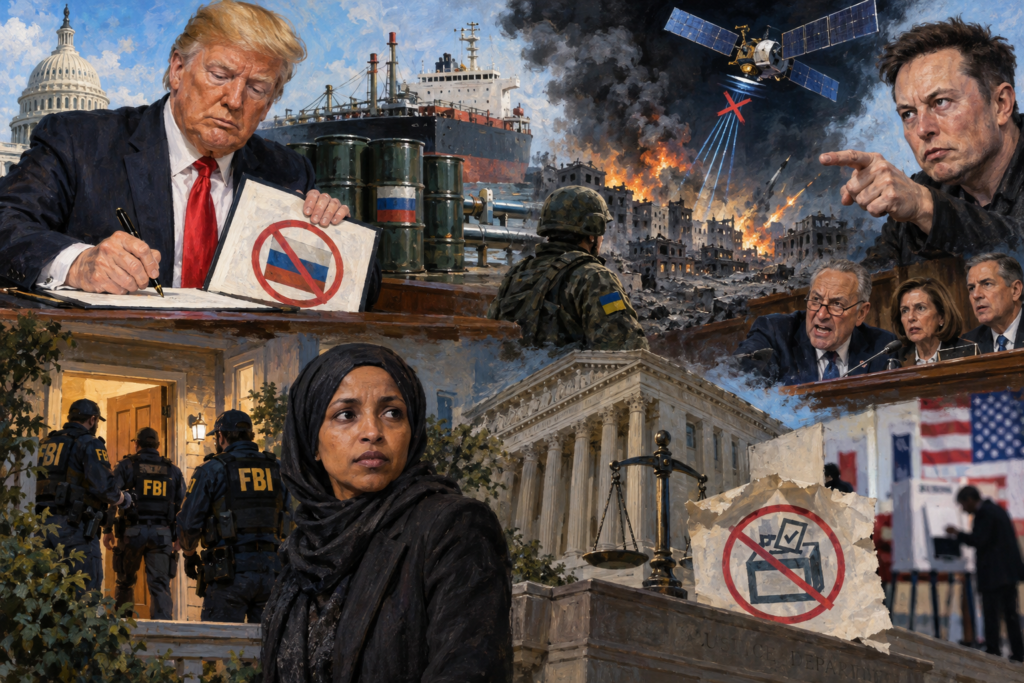
This week’s throughlines
- Executive override of congressional Russia policy — Trump waived bipartisan sanctions on Russia multiple times through the week, paired with a Russian diesel purchase and the restriction of Ukraine's Starlink/Starshield access, drawing bipartisan congressional anger and calls for investigation that culminated in Trump refusing to explain the decision and defending Musk unconditionally by week's end.
- DOJ abandons pre-election neutrality — Federal law enforcement conducted a cascade of politically charged actions in the pre-election window: the search of Omar's home, a wave of voter-fraud prosecutions and theatrical arrests, a lawsuit against California over voter rolls, and the explicit abandonment of the traditional 60-day enforcement blackout, raising sustained alarm from a former president and members of both parties.
- Private power over public infrastructure — Elon Musk's unilateral control over Starlink/Starshield emerged as a flashpoint, with bipartisan senators demanding testimony and funding consequences, Musk responding with a threat against lawmakers, and administration officials offering contradictory cover stories before Trump ultimately refused accountability.
- Degradation of campaign conduct — A campaign ad attacking a gubernatorial candidate using her documented childhood sexual abuse, defended by the vice president and endorsed by the president, exposed deep fractures over basic decency even as Republicans publicly split over it.
- Information ecosystem under strain ahead of midterms — Russian disinformation targeted a Senate candidate, a polling firm admitted to fabricating data used by major outlets, fraudulent leaflets circulated in Texas, and platforms repeatedly suspended protest-organizing accounts—compounding doubts about the reliability of the pre-election information environment.
This was the week American foreign policy and American elections began visibly bending under the same hand. In the space of six days, a president waived bipartisan sanctions on Russia, a sitting congresswoman's home was searched weeks before her own election, and a private satellite network serving a wartime ally went dark without public explanation. By Friday, none of the three stories had resolved — they had simply hardened into open questions that Congress, the courts, and the public were left to sort out.

**The Weekend**

The weekend set the tone. Just before congressionally mandated sanctions on Russia were set to take effect, Trump issued an executive order waiving them, a move that drew criticism from lawmakers in both parties who saw it as capitulation to Moscow during an active war. The waiver arrived alongside a separate, developing deal to purchase Russian diesel, and Energy Secretary Chris Wright offered a defense of the shift that struck observers as internally contradictory.

At nearly the same moment, federal agents searched the home of Representative Ilhan Omar and seized her phone, part of an investigation into her immigration paperwork opened weeks before she faced voters in the midterms. Her attorneys called the search unlawful, and the administration's border czar soon floated the possibility of denaturalization and deportation — language rarely aimed at a sitting member of Congress.

The same weekend, more than 3,000 "No Kings Vote Early" events unfolded nationwide in what organizers described as the largest early-voting mobilization in American history, only for Meta to remove and repeatedly suspend the movement's Instagram account — a pattern the group read as deliberate suppression timed to its organizing push. Smaller stories rounded out the weekend: a White House press secretary was removed after five days when it emerged she had falsely claimed for years to be a practicing attorney, and the administration floated, then canceled, a televised firing-squad execution after unfavorable polling.

**Monday**

By Monday, the Omar story had grown a second chapter. Her legal team formally accused the Justice Department of violating its own policy against election-season enforcement actions and demanded the return of her seized property. Former President Obama entered the fray publicly, warning that normalizing this kind of investigation against one official put every officeholder at risk — a notable intervention from a former president typically reluctant to comment on ongoing matters.

The Justice Department, meanwhile, widened its election-season enforcement considerably, charging 28 lawful permanent residents in California with voting violations as part of a broader, unproven claim that roughly 20,000 California voters might be noncitizens; eleven were arrested that same day. Meta suspended the No Kings Instagram account again, this time for about 90 minutes during a nationwide day of protest, offering explanations organizers found unpersuasive.

The security picture darkened further when more than 100 letters containing white powder, many postmarked from a single Texas mail facility, were sent to over 36 congressional offices and election centers in at least 15 states — a bipartisan target list that included lawmakers from both parties. Separately, CBS News' editor-in-chief directed investigative resources toward an unsubstantiated claim linking a Michigan Senate candidate to extremism based on a decade-old tweet by a relative, prompting internal staff conflict over coverage bias.

And in Ukraine, the week's defining infrastructure story began: Starlink and Starshield access was abruptly restricted without clear explanation, with Ukrainian officials saying the order originated with the U.S. government while Secretary of State Rubio and SpaceX each pointed elsewhere. In Mississippi, the state's attorney general ruled a police shooting that killed a one-year-old child in Senatobia "justified," despite an independent autopsy that contradicted the official account.

**Tuesday**

Tuesday kept the Russia and election threads moving in parallel. Trump announced an $8 billion farmer assistance program but withheld payment details until after the election, and separately told a Kansas audience that a favorable ethanol rule would depend on whether the Republican Senate candidate won — an explicit linking of federal policy to electoral outcome. The administration also finalized its Russian diesel purchase, an arrangement Ukrainian officials calculated provided no real economic benefit to U.S. energy needs but offered Moscow a financial and political lifeline during the war — connecting directly back to the weekend's sanctions waiver as part of a single, reinforced policy direction rather than an isolated decision.

Elon Musk announced he would give a share of SpaceX stock, worth roughly $10.5 billion in aggregate, to every American child through federal "Trump Accounts" — a structure that also let him avoid an estimated $2.5 billion in capital gains taxes while tying millions of families financially to his company.

In Ohio, Vivek Ramaswamy's gubernatorial campaign aired an ad featuring opponent Amy Acton's estranged mother disputing Acton's documented account of childhood sexual abuse — funded partly by major corporate PAC money and condemned across the political spectrum, planting a controversy that would escalate sharply by week's end. Smaller developments included FEMA signaling a shift of disaster-response responsibility onto states, and Alabama Governor Kay Ivey commuting a death sentence amid longstanding doubts about the underlying conviction.

**Wednesday**

Wednesday brought the Starshield story into open bipartisan conflict. Republican and Democratic lawmakers — including Rep. Brian Fitzpatrick and Sen. Adam Schiff — demanded investigations and sworn testimony from Musk, with some threatening to cut federal funding for the agencies involved; Rep. Jim Himes went so far as to call Trump "an ally of Vladimir Putin" and urged veto-proof legislation.

The courts, meanwhile, offered real if partial checks on executive action. The Supreme Court declined to let the administration immediately enforce new restrictions on gender-affirming care for transgender federal prisoners, preserving access during ongoing litigation over the objections of Justices Thomas and Alito. A federal judge issued a preliminary injunction limiting DHS's election-related field operations in nine states, finding that the government's data sweeps risked wrongly targeting citizens and chilling voter-assistance work.

Against that judicial caution, DOJ's enforcement posture turned theatrical: DHS agents arrested 72-year-old lawful permanent resident Omar Muñoz in a heavily publicized, helicopter-supported operation, handcuffing him despite his frail post-surgical condition — part of the broader wave of charges against green-card holders whose underlying fraud claims remained unproven. Trump also suggested he would personally arbitrate DOJ whistleblower reward disputes despite the department's stated "sole discretion," Nancy Pelosi's office received its own white-powder letter as part of the ongoing intimidation wave, and New Mexico's attorney general sued Jeffrey Epstein's longtime attorney and accountant over alleged concealment of his crimes.

**Thursday**

Thursday was the week's most crowded day, and it was the day the Starshield story turned confrontational. Responding to the bipartisan calls for his testimony, Musk posted a threat on social media vowing to "find out who is really pulling the strings and come for them" — language widely read as an attempt to intimidate the lawmakers conducting oversight of his control over military-critical infrastructure.

At an Iowa rally the same day, Trump endorsed Ramaswamy's ad attacking Acton, dismissed a reporter's challenge by calling her a "horrible little reporter," and separately attacked Ohio Governor Mike DeWine on social media for criticizing the ad — an attempt to punish intra-party dissent even as Republicans publicly split over the spot.

A Russian influence operation was exposed targeting Democratic Senate candidate James Talarico in Texas with a fabricated misconduct claim, spread through bot networks and later amplified by verified accounts, part of a documented pattern of foreign interference in close races. Compounding the information strain, a polling firm, Wedgewood Polls, admitted to deliberately fabricating survey data that had been republished by major outlets and folded into national polling averages, prompting the New York Times and Decision Desk HQ to pull the figures.

On a separate track, a federal magistrate ordered Trump to comply with discovery and sit for a deposition in his $10 billion lawsuit against the BBC, rejecting his bid to block videotaping and threatening sanctions for noncompliance. The DOJ also released a promotional, upbeat-music video of Muñoz's arrest under the caption "OPERATION PROTECT THE VOTE," which former officials called a sharp break from departmental norms of neutrality.

A data breach separately exposed more than 420,000 documents detailing Germany's far-right AfD party's decade-long courtship of Trump, Steve Bannon, and other allies, including meetings with State Department officials and Vice President Vance, and Hillary Clinton publicly suggested Trump's Russia alignment reflected either financial self-interest or material Putin held over him. Administration officials, for their part, offered conflicting explanations for the Starshield restriction, with Rubio and the NATO ambassador framing it as a routine business decision at odds with reports that Trump had personally called Musk to request service be restored.

**Friday**

The week closed without resolution on its central accountability question. Pressed on who had ordered Ukraine's Starlink access restricted, Trump said "I have no idea" and "I wouldn't tell you if I did know," while declaring that Musk "will never do anything wrong" — a response that left the week's most consequential national-security decision unexplained even as bipartisan pressure for answers had only grown.

The Justice Department escalated its election-season posture further by suing California over claims that 20,000 noncitizens remained on its voter rolls, seeking to block certain ballot tabulations over objections from state officials who said the claim wrongly flagged citizens and already-cancelled registrations. Reporting also revealed that an FBI corruption probe into a defense contractor's alleged "cash-for-contracts" dealings with two members of Congress had been effectively halted after the administration gutted the teams responsible for public corruption investigations, and that Republicans had structured their budget bill so the largest Medicaid and food-assistance cuts would take effect only after the midterms.

A billionaire banker facing felony bribery charges received a full pardon from Trump shortly after his family hired Trump's former personal lawyer for a reported fee exceeding $50 million. Reports of internal White House power struggles surfaced amid the mounting controversies, and Health Secretary Robert F. Kennedy Jr. curtailed flu vaccine promotion just as an unusually early and severe flu season emerged on the West Coast.

**Looking Back**

Taken as a whole, the week showed institutions pulling in different directions at once. A president reinforced, across multiple days, a Russia policy that bipartisan majorities in Congress had explicitly rejected, while a private individual's control over wartime communications infrastructure became a flashpoint serious enough to draw threats against the legislators investigating it. The Justice Department abandoned long-settled norms against election-season enforcement, pursuing prosecutions and lawsuits whose underlying claims remained unproven and in some cases were checked by federal courts.

Those courts — on transgender prisoner care, on DHS's voter data sweeps, on a sitting president's discovery obligations — did what they are built to do, applying law without regard to who held power. And the week's campaign conduct, information environment, and intimidation mailings suggested a political system under genuine strain heading into a midterm election, with foreign disinformation, fabricated polling, and platform suppression compounding uncertainty about what voters could reliably know.

Whether the accountability sought this week — over Starshield, over the Russia sanctions reversal, over the DOJ's election-season conduct — would be delivered remained, by Friday, an open question resting with Congress, the courts, and ultimately the voters themselves.