This week’s throughlines
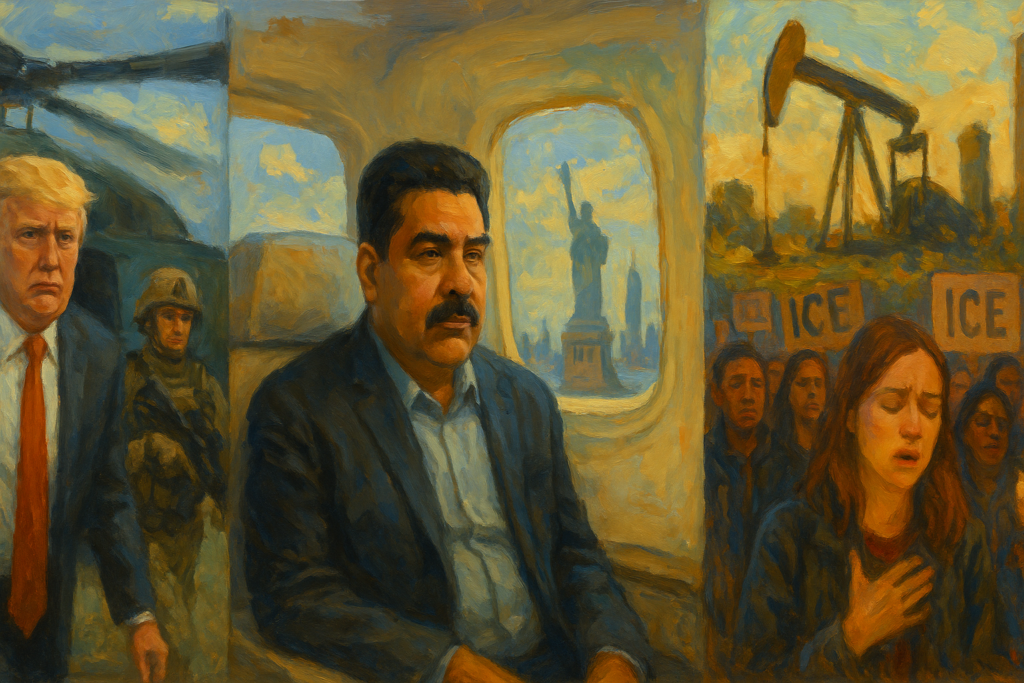
- Executive action in Venezuela moved from military force to legal and economic control — The administration began with a unilateral operation against Maduro, then defended the lack of congressional notice, brought Maduro into U.S. court, and shifted toward controlling Venezuelan oil revenue and reopening oil flows in ways that appeared to benefit connected private interests.
- The Minnesota immigration surge escalated into a national accountability crisis — A major ICE deployment in Minnesota was followed by the fatal shooting of Renee Nicole Good, disputes over the official account, federal exclusion of state investigators, and widening protests that drew further force and political backlash.
- Transparency and lawful oversight kept colliding with executive resistance — The DOJ’s failure to comply with the Epstein Files Transparency Act became a weeklong story of missed deadlines, partial disclosures, congressional escalation, and court-centered efforts to force compliance, while other FOIA suits reinforced the same pattern.
- Federal pressure on states, cities, and institutions broadened across domains — Beyond the week’s two main crises, the administration used lawsuits, appointments, and enforcement pressure against states over voter data, California cities over energy policy, and internal watchdog structures inside DOJ and FEMA.
The week opened with a dramatic assertion of presidential power abroad and closed with a domestic struggle over force, truth, and accountability. In between, institutions at every level—courts, Congress, state governments, and the streets—were pulled into conflicts over who decides when the United States uses violence, who controls vital information, and whose version of recent history will prevail.
Over the weekend, the White House launched “Operation Absolute Resolve,” a surprise raid in Caracas that seized Venezuelan president Nicolás Maduro and his wife, Cilia Flores. U.S. special forces, acting on President Trump’s orders and without congressional authorization or prior briefings to key lawmakers, abducted the couple and flew them out of the country. The administration framed the action as a narco-terrorism arrest, but reports from Venezuela described multiple strikes and dozens of deaths, and foreign governments called it an invasion and a crime of aggression. Within hours, the operation was being discussed not only as a military gamble but as a test of constitutional war powers and international law.
The domestic response was swift. Anti-war groups organized emergency protests in major cities, denouncing the raid as an illegal invasion and demanding congressional oversight. Demonstrators called for impeachment and an end to escalation, and early polling showed only a small minority of Americans supported a U.S. invasion of Venezuela. That gap between executive action and public consent set the stage for a week in which Congress would be pressed to reassert its role. At the same time, confirmation that Maduro had been transferred to U.S. custody, with plans to arraign him in New York on drug and weapons charges, signaled that the administration intended to move the conflict into American courts, further blurring the line between foreign policy and criminal prosecution.
Other weekend developments sketched the broader institutional landscape. In New York City, newly sworn-in mayor Zohran Mamdani revoked all executive orders issued by his indicted predecessor after September 2024, presenting the move as a break with corruption and a reset of local executive power. The Ninth Circuit struck down California’s open-carry ban in populous counties, extending recent Supreme Court doctrine on the Second Amendment and underscoring the judiciary’s role in reshaping rights. And early signs of friction over transparency and immigration enforcement emerged: the Justice Department faced a looming deadline under a new law to justify any redactions in the Jeffrey Epstein files, amid concerns it was already behind, while a Wisconsin judge resigned under threat of impeachment after being convicted of obstructing a federal immigrant arrest. Those threads—federal secrecy in an elite case and conflict over immigration enforcement—would grow into major arcs as the week unfolded.
By Monday, the Venezuela operation had arrived in a Manhattan courtroom. Maduro and Flores appeared before a federal judge, pleading not guilty to narco-terrorism, cocaine importation, and weapons charges. Maduro described himself as a kidnapped president and prisoner of war, while the administration insisted the Caracas raid was a law enforcement action rather than an act of war. Critics at home and abroad rejected that framing, arguing that using special forces to seize a sitting foreign leader without congressional authorization or international sanction crossed a line. The case raised novel questions about whether U.S. courts could be used to legitimize regime change and how far domestic criminal jurisdiction could reach into contested international conflicts.
At the same time, the administration’s priorities around the raid became clearer. Trump acknowledged that oil executives had been briefed on the Venezuela operation before Congress, and lawmakers from both parties said they had not received the required war-powers briefings. Representative Ted Lieu publicly called the attack illegal. The revelation that private energy interests were treated as key stakeholders in a decision to use force, while elected representatives were sidelined, deepened concerns that foreign policy was being driven by corporate beneficiaries rather than constitutional process. Separate from Venezuela, the Justice Department sued 22 states that refused to hand over complete voter rolls, including sensitive personal data, as part of a federal effort to build a national voter file and accelerate purges. Many of the targeted states had Democratic election officials, raising alarms about partisan use of federal power over state-run elections and the potential for large-scale voter suppression.
Monday also brought a series of domestic flashpoints around rights and dissent. In Kentucky, authorities arrested Melinda S. Spencer and charged her with first-degree fetal homicide, abuse of a corpse, and evidence tampering after she allegedly ordered abortion pills online and buried the remains. The charges appeared to conflict with state law, which explicitly bars using the fetal homicide statute against a pregnant woman for her own pregnancy outcome, illustrating how prosecutors can stretch criminal law to police pregnancy and chill reproductive autonomy. In California, five Stanford students prepared to stand trial on felony conspiracy and vandalism charges stemming from a 2024 pro-Palestinian sit-in at the university president’s office, a case they argued was meant to deter campus protest. And in Phoenix, the Arizona Supreme Court building was evacuated after vials of a homemade explosive substance were found, a reminder of the physical vulnerability of judicial institutions. Meanwhile, new polling confirmed that only 16 percent of Americans supported a U.S. invasion of Venezuela, reinforcing the political risks of expanding the operation.
On Tuesday, the week’s foreign and domestic themes converged around presidential power. A retrospective account described how, upon returning to office in 2025, Trump had ignored the Impoundment Control Act to seize control over federal spending and deployed troops in Democratic-led cities despite legal limits. Against that backdrop, he now asserted a right to use military force to seize foreign oil and floated military options to acquire Greenland, straining NATO norms and treating territorial acquisition as a live policy option. The pattern was one of treating statutory and international constraints as optional, concentrating power in the presidency and normalizing resource-driven military action.
The administration also moved to rewrite the story of January 6. In the anniversary week of the Capitol attack, Trump issued sweeping pardons and commutations for participants, calling their prosecutions a “grave national injustice.” The White House described the rioters as “peaceful patriotic protesters” and cast Democrats who certified the 2020 election as villains, despite the violence and injuries documented that day. This effort to erase the nature of the attack and absolve those involved directly challenged the idea that there should be accountability for assaults on the transfer of power. At the same time, new disclosures showed that major corporations including Cigna, Comcast, and General Mills had quietly resumed donations to lawmakers who voted against certifying the 2020 election, despite earlier pledges to stop. A few firms, such as Airbnb and Farmers Insurance, maintained their bans. The split highlighted how corporate commitments to democratic norms can erode once immediate public pressure fades.
The fight over the Epstein files intensified on Tuesday as well. Court filings revealed that the Justice Department had released less than 1 percent of the documents required under the Epstein Files Transparency Act, which mandated broad disclosure by December 19. DOJ cited the need to review millions of documents and protect victim privacy, but it had not provided the required justifications or an unredacted list of implicated officials. In response, Representatives Ro Khanna and Thomas Massie began exploring rare enforcement tools, including Congress’s inherent contempt power, and later asked a judge to appoint a special master to oversee compliance. The standoff raised basic questions about whether Congress could compel disclosure in a case involving powerful figures and whether the Justice Department would obey a transparency statute that directly constrained its discretion.
Tuesday also saw the opening moves in a domestic enforcement surge that would dominate the second half of the week. The Department of Homeland Security announced “Operation Metro Surge,” an unprecedented deployment of roughly 2,000 ICE and Homeland Security agents to Minnesota, focused on alleged fraud and “criminal illegal aliens,” particularly in Somali communities. Local leaders and residents described the operation as a “war” on their state, and detention levels quickly exceeded facility capacity. Senators Ruben Gallego and others would soon question the mass reassignment of more than 28,000 law enforcement personnel to ICE, warning that investigations into child exploitation, human trafficking, and drug cartels were being hollowed out in favor of deportations. At the same time, the administration sued two California cities over local restrictions on natural gas infrastructure in new buildings, arguing federal preemption and signaling a broader effort to block city-level climate policies.
By Wednesday, the consequences of the Minnesota surge turned deadly. During a large-scale ICE operation in Minneapolis, agent Jonathan Ross shot and killed 37-year-old Renee Nicole Good, a legal observer, as she sat in her car. DHS quickly claimed she had weaponized her vehicle and that the shooting was self-defense, labeling her a domestic terrorist and tying her to a supposed leftwing terror network. But video reviewed by Reuters and eyewitness accounts suggested her car was turning away when shots were fired. Minneapolis’s mayor called the federal story “bullshit,” and Minnesota’s governor and other state leaders condemned the operation, demanding that ICE leave the city. The killing raised fundamental questions about the use of force by federal agents, the targeting of immigrant communities and their allies, and whether local authorities had any meaningful ability to hold federal actors accountable.
The clash over what had happened in Minneapolis deepened as the day went on. While DHS and Vice President JD Vance stuck to the self-defense narrative, independent media verification of the video undercut their claims. Local officials demanded full release of evidence, and reports emerged that federal officers had blocked medics from reaching Good immediately after the shooting. The episode became a test of whose account would prevail: the federal agencies conducting the operation or the combination of local officials, witnesses, and journalists challenging their version of events. In Washington, Trump signed an executive order titled “Prioritizing the Warfighter in Defense Contracting,” barring underperforming defense contractors from stock buybacks and dividends until they met performance standards and empowering the Secretary of War to enforce compliance through the Defense Production Act and contract changes. In a separate interview with the New York Times, he minimized international law as a constraint on his authority, saying he was limited only by his own morality and brushing aside concerns about ousting Maduro or the expiration of arms control treaties. Together, these moves underscored a personalized theory of power that extended from foreign interventions to domestic economic leverage.
Wednesday also brought shifts in social policy. The administration unveiled a new food pyramid that encouraged alcohol as a “social lubricant” and removed science-based childhood vaccine recommendations, justifying the changes in terms of boosting GDP through longer working lives. It simultaneously announced the revocation of billions in childcare funding, part of broader cuts to social services. These decisions contrasted sharply with the long-term gains of the previous decade—expanded tax credits, reduced uninsured rates, and narrowed Black–White employment gaps—and foreshadowed a week in which competing visions of the state’s role in supporting families and communities would be on display.
On Thursday, Congress escalated its confrontation with the Justice Department over the Epstein files. After DOJ admitted in court that it had released only a fraction of the documents and missed key deadlines, Representatives Khanna and Massie formally asked a federal judge to appoint a special master to oversee the release and again raised the possibility of inherent contempt against Attorney General Pam Bondi. DOJ’s filings acknowledged that “substantial work remains,” even though the statutory deadline had passed weeks earlier. The move to seek judicial oversight signaled how seriously lawmakers viewed the transparency breach and tested whether Congress could enlist the courts to enforce its will in an elite case.
The Senate, meanwhile, took its most concrete step yet to check the president’s war-making. By a 52–47 vote, with five Republicans joining Democrats, senators advanced a War Powers Resolution that would bar further military action in Venezuela without explicit congressional authorization. Trump threatened a veto and insisted he could launch invasions in the Western Hemisphere without Congress, but the vote marked a rare bipartisan rebuke and an attempt to reassert the legislature’s constitutional role over the use of force. Even as the Senate moved to limit the operation, the administration was turning it into a long-term resource project. Energy Secretary Chris Wright announced that the United States would take control of all Venezuelan oil “for the foreseeable future,” with proceeds deposited outside the U.S. Treasury. Trump and aides met with oil executives, promising “total safety” for investments and touting billions in potential profits. Plans were floated to seize 30–50 million barrels of Venezuelan crude and to use taxpayer-backed schemes to rebuild the country’s oil sector. What had begun as a contested raid was now being openly framed as a resource grab benefiting politically connected investors.
Back in Minnesota, federal authorities tightened their grip on the investigation into Renee Good’s killing. The FBI informed the state’s Bureau of Criminal Apprehension that it would lead the probe and revoked state access to evidence, witnesses, and interviews. The BCA withdrew, and Minnesota’s governor and local officials warned that centralizing the case inside federal agencies aligned with the shooter undermined public confidence in any eventual findings. Reports that federal officers had blocked medics from reaching Good added to the sense that the agencies under scrutiny were controlling both the facts and the narrative. Elsewhere in the federal bureaucracy, a leaked draft revealed plans to cut FEMA’s staff by more than half by the start of the next fiscal year, part of a restructuring under DHS Secretary Kristi Noem. FEMA said no final decisions had been made, but the proposal aligned with a Trump task force’s recommendations and raised alarms about the country’s capacity to respond to disasters as climate-related emergencies intensify.
Not all developments pointed toward retrenchment. New York City and state leaders announced a universal child care plan providing two years of free care for two-year-olds, expanding on existing pre-K programs and offering a tangible boost to families’ economic security. In Washington, the House passed a three-year extension of Affordable Care Act tax credits with support from 17 Republicans, sending the bill to a skeptical Senate but demonstrating that bipartisan coalitions still existed around health coverage. Federal courts also continued to check politicized Justice Department appointments: one judge disqualified former Trump campaign lawyer John Sarcone from investigating New York Attorney General Letitia James, citing his unlawful appointment, while another ordered Trump-appointed lawyer Lindsey Halligan to explain why she continued to act as a U.S. attorney after her appointment had been ruled invalid. And in the private sector, a Trump family cryptocurrency venture, World Liberty Financial, applied for a national banking license, raising fresh questions about conflicts of interest and regulatory favoritism.
By Friday, the Minneapolis shooting had sparked a national response. Protests and vigils demanding accountability for ICE and DHS spread across all 50 states. Organizers launched “ICE OUT FOR GOOD” actions, Moral Monday protests linked benefit cuts to immigrant rights, and training sessions to prepare volunteers to monitor ICE activity. Demonstrators highlighted that 92 percent of recent growth in ICE detentions involved people without criminal convictions and called for justice for Renee Good, deep reforms, or outright abolition of ICE. The scale and coordination of the protests signaled deep public concern about federal enforcement practices and put pressure on Congress and local governments to respond.
On Capitol Hill, House Democrats moved to use some of their strongest tools against DHS leadership. Representative Robin Kelly filed three articles of impeachment against Secretary Noem, accusing her of obstruction of justice, violation of public trust, and self-dealing in connection with the Minneapolis shooting and broader department conduct. Other Democrats threatened to withhold DHS funding unless reforms were enacted, including warrant requirements and limits on ICE operations in cities. These steps did not immediately change conditions on the ground, but they showed lawmakers willing to test the outer edges of their authority to discipline cabinet officials and reshape agency behavior.
The week’s economic news added another layer of uncertainty. The December jobs report showed only 50,000 jobs added, capping the weakest non-recession year for job growth since 2003, with continued manufacturing losses. At the same time, Trump was accused of leaking confidential jobs data before its official release, potentially affecting financial markets. Administration advisors downplayed the numbers, blaming data revisions rather than policy, but the combination of a slowing labor market and alleged misuse of market-moving information raised concerns about both economic security and the integrity of official statistics. In California, unions and allies launched a ballot drive for a one-time 5 percent tax on residents worth over $1 billion to fund education, food assistance, and healthcare, drawing support from some Democrats and opposition from Governor Gavin Newsom. Together with the House’s ACA subsidy extension, the proposal highlighted competing economic visions: taxing extreme wealth and bolstering social supports versus prioritizing defense and enforcement spending.
The battle over January 6’s meaning continued to play out in symbolic and diplomatic arenas. The Senate unanimously approved a resolution to install a plaque honoring police who defended the Capitol, reinforcing an institutional narrative that treats the attack as a serious assault on democracy. This stood in sharp contrast to the White House’s pardons and rhetoric earlier in the week. Abroad, polling showed German trust in the United States had fallen to levels comparable to trust in Russia, as the European Union pursued new trade deals without Washington. That erosion of allied confidence was compounded by a sweeping presidential memorandum announcing U.S. withdrawal from the UN Framework Convention on Climate Change and 65 other international organizations. Climate experts and former officials warned that leaving foundational international bodies would isolate the United States from global efforts on shared problems like climate change and remove external checks on U.S. policy. Meanwhile, aggressive immigration enforcement tactics extended beyond Minnesota: outside a Portland hospital, Border Patrol agents shot two people while attempting to stop a vehicle in search of a suspected undocumented immigrant linked to a Venezuelan gang, prompting new calls for a pause on such operations in civilian spaces far from the border.
Taken together, the week’s events traced a contested landscape in which executive power was asserted forcefully in foreign interventions, immigration enforcement, and information control, while other institutions struggled to respond. Congress advanced a War Powers Resolution on Venezuela, pressed the Justice Department over the Epstein files, extended health subsidies, and moved to impeach a cabinet secretary. Courts checked politicized appointments and, in some areas, expanded individual rights. Cities and states experimented with universal child care and wealth taxes even as federal agencies drafted deep cuts to disaster response and social supports. In the streets, protests over war, immigration, and January 6’s legacy signaled that public consent could not be taken for granted. The balance between unilateral action and institutional constraint remained unsettled, but the week showed that the struggle over law, accountability, and the uses of state power is ongoing and deeply intertwined across foreign and domestic fronts.