This week’s throughlines
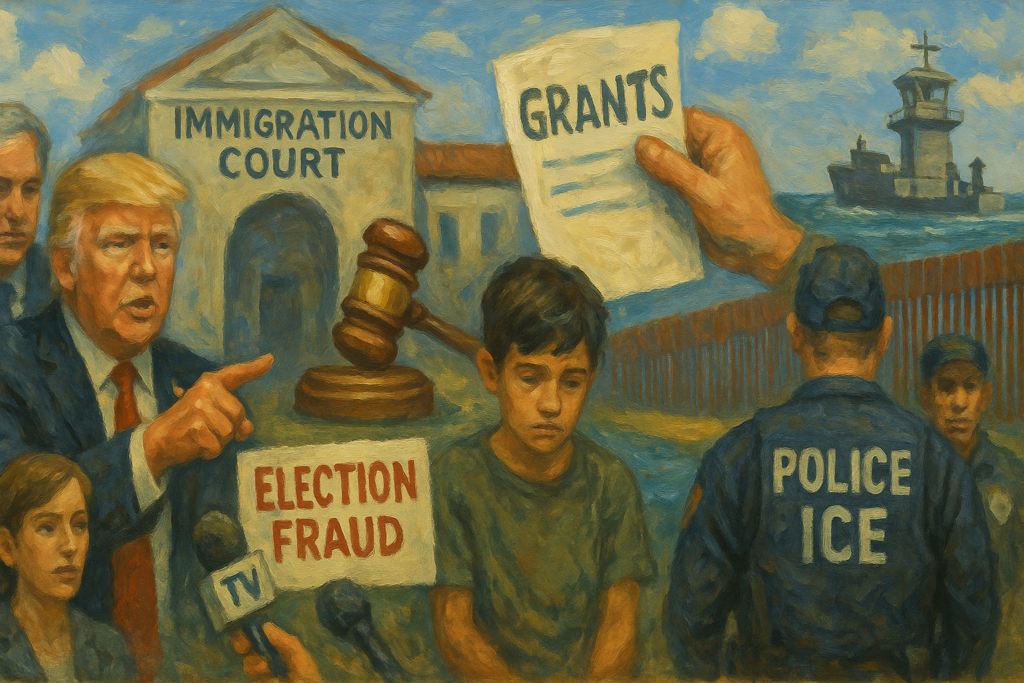
- Federal pressure on election administration intensified — The week began with direct federal demands on state voter rolls and continued with lawsuits over grant conditions that tied disaster and homeland security money to voting-system changes, while court rulings and redistricting decisions further weakened voting-rights protections.
- Immigration enforcement expanded while accountability lagged — The administration opened new legal and physical infrastructure for removals, cut access to counsel, and drove arrests to record levels, even as deaths, excessive-force complaints, and disputes over body-camera transparency raised questions about oversight.
- The Iran conflict drove a struggle over money, powers, and information — As the Pentagon sought more war funding and Congress moved defense and budget bills, lawmakers also tried to reclaim war powers. Throughout the week, casualty reporting and military spending disclosures became a parallel fight over transparency.
- Courts remained the main institutional brake — Judges blocked or narrowed several administration actions affecting immigrants, voting, civil service protections, and reproductive rights, while states and advocacy groups increasingly turned to litigation to challenge executive leverage.
The week began with a coordinated attempt to push federal power deeper into election administration, and much of what followed grew from that opening move. Over six days, the administration pressed states on voter rolls and immigration cooperation, Congress fought over how to fund and constrain the Iran conflict, immigration enforcement widened in both reach and severity, and courts repeatedly became the place where these disputes were slowed, tested, or clarified. By Friday, the same themes had hardened: more executive leverage through money, more pressure on information, and more reliance on judges to draw lines that elected institutions were struggling to hold.
Over the weekend, President Trump and Homeland Security officials put the SAVE America agenda at the center of national politics. Trump directed the Department of Homeland Security to notify states about alleged noncitizens on voter rolls and urged Congress to pass the SAVE America Act. Homeland Security Secretary Markwayne Mullin went further, demanding that states use a disputed federal screening tool and warning of prosecution if they did not comply. The immediate issue was voter-list maintenance, but the larger effect was to shift authority toward the executive branch by using federal agencies to pressure state election officials. That pressure would not remain rhetorical for long: it set up both the week’s later lawsuits and the House’s decision to tie voting restrictions to major spending legislation.
That same weekend, administration allies paired election politics with emergency language. Secretary of State Marco Rubio described the “radical left” as a terrorism threat, while Stephen Bannon suggested that a communist-threat narrative could justify a national security emergency order linked to the administration’s domestic agenda. Trump also intensified his attacks on the press and on the basic reality of election administration, accusing journalists of concealing fraud, calling for broadcasters’ licenses to be revoked, and falsely claiming that China had compromised 220 million U.S. voter files. The significance lay less in any single statement than in the governing style they reflected: domestic opponents cast as security threats, journalists as enemies, and election systems as inherently suspect.
Immigration policy opened the week on two tracks at once: expansion of state power and judicial resistance. The Justice Department filed the first-ever application in the Alien Terrorist Removal Court, a little-used and secretive process that permits the use of classified evidence in removal proceedings. In a separate case, however, a federal judge blocked the administration from revoking work permits for asylum seekers and people with Temporary Protected Status. The contrast would define the week. The administration kept building new tools for detention and removal, while courts remained one of the few institutions capable of slowing those efforts case by case.
Elsewhere over the weekend, the weakening of voting-rights protections continued to reshape the political landscape before any ballots were cast. A recent Supreme Court ruling narrowing the Voting Rights Act was already prompting new map changes in Southern states, while civic groups responded with voter-registration and engagement efforts. At the same time, immigration enforcement grew more aggressive and less transparent. Reports said the FBI would stop investigating confrontations involving ICE. In Houston, an ICE officer fatally shot Lorenzo Salgado Araujo. Under mounting scrutiny, border czar Tom Homan announced that ICE officers would be required to use body cameras during vehicle stops. Even then, the promise of accountability arrived only after a death and amid signs that outside review was weakening.
The weekend also foreshadowed the week’s other major struggle: the Iran conflict. House leaders rushed major legislation before recess, the Pentagon sought more money for operations in Iran, and the military disclosed casualties only after criticism over earlier silence. From the start, the war story had three connected parts: how much money the administration wanted, whether Congress could still assert any war powers, and whether the public was getting a truthful account of casualties and costs.
By Monday, the administration had widened its use of federal leverage beyond elections and immigration enforcement. The Office of Management and Budget proposed an overhaul of federal grant-making that would place nearly $1 trillion in decisions more directly under political appointees. Health, education, social services, environmental programs, and scientific collaboration could all be affected. This was not a narrow budget adjustment. It was a structural move that would give the White House more influence over how money reaches states, institutions, and communities, and it fit neatly with the weekend’s pressure campaign on state governments.
Lawsuits quickly followed this broader pattern of secrecy and coercion. Civil rights groups sued the Department of Health and Human Services over withheld records tied to childcare and family-assistance restrictions that reportedly targeted Somali providers. What might otherwise have looked like a technical funding dispute became a test of whether agencies could conceal discriminatory administration behind opaque paperwork. Monday also brought a new sign of how immigration enforcement was being built out physically and politically: DHS posted a solicitation for offshore detention facilities, while reporting showed broad congressional support for expanding ICE and identified major corporate donations to lawmakers backing those efforts. Enforcement was no longer just about arrests at the border or in cities. It was becoming an infrastructure project.
The administration’s pressure on information also came into sharper focus Monday when it became public that officials had sought phone records for New York Times reporters and their relatives in connection with reporting on security concerns surrounding Trump’s new Air Force One. The subpoenas were later withdrawn, but the effort itself mattered. Seeking reporters’ records, especially in a national-security context, can chill sources long after a subpoena is rescinded. Meanwhile, the Pentagon’s casualty story kept shifting. After weekend criticism, it updated its casualty database for the Iran conflict, but questions remained about delayed disclosures and whether the public was still seeing only a partial accounting.
Tuesday brought the week’s clearest sense of acceleration. Defense Secretary Pete Hegseth asked for nearly $88 billion in supplemental funding for the Iran war while defending a much larger military budget. Lawmakers pressed for explanations of cost, purpose, and oversight. Appropriations are one of Congress’s few concrete checks on military action, and the hearing showed how strained that check had become when the executive was already expanding the conflict and controlling much of the information about it.
Immigration enforcement escalated just as sharply. New data showed that ICE made a record 43,138 arrests in June and had reached record daily arrest levels in early July. House Democrats disclosed 56 excessive-force complaints, and senators demanded investigations into recent fatal shootings. The numbers gave institutional form to what the weekend had suggested: this was not simply a tougher posture, but a rapid enlargement of the enforcement apparatus. With arrests rising so quickly and accountability systems still weak or improvised, the risk of abuse, wrongful detention, and coercive error rose with it.
Tuesday also showed how election administration and institutional control were moving together. In Arizona, election deniers won key Republican primaries for governor and for the state’s top election office. At the same time, other court actions underscored that judges remained central to disputes over executive power, civil service protections, and congressional oversight. The Arizona results mattered because election law is only part of the story; who runs elections matters too, especially when candidates have rejected past results. A separate court order requiring Trump to disclose financial details in his BBC lawsuit added to the week’s broader pattern: transparency fights, whether about presidential finances, war records, or press surveillance, were increasingly being pushed into court.
Wednesday was the busiest legislative day of the week and the one that most clearly fused separate conflicts into single vehicles. House Republicans passed a defense bill and related budget measures that combined Iran war funding with SAVE America voting restrictions, while also moving a stopgap spending bill to avoid a shutdown. Bundling these issues together reduced the chance for clear debate on any one of them. War policy, election rules, and basic government funding were no longer being argued on separate tracks; they were being tied together in must-pass legislation, increasing the executive’s leverage and narrowing the space for focused opposition.
States answered that pressure in court. Twenty-five states and the District of Columbia sued over FEMA and DHS grant conditions that would require changes to voting systems, voter-citizenship verification, and immigration cooperation in exchange for federal funds. The case went to the heart of the week’s central question about power: whether money appropriated by Congress for disaster and homeland security purposes could be used by the executive branch to force unrelated policy changes in the states. Wednesday also brought another due-process setback for immigrants. The administration cut legal aid funding for more than 20,000 unaccompanied immigrant children, while separate litigation challenged barriers facing immigrant youth and the use of federal funds to compel immigration-policy changes. Removing counsel from children in immigration proceedings was not just a budget choice. It made it materially harder for vulnerable people to assert rights against the state.
The same use of money as pressure appeared elsewhere Wednesday when HHS withheld more than $1 billion in Medicaid funding from California and Minnesota. Retaliation politics also reached another former Trump investigator when Jim Jordan urged the Justice Department to prosecute former special counsel Jack Smith. The move did not itself create a criminal case, but it showed how congressional oversight powers were being used not only to investigate government conduct but to seek legal pressure against those who had investigated the president.
On Thursday, Congress tried to reclaim some authority over the Iran conflict, though only in limited form. The House passed a war powers resolution directing Trump to end U.S. involvement in the conflict. The measure was largely symbolic rather than immediately binding, but it still marked institutional resistance at a moment when lawmakers said they lacked a clear accounting of military spending and the Pentagon was again revising casualty numbers. The vote mattered less for its immediate legal force than for what it revealed: Congress was trying to reassert a role after funding requests, battlefield disclosures, and strategic decisions had already been driven from the executive side.
States also formalized and expanded their challenge to the administration’s grant conditions on Thursday, arguing that FEMA homeland security funds were being used unlawfully to force changes in voting systems, voter-data sharing, and immigration policy. In Tennessee, meanwhile, federal judges declined to block a new congressional map that split Memphis, a move critics said diluted Black voting power. Coming after the Supreme Court’s weakening of the Voting Rights Act, the ruling showed how representation can be altered before an election through redistricting decisions that courts are increasingly reluctant or unable to stop. Thursday also brought a formal escalation against Jack Smith, as the House Judiciary Committee referred him for criminal investigation, turning the previous day’s demand into an official Justice Department matter.
By Friday, the week’s conflicts had not resolved so much as sharpened. The war-powers fight continued after the House vote. Hegseth sought still more funding, lawmakers said the administration still had not accounted for military spending, casualty revisions remained under scrutiny, and Trump threatened retaliation against Iranian civilian infrastructure. The unresolved questions were the same ones that had surfaced over the weekend: who decides the scope of war, who pays for it, and how much the public is allowed to know while it is underway.
The legal fight over federal grant coercion also intensified Friday, with Democratic attorneys general pressing their case that the administration was unlawfully conditioning disaster aid on changes to state voting and immigration policies. Immigration enforcement widened again as DHS moved ahead with border wall construction in Organ Pipe Cactus National Monument. At the same time, a federal appeals court rejected the administration’s bid to redetain Georgetown scholar Badar Khan Suri, and other detention cases continued to show how broadly current enforcement practices were reaching. The pattern was now unmistakable: physical expansion at the border, aggressive detention inland, and only partial judicial checks.
Friday also undercut one of the administration’s own accountability claims. New documents showed that ICE had delayed buying body cameras despite having funding to do so, contradicting official statements made after fatal shootings. What had been presented as a prompt response to public concern looked instead belated and misleading. Pressure on the press widened again as fresh reporting showed that subpoenas for New York Times journalists’ phone records had reached relatives as well. Extending source-hunting to family members raised the stakes beyond a standard leak inquiry; it broadened the circle of intimidation around reporting on executive conduct.
Even at week’s end, courts remained one of the few functioning brakes. A federal judge dismissed the Republican National Committee’s bid for New Jersey voter data. Another judge ordered the Pentagon to explain a policy affecting transgender service members. A Virginia judge ruled that FDA restrictions on mifepristone were arbitrary and capricious. These were discrete rulings in different fields, but together they illustrated the same institutional fact visible all week: when executive pressure expanded faster than legislative restraint, and when Congress itself was divided or complicit, judges became the main arena where limits were still being argued and sometimes enforced.
Taken as a whole, the week showed how democratic strain often appears not in one dramatic break but in linked efforts across institutions. Election administration was pressured through federal threats and funding conditions. Immigration enforcement expanded through arrests, detention infrastructure, and reduced access to counsel. War policy advanced through spending requests and incomplete disclosures even as Congress struggled to reassert authority. Information itself became a battleground, from casualty records to public documents to reporters’ phone logs. What held these stories together was not a single policy dispute but a recurring contest over whether power would be exercised through law, oversight, and transparent process, or through leverage, secrecy, and faits accomplis later left for courts to sort out.