This week’s throughlines
- Minnesota became the week’s main testing ground for federal immigration power — A large federal deployment in Minnesota drove the week’s central story: raids, disputed shootings, child detentions, protest crackdowns, subpoenas to local leaders, and a growing confrontation between federal enforcement and local resistance.
- Legal and institutional pressure widened beyond immigration enforcement — The administration and its allies targeted watchdogs, law firms, universities, and political opponents, while courts and Congress became key arenas for resistance, oversight, and retaliation.
- Information control and narrative warfare intensified — The White House and Trump allies attacked polls and media outlets, threatened broadcasters, spread false election claims, leaked private diplomatic communications, and used altered imagery to shape public perception.
- Civil society answered escalation with larger, more coordinated protest — National walkouts and Minnesota-specific strikes, blackouts, marches, and clergy actions showed dissent moving from symbolic protest toward organized noncooperation.
The week unfolded around a widening immigration crackdown and a struggle over who controls information about it. Federal agents moved aggressively in Minnesota and Maine, backed by a border “emergency” that has become a standing justification for extraordinary powers. At the same time, the administration worked to shape public perception through doctored images, recycled election lies, and the misuse of government data, while courts, some members of Congress, and civil society mounted uneven resistance.
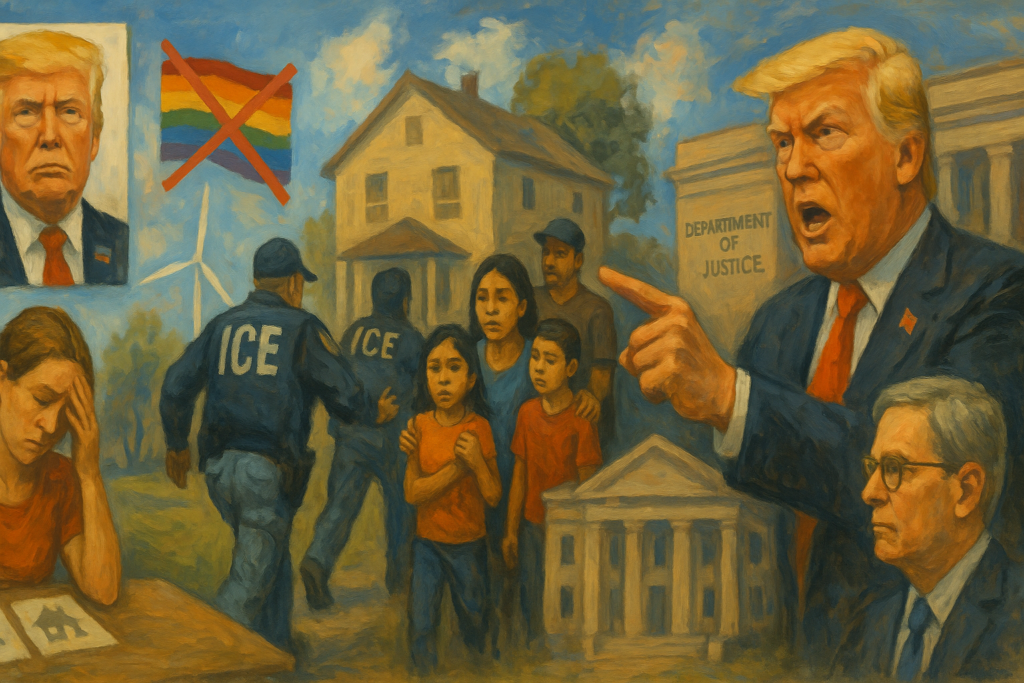
Over the weekend, the backdrop to these confrontations came into clearer view. Earlier decisions that now define the administration’s second-term baseline continued to bite: executive orders had rolled back LGBTQ protections, cutting federal support for gender-affirming care and recognition on passports. Renewable energy projects and home-efficiency incentives were blocked, and a major low-income energy assistance program was slashed, narrowing the cushion for households facing high utility costs. Federal housing policy had been redirected away from permanent supportive housing toward temporary shelters, a shift that local officials warned would push tens of thousands closer to homelessness. These structural changes set the social and economic floor on which the week’s enforcement campaigns would play out.
Minnesota emerged over the weekend as an early testbed for how far federal immigration power would reach into state and local governance. The Justice Department opened or advanced investigations into Governor Tim Walz and Minneapolis Mayor Jacob Frey, accusing them of impeding immigration enforcement. Thousands of federal agents were deployed in the state, and reports described aggressive ICE tactics, racial profiling, and a fatal shooting that would dominate the week’s debates. DOJ signaled that it would treat local resistance not as a policy disagreement but as potential criminal conspiracy, testing the balance between national authority and local autonomy.
Elsewhere, institutions and activists prepared for looming fights over elections and information. Advocacy groups mobilized around an impending Supreme Court decision expected to reshape election law, warning that new “integrity” rules could narrow voting access. In North Carolina, a newly Republican-controlled elections board readied for a key meeting amid concerns about how it might wield its powers, while organizers planned a “Long March” to protest racial gerrymandering and defend Black voting strength. On the information front, the White House warned CBS to air a Trump interview unedited or face legal action, leveraging a prior settlement to pressure editorial choices. Trump dismissed a poll showing minimal support for acquiring Greenland as fake, even as European leaders began signaling they would resist U.S. tariff threats tied to his Greenland rhetoric and consider countermeasures. These moves previewed the week’s twin themes: hard-edged enforcement at home and pressure on independent sources of information.
By Monday, the Minnesota confrontation had sharpened into a direct clash over accountability. Deputy Attorney General Todd Blanche announced that the Justice Department would not investigate the January 7 shooting of Renee Good by an ICE officer in Minneapolis, despite video and forensic evidence that undercut claims of self-defense. The decision stood in stark contrast to DOJ’s 2020 response to George Floyd’s killing and triggered resignations among federal prosecutors. Minnesota officials and civil rights advocates condemned the refusal as politicized non-enforcement, reading it as a signal that federal agents would be shielded from scrutiny even in lethal-force cases.
At the same time, immigration enforcement in Minnesota strained due process and protest rights. As ICE operations intensified, attorneys reported being physically blocked from seeing clients arrested in Minneapolis, raising alarms about access to counsel. DOJ opened an investigation into protesters who had disrupted services at a church pastored by a local ICE official, framing the action as a civil-rights violation against worshippers. Together with the non-investigation of the Good shooting, these moves suggested a hierarchy of rights in which institutional protection and enforcement priorities outweighed both legal safeguards for detainees and the right to protest officials’ dual roles.
Monday also exposed weaknesses in federal transparency. Congressional deadlines for releasing investigative files on Jeffrey Epstein passed with millions of documents still unreleased. Lawmakers accused DOJ of asserting privileges beyond what the statute allowed and of missing reporting requirements. When they sought a special master through the Ghislaine Maxwell case to enforce compliance, a federal judge declined, leaving enforcement in DOJ’s hands. The episode underscored how, in politically sensitive matters, the Justice Department’s willingness to comply with oversight can determine whether transparency laws have real force.
On the economic and social front, Representative Rashida Tlaib prepared legislation to curb subsidies and tax advantages for billionaire oligarchs and redirect resources toward public needs, highlighting a countervailing push against concentrated wealth. Localities continued to fight Trump administration changes that redirected federal housing vouchers from permanent housing to short-term shelters. Courts had begun to block aspects of the shift, but the policy still threatened to displace tens of thousands, illustrating how federal choices about subsidies and program design can either entrench oligarchic power or support basic stability for vulnerable people.
Tuesday marked a hinge point as the administration consolidated emergency powers and reoriented federal law enforcement. On his first day back in office, Trump had declared a national emergency at the southern border, reinstated “Remain in Mexico,” deployed troops, and used the Alien Enemies Act to deport Venezuelans to a mega-jail in El Salvador. By the end of the year, the administration claimed over 622,000 deportations and 1.9 million self-deportations. This week’s events showed how that emergency framing had become a standing tool, normalizing extraordinary measures—troops, mass removals, and detention regimes—as part of ordinary governance.
In parallel, Trump moved to weaken internal checks. He rapidly dismissed 17 inspectors general across the federal government, despite legal objections, and had already removed numerous career DOJ lawyers associated with earlier investigations of him. In Virginia, an interim U.S. attorney appointment that bypassed normal procedures would soon be forced out by judges, but for now the pattern was clear: experienced prosecutors and watchdogs were being replaced or sidelined in favor of loyalists. These changes hollowed out the internal oversight mechanisms that typically guard against abuse of power.
Trump also crossed a line that previous presidents had largely observed: he ordered the Justice Department to investigate specific named individuals, including whistleblower Miles Taylor, former cybersecurity chief Chris Krebs, former FBI director James Comey, New York Attorney General Letitia James, and Federal Reserve Chair Jerome Powell. All had, in different ways, challenged Trump or his policies. Directing prosecutors at such critics blurred the distinction between neutral law enforcement and personal retribution, and foreshadowed later threats against DOJ officials and law firms.
On the ground in Minnesota, the immigration crackdown escalated into what residents described as a federal enforcement zone. DHS and ICE surged roughly 3,000 agents into the state, conducting door-knocking operations, engaging in racial profiling, and making aggressive arrests that disrupted daily life. Local unions, faith groups, and community leaders organized an economic blackout in response, signaling a shift from symbolic protest to economic noncooperation. The administration, in turn, opened a criminal investigation into Governor Walz and Mayor Frey for allegedly conspiring to impede ICE. A leaked ICE memo, dated earlier, claimed agents could enter homes based on internal removal forms rather than judge-signed warrants, hinting at a reinterpretation of Fourth Amendment limits that would become explicit later in the week.
Tuesday also saw the administration extend cultural battles into the machinery of government and higher education. Trump signed an order eliminating federal diversity, equity, and inclusion programs and declaring there are only two sexes in government policy, while ordering DEI programs in federal agencies dismantled. A separate order, framed as ending “government censorship,” froze billions in federal funding for universities and targeted law firms representing perceived enemies, threatening contracts and security clearances. These moves used funding and contracting power to enforce ideological lines on gender and race, narrowing space for independent institutions and chilling legal advocacy.
Economic policy mixed populist gestures with harder edges. Trump issued an executive order directing agencies to curb large institutional investors from buying single-family homes, a nod to popular frustration with Wall Street landlords. At the same time, he used the International Emergency Economic Powers Act to impose a 10 percent tax on imports and additional tariffs on about 90 countries, measures presented as protecting American workers but associated with manufacturing job losses. ICE halted payments for detainee medical care after a Veterans Affairs processing agreement ended, leaving providers unpaid and detainees at risk, illustrating how budget and contracting decisions can translate into life-or-death conditions in detention.
The courts, meanwhile, heard cases that would shape the boundaries of rights and executive power. The Supreme Court took up a challenge to Hawaii’s rule that guns are banned on most private property open to the public unless owners opt in, testing how far Second Amendment protections extend into commercial spaces. In another case, the Court examined Trump’s attempt to remove Federal Reserve Governor Lisa Cook over contested allegations, probing how insulated the central bank should be from presidential firing power. These arguments underscored that even as the executive branch expanded its reach, judicial decisions would still define key limits.
By Wednesday, the leaked ICE memo’s implications were visible on the streets. An internal document surfaced authorizing agents to forcibly enter homes based on administrative removal forms rather than judge-signed warrants, contradicting prior training on Fourth Amendment standards. In Minnesota, agents detained five-year-old Liam Ramos and his father, reportedly using the child to knock on doors and see who was inside, and swept up multiple other students near schools. Trump publicly labeled Minnesota protesters “agitators and insurrectionists” and singled out Governor Walz and Representative Ilhan Omar as corrupt. Authorizing home entries without judicial warrants and using children in operations pushed immigration enforcement toward tactics more associated with paramilitary policing than civil law enforcement.
The week’s second major thread—information control—also advanced on Wednesday. A Justice Department filing revealed that staffers at the Department of Government Efficiency had secretly signed a data-sharing agreement to give Social Security information to a political advocacy group hunting for voter fraud, without the Social Security Administration’s knowledge. Another staffer sought Florida voter registration data for cross-checking, and a third later boasted at a rally that millions of non-citizens were registered—claims that were false and produced no prosecutions. The episode showed how confidential government data could be repurposed to feed partisan narratives about election illegitimacy, undermining privacy and laying the groundwork for restrictive voting measures.
There were still pockets of judicial pushback. Lindsey Halligan, a Trump-appointed interim U.S. attorney in Virginia with no prosecutorial experience, left her post after judges ruled her appointment unlawful and ordered her to stop presenting herself as U.S. attorney. Her predecessor had been pushed out for not charging political targets. The ruling underscored that, even in a politicized environment, courts could enforce appointment rules and limit efforts to capture prosecutorial offices for partisan ends. In the electoral arena, the California Republican Party asked the Supreme Court to block a voter-approved congressional map it said used race illegally and could shift several House seats to Democrats, while in New York a state judge ordered the redrawing of the 11th congressional district after finding that the current map diluted Black and Latino voting power. Both cases highlighted how control over maps—and racial representation—remains central to the struggle for congressional power.
Information manipulation from the top continued. Trump reposted long-debunked claims about Dominion voting machines and foreign interference in the 2020 election, even as lawyers who had advanced those theories lost their licenses. The Supreme Court’s grant of broad immunity for him contrasted with Brazil’s treatment of Jair Bolsonaro, who faced legal consequences for similar conduct. In parallel, the White House posted an altered image of Minnesota activist Nekima Levy Armstrong, changing her expression and darkening her skin. The image raised concerns about racial prejudice in her case and about the use of AI tools to shape public perception of protest leaders, linking the administration’s immigration crackdown to its broader efforts to control narratives.
Thursday brought a dense cluster of developments that extended both the enforcement campaign and the information struggle. In Washington, the House passed a Homeland Security funding bill that preserved ICE’s $10 billion budget, modestly reduced enforcement operations, and added money for body cameras. Despite Democratic concerns about abuses, the core funding for ICE remained intact. In a separate vote, the House rejected a resolution that would have barred Trump from deploying or keeping troops in Venezuela, after GOP leaders held the vote open to secure a decisive vote against the measure. By maintaining ICE’s resources and declining to assert war powers, Congress left key elements of Trump’s enforcement and foreign policy largely unchecked.
On the ground, ICE enforcement spread beyond Minnesota. “Operation Catch of the Day” launched in Maine, arresting over 100 people in days and focusing on Somali and African communities, including individuals with valid work authorization. In New Haven, Connecticut, fear of deportation and easier ICE access to schools disrupted education for immigrant students, prompting the school district to require legal verification before allowing agents inside. Local officials in both states criticized the lack of transparency and racial profiling. These operations showed how aggressive enforcement, once concentrated at the border or in a single state, could quickly extend into new regions and into spaces like schools, directly affecting children’s access to education and community trust.
At the same time, DHS announced it would end Temporary Protected Status for more than 500,000 Venezuelans, arguing that the capture of Nicolás Maduro made it safe for them to return. The decision threatened to uproot hundreds of thousands of people with deep ties to the United States. That same day, Trump called for the impeachment of Judge James Boasberg after Boasberg blocked deportations of Venezuelan migrants to a notorious prison in El Salvador, labeling the judge a “radical left lunatic.” The attack fueled threats against the judiciary and underscored how migrant protections and judicial independence were being contested together.
Back in Minnesota, the line between protecting worship and punishing dissent blurred further. Following a protest at a church where an ICE field director serves as pastor, federal authorities arrested organizers Nekima Levy Armstrong, Chauntyll Louisa Allen, and William Kelly on conspiracy charges. DOJ filed criminal complaints against seven protesters and sought to charge journalist Don Lemon for his coverage, but a magistrate judge refused to sign the warrant. Attorney General Pam Bondi was reportedly angered, and DOJ signaled it might pursue a grand jury route. The magistrate’s refusal was a rare instance of judicial resistance in a week otherwise marked by aggressive prosecutions.
The administration’s information tactics came under sharper scrutiny. The White House’s altered images of Levy Armstrong—showing her crying hysterically and with darkened skin—drew criticism from journalists and legal experts, who warned they could prejudice jurors and mislead the public. Trump expanded his defamation suit against the New York Times to include a recent poll he claimed was biased, and he continued to rail against “fake” polling and media. Combined with earlier threats against CBS, these actions formed a pattern of using legal and digital tools to intimidate critical outlets and reshape narratives around protests and elections.
Cultural and health policy also shifted under ideological pressure. The administration expanded the Mexico City policy so that foreign aid recipients could not fund DEI initiatives or what it called “gender ideology,” affecting roughly $30 billion in assistance. Domestically, executive orders restricting DEI pushed organizations like the American College of Obstetricians and Gynecologists to reject federal funding rather than compromise their equity work, and hospitals halted pediatric gender-affirming care under political pressure and settlements. In health coverage, medical and advocacy groups warned that the One Big Beautiful Bill Act’s Medicaid and ACA cuts would leave about 10 million people uninsured and destabilize hospitals, especially in rural areas. The CDC stopped recommending Covid vaccines for pregnant women, a move criticized by ACOG as not grounded in robust evidence, and moved to block “never use alone” messaging in overdose prevention campaigns under an executive order against “crime and disorder.” These shifts weakened evidence-based public health guidance and reduced access to care, with disproportionate impact on low-income, pregnant, and substance-using populations.
Even as ICE’s internal memo on warrant standards was being implemented in Minnesota and Maine, it drew attention in Washington. The leaked document, asserting that agents could enter homes without judge-signed warrants by relying on internal paperwork, prompted Senator Richard Blumenthal to call it a Fourth Amendment violation and demand details on training and usage. His letter underscored that ICE’s reinterpretation of warrant rules was not just a technical policy tweak but a potential constitutional breach, and showed how congressional oversight could at least spotlight such shifts even if it could not immediately reverse them.
Friday shifted the focus outward, offering a case study in how foreign policy theatrics can trigger real economic consequences and then be moderated by markets and allies. Trump threatened 10 percent tariffs on European countries that opposed his plan to seize Greenland and floated potential military action, prompting EU leaders to consider using their Anti-Coercion Instrument and to refuse ratification of a new trade deal. Financial markets reacted with stock selloffs, a weaker dollar, and rising Treasury yields. After meeting NATO’s secretary general, Trump backed down from military and tariff threats, instead announcing a supposed “deal” for U.S. military access and mineral rights in Greenland. Markets stabilized, illustrating how financial pressure and allied resistance can sometimes constrain executive brinkmanship, even when formal checks are weak.
Economic governance at home raised its own questions about power and profit. Trump signed an executive order easing SEC oversight of cryptocurrencies and, with Congress, enacted the Genius Act to set a light-touch framework for stablecoins. Both moves aligned with the interests of his family’s firm, World Liberty Financial, which holds large crypto stakes. He then pardoned Binance founder Changpeng Zhao after Zhao’s anti–money laundering conviction and a $2 billion investment deal with Trump’s business. Lawmakers demanded investigations into the diversion of more than 25,000 agents from white-collar crime to immigration enforcement, warning that financial crimes were going unpoliced. The combination of deregulation, a high-profile pardon, and resource shifts away from financial enforcement blurred the line between public policy and private gain.
Civil society responded to the week’s enforcement campaigns with escalated noncooperation. Grassroots groups organized nationwide “Free America Walkouts” and economic blackouts, with particular intensity in Minnesota, to protest what they described as authoritarian policies and immigration abuses. Trainings by racial justice organizations aimed to help communities document enforcement actions and support those targeted. These actions built on earlier Women’s March calls for a national walkout and signaled a move from symbolic protest to sustained disruption, testing how resilient institutions and supply chains are to coordinated civic resistance.
The battle over election truth continued despite formal oversight. Former special counsel Jack Smith testified again before Congress, reiterating that he had proof beyond a reasonable doubt of Trump’s criminal conduct around the 2020 election, even though those cases were dropped after Trump’s reelection. Republican members focused on discrediting him rather than engaging the evidence. Meanwhile, Trump continued to promote conspiracy theories about the election and attacked polls and media as fraudulent, reinforcing a narrative of victimhood despite broad legal immunity. The persistence of these claims, even in the face of detailed testimony, kept public trust in electoral outcomes fragile.
Amid the upheaval, some quieter developments showed that not all governance was consumed by conflict. Three bipartisan veterans’ bills became law, expanding housing support, improving VA budget accountability, and enhancing services. Health insurance executives testified about rising healthcare costs, with one major insurer pledging to rebate ACA plan profits. Agencies like FDA, EPA, CDC, and FCC continued technical rulemaking on drugs, environmental standards, data collection, and communications. These routine actions illustrated that much of government still operates in the background, even as headline institutions are politicized.
Taken together, the week offered a stark picture of federal power surging across multiple fronts: immigration treated as a permanent emergency, legal tools aimed at critics and shielded allies, and information channels bent through doctored images, data misuse, and attacks on independent media. Yet it also showed that institutions are not monolithic. Judges blocked an unlawful U.S. attorney appointment and refused charges against a journalist; a senator challenged ICE’s warrantless-entry memo; local school districts set limits on agents’ access; and civil society organized walkouts and documentation efforts. The contest over democracy this week was not only about who holds office, but about how law is used, whose stories are believed, and whether constitutional and civic norms can withstand sustained pressure from the executive branch.