This week’s throughlines
- The Epstein files fight widened from noncompliance into a broader credibility crisis — What began as a missed legal deadline and heavily redacted release turned into a multi-day dispute over missing files, selective disclosures, restored records, congressional threats, and the Justice Department's claim that more than a million additional documents had surfaced.
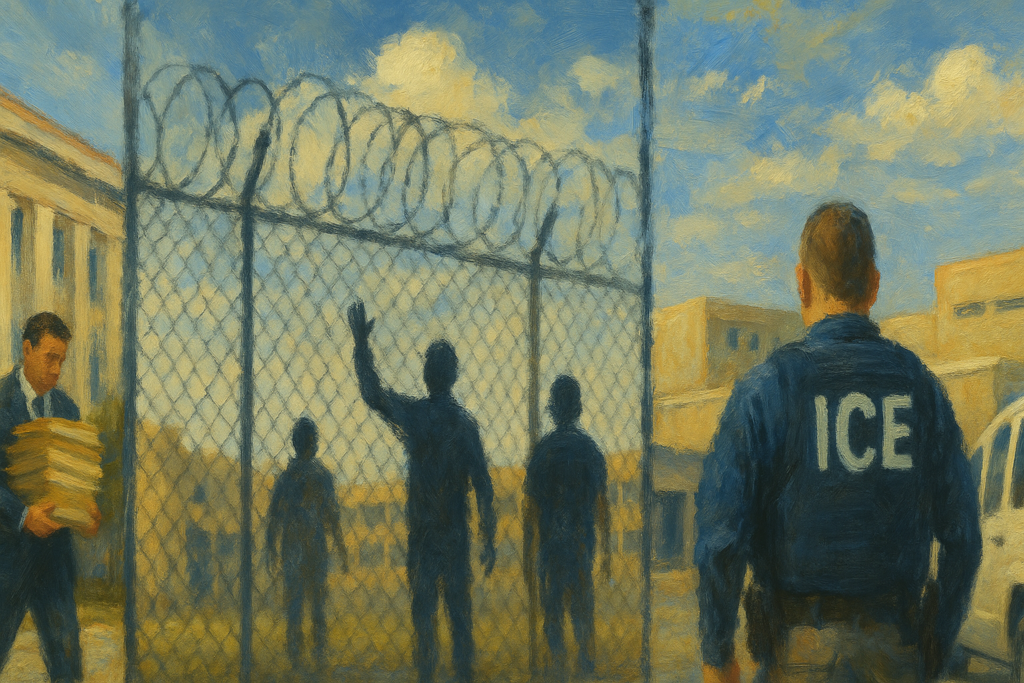
- Immigration enforcement moved from aggressive practice to larger-scale infrastructure and propaganda — The week connected individual detention and deportation cases to a much larger enforcement buildout, including new detention capacity, threats to states, court fights over removals, and official holiday messaging that treated deportation as spectacle.
- Courts repeatedly checked executive overreach — Judges and the Supreme Court imposed several limits on the administration, including on National Guard deployment, immigration detention and deportation practices, coercive funding threats to states, and Justice Department misconduct in a separate prosecution.
- Pressure on public information and independent media continued — The administration and aligned institutions kept attacking or constraining information channels through anti-press rhetoric, a pulled television investigation, politicized Justice Department communications, and broader manipulation of public records.
- Executive policy shifts kept narrowing rights and state autonomy — Beyond immigration, the administration used federal power to block state climate policy, cut clean-energy support, end abortion services for veterans, and continue shrinking the federal workforce and regulatory state.
The week opened with two intertwined tests of American institutions: whether the Justice Department would obey a new law requiring transparency about Jeffrey Epstein’s crimes and connections, and how far the administration would go in hardening immigration enforcement. Around those pillars, the government moved to dismantle clean‑energy policy, shrink the civil service, and personalize state symbols, while courts and civil society tried to draw lines around executive power.
Over the weekend, the administration took a series of sweeping steps to redirect federal energy policy away from renewables. Officials canceled $679 million in offshore wind funding, including a major terminal in California, and terminated a $7 billion solar program meant to help low‑income communities. At the same time, Washington moved to block California’s planned 2030 ban on new gas‑powered cars, undercutting a state that has often set de facto national standards on air quality and vehicle emissions. These decisions signaled a broader shift toward fossil fuel interests and away from state‑level climate leadership, foreshadowing later moves to sideline climate science itself.
The first days of the Epstein files saga also unfolded over the weekend. Under the new Epstein Files Transparency Act, the Department of Justice (DOJ) was required to release a broad set of records about Epstein’s activities and the government’s handling of his case by a fixed deadline. Instead, DOJ began with a partial, heavily redacted batch. The initial release prominently featured photos of Bill Clinton with Epstein and Ghislaine Maxwell, while comparable material involving Donald Trump was absent. Observers quickly noted that only a fraction of the mandated records had been posted, and the pattern of what appeared and what did not raised questions about whether the department was curating disclosures to shape public perception rather than simply complying with the law.
By Sunday, those doubts deepened. At least 16 Epstein‑related files disappeared from DOJ’s public site, including a photo of Trump with Epstein and Maxwell. Some files were later restored after internal review, but the department offered no clear explanation for the removals. At the same time, reporting surfaced that the FBI had ignored a 1996 report about Epstein’s abuse, suggesting that failures in handling evidence stretched back decades. The combination of unexplained takedowns and long‑standing investigative gaps fed a sense that the justice system had not treated this case with the rigor applied to ordinary defendants.
Immigration policy also came into view over the weekend, both in official directives and public reaction. A public art project in Los Angeles projected portraits and stories of people affected by Immigration and Customs Enforcement (ICE) raids onto buildings, highlighting fear and civil‑liberties concerns in immigrant communities. Reporting described a directive authorizing attacks on small Venezuelan boats tied to cartels and the case of an asylum seeker held for months in poor conditions despite no criminal record. These stories previewed a week in which immigration enforcement would become more expansive and more visible, even as resistance grew.
Other weekend developments sketched the broader political climate. Former special counsel Jack Smith testified behind closed doors to the House Judiciary Committee that he had proof beyond a reasonable doubt of Trump’s criminal scheme to overturn the 2020 election. Smith asked that his testimony be released, but committee leaders refused, setting up a fight over how much the public will learn about efforts to subvert the last presidential election. At Turning Point USA’s AmericaFest, Vice President J.D. Vance declared that the United States is a Christian nation, drawing applause despite the Constitution’s ban on religious establishment and underscoring a growing embrace of religious identity as a political organizing principle. Trump, for his part, delivered an economic speech laced with false claims and posted online suggesting filmmaker Rob Reiner’s death was tied to his opposition to Trump, continuing a pattern of conspiratorial messaging.
By Monday, the administration’s immigration strategy moved from hints to structure. Officials announced a $170 billion plan to expand immigration enforcement starting in January 2026. The plan included new detention facilities, workplace raids, and deportation processing infrastructure. ICE data showed detention already at record highs, with more than 68,000 people held, many without criminal records. Plans for warehouse‑style facilities and aggressive deportation targets suggested a long‑term, highly coercive model that would be difficult for future administrations to unwind, reshaping the balance between security and liberty for non‑citizens and the communities around them.
Courts, however, began to draw limits on how far the executive could go in using military and financial tools to enforce its immigration agenda. On Monday, the Supreme Court and lower courts ruled against Trump’s attempts to deploy National Guard troops for immigration enforcement in Illinois and to slash homeland security grants to states that resisted his policies. Judges found that the administration lacked authority for these moves and criticized the practice of tying security funding to immigration compliance. These decisions preserved elements of federalism and civil‑military norms by reinforcing that troops and grants could not simply be wielded as levers to coerce state policy.
The Epstein files controversy escalated in Congress the same day. Senate leader Chuck Schumer announced a resolution to authorize a lawsuit against DOJ for failing to fully release the files as required by law. House Democrats accused the department of violating federal statutes, and Republican Representative Thomas Massie later argued that some redactions were illegal. Former President Bill Clinton publicly demanded full disclosure. The law was clear: DOJ was supposed to release a broad set of records by a specific deadline. The department’s partial, opaque compliance prompted lawmakers from both parties to consider litigation and contempt as tools to enforce their own transparency statute.
Monday also brought other shifts in rights and governance. The Department of Veterans Affairs ended abortion and abortion counseling services and allowed staff to opt out of care on moral or religious grounds. A broader administration ban followed, prohibiting VA abortions even in cases of rape or incest and reversing a Biden‑era policy. Given that the VA serves nearly 10 million veterans, many in states with restrictive abortion laws, the change embedded contested moral views into a nationwide federal health system and sharply curtailed reproductive options for veterans. Separately, ProPublica reported that Deputy Attorney General Todd Blanche held significant cryptocurrency investments while ending investigations into crypto companies, raising conflict‑of‑interest questions at the top of DOJ. A federal judge ordered the administration to return 137 Venezuelan men deported to El Salvador’s CECOT megaprison or allow them to challenge their removals in U.S. courts, finding the deportations illegal. CBS News leadership, meanwhile, pulled a fully vetted 60 Minutes investigation into those deportations, prompting accusations of political interference and soft censorship. The administration announced it would resume garnishing wages of borrowers in default on federal student loans, up to 15 percent of after‑tax income, even as it celebrated cuts to federal employment. And under new leadership, the FBI redirected resources away from investigating far‑right extremist groups such as the neo‑Nazi organization known as the Base, raising alarms about uneven enforcement against domestic threats. In the cultural sphere, a Trump‑appointed board voted to rename the Kennedy Center the “Trump‑Kennedy Center,” prompting a lawsuit from Representative Joyce Beatty, who argued that congressional approval is required to alter a federally designated memorial and that she was muted during the vote. The move highlighted the personalization of national institutions in the president’s image.
On Tuesday, the Supreme Court made its stance on domestic troop deployments more explicit. In Trump v. Illinois, the Court denied the federal government’s request for a stay, leaving in place lower‑court rulings that blocked Trump’s attempt to send National Guard troops to Chicago for immigration enforcement. Three justices dissented, but the majority reinforced earlier findings that the administration had not met legal thresholds for using military forces in this domestic context. Even a Court often sympathetic to executive power signaled that statutory and constitutional limits on deploying troops inside the country still applied.
The Epstein releases continued in confusing, contested batches. DOJ posted additional files, including references to Trump’s flights on Epstein’s plane and a subpoena to Mar‑a‑Lago, while warning that some claims in the documents were unverified or false. The department publicly declared a purported Epstein letter to disgraced doctor Larry Nassar a fake. Survivors and lawmakers criticized the slow pace and heavy redactions, noting that only about 10,000 documents had been released out of hundreds of thousands required. The gap between what the law demanded and what DOJ had actually produced kept the focus on institutional compliance rather than the salacious details of individual documents.
The information environment around these conflicts grew more hostile. The Freedom of the Press Foundation reported 170 assaults on journalists in 2025, nearly matching the previous three years combined. Most attacks occurred during protests against Trump’s immigration policies. The group linked the rise to both increased protest coverage and hostile rhetoric from Trump and other leaders, which had fostered public animosity toward reporters. At the same time, reports would later show that the Trump White House had seized control of DOJ’s social media accounts, using them to insult reporters and engage in unprofessional exchanges, further blurring the line between an ostensibly independent law enforcement agency and the president’s political messaging operation.
Congress, meanwhile, took a step to bolster the civil service. The House passed a bill to restore collective bargaining rights for more than a million federal employees, reversing Trump executive orders that had stripped those protections. Unions had described the orders as the largest attack on federal unions in U.S. history. Restoring bargaining rights was framed as a way to strengthen worker voice inside the civil service and push back against efforts to politicize or weaken the federal workforce. Elsewhere, Trump announced plans at Mar‑a‑Lago for two new “Trump‑class” battleships, expected to have nuclear capabilities, emphasizing his personal role in their design. Branding major weapons systems after a sitting leader underscored the week’s theme of personalizing state institutions. Regulatory agencies quietly advanced technical rules on synthetic opioids, medical devices, and spectrum auctions, while European policymakers debated more protectionist responses to Chinese high‑tech exports, shaping the economic and security backdrop to the week’s more visible conflicts.
On Wednesday, Christmas Eve, the Epstein transparency fight reached a new stage. DOJ admitted it had uncovered roughly a million additional Epstein‑related documents from the Southern District of New York and the FBI, saying it needed weeks to review and redact them. This admission came after the department had already missed the December 19 deadline set by the transparency act and as lawmakers threatened contempt hearings. The late discovery of such a large archive reinforced fears that, even under explicit statutory orders, the justice system could not or would not fully expose elite wrongdoing.
Immigration enforcement and rhetoric hardened in parallel. The official White House account posted a meme urging migrants to “self‑deport before Christmas,” which ICE amplified. Framed as a joke, the message came as ICE pursued record‑level detentions and deportations and as individual cases highlighted family separation and harsh conditions. Using official channels to ridicule migrants normalized cruelty in both policy and public discourse, making it easier to justify rights‑eroding enforcement. In the courts, Federal Judge Mary McElroy blocked the administration’s effort to cut more than $230 million in homeland security funding from states and the District of Columbia that did not align with its immigration priorities, calling the move an abuse of grant administration. The ruling limited the executive’s ability to weaponize federal grants against jurisdictions with different policy choices, preserving some space for local autonomy.
Civil society began organizing a more coordinated response. Activists from the 50501 Movement and the Women’s March promoted a nationwide “Free America Walkout” for January 20, 2026, urging people to leave workplaces, schools, and homes to protest what they described as authoritarian practices. The action was framed as a visible refusal to normalize current governance and sought local hosts across the country, testing whether nonviolent mass action could serve as a counterweight when formal checks on power seemed strained.
Environmental policy remained a central front. Building on the weekend’s cancellations, the Interior Department suspended five offshore wind projects, citing national security concerns and even referencing the long‑defunct “Department of War.” A federal judge had recently called a related suspension “arbitrary and capricious,” and critics saw the new move as another attempt to stall clean‑energy infrastructure under a thin legal pretext. Invoking vague security claims to halt major infrastructure projects undermined predictable, rule‑based governance and slowed the transition away from fossil fuels. Reports also revealed that the Trump White House had taken control of DOJ’s social media, using it to insult reporters, tying the administration’s information strategy directly to an agency that is supposed to maintain a measure of independence.
On Thursday, Christmas Day, the president’s public messaging fused hardline immigration policy with personalized attacks and conspiracy theories. Trump boosted ICE social media posts celebrating deportations, framing them as a kind of holiday achievement. He then publicly called for the prosecution of former President Barack Obama without presenting evidence, extending his pattern of using criminal accusations against political rivals. Later, he shared a video from Roseanne Barr claiming that COVID‑19 was deliberately unleashed to enable Democrats to steal the 2020 election through mail‑in voting, echoing QAnon‑style narratives despite years of evidence about the pandemic’s origins and the integrity of the 2020 vote. When a sitting president amplifies fringe conspiracy theories about elections and public health, it further erodes trust in both democratic processes and scientific institutions.
The Epstein story did not pause for the holiday. DOJ acknowledged that about 1.2 million Epstein‑related documents had never been reviewed, after media reports revealed their existence in old emails. Coming on top of missed deadlines, partial releases, and unexplained file removals, the revelation suggested systemic failures in how the justice system handles crimes tied to powerful figures. The backlog fueled the perception that elite impunity was not just a matter of individual decisions but of institutional design and priorities.
By Friday, the week’s themes converged into broader structural moves. Reporting detailed how the administration had fired federal scientists, removed public climate data, backed fossil fuels over renewables, and sought to block solar and wind farms despite broad public opposition. These steps built on earlier cancellations of wind and solar funding and the suspension of offshore wind projects, amounting to a systematic rollback of evidence‑based environmental policy. In the longer history of U.S. climate policy, where federal action has often lagged and states like California have tried to lead, this represented a deliberate effort to reverse course and make future policy corrections more difficult.
The administration also celebrated shrinking the civil service. Trump publicly boasted of eliminating hundreds of thousands of federal jobs in areas such as emergency management, data collection, and public health. The cuts coincided with rising unemployment and higher national debt, raising questions about the stewardship of public resources. A smaller, more politicized civil service weakens the state’s ability to deliver basic services and respond to crises, shifting power toward political appointees and private contractors and making it harder for neutral expertise to shape policy.
Despite court setbacks, the president continued to use the National Guard as a visible instrument of domestic policy. Thousands of Guard troops were deployed to cities including Chicago, Los Angeles, Memphis, New Orleans, and Washington, D.C., ostensibly for immigration enforcement. Courts had restricted their role largely to guarding federal property, but the military presence in Democratic‑led cities sparked protests and concerns about the politicized use of security forces. Even when their formal powers were limited, the troops served as a backdrop to the administration’s immigration agenda, raising questions about the normalization of military involvement in civilian governance.
Finally, a federal judge rebuked DOJ over its conduct in another politically charged case. In litigation stemming from the failed prosecution of former FBI Director James Comey, the judge ruled that DOJ had unlawfully seized attorney‑client communications and ordered the materials returned. The department missed the deadline and sought more time, citing staffing shortages. Coming in the same week as conflict‑of‑interest allegations involving senior DOJ leadership and the Epstein transparency crisis, the ruling further undermined confidence in the department’s competence and impartiality when handling high‑profile figures.
Taken together, the week’s events showed institutions straining under the weight of concentrated executive power and contested facts. Congress and the courts did at times enforce legal limits—blocking certain National Guard deployments, halting funding punishments, moving to restore federal workers’ bargaining rights, and pressing for compliance with transparency laws. Civil society organized protests and walkouts, and journalists continued to report despite rising violence and official hostility. Yet the administration’s ability to harden immigration enforcement, roll back environmental protections, personalize state symbols, and flood the public sphere with disinformation underscored how much depends on the day‑to‑day choices of those in power, and how fragile democratic norms can be when law, information, and institutional capacity are all under pressure at once.