This week’s throughlines
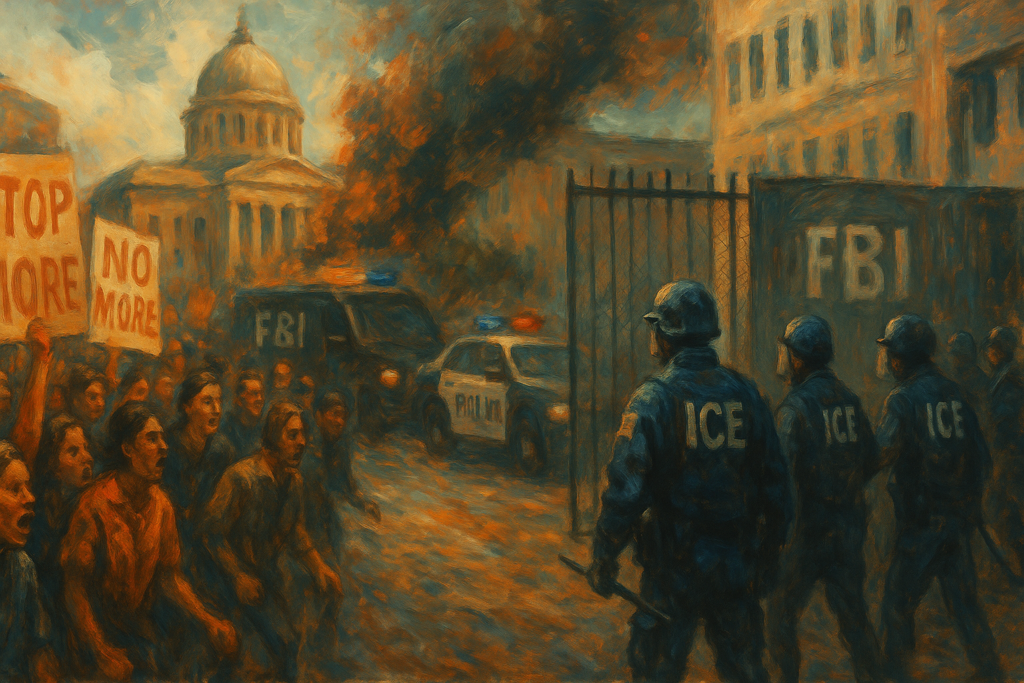
- Minnesota escalated from enforcement operation to national constitutional conflict — What began as a large federal immigration sweep became a broader clash over lethal force, protest rights, state authority, and the possibility of emergency powers being used against a state.
- The administration worked to control both the investigation and the public story around the ICE killing — Federal authorities excluded state investigators, declined a civil-rights inquiry, selectively released evidence, and used public messaging to defend the shooting and discredit critics.
- Courts and states became the main sites of resistance — Minnesota, Illinois, the ACLU, immigrant-rights groups, and several judges moved to challenge federal enforcement tactics, secrecy, retaliation, and overreach.
- Pressure spread beyond immigration to independent institutions and the press — The week also brought threats and investigations aimed at the Federal Reserve, raids on a reporter, and new efforts to bring military media under tighter executive control.
- Executive power abroad remained tied to weak oversight at home — The Venezuela operation and oil-revenue moves continued through the week, while Congress struggled to reassert war powers and transparency requirements.
The week opened with a clash between federal power and local communities that would shape every day that followed. A massive immigration enforcement surge in Minnesota, the killing of a U.S. citizen by an ICE agent, and the government’s rapid move to control the story set off protests, lawsuits, and a broader struggle over who gets to define the law and the truth.
Over the weekend, Homeland Security sent roughly 2,000 agents into the Minneapolis–St. Paul area under “Operation Metro Surge.” Agents conducted door-to-door raids at businesses and in residential neighborhoods, appearing at workplaces, apartment complexes, and even near schools and churches. In the middle of this operation, ICE agent Jonathan Ross shot and killed Renee Good, a U.S. citizen, in Minneapolis. Federal officials quickly claimed Ross had acted in self-defense, but video and eyewitness accounts painted a more complicated picture, showing Good apparently trying to comply when shots were fired. The killing came amid a record pace of deaths in ICE custody and other recent shootings by federal agents, and it immediately became a national flashpoint.
As images and accounts of the shooting spread, protests erupted across the country. Under the banner “ICE Out For Good,” more than a thousand protests, vigils, and marches took place over the weekend, with the largest in Minnesota and Portland. Families described relatives taken in raids without notice, children coming home to empty apartments, and neighborhoods where residents were afraid to go to work or school. Polling showed a plurality of Americans now supported abolishing ICE altogether, and Latino focus groups, including some former Trump voters, voiced regret over backing an administration whose tactics they now saw as cruel and destabilizing.
At the same time, the federal government moved quickly to limit outside scrutiny. Homeland Security Secretary Kristi Noem implemented a policy restricting congressional visits to ICE facilities, and Minnesota representatives were blocked from entering a detention center despite a court ruling that should have allowed access. The FBI took over the investigation into Good’s killing almost immediately, removed Minnesota’s Bureau of Criminal Apprehension from the case, and limited local prosecutors’ access to evidence. Reports indicated that agents left the scene in ways that departed from standard protocol and that required body-camera footage had not been released. The White House publicly defended Ross and described Good as a threat, even as the available video raised doubts. Minnesota’s attorney general and Minneapolis’s mayor protested their exclusion, warning that any findings would lack public credibility if state investigators were kept out.
State and local officials began to push back. Over the weekend, Oregon’s attorney general opened an investigation into federal agents who had shot two undocumented immigrants in Portland, and Minnesota’s attorney general, along with the Hennepin County prosecutor, announced a state probe into Good’s killing. They explicitly challenged claims that federal officers enjoyed “absolute immunity” from state law, arguing that no one should be above basic standards governing the use of lethal force. Minneapolis’s mayor urged the FBI to include state investigators and criticized the administration for labeling Good a terrorist without evidence, framing the issue as one of both justice and public trust.
Even as the confrontation in Minnesota escalated, the president used other levers of federal power against the state. Trump announced he was withholding $129 billion in federal funding from Minnesota, citing alleged child-care fraud, shortly after a judge had blocked a separate attempt to cut antipoverty funding. In foreign policy, he signed an executive order declaring a national emergency over Venezuelan oil revenue, blocking repayments and consolidating executive control over seized assets with little congressional involvement. These moves blurred the line between national policy and domestic punishment, signaling that a state challenging federal tactics could face both security crackdowns and financial retaliation.
By Monday, the legal fight over Operation Metro Surge had moved into federal court. Minnesota’s attorney general filed suit against the Trump administration and DHS to halt the surge, alleging excessive and lethal force, warrantless arrests, and the targeting of courts, churches, and schools in violation of administrative law and the Constitution. Cities in Minnesota and civil-rights groups, including the ACLU, prepared parallel actions, describing the operation as a “federal invasion” and a campaign of racial profiling against Somali and Latino communities. The lawsuits argued that the raids had fundamentally altered civic life, making residents afraid to attend school, seek medical care, or participate in public meetings.
In Washington, the administration was expanding its enforcement and surveillance tools. DHS created a Program Executive Office for unmanned aircraft systems and counter-drone systems, centralizing federal drone capabilities under Homeland Security. Officials framed the move as necessary for border security and airspace control, but there was little public discussion of oversight or civil-liberties safeguards, raising concerns about how such tools might be used in future protests or domestic operations.
The week also saw a sharp escalation in pressure on the Federal Reserve. Trump threatened criminal charges against Fed Chair Jerome Powell for not cutting interest rates quickly enough, and the Justice Department served subpoenas and opened a criminal investigation into Powell’s testimony about a costly headquarters renovation. The probe was led by the U.S. attorney in Washington, a Trump appointee, and critics saw it as part of a broader campaign to bend monetary policy to the president’s political needs. At the same time, Congress and the courts were pressing DOJ on a different front: the Epstein Files Transparency Act, which required the department to release all Epstein-related records by December 2025, had been largely ignored. Less than 1% of the files had been released, prompting Representatives Ro Khanna and Thomas Massie to ask a federal judge to appoint a special master to enforce the law. Judge Paul Engelmayer ordered DOJ to explain its noncompliance, underscoring how an executive branch can effectively nullify transparency mandates unless other institutions intervene.
Monday also brought early tests of Trump’s emergency and war powers. The Senate advanced a bill that would require congressional approval for further military action in Venezuela, and the Supreme Court agreed to hear challenges to Trump’s global tariffs imposed under emergency economic authorities. An earlier Court ruling limiting his ability to federalize National Guard troops in Chicago served as a reminder that judicial checks on domestic military use still existed, even as Congress struggled to assert itself on foreign deployments.
On Tuesday, the campaign against the Federal Reserve drew international attention. As news of DOJ’s criminal investigation into Powell became public, central bank leaders around the world issued a rare joint statement defending him and warning that political interference with the Fed threatened global financial stability. Powell reiterated that interest-rate decisions must be based on economic conditions, not political pressure. The episode highlighted how domestic attacks on an independent central bank can ripple through the global system, affecting confidence in U.S. governance and the dollar.
States broadened their legal front against federal immigration operations. Illinois sued DHS over “Operation Midway Blitz,” alleging warrantless violent detentions and the use of chemical agents that treated communities as occupied territory. Minnesota’s lawsuit against Operation Metro Surge gained detail, describing masked agents demanding papers from U.S. citizens and raids that left children without caregivers. Together, the suits framed federal tactics as unconstitutional, discriminatory, and corrosive to basic civil order. In a related development, Siskiyou County in California agreed to policing reforms and independent oversight after Hmong residents sued over racial profiling, while Illinois and New York advanced state-level mechanisms to document and respond to federal agent misconduct, showing how localities were building their own accountability structures.
The Supreme Court opened new fronts on civil rights and elections. It heard arguments on state bans barring transgender girls and women from female sports in Idaho and West Virginia, with the conservative majority signaling skepticism of the challengers. In a separate case, the Court revived a Republican congressman’s challenge to Illinois’s law allowing mail ballots to be counted up to two weeks after Election Day, granting candidates standing to contest election rules. These cases promised to reshape protections for transgender students and expand the ability of candidates to attack state voting rules, potentially altering both school policies and election administration.
Transparency battles remained deeply entangled with partisan politics. Bill and Hillary Clinton refused to comply with House subpoenas in a Republican-led Epstein inquiry, calling them invalid and politically motivated. House Oversight Chair James Comer moved toward contempt proceedings, even as the Clintons criticized him for failing to enforce the Epstein Files Transparency Act against DOJ. The dispute illustrated how subpoena power and transparency demands were being applied selectively, depending on political interests, even as the underlying records remained largely sealed.
Press freedom came under strain in multiple arenas. The BBC asked a Florida court to dismiss Trump’s $10 billion defamation suit over a January 6 documentary, arguing that the case lacked jurisdiction and legal merit. Meanwhile, earlier Pentagon rules had already driven most traditional reporters out of the Pentagon press corps, replacing them with pro-Trump online figures willing to accept strict content limits. These changes, combined with the administration’s attacks on critical outlets, showed how both litigation and access rules could be used to chill scrutiny of security institutions.
By Wednesday, the federal narrative around the Good shooting had hardened. Federal officials leaked a 47-second video of the incident to a right-wing outlet, which framed Ross as a victim under attack. DHS then reposted the clip, and Trump and Vice President J.D. Vance publicly claimed that Good had tried to run Ross over and labeled her a domestic terrorist, despite contradictory footage and witness accounts. Inside DOJ, leadership decided to investigate the incident as an assault on a federal officer rather than a potential civil-rights violation. Senior civil-rights officials who objected to this framing resigned, and the department later declared there was “no basis” for a civil-rights probe. The sequence—federal takeover of the investigation, exclusion of state agencies, selective leaks, and a prosecutorial decision to treat the officer as the victim—demonstrated how narrative control and legal discretion could be used to shield federal agents from accountability.
The information environment around national security tightened further. The Pentagon announced a policy change to assume editorial control over Stars and Stripes, the historically independent newspaper for service members. Requirements for a civilian editor and independent ombudsman were removed, bringing the paper more directly under military leadership. Coming on top of earlier restrictions that had already reshaped the Pentagon press corps, the move reduced an internal check on military power and limited what service members could read about their own institution.
On the ground in Minnesota, the president’s rhetoric escalated. As Operation Metro Surge continued, Trump warned that a “day of reckoning & retribution is coming” for the state, while DHS deployed hundreds more agents to Minneapolis. The combination of threatening language and a growing federal security presence signaled a willingness to use both force and intimidation against a state that was openly challenging federal tactics. At the same time, the administration indefinitely suspended visa processing for 75 countries, including Brazil, on the grounds that migrants from those nations “take welfare from the American people.” The White House posted a cartoon referencing “Which way, Greenland man?”—a phrase experts linked to white supremacist literature—while the Labor Department faced criticism for slogans echoing Nazi rhetoric. Together, these actions blended sweeping exclusionary policies with coded extremist messaging, normalizing ethnonationalist ideas in official discourse.
Foreign business ties added another layer of concern. The Trump Organization announced two major deals with Dar Global, a Saudi state-linked developer: a $7 billion Trump-branded hotel and golf project in Diriyah and a $3 billion Trump Plaza in Jeddah. Reports indicated that most of the money would flow directly to Trump, raising fresh conflict-of-interest questions about whether U.S. policy toward Saudi Arabia could be separated from the president’s personal financial interests. These deals unfolded alongside his expanding control over Venezuelan oil revenues, deepening worries about the fusion of public power and private gain.
On Thursday, Congress tested its ability to restrain the president’s use of force abroad and came up short. The Senate voted 50–50 on a war powers resolution that would have required Trump to seek congressional approval before further military action in Venezuela. Vice President Vance broke the tie to defeat the measure, after two Republican senators who had initially supported it switched their votes following assurances from the administration. The outcome left Trump’s unilateral authority over the Venezuela operation largely intact and showed how fragile legislative checks on war powers can be when party loyalty prevails.
Back in Minnesota, legal scrutiny of ICE tactics deepened. The ACLU of Minnesota and other attorneys filed a class-action lawsuit accusing ICE of racial profiling and unlawful arrests targeting Somali and Latino communities during Operation Metro Surge. Plaintiffs included U.S. citizens stopped by masked agents demanding identification and proof of status. The suit joined Minnesota’s own case against DHS, arguing that the surge had transformed daily life—empty playgrounds, shuttered businesses, and residents avoiding public spaces—into something resembling occupation, in violation of constitutional protections.
The administration’s use of legal tools against critics widened. Federal prosecutors opened investigations into three House Democrats and Senator Elissa Slotkin over a video reminding troops that they must refuse illegal orders, after Trump denounced the message as “seditious.” The lawmakers framed the video as a straightforward explanation of military law and the duty to disobey unlawful commands. In contrast, a federal judge ordered the administration to restore whistleblower attorney Mark Zaid’s security clearance, finding it had been revoked as political retribution for representing clients adverse to the government. Together, these developments showed how criminal investigations were being deployed against sitting lawmakers for their speech, even as courts tried to preserve space for adversarial legal work.
The Justice Department also pursued sweeping lawsuits against 23 states and the District of Columbia to obtain detailed voter information, including partial Social Security numbers and full birth dates, under the banner of ensuring voter-roll accuracy. A federal judge in California dismissed DOJ’s suit there, ruling that the request threatened democracy by chilling registration and turnout and that the department was not entitled to such sensitive data. The decision underscored how “election integrity” initiatives can double as attempts to centralize voter information and how courts can act as a backstop for privacy and participation.
Health policy shifts added to a sense of institutional drift. Under Health and Human Services Secretary Robert F. Kennedy Jr., the department changed flu vaccine recommendations for children to “shared clinical decision-making” during a severe flu season, a move expected to reduce uptake despite CDC evidence of benefits. Separately, the administration refused to extend Affordable Care Act subsidies, risking coverage losses and higher costs for many enrollees. These decisions weakened two pillars of preventive health—vaccination and affordable coverage—without offering clear alternatives, increasing vulnerability among children and low-income households. Meanwhile, a CNN poll found that 58% of Americans viewed Trump’s first year as a failure, with majorities saying his policies had worsened economic conditions and done too little to reduce the cost of living. Reporting showed manufacturing employment had declined since the introduction of high tariffs, undercutting claims that tariffs would bring back factories and jobs.
By Friday, the confrontation in Minnesota had spilled fully into the streets. In Minneapolis, federal agents used tear gas, flash-bang grenades, and mass arrests against protesters outside a federal building. Witnesses reported a protester shot in the leg and children hospitalized after a flash-bang detonated near their car. Trump repeatedly threatened to invoke the Insurrection Act if Minnesota officials did not “control” protests against ICE, framing demonstrations as attacks on federal law enforcement rather than protected political expression. Additional agents were deployed, making Operation Metro Surge the largest in DHS history and pushing the boundary between domestic policing and potential military involvement.
Even as clashes unfolded, Congress tried to document what was happening. Democratic representatives, including Ilhan Omar and Pramila Jayapal, held a field hearing in St. Paul titled “Kidnapped and Disappeared: Trump’s deadly assault on Minnesota.” Witnesses described family members taken in raids without notice, the trauma of children returning to find parents gone, and the chilling effect on civic life as residents avoided public spaces and public services. Lawmakers warned Secretary Noem to preserve records for a future investigation into the administration’s use of force and signaled support for legislative efforts such as a proposed “Abolish ICE Act.” By placing these stories into the congressional record, the hearing laid groundwork for future oversight and potential structural reforms.
Foreign policy and domestic accountability remained tightly intertwined. The administration completed its first sale of Venezuelan oil, valued at $500 million, to Vitol, whose executive had donated $6 million to Trump-aligned political committees. Treasury confirmed its role in managing the revenue, much of it held in opaque accounts in Qatar and U.S. Treasury accounts, while Trump publicly claimed authority to control the funds. These moves came as the Supreme Court reviewed the legality of his global tariffs and Congress had narrowly failed to limit his Venezuela war powers. Channeling foreign oil revenues through donor-linked firms while courts and Congress struggled to check related powers raised serious concerns about corruption and the concentration of foreign-policy authority in the executive.
The week closed with press freedom under renewed pressure. The FBI searched the home of Washington Post reporter Hannah Natanson, seizing phones and laptops in a leak investigation. Natanson was known as a contact for hundreds of federal sources, and press freedom groups condemned the raid as a threat to source confidentiality and a deterrent to whistleblowers. The search followed the Pentagon’s move to take editorial control of Stars and Stripes and earlier restrictions on the Pentagon press corps, forming a pattern in which both military and civilian agencies were narrowing the space for independent reporting on national security and federal power. Meanwhile, DOJ’s stonewalling on the Epstein files continued despite Judge Engelmayer’s order, with less than 1% of the required material released and political actors trading accusations rather than enforcing the law.
Taken together, the week’s events traced a broad contest over who wields power and who can hold it to account. In Minnesota, a single enforcement surge radiated outward into protests, lawsuits, congressional hearings, and threats of military deployment. In Washington, the administration used legal tools against central bankers, lawmakers, lawyers, and journalists while declining to investigate its own agents and resisting transparency mandates. Courts, states, and parts of Congress mounted scattered but significant resistance—blocking demands for voter data, challenging immigration tactics, defending whistleblowers, and documenting abuses. The durability of democratic life in this period depended not on any single institution, but on the cumulative effect of these checks and the willingness of communities, states, and judges to insist that even the most powerful agencies remain subject to law.