This week’s throughlines
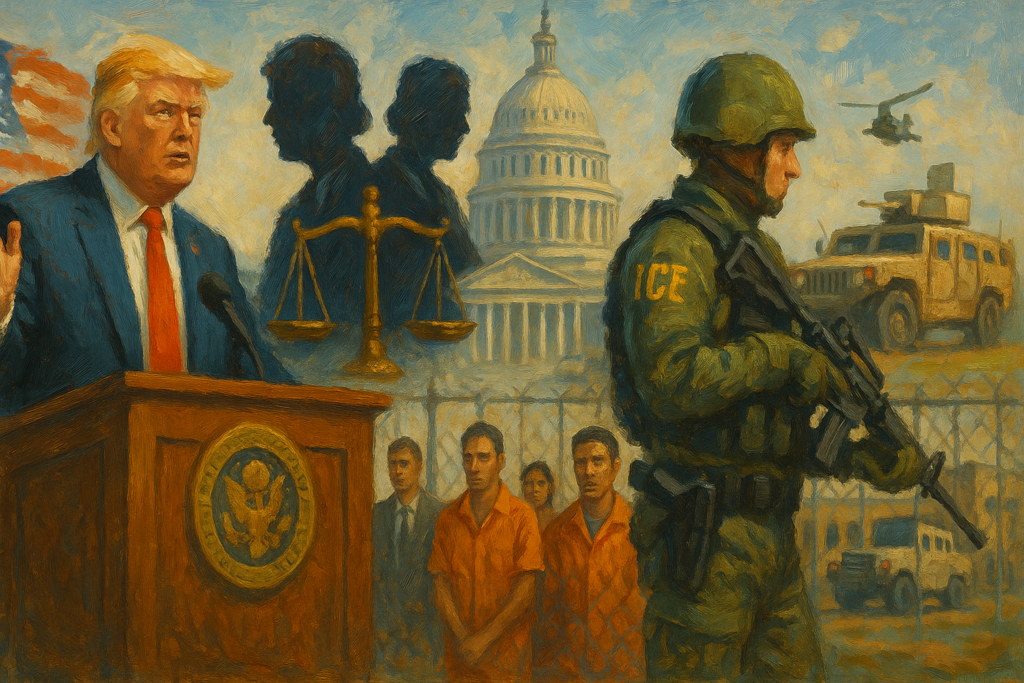
- Immigration enforcement widened from tactics to structure — The week moved from reports of forceful street- and courthouse-level immigration arrests to larger structural steps: expanded denaturalization targets, paused status proceedings for 19 countries, a major ICE recruitment drive, and a killing by an off-duty ICE agent that intensified scrutiny of the agency.
- Courts and formal institutions checked some executive moves — Judges and legal rulings imposed limits in several areas, including immigration prosecution, CFPB funding, and attempted National Guard deployments, showing that institutional resistance remained active even as executive pressure increased.
- Control of information and records became a central political fight — The week featured censorship concerns, deceptive political messaging, repeated misinformation from high-level channels, and an escalating dispute over the scale and release of Epstein-related documents.
- Public institutions and public goods were drawn into personal or political retaliation — The Kennedy Center fight, the Colorado and Everglades vetoes, and the termination of a public golf-course lease all pointed to a pattern in which public institutions, contracts, and projects were treated as tools of political leverage or personal branding.
The final week of 2025 and the first days of 2026 unfolded as a test of how far executive power could reach and how firmly other institutions would push back. Retaliatory vetoes, an expanding immigration enforcement machine, and opaque overseas strikes set the tone, while courts, Congress, and civic actors tried to draw lines around war‑making, policing, and access to basic services.
Over the weekend, the House of Representatives turned inward, using its disciplinary tools to police members’ conduct and speech. Lawmakers formally censured Rep. Al Green for interrupting Donald Trump during a joint session and passed a resolution condemning Rep. Chuy Garcia over alleged maneuvering to help his chief of staff succeed him. Backed by Republicans and some Democrats, the measures showed how censure and similar resolutions can become instruments for punishing dissent and intra‑party tactics rather than tools reserved for clear ethical breaches.
Beyond the Capitol, immigration enforcement remained both aggressive and visible in daily life. Reports described immigrants being dragged from cars and courthouse hallways, and the earlier deportation of Oregon vineyard manager Moises Sotelo continued to reverberate through his family and local economy. These stories underscored how enforcement now reaches into workplaces, courts, and communities in ways that can deter people from seeking legal redress or public services. At the same time, Trump again pressed Republican senators to scrap the filibuster, arguing that the Senate rule blocked his agenda. GOP leaders remained wary, mindful they might need the filibuster if they lost their majority, but the pressure highlighted how procedural guardrails themselves had become political targets.
The weekend also brought signs of how foreign and domestic power were being intertwined. Advocacy group Indivisible urged the public to press senators to rein in unauthorized U.S. military actions against Venezuela, citing killings at sea and attempted tanker seizures without clear legal justification. Those calls came as the administration leaned into Christian nationalist themes: DHS and other agencies posted explicitly Christian holiday messages featuring Trump, and the White House announced strikes on ISIS‑linked militants in Nigeria and Syria, framing them as defending persecuted Christians and even as a “Christmas present” for extremists. Official communications emphasized a Christian national identity and tied military action abroad to religious protection, blurring church‑state separation and embedding religious identity in foreign policy narratives.
Domestically, militarized federal agents in fatigues and carrying assault rifles remained a presence in major cities as part of the administration’s response to protests and unrest. Their deployment, often without clear local consent, continued to blur the line between civilian policing and military force. At the same time, anti‑Muslim rhetoric escalated: Sen. Tommy Tuberville called for mass deportation of Muslim Americans, and ICE posted an AI‑generated video of Santa deporting an immigrant as a festive message about reducing the “illegal population.” These moves paired symbolic imagery with calls to expel religious minorities, normalizing the idea that some groups sit outside the circle of equal citizenship. In the information sphere, CBS and 60 Minutes pulled an investigative report on CICOT from official channels even as bootleg copies spread online, raising questions about editorial pressure and the ability of powerful actors to bury uncomfortable reporting. And in the background, large Trump‑era cuts to healthcare, scientific research, and anti‑hunger programs continued to draw criticism, with advocates warning of long‑term damage to public health and innovation.
By Monday, the immigration story had become more targeted. Trump ended legal protections for Somali immigrants in Minnesota, accusing the state of being a fraud hub, while the FBI surged resources to investigate large‑scale fraud tied to federal programs. Some cases were referred for denaturalization and deportation. Linking an entire community to fraud and pairing criminal probes with immigration penalties risked collective stigma and signaled how enforcement could be steered toward particular groups. At the same time, leaked plans showed ICE preparing to expand detention using warehouse‑style facilities near logistics hubs, backed by a GOP spending package proposing $170 billion for ICE and Border Patrol through 2029. The design emphasized speed and throughput over individualized process, treating detainees more as logistical units than as rights‑bearing individuals.
Courts, however, showed they could still check some overreach. A federal judge granted a temporary restraining order blocking detention of Imran Ahmed, head of the Center for Countering Digital Hate, while his lawsuit proceeds, and another judge dismissed with prejudice an indictment against TikTok streamer Carlitos Ricardo Parias after finding serious due‑process violations in his post‑arrest detention by ICE. These rulings underscored that, even as enforcement agencies pushed their authority, judges could still protect critics and defendants from abusive tactics. In the realm of information control, Reuters reported that the administration had imposed visa bans on several European officials and experts involved in enforcing platform rules against disinformation, branding their work as censorship. Punishing foreign watchdogs for moderating propaganda signaled hostility to independent oversight and threatened international cooperation on information integrity. Meanwhile, agencies like CDC, DHS, FCC, FDA, OSHA, and EPA continued to issue technical notices on meetings, penalties, and environmental plans, a reminder that the machinery of governance still turned beneath the higher‑profile conflicts.
On Tuesday, the focus shifted outward and upward. Trump announced a strike on a Venezuelan drug facility during a talk‑radio appearance, while U.S. officials declined to confirm details. Southern Command separately reported a lethal small‑boat strike in the eastern Pacific as part of a broader campaign that had killed over 100 people, and a failed attempt to seize an oil tanker bound for Venezuela heightened tensions. These lethal operations, announced without clear legal basis or transparency, made it difficult for Congress, courts, or the public to assess legality or hold anyone accountable, continuing a pattern of unilateral war‑making.
At home, immigration enforcement was formally scaled up and legal status made more fragile. A Justice Department memo ordered denaturalization cases to be prioritized, with USCIS field offices told to feed 100–200 cases per month into the pipeline. A separate USCIS memo paused immigration proceedings for nationals of 19 travel‑ban countries, abruptly canceling naturalization ceremonies and green‑card interviews nationwide. Together with the weekend’s visible arrests and Monday’s warehouse‑style detention plans, these moves outlined a coherent shift: citizenship and lawful status were being treated as contingent and revocable, while the physical and bureaucratic capacity for detention and deportation was being expanded.
Other institutions pushed back in different arenas. Judge Amy Berman Jackson ordered the administration to keep funding the Consumer Financial Protection Bureau, rejecting arguments that Federal Reserve losses justified cutting off its budget and calling the move an attempt to evade a prior injunction. The ruling protected an independent consumer watchdog created by Congress from being dismantled through budget maneuvers. Economic and health policy choices, however, moved in the opposite direction. A major tax and fiscal package and tariff adjustments were touted as relief but left many households squeezed by rising costs for essentials. HHS Secretary Robert F. Kennedy Jr. cut hundreds of millions from mRNA research and billions from NIH, and a 43‑day shutdown set the stage for enhanced Affordable Care Act tax credits to expire, doubling premiums for many enrollees. The Richmond Fed and Bureau of Labor Statistics detailed how that shutdown had also prevented collection of key inflation and employment data, creating unprecedented holes in official statistics and making it easier to spin economic narratives without evidence.
Cultural institutions became a new front in the struggle over power and symbolism. Trump moved to rename the Kennedy Center the “Trump Kennedy Center” after trustees changed bylaws to concentrate voting power in his appointees. In response, artists canceled New Year’s Eve and upcoming performances rather than legitimize the change. The episode showed how a congressionally chartered cultural institution could be rebranded around a sitting leader, and how artists could use boycotts to impose reputational costs. Corporate and civic actors also signaled resistance: Rocket Money dropped sponsorship of Tucker Carlson’s podcast after reporting on his white‑supremacist content, and organizers announced a nationwide “Free America Walk Out” for January 20, urging people to leave work, school, and commerce to protest what they described as the construction of a coercive state. Meanwhile, internal documents revealed Social Security Administration caseload backlogs swelling past six million, with applicants struggling to get basic information, and a plan to sharply limit phone service was scrapped only after media exposure and public pressure. Investigations into a $20 billion bailout of Argentina and a delayed Medicare rule suggested that major financial decisions were tracking donor interests, further blurring the line between public policy and private enrichment. In immigration, a right‑wing media personality previously expelled for running an illegal Russian propaganda operation was quietly allowed back into the U.S. with help from administration officials, even as broader crackdowns intensified, underscoring how ideology and connections could override stated security rationales.
New Year’s Eve brought a series of legal confrontations over the use of force and access to care. The Supreme Court issued a rare rebuke blocking National Guard deployment in Illinois and preliminarily rejected Trump’s justification for using Guard units in domestic law‑enforcement roles. The Justice Department stopped contesting a California ruling returning Guard control to Gov. Gavin Newsom. Trump then announced he was ending attempts to deploy Guard units in Los Angeles, Chicago, and Portland, while threatening to redeploy them later in a “much stronger form.” These decisions reaffirmed state authority over Guard units and showed that courts could still block attempts to militarize responses to domestic unrest.
In the realm of reproductive health, a federal appeals court lifted an injunction and allowed a provision in a tax‑and‑spending bill to strip Medicaid funding from Planned Parenthood affiliates in 22 states and the District of Columbia. The ruling threatened closure of clinics that provide reproductive and basic health services, illustrating how judicial appointments and spending riders can reshape access to care. Immigration enforcement capacity continued to grow: reporting showed ICE had increased spending on guns and chemical weapons by 600% under Trump and launched a $100 million, year‑long media campaign targeting conservative audiences with large signing bonuses and loan forgiveness to recruit thousands of new agents for 2026 deportation goals. This weapons surge and recruitment blitz, layered on top of warehouse‑style detention plans and denaturalization quotas, marked a shift toward industrial‑scale enforcement.
Courts again intervened in immigration practices at the margins. A federal judge ordered the administration to either return immigrants transferred to El Salvador’s CECOT mega‑prison or provide hearings so they could challenge their detention, pushing back against outsourcing detention to foreign facilities without meaningful legal recourse. In Congress, former special counsel Jack Smith testified before the House Judiciary Committee, and a 255‑page deposition transcript was released. Smith asserted he had proof beyond a reasonable doubt in the classified‑documents and election‑interference cases against Trump, emphasized his independence from political influence, and explained how legal challenges and Trump’s return to office led to dropped charges. The testimony created a detailed record of how a former president was investigated and charged, and how political power later reshaped accountability.
Battles over information and memory intensified around the Epstein files. Congress passed the bipartisan Epstein Files Transparency Act, requiring the Justice Department to release Epstein‑related files by December 19. DOJ then disclosed it was reviewing roughly 5–5.2 million pages—far more than previously stated—and signaled it would miss the deadline, citing the need for extensive redactions and hundreds of lawyers. House Democrats later revealed that DOJ had confirmed the existence of roughly five million additional Epstein‑related documents beyond what had been acknowledged, with less than 5% produced so far, prompting accusations of legal violations and concealment. New reporting described Jeffrey Epstein as a frequent visitor at Mar‑a‑Lago and alleged that young female spa workers from Trump’s club were sent to Epstein’s mansion for “house calls,” deepening questions about who enabled his crimes and how proximity to power may have shielded his network. The clash between a statutory transparency mandate, DOJ’s slow and opaque process, and fresh allegations involving elite spaces highlighted how archives around powerful figures can be managed to delay or dilute accountability. In a different information battle, Trump posted an image claiming a U.S. wind turbine had killed a bald eagle—actually an old photo of a falcon killed in Israel—and an official White House account amplified the post, alongside similar misleading images from Spain and Taiwan used to attack wind energy. The use of false visuals from official channels showed how disinformation could be deployed to shape public views on energy policy. Even as these high‑profile fights played out, OSHA and EPA continued technical rulemakings and approvals on testing labs, safety training, and power‑plant compliance deadlines, illustrating that parts of the administrative state still functioned in routine ways.
New Year’s Day saw Trump wield the veto pen in ways widely read as retaliatory. He vetoed a bill to protect the Osceola Camp area in Everglades National Park, home to the Miccosukee Tribe, arguing the tribe was not authorized to live there and casting the project as contrary to his immigration agenda. He also vetoed a unanimously passed bill to fund safe drinking water for 39 Colorado communities, a move widely seen as tied to state officials’ stance on a convicted election‑fraud figure and their advocacy around the Epstein files. Using veto power to punish disfavored regions and tribes over unrelated political disputes turned basic infrastructure and environmental protection into leverage points in broader political conflicts.
Climate and economic policy choices followed a similar pattern of undercutting public goods. The administration cut federal funding for public transit systems, despite their central role in meeting emissions targets, while continuing to deride climate policy as a “scam.” These cuts came even as states like New York and Vermont pursued climate superfund laws to make polluters pay, highlighting a divergence between federal rhetoric and subnational efforts. The earlier shutdown’s impact on health care became concrete as enhanced Affordable Care Act tax credits expired, leading to an average 114% premium increase for more than 20 million enrollees. A possible January House vote offered only uncertain relief, leaving many households facing sudden, steep costs. Trade policy, loudly advertised as tough, softened under pressure: Trump signed a proclamation delaying steep tariff increases on upholstered furniture and cabinets until 2027 just hours before they were to rise, and the Commerce Department slashed threatened antidumping duties on Italian pasta from over 90% to single‑digit or low‑teens rates after lobbying by Italy and affected firms. These reversals showed how well‑organized sectors could secure carve‑outs, complicating the narrative of unbending trade enforcement. Closer to home, Trump terminated the National Links Trust’s lease to manage Washington, D.C.’s public golf courses without a clear successor plan, halting renovations and leaving workers uncertain. Critics saw the move as opening the door to more personally lucrative arrangements, raising fears of self‑dealing in the management of public assets.
The week closed on Friday with explicit assertions of centralized control and new flashpoints in rights and representation. New reporting described the White House claiming direct control over immigration policy, criminal law, and forcible renditions, centralizing decisions that traditionally involve multiple branches and agencies. Concentrating coercive powers in the presidency erodes checks and balances and makes abuses harder to detect or contest, especially when combined with the week’s denaturalization quotas, case freezes, detention build‑outs, and ICE’s weapons and recruitment surge. In Tennessee, the state House expelled Reps. Justin Pearson and Justin Jones after they led a floor protest demanding stronger gun laws following a deadly school shooting. Although both later regained their seats, the expulsions drew national attention to the punitive use of legislative power against protest speech, narrowing the space for dissent inside elected bodies and temporarily disenfranchising their constituents.
Reproductive rights faced further constriction at the state level. In Kentucky, Melinda S. Spencer was arrested and charged with first‑degree fetal homicide, abuse of a corpse, and evidence tampering after allegedly inducing her own abortion with pills ordered online and burying the remains, even though state law does not explicitly criminalize self‑managed abortion. The case illustrated how broad criminal statutes can be repurposed to police pregnancy outcomes, extending the reach of abortion bans and creating legal uncertainty for pregnant people. In North Carolina, the democratic landscape was contested on multiple fronts. Organizers announced a February 11–14 Long March culminating in Raleigh to protest new district maps they say disenfranchise Black voters, turning to mass protest as one of the few tools available when courts and legislatures entrench maps that dilute minority voting power. Republican leaders of the state’s Select Committee on Oversight and Reform targeted the Chapel Hill School District, prompting groups like Public School Strong to organize a January 8 response event to defend public schools from politicized oversight. At the same time, the GOP‑led General Assembly moved toward another round of tax cuts for high‑income individuals and profitable corporations, even as it delayed a full state budget, raising warnings about strain on childcare centers, rising health premiums, and unpaid providers. These state‑level fights showed how tax policy, oversight hearings, and redistricting can quietly reshape the conditions for equal participation.
The week’s information battles extended even into aesthetics and foreign policy rhetoric. DHS used a beach scene by Japanese artist Hiroshi Nagai without permission in a social‑media post depicting a peaceful America after mass deportations. Nagai publicly objected, adding to criticism of DHS’s pattern of appropriating art to sell its immigration agenda and illustrating how imagery is used to soften coercive messaging. In the background, contextual notes recalled the Page Act of 1875, the Chinese Exclusion Act of 1882, and later federalization of immigration control, situating current bans, denaturalization efforts, and enforcement surges within a long history of racially targeted restrictions and centralized authority. Abroad, Trump posted that the U.S. was “locked and loaded” and would act if Iran “shoots and violently kills peaceful protesters,” prompting stern warnings from senior Iranian officials. Such freelance threats of intervention by a former president risk inflaming tensions and complicating official diplomacy. Meanwhile, EPA, FDA, TSA, and GSA continued to issue technical decisions on air plans, hazardous‑air enforcement, emission limits, drug safety, pipeline security, and federal mileage and gift thresholds, underscoring that even as some agencies were politicized or hollowed out, the quieter work of setting standards and safeguards continued.
Taken together, the week’s events traced a sharp contest over who wields power and how. The federal government expanded its capacity to detain, arm, and deport, and the president used vetoes and emergency‑style actions to reward allies and punish critics, at home and abroad. Courts, state governments, and civil society responded with injunctions, testimony, boycotts, marches, and organizing, trying to preserve space for protest, reproductive autonomy, transparent archives, and functioning public services. As 2026 opened, American democracy appeared less as a stable equilibrium than as a moving struggle among branches, levels of government, and citizens over the limits of coercion and the meaning of accountability.