This week’s throughlines
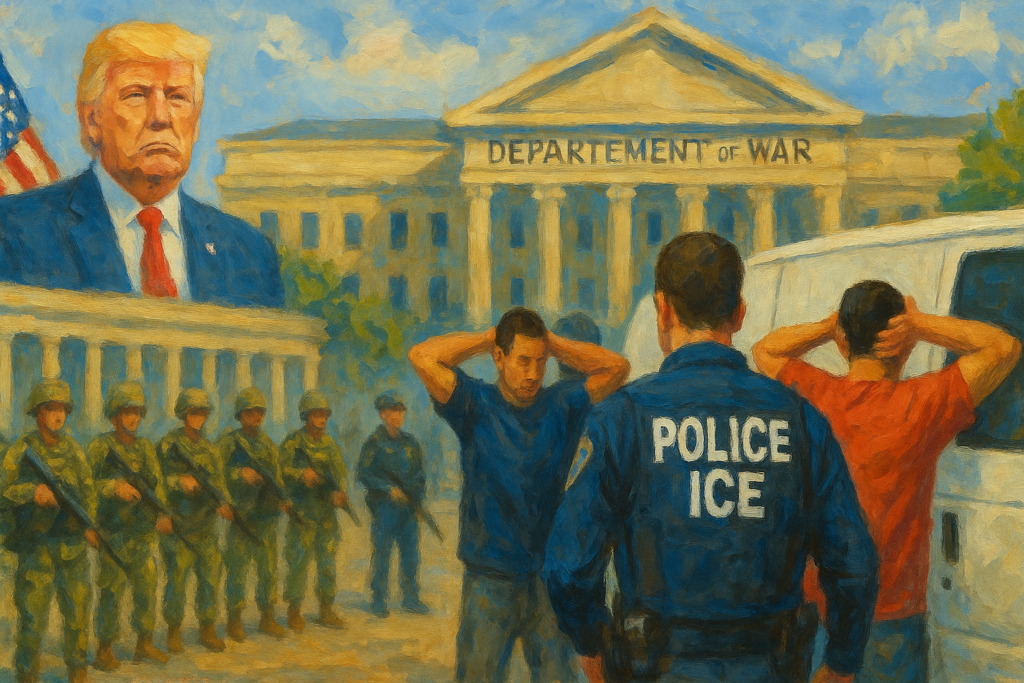
- Federal force moved from threat to deployment — The week began with threats and troop deployments in Washington and Chicago, then widened through immigration operations, local warnings, protests, and a Friday shooting near Chicago during federal enforcement.
- Immigration enforcement hardened through courts and operations — Mass raids in Georgia and New York were followed by the Supreme Court allowing broader Los Angeles stops, new Chicago and Boston operations, and evidence of pressure on even lawful visa holders.
- Checks on executive power were uneven and often temporary — Courts upheld some limits on Trump, including the E. Jean Carroll verdict and blocks on firing Lisa Cook, restricting immigrant services, and subpoenaing trans patients’ records. But the Supreme Court also gave the administration room on immigration raids, foreign aid, tariffs, and agency control.
- Transparency and public memory became active battlegrounds — The administration and allies resisted disclosure in the Epstein matter, delayed records requests, recalled intelligence reporting, and fought over how January 6 and other public events would be remembered.
- Political violence quickly became a pretext for speech policing — After Charlie Kirk was killed, Trump and allied figures blamed the left, employers and institutions punished speech, and lawmakers and influencers openly discussed bans and retaliation.
The week unfolded under the shadow of expanding federal power at home and abroad. From the president’s move to rename the Pentagon and deploy troops into American cities to Supreme Court rulings that opened the door to race-based immigration patrols, the lines between civilian life, law enforcement, and military authority were repeatedly redrawn. At the same time, political violence and its aftermath—most notably the assassination of conservative activist Charlie Kirk—became a stage for efforts to police speech and reshape public memory, while courts and legislatures quietly shifted the foundations of social programs, science funding, and climate policy.
Over the weekend, the administration made a symbolic and practical break with post–World War II norms by ordering the Department of Defense to be renamed the Department of War. The change was more than cosmetic: Trump simultaneously deployed roughly 2,000 National Guard troops to take control of policing in Washington, D.C., over the objections of local officials, and threatened similar deployments to Chicago and Baltimore, citing crime despite data that undercut his claims. The Guard’s presence in the capital, combined with a federal takeover of the city’s police department, drew immediate protests and raised questions about using military forces in domestic law enforcement. Demonstrators in D.C. and Chicago framed the deployments as an occupation rather than a public safety measure, underscoring how federal power was being asserted against local self-governance.
Beyond U.S. borders, reports surfaced that the administration’s aggressive posture extended to covert military operations. Journalists revealed that Trump had approved a 2019 Navy SEAL mission inside North Korea without briefing congressional leaders, an apparent violation of long-standing expectations that the executive consult key lawmakers on sensitive uses of force. The mission reportedly resulted in civilian deaths. In a separate incident, U.S. forces launched a deadly strike on a civilian boat in international waters, later described as an anti-smuggling operation even as Pentagon lawyers scrambled to identify a legal basis. A planned congressional briefing on a related Caribbean strike was canceled and rescheduled, highlighting how sporadic and fragile legislative oversight had become over lethal operations.
Immigration enforcement emerged as a central domestic front. Over the weekend, ICE carried out one of the largest single-site raids in the history of the Department of Homeland Security at a Hyundai–LG battery plant in Georgia, detaining about 475 workers, including more than 300 South Korean nationals. The scale of the operation prompted Seoul to form a government taskforce, signaling diplomatic strain over the treatment of its citizens and a major investment. A separate raid at a food facility near Syracuse, New York, swept up more than 40 workers, many of them parents, and drew condemnation from New York’s governor. These actions coincided with the rollout of “Patriot 2.0,” a renewed ICE campaign targeting immigrants released from custody in Massachusetts and other sanctuary jurisdictions, reinforcing the sense that federal enforcement was being used as a blunt instrument against particular communities and local policies.
The weekend also saw a different kind of struggle over power and secrecy in the long-running Jeffrey Epstein saga. The Justice Department moved to keep sealed the names of Epstein associates who had received large payments, sought to dismiss a civil suit by 33 survivors alleging federal inaction, and delayed a key Freedom of Information Act response on Epstein records until 2027. In contrast, the House Oversight Committee released estate records, including a birthday note signed by Trump, and JPMorgan Chase belatedly flagged billions in suspicious Epstein-related transactions. Speaker Mike Johnson briefly claimed, then retracted, that Trump had been an FBI informant in the case. The conflicting moves illustrated how different branches of government were pulling in opposite directions on transparency and accountability for elite misconduct.
At the state level, religion and public education collided. In Texas, a new law took effect allowing school time for prayer and Bible reading, while Attorney General Ken Paxton vowed to appeal a ruling that had blocked mandatory Ten Commandments displays in classrooms. Critics argued that these measures privileged Christianity and eroded the constitutional separation of church and state, particularly for non-Christian students in public schools. Elsewhere, a federal appeals court ruled that Trump had exceeded his authority with sweeping global tariffs, setting up a future Supreme Court showdown, while a hate crime bill in South Carolina remained stalled in the state Senate despite broad support, showing how leadership bottlenecks can halt civil rights protections. Symbolic politics also played out in Washington and Florida: Trump opened an exclusive “Rose Garden Club” at the White House for loyalists, blurring the line between public property and partisan reward, and Florida’s surgeon general announced the state would abandon mandatory childhood vaccines, citing parental rights despite rising preventable diseases.
By Monday, the courts had moved to reshape immigration enforcement directly. In a series of 6–3 decisions and emergency orders, the Supreme Court lifted injunctions that had limited ICE raids in Los Angeles. The Court allowed “roving” patrols to resume and permitted agents to consider race, language, job, and location when deciding whom to stop. These rulings reversed a district judge’s findings that the practices amounted to racial profiling and were widely interpreted as legalizing race-based immigration enforcement. For Latino and immigrant communities in Los Angeles, the practical effect was immediate: protections that had constrained indiscriminate stops and raids were gone, and the Court had signaled that such practices were now within the bounds of federal authority.
On the same day, other courts sent mixed signals about the reach of presidential power. A federal appeals court upheld the $83.3 million defamation verdict against Trump in the E. Jean Carroll case, rejecting his claims of immunity and emphasizing the reprehensible nature of his conduct. Yet Chief Justice John Roberts, acting in his administrative capacity, allowed Trump to fire a Biden-appointed member of the Federal Trade Commission despite ongoing litigation, and another appeals court dismissed a multistate challenge to mass firings of probationary federal employees for lack of standing. In contrast, a judge temporarily blocked Trump’s attempt to fire Federal Reserve Governor Lisa Cook, and a separate appeals court reinstated a Library of Congress official challenging her dismissal. Together, these decisions showed courts holding Trump personally liable in one context while loosening structural protections for independent regulators and civil servants in others.
Chicago became the next focal point for immigration enforcement. The Department of Homeland Security announced “Operation Midway Blitz,” a militarized campaign targeting Chicago and surrounding sanctuary areas, invoking wartime imagery to describe what was formally a law enforcement effort. Chicago’s mayor publicly opposed the operation, citing ICE’s history of detaining U.S. citizens and violating rights, and the nearby city of Evanston warned residents about likely ICE activity, urging them to report encounters with federal agents. These local responses underscored a deepening clash between federal crackdowns and city-level protections, as the administration prepared broader surges of ICE agents into Chicago and Boston ahead of elections.
Meanwhile, the Supreme Court agreed to hear Trump’s emergency appeal on the legality of his global tariffs, leaving them in place while arguments proceed. The administration also filed an emergency appeal to freeze billions in foreign aid that a lower court had ordered spent before expiration, and the Court temporarily allowed Trump’s “pocket rescission” strategy to continue. Pocket rescission refers to an executive tactic of delaying or withholding congressionally appropriated funds until they expire, effectively canceling them without a formal veto. These moves, combined with Congress’s reluctance to challenge unilateral strikes and spending cuts, signaled a growing willingness by both branches to tolerate expanded executive control over trade and foreign aid. In the background, agencies like the National Archives and FCC took routine steps on records schedules and regulatory fees, decisions that quietly determine what information will be preserved or disclosed in the future.
Tuesday’s developments shifted attention to elections and representation. In Michigan, a judge dismissed felony charges against 15 individuals who had signed false certificates claiming Trump won the state in 2020, ruling that prosecutors had not shown sufficient evidence of fraudulent intent. The collapse of one of the most prominent fake elector cases weakened legal deterrence against similar schemes in future elections. In Missouri, Republicans approved a new congressional map that dismantled a Kansas City–based Democratic district represented by Emanuel Cleaver and added a Republican-leaning seat. Opponents vowed to seek a referendum, but the map, if it stands, would further entrench partisan advantage and dilute minority representation in the state’s delegation.
At the federal level, Trump’s allies began to float more direct interventions in election administration. Cleta Mitchell, a lawyer who has long worked on conservative election efforts, suggested that Trump could declare a national emergency to claim powers over federal elections, potentially overriding the traditional authority of states to run their own contests. At the same time, reporting revealed that the Justice Department was building a national voting database, raising concerns that centralized voter data could be used to challenge registrations or target specific communities under the banner of “election integrity.” Together, these ideas pointed toward a model in which the executive branch might use emergency powers and data tools to influence who votes and how elections are run.
Courts also weighed in on federal spending priorities. A district court in Washington, D.C., refused to block the administration’s termination of more than $1 billion in National Science Foundation grants, allowing the cuts to proceed while litigation continues. Separately, the Supreme Court temporarily allowed Trump to withhold nearly $5 billion in congressionally appropriated foreign aid, including funds for global health and democracy programs, as part of the same pocket rescission strategy. These decisions weakened Congress’s practical control over the purse and threatened long-term investments in science and global health, with disproportionate effects on vulnerable populations and research institutions.
Immigration status became a dividing line in access to basic services. An executive order issued in July, now nearing enforcement, reinterpreted Head Start and other federal programs as “public welfare” in order to exclude certain immigrant children. Attorneys general and Head Start organizations challenged the order as unconstitutional, delaying implementation until at least September 10 and setting up a later ruling that would block related restrictions on immigrant services. In the realm of children’s health, the administration released its second “Make America Healthy Again” report on chronic illnesses in children. While acknowledging potential harms from pesticides and ultra-processed foods, the report avoided proposing direct regulatory limits, instead emphasizing vaccine technology and ingredient scrutiny. Critics argued that the document highlighted risks without confronting powerful agricultural and food industry interests, shaping public understanding without matching it with strong protections.
On Wednesday, state governments and Congress offered contrasting models of social policy. New Mexico announced it would become the first state to offer universal free child care, a significant expansion of social support for families. Massachusetts moved to slash environmental review times to accelerate housing construction, betting that streamlined processes could ease housing shortages, while California deployed state resources to protect sequoia groves amid federal inaction on climate and conservation. In sharp contrast, the Trump Education Department cut funding for programs serving students with hearing and vision loss and withheld $350 million in grants from colleges that primarily serve students of color. A Republican tax and spending plan shifted more responsibilities onto states, forcing budget cuts in places like Maryland. These divergent choices showed how some states were trying to buffer residents from federal retrenchment while others were constrained by it.
The federal takeover of Washington, D.C., deepened as congressional Republicans stripped $1 billion from the city’s budget. Coming on top of the earlier deployment of National Guard troops and federal control of local policing, the budget cut further undermined the capital’s limited autonomy. Because D.C. lacks full voting representation in Congress, the move highlighted the vulnerability of its residents to decisions made by lawmakers they cannot fully hold to account. Local activists and officials argued that the cuts would impair basic services and were being used as a tool of political discipline.
The assassination of Charlie Kirk, which had occurred days earlier, began to reshape the media and political landscape. MAGA-aligned influencers organized campaigns to identify and report people who posted negative comments about Kirk, leading to firings across the country. Representative Clay Higgins called for lifetime social media bans and targeting business licenses for those who “belittled” the assassination. MSNBC fired commentator Matthew Dowd after he criticized Kirk’s rhetoric on air, and a Texas Tech student was arrested and expelled for mocking Kirk’s death online. These responses blurred the line between social sanction and state power, as employment decisions, law enforcement, and proposed federal measures were marshaled to punish speech about a political figure’s death.
At the same time, political leaders moved to enshrine Kirk’s memory while resisting recognition of others. At a 9/11 commemoration, Trump announced he would award the Presidential Medal of Freedom posthumously to Kirk. In Congress, Representative Anna Paulina Luna and allies requested a statue of Kirk in the Capitol. Yet Speaker Mike Johnson refused to implement a bipartisan law requiring a plaque honoring police who defended the Capitol on January 6. The selective commemoration—elevating a partisan ally while ignoring those who protected the legislature during an insurrection—signaled a broader effort to curate which sacrifices are officially honored. In a separate but related arena, a House subcommittee held a hearing titled “How the Corruption of Science Has Impacted Public Perception and Policies Regarding Vaccines,” centering on an unpublished, methodologically disputed study comparing chronic illness in vaccinated and unvaccinated children. By giving such work a congressional platform, lawmakers risked lending institutional legitimacy to fringe claims and further eroding public trust in vaccination.
Thursday brought the events around Kirk’s killing into sharper focus. At an outdoor event in Utah, a gunman had shot and killed Kirk; less than an hour later, a separate shooter wounded two students at a Colorado high school before dying by suicide. Trump addressed the nation from the Oval Office, blaming the “radical left” for Kirk’s assassination and listing only left-wing incidents as examples of political violence. He later escalated his rhetoric, calling for action against “radical left lunatics.” Law enforcement quickly identified a suspect, Tyler Robinson, and pursued him, while FBI Director Kash Patel’s public handling of the case drew criticism for its tone and politicization. How leaders frame such violence—either as a shared tragedy or as the fault of a broad ideological enemy—can either calm or inflame tensions; in this case, the framing risked further radicalization and retaliatory attacks.
Immigration policy hardened further in Congress. The House passed the Stop Illegal Entry Act, which imposed five- and ten-year mandatory minimum prison sentences for migrants who illegally re-enter the United States and commit certain crimes. Mandatory minimums are fixed sentences that judges must impose, regardless of individual circumstances, limiting judicial discretion and often leading to longer prison terms. The bill passed largely along party lines with some Democratic support and backing from the White House, and Senator Ted Cruz began pushing it in the Senate. In parallel, the Supreme Court’s conservative majority, using its “shadow docket” of emergency orders rather than full opinions, issued rulings that lifted remaining restrictions on federal immigration agents and effectively permitted racial profiling in immigration stops. By acting through the shadow docket—without full briefing, oral argument, or detailed written opinions—the Court reshaped civil rights standards with limited transparency or public scrutiny.
Beyond U.S. borders, NATO faced a test of cohesion. Poland shot down 19 Russian drones that had entered its airspace during an attack on Ukraine and formally invoked Article 4 of the NATO treaty, which triggers consultations among member states when a country feels its security is threatened. Trump publicly questioned the incident and suggested the incursion might have been a mistake, downplaying Polish officials’ view that it was deliberate. His response raised concerns about how the United States would respond to future provocations and how presidential rhetoric might affect alliance deterrence. Meanwhile, Reuters reported that the administration planned to propose significant asylum restrictions at the United Nations, including requiring asylum seekers to claim protection in the first country they enter and making asylum status temporary. If adopted, such rules would weaken international refugee protections and shift burdens onto frontline countries.
On Friday, law enforcement announced a breakthrough in the Kirk case. Utah authorities arrested 22-year-old Tyler Robinson after family members recognized him from surveillance images and contacted law enforcement. FBI Director Kash Patel and Utah officials held a joint announcement, while Trump used a Fox News interview to tout the capture and call for “quick trials” for suspects caught on tape. Multiple accounts emphasized the role of family, a pastor, and public tips in Robinson’s surrender. While the arrest may have eased immediate fears, the president’s call for expedited trials raised concerns about due process and the presumption of innocence in a politically charged case.
In Chicago, the week’s arc of militarized immigration enforcement reached a deadly point. As part of a broader initiative to address violent crime in major cities, ICE personnel were deployed in and around Chicago alongside threatened National Guard deployments. On the outskirts of the city, ICE officers shot and killed Silverio Villegas-Gonzalez during a vehicle stop after he allegedly dragged an officer with his car. The killing sparked protests and condemnation from immigrant rights groups, who denounced both the aggressive tactics and the broader militarization of enforcement. For many residents, the combination of expanded federal presence and lethal force deepened mistrust between immigrant communities and law enforcement.
Access to health care and social supports narrowed for many low-income Americans. A federal appeals court allowed the administration to proceed with blocking Medicaid reimbursements to Planned Parenthood for a year, a move that could force up to 200 clinics to close and affect 1.1 million low-income patients who rely on them for reproductive and basic health services. In North Carolina, the General Assembly’s failure to pass a full budget created a $319 million Medicaid shortfall, forcing immediate cuts to coverage for more than 3 million residents. These decisions, combined with earlier cuts to disability programs and minority-serving colleges, signaled a redistribution of resources away from vulnerable communities.
Climate and energy policy also shifted. The Environmental Protection Agency moved to claw back $7 billion in Solar for All grants intended to help low- and middle-income families access solar energy, a step critics called illegal and harmful to clean energy adoption. In a separate decision, the agency announced plans to end a 15-year-old program requiring major polluters to report greenhouse gas emissions, dismissing it as bureaucratic red tape. Ending emissions reporting would make it harder for the public, researchers, and regulators to track pollution trends and hold companies accountable, while reclaiming solar grants would slow the spread of clean energy in communities that stand to benefit most.
Further reporting on the Hyundai–LG battery plant raid in Georgia tied immigration enforcement to workplace safety and international trade. Journalists revealed that three workers had died in accidents at the site over two years and that the presence of undocumented workers may have discouraged safety complaints. The raid, which detained 475 people including 320 Korean nationals, raised questions about whether vulnerable workers were being exploited and then criminalized, and what the crackdown would mean for the future of a major South Korean investment in the United States. In Washington, reports indicated that Trump had amassed additional troops in D.C. amid ongoing large-scale protests against his actions and policies. National Guard documents described the federal law enforcement takeover as leveraging fear and driving a wedge between citizens and the military, underscoring the risks of normalizing troop deployments as a backdrop to political conflict.
The week closed with public health policy moving further away from evidence-based practice. The Washington Post reported that Trump health officials planned to link COVID-19 vaccines to child deaths based on unverified reports as they considered limiting vaccine access. This came on top of Florida’s abandonment of mandatory childhood vaccines and congressional hearings that elevated unreviewed research critical of vaccination. Using unverified data to justify restricting vaccines threatened to leave communities more vulnerable to preventable disease and to further erode trust in scientific institutions.
Taken together, the week’s events traced a pattern of concentrated executive power, weakened institutional checks, and contested public memory. Courts alternated between holding Trump personally accountable and enabling his structural ambitions; Congress advanced harsh immigration penalties and eased confirmations for presidential nominees while declining to assert its full oversight powers; and agencies rolled back data collection and social supports that underpin informed self-government. At the same time, political violence and its aftermath were used to police speech and elevate partisan martyrs, even as those who defended democratic institutions on January 6 went unrecognized. In this environment, the health of American democracy depended increasingly on the resilience of local governments, civil society, and the remaining pockets of judicial and bureaucratic independence that continued to push back against the most sweeping assertions of federal power.