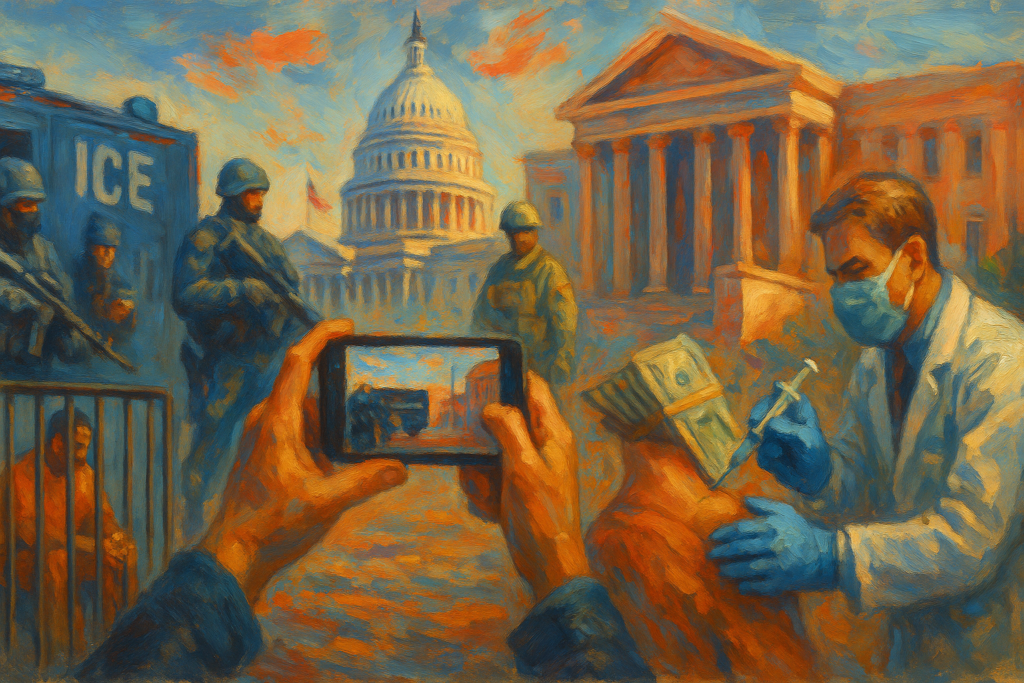
This week’s throughlines
- The Charlie Kirk aftermath became a vehicle for broader speech policing — What began as official mourning and security requests expanded into pressure on educators, workers, visa holders, journalists, comedians, and broadcasters over what they said about Kirk and political violence.
- Immigration enforcement widened in scope and intensity — The week linked aggressive raids, detention abuses, the rollback of protected spaces, threats to local autonomy, new barriers for migrants, and force against protesters and elected officials challenging ICE operations.
- Political control over knowledge institutions intensified — The administration and its allies moved against scientific, educational, and historical institutions through vaccine panel changes, the firing of health officials, pressure on universities, removal of public records, and changes to historical presentation.
- Checks from courts and oversight bodies remained active but partial — Judges, committees, and lawmakers pushed back in several arenas, from the Federal Reserve and FBI oversight to election administration and media intimidation, but mostly after executive pressure had already been applied.
The week opened with the killing of conservative activist Charlie Kirk already being turned into a political fulcrum. From the White House to federal agencies and media regulators, his death was invoked to justify new security spending, threaten critics, and reshape who could speak and at what risk. At the same time, immigration enforcement hardened on the ground, public health and climate science were stripped of independent expertise, and courts and civil society tried—unevenly—to slow the concentration of power.
Over the weekend, Florida’s surgeon general abruptly ended long‑standing school vaccine requirements for diseases such as measles and polio, likening mandates to “slavery.” That move broke with decades of bipartisan practice that treated childhood immunization requirements as basic infrastructure, like clean water. It signaled a shift from consensus‑driven health policy toward ideological discretion at the state level. In Washington, early signs emerged that federal vaccine advisory bodies would also be purged and repopulated, suggesting that Florida’s move was not an isolated experiment but part of a broader reorientation of health governance.
The same weekend, the administration elevated Kirk’s killing into a national political moment. Trump ordered flags flown at half‑mast and promised a posthumous Presidential Medal of Freedom, treating a partisan media figure as a kind of state martyr. Within days, the White House requested roughly $58 million in new security funding for the executive branch, judiciary, and potentially Congress, tying the ask to rising political violence. Even as facts about the Utah shooting remained unsettled and early FBI missteps drew criticism, right‑wing media and officials quickly blamed “the Left,” laying the groundwork for later efforts to police speech and protest in Kirk’s name.
Immigration enforcement also escalated sharply over the weekend. In Los Angeles, Immigration and Customs Enforcement (ICE) agents conducted military‑style raids, detaining immigrants and even U.S. citizens in unmarked vehicles. In Georgia, ICE raided a Hyundai plant and swept up Korean workers who held valid visas, while reports surfaced of harsh conditions for those detained. In Illinois, state leaders demanded answers after ICE agents fatally shot a man during a traffic stop near a school. These actions blurred the line between civil immigration enforcement and paramilitary policing, spreading fear in immigrant communities and straining relations with South Korea, a key U.S. ally.
Courts at home and abroad sent mixed signals about the rule of law. In Georgia, a judge threw out sweeping racketeering charges against dozens of “Cop City” protesters, ruling that the state attorney general had overstepped his authority. The decision showed that state courts could still check prosecutorial overreach against demonstrators. Abroad, Brazil’s Supreme Court sentenced former president Jair Bolsonaro to more than 27 years in prison for plotting a coup, a rare example of a former leader being held criminally accountable for an attempt to overturn an election. Meanwhile, NATO launched the “Eastern Sentry” exercise after a Russian drone attack on Poland, and Congress advanced a bipartisan Russia sanctions package. Trump, however, began backing away from strong sanctions, tying any action to unrealistic demands on NATO allies, underscoring how executive preferences could undercut legislative and alliance responses.
The weekend also brought early signs of a broader campaign against dissent and vulnerable groups. Former Trump adviser Stephen Miller warned that law enforcement power would be used against political opponents labeled “domestic terrorists.” Elon Musk amplified lists of educators accused of insensitive comments about Kirk’s death, leading to suspensions and firings. On Fox News, Brian Kilmeade suggested executing unhoused and mentally ill people before walking his comments back. In the legislative arena, Missouri lawmakers approved a mid‑decade gerrymander designed to flip a Democratic congressional seat, and Texas advanced a law restricting property purchases by nationals of several countries, echoing early‑20th‑century “alien land laws.” Together, these moves pointed toward a narrowing of who could safely speak, vote, or own property without fear of reprisal.
By Monday, federal power was being pushed more directly into local policing and immigration. Trump signed an order deploying National Guard troops and a multi‑agency “Memphis Safe Task Force” into Memphis, despite the city’s relatively low crime rates. He separately threatened to declare a national emergency to seize control of Washington, DC’s police if city leaders did not cooperate with mass deportations, and warned that New York City could lose federal funds if a left‑wing mayoral candidate won. These threats used emergency powers and budget leverage to discipline disfavored cities and voters, weakening traditional norms of local control over policing.
Immigration and ideology became more tightly linked. Secretary of State Marco Rubio vowed to revoke visas of people who celebrated Kirk’s killing, and lawmakers confirmed that revocations were underway. Texas enacted its property‑purchase restrictions on certain foreign nationals, and a federal judge, while condemning the deportation of protected men to Ghana, said she could no longer intervene under current law. In a small countercurrent, a bill was introduced to ban employer credit checks in hiring, aimed at reducing structural discrimination. The overall pattern, however, was clear: visas, property rights, and even physical safety were increasingly contingent on political expression and national origin.
Inside the Justice Department and FBI, resources and priorities shifted. Roughly one‑fifth of FBI agents, including most of Baltimore’s domestic terrorism squad, were reassigned to immigration enforcement. Former officials warned that this would leave extremist groups freer to operate. Attorney General Pam Bondi announced a civil‑rights investigation not into violence but into an Office Depot worker who refused to print posters honoring Kirk. The administration discussed using federal racketeering laws against protesters, including pro‑Palestinian demonstrators, and considered terrorism designations for domestic opponents. These moves redirected investigative capacity away from organized violence and toward political targets, turning law enforcement into a tool of message discipline.
Courts and regulators did register some resistance. A federal appeals court blocked Trump’s attempt to fire Federal Reserve governor Lisa Cook ahead of a key meeting, preserving, at least temporarily, the central bank’s independence. The administration continued trying to remove her, and Treasury Secretary Scott Bessent’s own mortgage paperwork came under scrutiny, illustrating how pressure on independent economic officials could be paired with personal vulnerability. Separately, a federal judge ordered improvements to harsh immigrant detention conditions in a Manhattan federal building, showing that litigation could still force changes in how detainees are treated.
The battle over history and media narratives intensified on Monday. The administration ordered slavery‑related exhibits removed from national parks, while the Justice Department took down a study showing far‑right extremists as the leading source of domestic terror killings. Washington Post columnist Karen Attiah was fired over social media posts about white men and political violence, and Bondi told employers they should fire workers who disparage Kirk. Vice President JD Vance used Kirk’s own podcast to spread debunked claims about left‑wing violence. These steps, combined with the earlier elevation of Kirk as a national symbol, turned the public record itself into a contested space, where uncomfortable history and data could be erased and critics punished.
On Tuesday, the focus shifted to digital platforms, labor protections, and environmental rules. Trump signed an order extending the delay of a TikTok ban until mid‑December, despite a statute and Supreme Court ruling requiring the app’s shutdown or sale. The order asserted exclusive executive authority over enforcement and barred states or private parties from acting. Whatever one’s view of TikTok, the move signaled that the president could selectively decline to enforce laws and court orders for favored platforms, weakening separation of powers.
At the Labor Department, officials advanced nearly 150 deregulatory actions, including proposals to strip minimum wage and overtime protections from an estimated 3.7 million domestic care workers. A leaked memo warned Labor staff of “serious legal consequences” for speaking to the media about working conditions, contradicting basic labor‑law protections for whistleblowing. At the same time, the Environmental Protection Agency’s foundational finding that greenhouse gases endanger human health came under Senate investigation for industry influence, and the administration cut $500 million in international child‑labor grants. These moves shifted power toward employers and fossil‑fuel interests while narrowing channels for internal dissent.
Universities and courts pushed back against some politicized uses of law. The University of California sued the administration over a research funding freeze and a $1.2 billion fine on UCLA, arguing that civil‑rights statutes were being weaponized to suppress campus speech. A Republican lawmaker withdrew a proposal that would have allowed the Secretary of State to revoke passports over alleged terrorism support after civil‑liberties outcry. The Justice Department sued Oregon and Maine over access to voter lists, which the states described as politically motivated fishing expeditions. Meanwhile, the House passed a bill to allow DC minors as young as 14 to be tried as adults, underscoring how federal power was also being used to reshape local criminal justice.
Media and data transparency battles deepened. FBI Director Kash Patel admitted he had not fully reviewed the Jeffrey Epstein files and refused to say whether Trump’s name appeared, raising questions about selective scrutiny of elite misconduct. The Justice Department removed its study on far‑right violence from public view. Trump filed a $15 billion defamation suit against the New York Times and other outlets, accusing them of being partisan “mouthpieces.” The Senate grilled Patel over politicized firings and resource shifts, while congressional committees opened inquiries into lobbying behind EPA’s climate rollbacks. The combination of incomplete investigations, scrubbed research, and massive lawsuits against critical reporting made it harder for the public to see how power was actually being used.
Wednesday brought a concentrated assault on environmental and health science. The EPA formally proposed rescinding its 2009 “endangerment finding” that greenhouse gases harm human health, a legal cornerstone for federal climate regulation. The agency also signaled plans to gut its research office. Without that finding, many existing and future climate rules would lack a statutory basis. In parallel, the Pentagon announced it would stop sharing key atmospheric and oceanic data with scientists and forecasters, citing cybersecurity concerns. The Justice Department sued Vermont to overturn its Climate Superfund Act, which requires major polluters to pay for climate damage. Together, these moves shifted authority away from public‑health and environmental agencies and toward fossil‑fuel interests, while restricting the data needed for independent climate research.
Public health institutions were also reshaped from within. Health Secretary Robert F. Kennedy Jr. fired CDC Director Susan Monarez after clashes over vaccine policy and had previously ordered her to work only with political appointees. He had already removed all members of the CDC’s Advisory Committee on Immunization Practices (ACIP), the expert panel that guides vaccine schedules, and now appointed new advisers, some with little vaccine experience or open skepticism about vaccine safety. In response, West Coast states issued their own Covid vaccine guidelines, diverging from federal recommendations. The purge and repopulation of ACIP meant that decisions about routine childhood shots and Covid boosters would be made by a body whose independence and expertise were in question.
At the same time, Trump signed a domestic spending package cutting more than $1 trillion from Medicaid and the Children’s Health Insurance Program. The Congressional Budget Office projected that at least 10.5 million people, many of them children, would lose coverage. Americans’ average credit scores fell at the fastest rate since the Great Recession, reflecting rising living costs and resumed student‑loan payments. These economic pressures, layered on top of health‑coverage cuts, deepened inequality and made households more vulnerable to shocks, with likely downstream effects on civic participation and political stability.
Immigration enforcement continued to blur the line between civil administration and punishment. An immigration judge ordered pro‑Palestinian activist and legal permanent resident Mahmoud Khalil deported for alleged misstatements on his green‑card form, even as a federal court barred his immediate removal. Another judge ordered improvements to unconstitutional conditions for immigrants held in a Manhattan federal building. ICE’s use of solitary confinement surged, and Louisiana’s Angola prison reopened its notorious Camp J unit as an ICE detention center under a new name, Camp 57. Repurposing a facility long associated with brutality for civil detainees underscored how immigration enforcement was adopting the harshest tools of the criminal system.
The media pressure campaign that began with Kirk’s killing took clearer shape on Wednesday. FCC Chair Brendan Carr threatened regulatory action over Jimmy Kimmel’s comments about Kirk’s death. Nexstar preempted Kimmel’s show, Sinclair demanded an apology and a donation to Kirk’s family, and ABC/Disney ultimately suspended the program. House Democrats demanded Carr’s resignation and opened investigations into ABC, Sinclair, and the FCC. In parallel, Trump’s defamation suit against the New York Times advanced toward a Florida court. The Kimmel episode showed how regulatory leverage and corporate caution could combine to remove a prominent critic, sending a signal to other outlets that sharp commentary about the administration might carry licensing and commercial risks.
Not all developments favored executive power. A federal judge ordered Rudy Giuliani to pay over $1.3 million in legal fees tied to his efforts to overturn the 2020 election, imposing a concrete cost for past attempts to subvert democratic outcomes. The House narrowly rejected a resolution to censure Rep. Ilhan Omar based on false claims about her comments on Kirk, suggesting that some lawmakers were unwilling to formalize misrepresentations as official rebukes. In Minnesota, Democrat Xp Lee won a special election to fill the seat of assassinated House Speaker Melissa Hortman, restoring a partisan tie in the state house and demonstrating that elections could still function to repair representation after political violence. Abroad, activists in the UK projected an image of Trump with Jeffrey Epstein onto Windsor Castle during his state visit, while Channel 4 aired a detailed fact‑check of his falsehoods, showing that foreign media and civil society were also contesting his narratives.
On Thursday, the administration moved more explicitly to redefine domestic opposition as terrorism. Trump announced plans to designate “antifa” as a “major terrorist organization,” despite the lack of legal authority to label domestic groups this way. Aides drafted an executive order to pursue antifa supporters under treason and sedition statutes, and discussions surfaced about investigating left‑wing nonprofits and voter‑turnout groups. The Justice and Homeland Security departments continued exploring racketeering and other heavy charges against protesters. These steps built on the earlier reorientation of the FBI and the rhetoric about “domestic terrorists,” opening the door to surveillance, asset freezes, and severe penalties for political activity that has long been protected.
Courts again acted as partial brakes. A federal judge in Florida dismissed Trump’s $15 billion defamation suit against the New York Times and others as procedurally deficient, though he allowed the president to refile. The Ninth Circuit Court of Appeals upheld Temporary Protected Status (TPS) for 600,000 Venezuelans, blocking the administration’s attempt to end it. Another federal judge halted the deportation of Guatemalan children with active cases, criticizing unproven government claims about parental wishes. These rulings showed that individual judges could still protect vulnerable migrants and press freedom, but they also highlighted how much depended on case‑by‑case judicial willingness to enforce basic norms.
Immigration enforcement hardened further. Under a state emergency order initially justified by prison overcrowding, Louisiana’s Angola prison reopened Camp J as ICE’s “Camp 57,” deepening the fusion of civil detention with punitive incarceration. In New York, a 42‑year‑old ICE detainee died in a county jail cell, prompting a state attorney general review. DHS agents arrested New York City and state officials who were attempting oversight at immigration courts. The combination of deaths in custody, notorious facilities, and arrests of oversight officials signaled an enforcement system increasingly insulated from transparency and external checks.
The struggle over media access and international press freedom continued. The Australian Broadcasting Corporation and other foreign outlets were barred from a joint Trump–Starmer press conference, following Trump’s threats against an ABC journalist. Carr defended Sinclair’s demands that Kimmel donate to Kirk’s family and launched investigations into NPR, PBS, and companies engaged in diversity initiatives. House Democrats responded by renewing calls for his resignation and expanding oversight probes. Excluding disfavored outlets from major events and using regulatory investigations to pressure media companies narrowed the range of voices able to question power in front of both domestic and international audiences.
By Friday, the week’s themes converged around immigration hierarchy, media freedom, and public health confusion. Trump signed a proclamation imposing a $100,000 annual fee on each H‑1B visa, a move expected to reshape the tech industry’s reliance on foreign workers and to raise legal questions about fee authority. He also created a “Gold Card” visa, granting expedited immigration to individuals or corporations that make million‑dollar “gifts” to the United States. These policies formalized a wealth‑based immigration system in which the affluent could buy access while many skilled workers and employers were priced out, deepening inequality in who could enter and remain in the country.
The newly repopulated ACIP met for two days and issued erratic guidance. The committee first voted to maintain Vaccines for Children coverage of the combined measles‑mumps‑rubella‑varicella (MMRV) shot, then reversed itself the next day and voted to end coverage, with members displaying limited understanding of the program’s purpose. ACIP also narrowly voted against recommending a prescription requirement for Covid vaccines but emphasized “individual‑based decision making” and clinician consultation. For ordinary families, these shifts threatened to reduce vaccine access for low‑income children and to make Covid vaccination less routine, undermining confidence in public‑health guidance.
On the streets, immigration policy was met with direct protest. In New York, city comptroller Brad Lander, state senator Gustavo Rivera, and other officials and activists were arrested for blocking access to an ICE intake facility during a demonstration over detainee treatment. In Chicago, federal agents in riot gear used teargas and pepper balls to disperse about 100 protesters, including congressional candidates, outside an ICE building. These confrontations followed earlier arrests of officials attempting oversight at immigration courts. When elected representatives and candidates are met with arrests and chemical agents while trying to inspect or protest federal facilities, the space for peaceful dissent and oversight narrows sharply.
In Congress, budget fights edged toward a potential shutdown. The House passed a short‑term funding bill to extend government operations for seven weeks, but the Senate blocked it over its failure to protect Medicaid and other health programs that had just been cut. Republicans inserted an $88 million increase in security funding for lawmakers, judges, and top officials into a stopgap measure, linking fiscal negotiations to expanded elite protection. Separately, the House passed a resolution honoring Kirk as a “courageous American patriot,” splitting Democrats, and Republicans advanced defense‑authorization provisions to delay a ban on toxic PFAS firefighting foam and to cut cleanup funds. These measures showed how appropriations and symbolic resolutions were being used to entrench health cuts, expand security for those in power, and shape how political violence and environmental risks are officially remembered.
The media freedom fight prompted a legislative response. In reaction to Kimmel’s suspension and FCC threats, Senator Chris Murphy and Representative Jason Crow announced plans for legislation to protect anti‑government speech from censorship and to create defenses for individuals targeted for their political views. House Democrats continued pressing for Carr’s resignation and investigating ABC, Sinclair, and the FCC. Trump suggested that networks covering him negatively could face punishment, while public outcry framed Kimmel’s suspension as an attack on artistic expression. The proposed legislation underscored how far regulatory and corporate pressure had gone in chilling criticism, and how much now depended on explicit statutory safeguards.
Elsewhere in civil society, ideological battles reached into universities and election oversight. Texas A&M University’s president resigned after a student complaint about “gender ideology” led to the firing of a teacher and the removal of a dean and department chair, highlighting how political pressure could reshape academic governance. The North Carolina Poor People’s Campaign organized a forthcoming march for workers’ rights, and Democracy Out Loud joined a divestment petition over Gaza, showing that grassroots mobilization continued despite headwinds. At the same time, the Federal Election Commission quietly canceled two upcoming open meetings, reducing transparency around campaign‑finance oversight at a moment when other institutions were already under strain.
Beneath the headline conflicts, routine regulatory work continued. The FDA scheduled an advisory meeting on influenza vaccines, issued guidance on safety labeling changes, and advanced tobacco‑related information collections. The Drug Enforcement Administration adjusted production quotas for ADHD medications, and federal agencies appointed performance review boards. The FCC implemented new inmate calling rules under the Martha Wright‑Reed Act, aiming to lower the cost of phone calls from prison. These technical decisions, though rarely in the spotlight, shaped access to medicines, communication, and public health in ways that will be felt long after the week’s political battles fade.
Taken together, the week showed a government increasingly willing to use emergency powers, immigration enforcement, and regulatory leverage to define who belongs, who may dissent, and which facts are allowed to stand. Yet it also revealed that courts, states, universities, and organized citizens still possess tools to resist or slow these trends—from blocking deportations and preserving protected status to challenging media crackdowns and electing new representatives after violence. The balance between concentrated executive authority and dispersed democratic checks remained unsettled, with each new raid, lawsuit, and court ruling helping to determine how resilient the country’s institutions will prove in the face of sustained pressure.