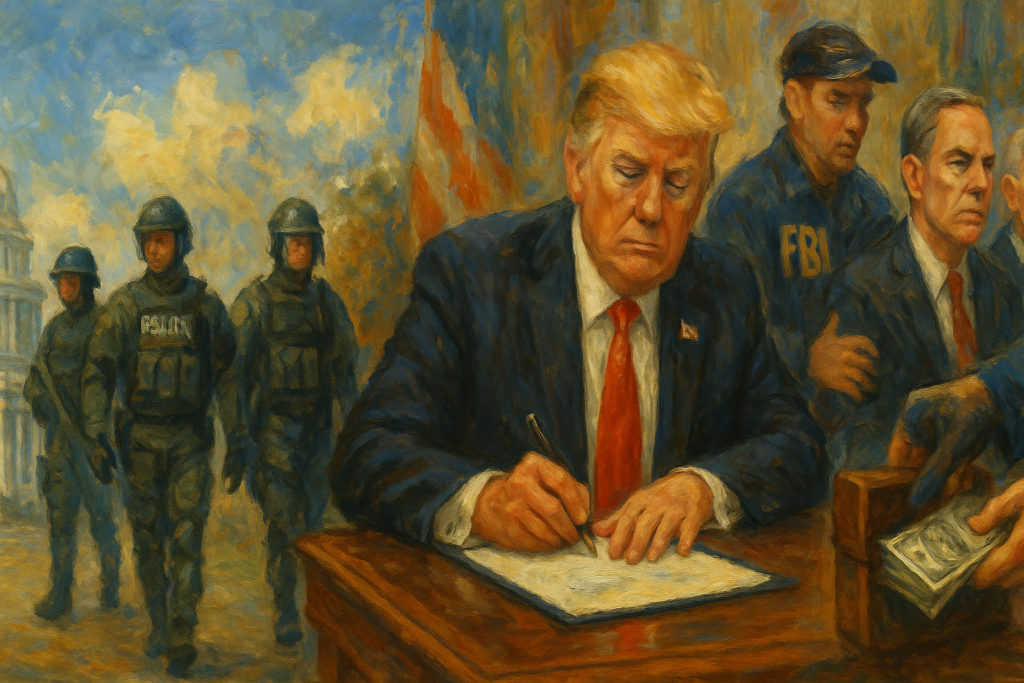
This week’s throughlines
- Justice Department independence gave way to overt political pressure — The week began with Trump publicly pressing for prosecutions, continued with the forced exit of Erik Siebert, and ended with Lindsey Halligan installed as a loyalist prosecutor while anti-corruption capacity and oversight remained under strain.
- Dissent was increasingly framed as terrorism or illegality — The administration moved from calling criticism illegal to formally designating antifa as a domestic terrorist organization and then broadening that logic into a memorandum aimed at left-wing groups, activists, and nonprofits.
- Pressure on information systems and media continued through both state action and corporate response — The Pentagon imposed new restrictions on reporters, the FCC threatened ABC over Jimmy Kimmel, and the fight continued through reinstatement, affiliate refusals, and renewed presidential attacks on the network.
- Immigration enforcement expanded in money, personnel, and human cost — The administration recruited military lawyers for immigration courts, Congress poured money into enforcement, and the week closed with new data showing more detainees without criminal records, plus deaths, hunger strikes, and force incidents around ICE custody.
- Shutdown politics became a vehicle for coercion — Trump canceled funding talks, the House and Senate failed to settle the spending fight, and the White House escalated by preparing for mass firings rather than ordinary furloughs if a shutdown occurred.
This week traced three converging lines of conflict over American democracy. Dissent and opposition were increasingly cast as security threats, with new terror designations and memoranda aimed at domestic activists. The justice and immigration systems were used asymmetrically, shielding allies while turning prosecutorial and detention powers against critics and vulnerable groups. And budget, foreign-aid, and trade tools were openly repurposed as partisan leverage at home and as instruments of ideological alignment abroad.
The weekend opened inside the national security apparatus. Director of National Intelligence Tulsi Gabbard abruptly revoked the security clearances of 37 people, including senior CIA officials and Democratic congressional staff. The move came without clear White House direction or a transparent paper trail, and was justified as correcting flawed assessments and punishing perceived adversaries. In a system that depends on independent analysis and robust oversight, such sweeping, targeted revocations signaled that access to classified information was being tied more closely to political loyalty than to professional standards.
At the same time, other institutions registered early resistance to executive overreach. A federal judge dismissed Donald Trump’s $15 billion defamation suit against the New York Times as improper, underscoring limits on using civil litigation to punish critical reporting. Representative Adam Schiff noted that more than 400 lawsuits had already forced courts to halt over 100 administration policies and reinstate civil servants and CDC funding. On the foreign-policy front, the Pentagon informed European diplomats it would end military assistance to NATO countries bordering Russia, including programs like the Baltic Security Initiative. The House responded by voting unanimously to increase funding for that same initiative, a rare bipartisan signal that Congress was unwilling to let the administration unilaterally pull back from NATO’s eastern flank.
The weekend also made explicit how the president intended to use law enforcement. On social media, Trump publicly pressed Attorney General Pam Bondi to prosecute New York Attorney General Letitia James, former FBI director James Comey, Representative Schiff, and others, insisting that action was needed “immediately” for the country’s reputation. He claimed he had fired a federal prosecutor who had found insufficient evidence to charge James; that prosecutor then resigned. In parallel, reports surfaced that the FBI and Justice Department had quietly closed a corruption probe into border czar Tom Homan, despite undercover recordings of him accepting $50,000 in cash for steering contracts. Trump appointees dismissed the case as a “deep state” effort and declared there was “no credible evidence” of wrongdoing, while the White House flatly denied he took the money. Together, these episodes sketched a two-track system: pressure to prosecute political opponents, and protection for loyalists facing documented bribery allegations.
Other weekend developments showed how state and local actors were still trying to uphold civil-rights and press protections. California Governor Gavin Newsom signed a law barring most officers, including federal immigration agents, from covering their faces while on duty, aiming to increase transparency and accountability in public encounters. In Washington state, four people were arrested and charged in a violent hate crime against a transgender woman, and in Sacramento a man was arrested after firing into the lobby of local ABC affiliate KXTV; the FBI later charged him with interfering with a federally licensed station. Meanwhile, the killing of conservative activist Charlie Kirk on a Utah campus quickly became a flashpoint. Prosecutors charged Tyler Robinson with capital murder, citing texts about Kirk’s “hatred.” In Washington, FCC chair Brendan Carr threatened ABC’s licenses after Jimmy Kimmel criticized the administration’s response to Kirk’s death, and a New York City mayoral candidate canceled a town hall in protest of Kimmel’s suspension. A single crime thus became a pretext for regulatory threats against critical media, foreshadowing a broader campaign to police speech around politically sensitive events.
Foreign policy and the use of force also reflected a more personalized approach. Trump threatened “bad things” against Afghanistan if it did not return Bagram Air Base to U.S. control and demanded that Venezuela accept prisoners and psychiatric patients he claimed had been forced into the United States. Around the same time, he ordered a lethal strike on a Venezuelan vessel he labeled a terrorist-linked drug boat, without providing evidence to Congress or the public. These moves bypassed normal diplomatic channels and congressional consultation on war powers, raising the risk that presidential rhetoric and unilateral action could escalate conflicts without clear oversight.
By Monday, the framing of domestic opposition as a security threat moved from rhetoric into formal instruments. Trump signed an executive order branding “antifa” a domestic terrorist organization, despite the absence of a statutory framework for domestic terror lists and the movement’s loose, non-organizational nature. The order directed agencies to investigate, disrupt, and prosecute people and funders associated with antifa and protests, reviving a pledge from his first term. In practice, this invited the use of counterterrorism authorities—surveillance, financial scrutiny, and enhanced penalties—against a broad, ill-defined set of protesters and activists.
Inside the Justice Department, the capacity to police corruption was being hollowed out even as Congress tried to revisit the Homan case. New reporting showed that DOJ’s Public Integrity Section, the unit responsible for prosecuting public corruption, had shrunk from 36 attorneys to just two since Trump returned to office, amid resignations and reassignments. Democrats on the House and Senate Judiciary Committees launched oversight inquiries into the closed Homan bribery case, seeking FBI and DOJ documents despite lacking subpoena power. The combination of a gutted integrity unit and limited congressional leverage underscored how difficult it had become to hold senior officials accountable through ordinary channels.
The Supreme Court added to the week’s theme of expanding executive control. In Trump v. Slaughter, the Court granted a stay blocking the reinstatement of Rebecca Slaughter, the last Democratic leader of the Federal Trade Commission, whom a lower court had found was illegally fired. The 6–3 decision allowed Trump to proceed with her removal while appeals continued, signaling a willingness to let contested firings at independent agencies stand during litigation. That shift tilted the balance toward presidential power over regulators that were designed to operate at arm’s length from the White House.
Monday also saw the administration move to control economic and health information. The Agriculture Department canceled its long-running national food insecurity survey and annual household food security report, calling them politicized and unnecessary, even as the last data showed 18 million households struggling. The Bureau of Labor Statistics postponed its consumer expenditures report shortly after Trump fired the BLS commissioner over disappointing jobs numbers. By eliminating or delaying key data on hunger and spending, the administration made it harder for lawmakers and the public to see economic hardship and evaluate policy. In the health sphere, Trump announced that pregnant women should limit acetaminophen use, claiming it raises autism risk, and repeated anti-vaccine talking points, despite decades of evidence supporting the safety of both. He said the FDA would notify doctors of a “very increased risk of autism,” drawing sharp criticism from public health experts and foreign officials. When a president promotes unsupported medical claims, it undermines trust in health authorities and can alter patient behavior on a large scale.
Abroad, the administration continued to align policy with ideological allies and fossil interests. Officials pledged unusual financial support to Argentina, potentially via Treasury’s exchange stabilization fund, and signaled willingness to use “all options” to stabilize the economy of right-wing president Javier Milei. Energy Secretary Chris Wright announced the return of $13 billion in green-project funds to the Treasury, deriding prior climate initiatives as a “Green New Scam.” These moves redirected resources away from climate action and toward governments and sectors aligned with the administration’s political and economic preferences.
On Tuesday, Trump asserted unilateral control over a major social media platform. He signed yet another executive order delaying enforcement of a congressionally mandated TikTok ban for 120 days while negotiations continued to shift ownership to U.S. investors. This was the fifth delay, issued despite a Supreme Court ruling and statute requiring action, and effectively instructed DOJ not to enforce the law during the divestiture window. The episode showed how executive orders could be used to override both Congress and the Court on digital infrastructure, concentrating decisions about data flows and speech in the White House.
Budget politics grew more openly coercive. Trump announced on Truth Social that he was canceling meetings with Democratic leaders on government funding, accusing them of holding citizens hostage despite unified Republican control of government. The House passed a short-term funding bill, but the Senate failed to advance it, with Democrats insisting on restoring Affordable Care Act subsidies. The standoff left a shutdown increasingly likely and framed basic funding negotiations as a partisan showdown rather than a shared responsibility to keep government functioning.
Transparency around elite misconduct remained contested. The Republican-led House Judiciary Committee voted against subpoenaing CEOs of major banks over $1.5 billion in Epstein-related transactions. The House Oversight Committee delayed releasing Epstein records that reportedly mention Trump, and FBI Director Kash Patel refused to answer questions about his own appearance in those files. Separately, newly received documents showed scheduled Epstein meetings with Elon Musk, Peter Thiel, and Steve Bannon. The pattern suggested that when investigations touched powerful figures across politics and business, both Congress and law enforcement were reluctant to pursue full disclosure.
At the United Nations General Assembly, Trump used the global stage to project his domestic narratives. In multiple speeches he attacked what he called a “globalist migration agenda,” urged countries to close borders and expel foreigners, derided green energy and the Paris climate agreement as a “con job,” and made false claims about sharia law in London and his own conflict-resolution record. He criticized European leaders and the UN itself, drawing concern from allies. In parallel, the administration imposed a 50 percent tariff on Brazilian goods, citing unfair trade and a “witch hunt” against former president Jair Bolsonaro, and Treasury sanctioned the wife of a Brazilian Supreme Court justice involved in Bolsonaro’s conviction. These moves were widely seen as interference in Brazil’s internal affairs and a signal of support for Bolsonaro’s camp. Together, the speeches and sanctions illustrated how anti-migration, anti-climate, and loyalty-to-allies themes were being projected into foreign policy.
Immigration policy also shifted toward greater stratification. The Department of Homeland Security filed a proposal to overhaul the H‑1B visa lottery to prioritize higher-paid, higher-skilled applicants, while Trump announced a $100,000 fee for companies employing H‑1B workers. These changes would make it significantly more expensive and selective for employers to hire foreign talent, reinforcing class-based access to the United States and reshaping labor markets. Inside the State Department, career staff reported that over half of ambassadorships were vacant and many senior roles were filled by inexperienced appointees. New internal rules measuring “fidelity” to the administration were seen as chilling dissent and affecting promotions and job security, weakening the professional diplomatic corps at a time of heightened international tension.
Wednesday’s developments showed how courts and agencies were rebalancing power over foreign aid and domestic enforcement. In Department of State v. AIDS Vaccine Advocacy Coalition and a related order, the Supreme Court granted stays that allowed the administration to pause or let lapse roughly $4 billion in congressionally appropriated foreign aid under Executive Order 14169. The 6–3 decisions meant aid to health and democracy programs could be withheld while litigation continued, effectively letting the executive veto appropriated aid and shifting power over the purse from Congress to the White House. The State Department then announced plans to redirect $1.8 billion in foreign aid toward “America First” projects, moving away from democracy and health programs, while Treasury prepared a $20 billion package for Argentina’s right-wing government outside normal appropriations channels. Domestically, FEMA and DHS expedited over $11 million in disaster aid to rebuild a Florida pier after intervention by a political donor. These steps blurred the line between public policy and patronage, both abroad and at home.
Immigration detention conditions came under growing scrutiny from multiple directions. Portland issued a notice of violation to an ICE facility for detaining people overnight in violation of its land-use permit, asserting local authority over federal operations. In Georgia, double-amputee Rodney Taylor filed a habeas petition challenging eight months of ICE detention despite serious medical needs. California officials opened an investigation into the death of Ismael Ayala-Uribe in ICE custody, and senators demanded information on detainee deaths nationwide. These cases highlighted how aggressive detention policies were colliding with local law, medical ethics, and basic oversight, especially for detainees with limited legal recourse.
Inside the federal civil-rights apparatus, whistleblowers described a quiet rollback. At HUD, staff reported that the Office of Fair Housing had been downsized, employees reassigned or laid off, and gag orders imposed, particularly in cases involving domestic violence victims and segregation. Political appointees allegedly intervened to drop or weaken cases and reduce settlements, prompting HUD attorneys to sue Secretary Scott Turner over their reassignments. Weakening fair-housing enforcement from within the agency threatened to undermine decades of civil-rights protections and entrench discriminatory housing patterns.
The handling of information and symbolism also reflected partisan priorities. A branch of the National Archives improperly released nearly unredacted military records of Democratic Representative Mikie Sherrill to an ally of her Republican opponent, likely violating the Privacy Act, even as NARA invited public comment on proposed records schedules governing how agencies dispose of records. The White House unveiled a “Presidential Walk of Fame” featuring gold-framed portraits of presidents, except Joe Biden’s, which was replaced by a photograph of an autopen. Critics saw the exclusion as a deliberate attempt to erase a disfavored predecessor from official imagery. At the Pentagon, Defense Secretary Pete Hegseth dissolved the long-standing advisory committee on women in the armed services, calling its work a “divisive feminist agenda,” and ordered hundreds of generals and admirals to gather at a Marine base in Virginia for an unusual in-person meeting on standards and “warrior ethos.” The moves suggested an effort to reshape military culture and senior leadership along more ideologically aligned lines.
Courts continued to draw some boundaries around federal leverage. A federal judge blocked the administration from conditioning billions in emergency management grants on state cooperation with immigration enforcement, calling the conditions unconstitutional and arbitrary. In a separate case, another judge ordered the restoration of $500 million in frozen federal grant funding to UCLA, emphasizing due process and protection from political interference. These rulings showed that, even as other decisions expanded executive discretion, courts could still limit the use of federal funding as a cudgel against states and institutions that resisted administration priorities.
On Thursday, the domestic terror framing that began with the “antifa” order widened. Trump signed a presidential memorandum directing the FBI, DOJ, and Treasury to investigate and dismantle what he called a radical left domestic “terror network” fueling violence against ICE and other targets. The memo authorized wide-ranging probes of activists and nonprofits and blurred the line between counterterrorism and political opposition, embedding vague political categories into terrorism directives in ways that could sweep in lawful protest and advocacy.
Budget brinkmanship escalated into a direct threat against the civil service. An Office of Management and Budget memo instructed agencies to prepare for large-scale reductions in force—permanent firings rather than temporary furloughs—if a shutdown occurred, targeting programs not aligned with Trump’s priorities. OMB director Russell Vought publicly warned that if Democrats did not accept the Republican funding bill, the administration would attempt to fire large numbers of federal employees. Using the prospect of a shutdown to justify purging the civil service on ideological grounds challenged the long-standing norm of a merit-based, politically neutral bureaucracy.
The week’s campaign against former law enforcement and intelligence officials reached a new peak. A federal grand jury in Virginia indicted former FBI director James Comey on two felony counts for allegedly lying to Congress and obstructing a congressional proceeding related to his 2020 testimony. The case was pushed by Trump appointee Lindsey Halligan after a previous U.S. attorney had declined to bring charges. Career prosecutors reportedly objected, and legal experts questioned the strength of the evidence. Coming after Trump’s public demands for prosecutions and the closure of the Homan bribery case, the indictment reinforced the perception that criminal law was being used to settle political scores.
Immigration enforcement data and individual cases underscored a system casting a wider net. New ICE figures showed, for the first time in Trump’s second term, more detainees with no criminal record than with one. A viral video of an ICE officer pushing Monica Moreta-Galarza to the ground at a New York immigration court led to the officer’s removal from duty and calls for felony charges. In Los Angeles, a car wash owner filed a $50 million lawsuit over an ICE raid, and detainees at Louisiana’s Angola prison launched a hunger strike over lack of medical care and basic services. These developments pointed to an enforcement system increasingly focused on sweeping up non-criminal immigrants, with mounting human-rights concerns and legal backlash.
Trade and aid tools were further repurposed for political and economic leverage. Trump announced steep new tariffs—100 percent on pharmaceuticals, 50 percent on kitchen and bathroom cabinets, 30 percent on upholstered furniture, and 25 percent on heavy trucks—citing national security and unfair trade. At the same time, State and Treasury moved ahead with redirecting $1.8 billion in foreign aid and preparing the $20 billion Argentina package outside normal appropriations, while the Supreme Court’s earlier decisions allowed $4 billion in aid to lapse. Concentrating these decisions in the executive, often tied to political grievances or ideological allies, reduced transparency and predictability in both domestic and foreign economic policy.
Federal power was also used to pressure local education policy. The administration announced it would withhold more than $65 million in federal magnet school grants from districts in New York City, Chicago, and Fairfax, Virginia, because they declined to change policies for trans and nonbinary students. Conditioning core education funding on rolling back inclusive practices put civil-rights protections for vulnerable students in direct tension with federal financial support. In the media sphere, the Jimmy Kimmel saga continued: after ABC reinstated his show under public pressure, Trump publicly criticized the network, claiming the program amounted to an illegal campaign contribution to Democrats and hinting at further action. Major station groups Sinclair and Nexstar announced they would not air the show on their ABC affiliates, despite Disney’s decision. Coming after earlier FCC threats, the combination of regulatory pressure and ownership decisions narrowed the range of critical viewpoints available on mass broadcast platforms.
By Friday, the administration was openly anticipating a shutdown and describing it as a political weapon. Senior officials signaled they expected the government to close the following week and had no plans to negotiate with Democratic leaders. One official said the shutdown would disproportionately affect Democratic constituencies and priorities, framing the disruption as politically advantageous rather than a failure to be avoided. This approach further eroded the idea of neutral public service and cast basic government operations as tools in partisan conflict.
Immigration detention data and protest actions brought the week’s enforcement arc into sharp relief. Newly released figures confirmed that ICE was holding more immigrants with no criminal record (16,523) than those with criminal records (15,725), contradicting administration claims that enforcement focused on “dangerous criminals.” Nineteen detainees at the ICE processing center inside Louisiana’s Angola state penitentiary began a hunger strike, demanding access to medical and mental health care, basic necessities, and legal and religious services. Advocacy groups described unsafe and degrading conditions, including lack of medications for chronic illnesses. A hunger strike inside a notorious prison repurposed for civil immigration custody underscored systemic problems in how the United States treats people who are detained but not serving criminal sentences.
The week also saw a stark example of violent rhetoric from an elected official. Arizona state representative John Gillette posted on X that Democratic congresswoman Pramila Jayapal should be “tried, convicted and hanged” in response to a video where she discussed non-violent protest against the Trump administration. Gillette had previously defended January 6 participants and made derogatory remarks about Muslims. When calls for execution enter mainstream political discourse from sitting lawmakers, they risk normalizing threats as part of politics and deterring participation and oversight.
The campaign against former national security officials widened. The administration initiated a criminal probe into former CIA director John Brennan over his role in the 2016 intelligence assessment of Russian interference in support of Trump’s campaign. Coming on the heels of the Comey indictment, the Brennan investigation fit a broader pattern of targeting officials associated with prior investigations into Trump, raising concerns that future intelligence leaders might hesitate to candidly assess foreign threats that implicate those in power. On the streets, protests and policing around UN week led to several arrests outside Israeli Prime Minister Benjamin Netanyahu’s New York hotel during a small, non-violent demonstration ahead of his speech. Separate reporting detailed how police use of teargas at protests in Michigan and Los Angeles over Gaza and immigration had caused long-lasting menstrual and hormonal disruptions among protesters, with little regulatory oversight of such chemicals. Meanwhile, a group of young climate activists filed a petition with the Inter-American Commission on Human Rights accusing the U.S. government of violating their rights by supporting fossil-fuel interests, seeking an international declaration that U.S. climate policy constituted a wrongful act.
Taken together, the week’s events showed an executive branch pressing its advantages across multiple fronts: redefining protest as terrorism, steering prosecutions toward critics and away from allies, using shutdown threats and foreign aid as partisan tools, and tightening control over information and data. Courts, states, and some members of Congress continued to push back in specific cases, restoring funding, enforcing local limits, and forcing votes on transparency. But the overall pattern was one of power flowing toward the presidency and away from independent institutions, with the justice system, immigration apparatus, and budget process increasingly enlisted in political struggles rather than standing apart from them.