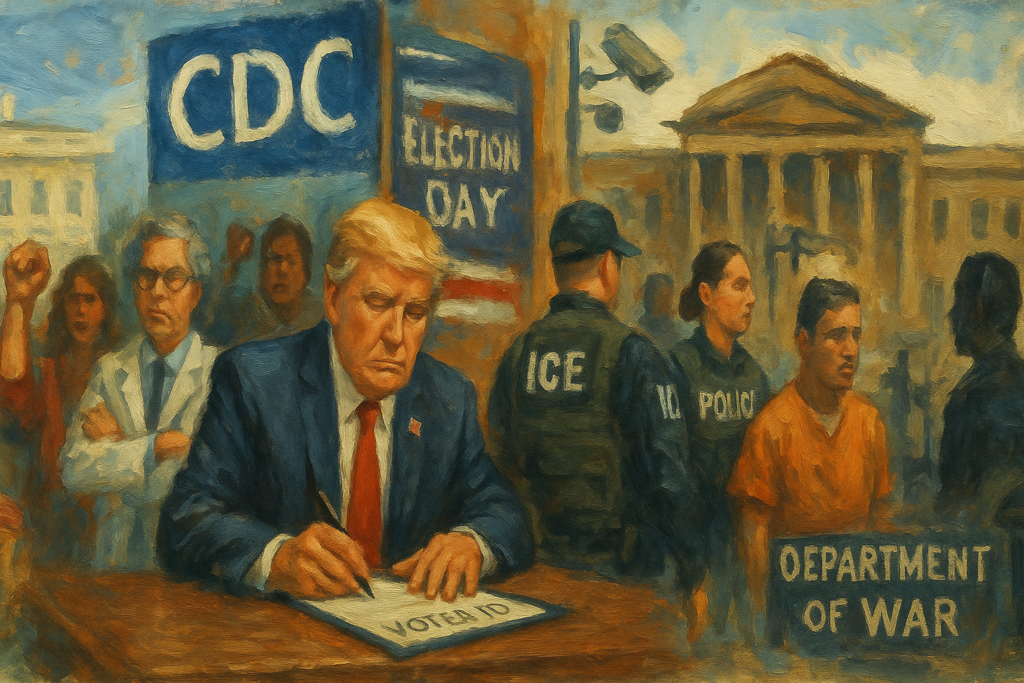
This week’s throughlines
- Immigration enforcement moved from policy hardening to militarized pressure on cities — The week began with stricter detention and surveillance tools, then expanded into recruitment drives, local-police incentives, lawsuits against sanctuary jurisdictions, and repeated threats to deploy troops or federal forces to Chicago and other cities.
- Public health leadership was politicized and then defended under congressional scrutiny — The firing of the CDC director and related resignations set off a week of warnings from former health leaders, contentious hearings for RFK Jr., and further moves against vaccine research and mandates.
- Executive power kept colliding with courts and institutional limits — The administration canceled appropriated funds, pushed election rules by executive order, appealed tariff and agency rulings, and faced repeated judicial checks on trade, immigration, university funding, and agency independence.
- Transparency and public memory became active political battlegrounds — Congressional fights over Epstein files and January 6 remembrance intensified, while reported DOJ handling of Epstein-related records and warnings against further disclosure deepened concerns about selective transparency.
The week opened with a jolt to the country’s public health system and closed with a symbolic shift in how the United States names its military power. In between, the administration moved to centralize control over elections, immigration, trade, and information, while courts, whistleblowers, state governments, and survivors tried to hold the line. What might look like scattered decisions—about bond hearings, voter registration tables, or research grants—added up to a steady reworking of how power is exercised and who is protected.
Over the weekend, the administration abruptly fired CDC director Susan Monarez, barely a month after her Senate confirmation. Monarez, a career scientist, had resisted Health Secretary Robert F. Kennedy Jr.’s push to align CDC guidance with his longstanding skepticism of vaccines. Trump backed Kennedy and installed Jim O’Neill, a biotech investor with no medical training, as acting director. Several senior CDC scientists resigned in protest. At the same time, the administration advanced deep cuts to CDC programs on smoking cessation, maternal and infant mortality, and other basic public health work. The combination of a leadership purge and program cuts signaled that scientific expertise would be subordinated to political loyalty, weakening the country’s capacity to manage both routine and emergency health threats.
The same weekend saw a broader campaign against internal dissent across the federal government. At the Environmental Protection Agency, at least seven employees were fired after signing a letter critical of agency leadership. At the Social Security Administration, chief data officer Charles Borges resigned under pressure after exposing massive data breaches affecting hundreds of millions of Americans. These cases unfolded alongside efforts to cancel union contracts and reclassify civil service roles, making it easier to remove career staff. The message to federal workers was clear: speaking up about mismanagement or risk would carry personal consequences, and the institutional channels that normally surface problems were being narrowed.
National security institutions were not spared. On Trump’s orders, Director of National Intelligence Tulsi Gabbard publicly revealed the identity of a senior undercover CIA officer who had worked on preparations for a Trump–Putin summit. She also revoked multiple security clearances, including that of an NSA artificial intelligence expert, without consulting the affected agencies. Exposing a covert officer and weaponizing clearances against perceived internal critics undercut the norms that protect intelligence work from political interference and signaled to analysts that their careers could hinge on political favor rather than professional judgment.
In economic policy, a federal appeals court in Washington, D.C., ruled 7–4 that Trump’s sweeping tariffs, imposed under the International Emergency Economic Powers Act, exceeded the authority Congress had granted. The decision voided most of the tariffs but delayed their removal to allow for appeal. Rather than accept the rebuke, the White House moved to preserve its trade posture by filing emergency appeals and, the same day, unilaterally canceling $4.9 billion in foreign aid that Congress had already approved. The administration’s assertion of control over spending that the Constitution assigns to Congress underscored an ongoing struggle over who directs economic statecraft: the legislature that writes the laws or a presidency leaning heavily on emergency powers.
Trump also used the weekend to announce plans to rewrite election rules from the Oval Office. Through social media and public remarks, he promised executive orders to impose nationwide voter ID requirements and sharply restrict mail-in voting, despite the Constitution’s assignment of election administration to the states. He urged Republican legislators in Texas, Indiana, and Missouri to redraw congressional maps to boost GOP representation and directed the Justice Department to investigate ActBlue, a major Democratic fundraising platform, while leaving its Republican counterpart untouched. None of these moves changed law immediately, but they signaled an intent to centralize control over the rules of political competition and to use federal investigative power selectively against opposition infrastructure.
Immigration policy hardened in parallel. The Department of Homeland Security advanced a legal position that anyone who entered the country illegally should be considered ineligible for bond, instructing government lawyers to appeal and automatically stay immigration judges’ bond decisions. The effect was to keep more people in detention for longer, regardless of individual circumstances. At the same time, DHS reinstated and expanded a contract with Israeli firm Paragon, giving Immigration and Customs Enforcement access to spyware capable of hacking phones and encrypted apps. Civil liberties advocates warned that combining expanded detention with powerful surveillance tools, in agencies that already operate with limited transparency, concentrated coercive power in ways that would be difficult to monitor or challenge.
The weekend also brought a sharp turn away from climate and clean-energy investments. Multiple agencies withdrew or canceled more than $1.3 billion in support for offshore wind projects in the Northeast, including halting the nearly complete Revolution Wind project and cutting Transportation Department funding. Labor leaders and governors warned of job losses, higher energy costs, and a stalled clean-energy transition. Separately, a federal appeals court allowed the administration to terminate over $16 billion in climate grants authorized under the previous administration. These decisions reshaped the energy economy not through new legislation but through executive reversals, shifting long-term environmental and economic risks onto states and local communities.
On immigration, the courts showed both their capacity to check and to enable executive action. Over the weekend, the administration attempted to deport up to 600 unaccompanied Guatemalan children from federal custody, some already on planes. Advocates rushed to court, and Judge Sparkle Sooknanan issued an emergency order halting the deportations and requiring that the children be returned to the Office of Refugee Resettlement. By Monday, all were reportedly back in ORR custody. The episode illustrated how quickly protections for vulnerable children could be bypassed—and how essential rapid judicial intervention can be in enforcing statutory safeguards.
Other weekend moves strained diplomacy and the information landscape. The administration suspended nearly all visitor visas for Palestinian passport holders and deployed naval forces and 4,000 troops off Venezuela’s coast under a drug-interdiction rationale, prompting Venezuelan troop movements and regional tension. Farm groups and manufacturers reported severe strain from Trump’s tariffs, with rising trade deficits, falling crop prices, and layoffs at firms like John Deere, even as the White House issued a Labor Day statement claiming—by orders of magnitude—that tariffs had generated $8 trillion in revenue. Kari Lake, acting head of the U.S. Agency for Global Media, announced layoffs of more than 500 staff at Voice of America and related outlets after a judge blocked her from removing VOA’s director, while PBS began its own layoffs tied to defunding of public broadcasting. Together with looming CDC cuts and university funding freezes, these steps narrowed the country’s independent information and research infrastructure. Amid these weighty shifts, smaller culture-war episodes—such as Cracker Barrel reversing a logo change after pressure from Trump, and a Trump-linked cryptocurrency quickly losing value after launch—showed how political influence was reaching into corporate branding and speculative finance.
Labor Day on Monday brought the contrast between the holiday’s origins and current policy into sharp relief. The White House canceled union contracts and stripped collective bargaining protections from nearly 450,000 federal employees, prompting protests and strikes, especially in the Washington, D.C., area. Framed as an efficiency measure, the move weakened organized labor in the public sector and made it easier to discipline or remove civil servants who resisted politicization. News coverage recalled that President Grover Cleveland had signed Labor Day into law in 1894 amid intense labor unrest, as a recognition of workers’ growing political power. The juxtaposition underscored how far federal labor policy had shifted away from protecting worker voice inside government.
Elsewhere on Monday, Trump announced that Space Force Command would be relocated from Colorado to Alabama, following lobbying by Senator Tommy Tuberville. Colorado’s delegation, including Republican Representative Lauren Boebert, opposed the move as politically motivated. Basing decisions for a major military command were thus openly treated as political rewards rather than strategic choices. In Congress, Representatives Thomas Massie and Ro Khanna pushed for a vote on their bill to compel disclosure of Jeffrey Epstein–related documents, with Massie preparing a discharge petition to force the issue. House leaders responded by adding a narrower oversight bill to the floor schedule, which Massie criticized as a diversion. Meanwhile, the Congressional Budget Office released estimates showing that Trump’s tax law delivered minimal benefits to families earning under $50,000 while significantly rewarding millionaires, often at the cost of Medicaid and food assistance. A Wall Street Journal–NORC poll found that only a quarter of Americans believed they could improve their standard of living, with many saying hard work no longer guaranteed getting ahead. The economic data and public mood pointed toward deepening inequality and frustration, conditions in which promises of strong, unconstrained leadership can gain traction.
On Tuesday, the fight over the Epstein files intensified. Massie filed his discharge petition to force a House vote on legislation mandating release of investigative files, needing 218 signatures and expecting broad Democratic support. At the same time, the House Oversight Committee, led by Republican Chair James Comer, issued subpoenas to figures including Hillary and Bill Clinton and demanded records from the Justice Department, Epstein’s estate, and the Treasury Department. These moves unfolded against White House resistance to broader disclosure. The outcome would determine whether Congress used its powers to expose or to selectively frame networks of elite abuse and potential official complicity.
House Republicans also moved to reshape public memory of January 6. They voted down an amendment requiring the Speaker to hang a plaque honoring police officers who defended the Capitol during the attack, and advanced plans for a new subcommittee, led by Representative Barry Loudermilk, to reinvestigate the events of that day. Supporters argued the prior committee had been biased; Democrats warned that the effort aimed to exonerate Trump and rewrite the history of an assault on the transfer of power. Control over how January 6 is officially remembered—whether as an insurrection, a protest, or something else—will influence accountability for political violence and public understanding of democratic norms.
Immigration enforcement accelerated further on Tuesday. DHS launched a drive to hire 10,000 new ICE officers and 3,000 Border Patrol agents by year’s end, offering bonuses and lowering age and training requirements. It also offered to cover salaries and benefits for state and local officers who joined federal immigration programs, with performance-based bonuses. Critics warned that rapid expansion with relaxed standards and financial incentives could fuel misconduct and deepen fear in immigrant communities. Attorney General Pam Bondi issued precedential immigration rulings narrowing asylum eligibility for families targeted by gangs and victims of domestic violence, using the attorney general’s authority over immigration courts to tighten humanitarian protections without new legislation. In the courts, the Fifth Circuit blocked Trump’s attempt to use the Alien Enemies Act—a wartime statute—to deport Venezuelans absent an actual invasion, while another appeals court stayed a lower-court order closing Florida’s “Alligator Alcatraz” immigration jail, allowing the controversial facility to keep operating. These rulings showed how judicial oversight could both limit and sustain aggressive enforcement tools, depending on the case.
Voting access was also affected by quieter administrative changes. U.S. Citizenship and Immigration Services issued a policy barring nongovernmental groups from registering new voters at naturalization ceremonies, cutting off a traditional moment when new citizens receive help exercising their franchise. Voting-rights advocates warned that such incremental steps, layered on top of broader rhetoric about restricting mail voting and imposing national ID rules, could cumulatively narrow access to the ballot for new Americans. Meanwhile, whistleblower advocates at the Government Accountability Project sent a letter to Congress alleging illegal retaliation against more than 30 FEMA employees who had been suspended after signing a letter warning lawmakers about agency problems, calling for investigations and stronger protections. And a federal appeals court confirmed that the administration could proceed with terminating over $16 billion in climate grants, reinforcing the executive branch’s ability to unwind large policy commitments without legislative input.
By Wednesday, resistance inside the health bureaucracy became public. More than 1,000 current and former employees of the Department of Health and Human Services signed a letter calling for Health Secretary Robert F. Kennedy Jr. to resign, accusing him of endangering public health by spreading vaccine misinformation and installing ideologues at the CDC. Nine former CDC directors published an op-ed warning that his policies and staff purges threatened national health. They pointed to Monarez’s firing and the appointment of vaccine skeptics to advisory roles as evidence that scientific standards were being replaced by ideology. Such open revolt from career health professionals and former leaders is rare, and it underscored how deeply the administration’s antivaccine turn had unsettled the public health establishment.
States also began to respond to federal enforcement pressure. California lawmakers passed a bill requiring K–12 schools, state universities, and community colleges to notify students, staff, and families when immigration enforcement agents were on campus, using systems similar to emergency alerts. The measure, awaiting the governor’s signature, was designed to protect educational environments from surprise raids and to reassure families that schools would not become traps. At the federal level, USCIS announced it would add law enforcement agents empowered to make arrests and execute warrants for immigration violations, shifting a benefits-focused agency further toward policing. Separately, reports emerged that the Justice Department was considering a policy to ban trans people from owning firearms by classifying being trans as a disqualifying mental illness. Both moves reflected the use of regulatory and enforcement tools to expand state power over specific populations, raising civil rights concerns.
The administration also used litigation to pressure localities. The Justice Department sued the city of Boston and Mayor Michelle Wu, arguing that the city’s sanctuary policies obstructed federal immigration enforcement. The case fit a broader pattern of using federal lawsuits to challenge jurisdictions that limited cooperation with ICE, testing the balance between local autonomy and federal power in setting public safety priorities. In Congress, House Republicans formalized their new January 6 subcommittee, granting it full subpoena authority and a mandate to report by the end of 2026, cementing their effort to reframe the attack. On the Epstein front, the House Oversight Committee released more than 33,000 pages of related records, but most were already public, drawing criticism for offering little new information. An undercover video captured a Justice Department official discussing plans to redact Republicans from Epstein files and to move Ghislaine Maxwell to a minimum-security prison; a subsequent DOJ statement effectively acknowledged the comments. For survivors and the public, the episode reinforced fears that politically connected figures were being shielded.
Wednesday also highlighted the risks to protest and oversight in a more securitized environment. Details emerged of the FBI’s July arrest of Bajun Mavalwalla, a former Army sergeant, on federal conspiracy charges tied to a protest at an ICE facility in Spokane. He faced up to six years in prison despite not being arrested at the scene. Veterans and legal experts warned that such charges against a protest organizer could chill lawful dissent. In the House, members declined to censure Democratic Representative LaMonica McIver, who had been indicted after attempting to conduct oversight at an ICE facility; five Republicans joined Democrats to block her removal from the Homeland Security Committee, signaling some bipartisan concern about criminalizing legislative oversight. Meanwhile, economic warning signs continued: ADP reported that private-sector hiring in August had slowed sharply, adding to evidence of a weakening labor market.
On Thursday, Trump made explicit what had been implicit in many of his moves. He reiterated that he required “authoritarian powers” to restore U.S. prosperity, framing democratic checks as obstacles. The same day, he issued an executive order implementing a new tariff framework with Japan, imposing a baseline 15 percent tariff on most imports and structuring large Japanese investments in the United States. These steps came as his team pursued emergency appeals to preserve his broader tariff regime in the face of adverse court rulings. By openly linking prosperity to unchecked executive power while consolidating trade tools in the presidency, the administration normalized a more concentrated model of economic governance.
Domestically, the security presence became more visible. Reports from Washington, D.C., described armed National Guard soldiers and federal agents—including ICE and FBI—patrolling neighborhoods, profiling and arresting residents, including children. Local organizers called for a national march, “We Are All DC,” to demand withdrawal of federal forces and restoration of local control. In Georgia, hundreds of workers, including South Korean nationals, were arrested in an immigration raid at a Hyundai battery plant under construction, despite Hyundai’s recent pledge of $26 billion in U.S. investments. South Korea’s Ministry of Foreign Affairs protested the arrests to the U.S. Embassy, expressing concern for its citizens’ rights and the impact on economic cooperation. Aggressive domestic enforcement actions were thus spilling into foreign relations, complicating ties with key allies.
The struggle over information and accountability continued on Thursday as well. Survivors of Epstein’s abuse held a press conference outside the Capitol, joined by bipartisan lawmakers, demanding justice and full disclosure of Epstein-related files. During their remarks, fighter jets flew overhead in restricted airspace, drowning out parts of the event; reporting indicated the flyover had been arranged by the administration. Combined with DOJ comments about redactions and easing Maxwell’s conditions, the spectacle reinforced fears that state power was being used to muffle and manage the scandal. Universities and public media absorbed further shocks: the president of Northwestern University resigned after the administration froze nearly $800 million in research funding, citing the need to preserve academic freedom, and PBS confirmed layoffs of 34 employees due to defunding of public broadcasting. These actions highlighted how federal funding levers were being used to pressure institutions that inform the public and scrutinize power. In the financial sphere, the Justice Department opened a criminal investigation into Federal Reserve governor Lisa Cook for alleged mortgage fraud, following referrals from a housing regulator. Critics questioned whether the probe reflected neutral enforcement or political pressure on an independent economic policymaker. At the grassroots level, community groups responded to the heightened federal presence by organizing ICE watch trainings to educate residents about their rights and how to document encounters, a form of civic self-defense when formal protections seemed to be weakening.
Friday brought the week’s closing symbol. Trump signed an executive order restoring the historic name “Department of War” as a secondary title for the Department of Defense, directing agencies to use it in communications and allowing the defense secretary to style himself “Secretary of War.” The Pentagon’s website began redirecting to war.gov, and officials were instructed to explore a permanent legislative change. The order bypassed Congress while asserting presidential control over the language and imagery of U.S. military power, signaling a more openly martial posture at a time when National Guard troops and federal agents were already patrolling domestic streets.
Public health policy continued its turn away from established science. Health Secretary Kennedy canceled $500 million in mRNA vaccine research funding, drawing sharp criticism from public health experts and former CDC directors who warned that the decision would slow innovation and preparedness for future outbreaks. In Florida, the state legislature advanced a proposal to eliminate all vaccine requirements for public school students, including for polio, measles, and tetanus, aligning state policy with Kennedy’s antivaccine stance. Together with the earlier CDC purge, these moves risked the return of preventable diseases and embedded fringe views into official health policy, with consequences that would likely unfold over years rather than days.
On the economic front, the administration formally petitioned the Supreme Court to overturn the appeals court ruling that had found its emergency-based tariffs illegal. The case will test how far a president can go in using national emergency declarations to reshape trade policy without Congress. In a counterpoint, a federal judge ruled that the administration had unlawfully terminated $2.6 billion in grants to Harvard University, ordering the funding restored. The court found the cuts were retaliatory after Harvard refused to alter its policies to meet White House demands, reinforcing legal limits on using federal money to punish academic institutions. Trump also issued an executive order creating a new designation—State Sponsor of Wrongful Detention—for foreign governments that detain U.S. nationals unjustly, authorizing sanctions, travel restrictions, and aid limits. The order strengthened tools to protect Americans overseas but also concentrated significant foreign-policy discretion in the executive branch.
The week’s final developments in the Epstein saga came from the Justice Department, which issued a statement effectively confirming an official’s recorded comments about improving Ghislaine Maxwell’s prison conditions and offering incentives for her silence. Combined with earlier talk of redacting Republicans from Epstein files and the orchestrated disruption of survivors’ press events, the episode deepened concerns that the department was shielding politically connected individuals even as it wielded its powers aggressively in other arenas.
Taken together, the week’s events traced a pattern: executive power pressing into domains traditionally buffered by professional norms, legislative authority, or local control—public health, elections, immigration, trade, and the military—while countervailing forces tried to assert limits. Courts blocked some overreaches, from mass child deportations to retaliatory university funding cuts, but allowed others, such as the continuation of harsh detention facilities and the termination of major climate programs. Whistleblowers, career officials, state legislatures, and survivors of abuse used letters, lawsuits, and public testimony to resist. As economic anxiety deepened and official narratives about past abuses and political violence were contested, the struggle over who sets the rules—and how far they can go—remained at the center of American democratic life.