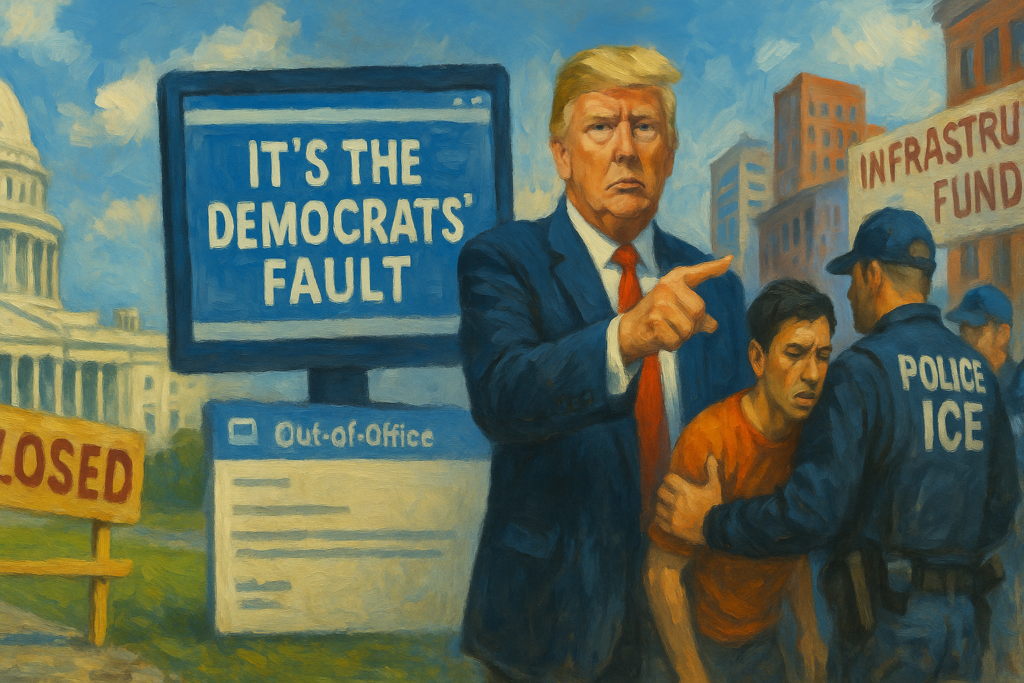
This week’s throughlines
- The shutdown became an instrument of executive leverage — What began as funding brinkmanship turned into a broader campaign: threats of mass firings, actual mass resignations, partisan agency messaging, and open talk of using the shutdown to make program cuts permanent.
- Federal coercion widened against cities, states, and protest spaces — The administration moved from ordering troops to Portland to freezing funds for Chicago and threatening other Democratic-led jurisdictions, while also expanding domestic-security framing around protest and cartel policy.
- Immigration enforcement hardened while courts and lawsuits pushed back unevenly — The week featured firings and appointments that reshaped immigration adjudication, lawsuits over raids and sanctuary policies, grim detention reports, and a late-week Chicago crackdown, alongside court rulings protecting some speech and procedural rights.
- Manipulated information moved from social media into official settings — False claims, deepfakes, and partisan government messaging escalated through the week, ending with synthetic videos in the White House briefing room and altered agency communications during the shutdown.
The week opened with the federal government edging toward a shutdown that the White House was already describing as an opportunity. Behind the budget brinkmanship were plans to thin the civil service, redirect public blame, and use control over money and force to reward allies and punish opponents. As agencies prepared to go dark, the administration also moved to deploy troops in U.S. cities, hardened immigration enforcement, and experimented with AI‑generated propaganda, while courts, unions, and some state officials tried to draw lines around what remained of institutional limits.
Over the weekend, the administration’s approach to domestic unrest and immigration came into sharper focus. Trump repeatedly announced plans to send federal troops and National Guard units into Portland, Oregon, to confront what he labeled “Antifa” and domestic terrorists. Oregon’s governor and Portland’s mayor objected, arguing there was no insurrection or mass disorder that could justify such a deployment. The state’s attorney general responded by filing lawsuits challenging both the legality of sending combat troops into the city and the federalization of 200 Guard members. Those suits framed the dispute as a test of long‑standing limits on using military forces at home and of the state’s authority to manage protests as a political, not military, problem.
At the same time, the administration accelerated its remaking of the immigration system. More than 100 immigration judges were fired and replaced with hundreds of military lawyers, shifting a quasi‑judicial system toward a more command‑driven model. Deportations of long‑settled Southeast Asian refugees with old convictions continued, even as members of Congress from Illinois and Oregon pressed ICE for oversight after clashes at detention facilities. ICE delayed or stonewalled those meetings. The Justice Department sued Minnesota over its sanctuary policies, and a federal filing detailed grim conditions at a Texas family detention center. Together, these moves concentrated discretion over who may remain in the country while signaling that sanctuary jurisdictions and refugees would face heightened pressure.
Shutdown preparations were already entwined with efforts to restructure the federal workforce. Trump ordered agencies to prepare for large‑scale firings tied to a possible funding lapse, building on a “Deferred Resignation Program” that had pushed tens of thousands of workers toward the exits. Unions sued, arguing the program was coercive and bypassed Congress’s role in setting employment terms. On Capitol Hill, Republicans embedded liability shields for pesticide makers into spending bills, seeking to insulate them from state warnings and lawsuits. As negotiations faltered, the prospect of a shutdown became not just a bargaining chip but a vehicle for changing who works in government and who can be held accountable in court.
The justice system itself was pulled into partisan crosscurrents. The Justice Department indicted former FBI Director James Comey for allegedly lying to Congress, a move widely seen as targeting a prominent Trump adversary. The New York City Bar Association warned against prosecutions driven by impermissible motives, underscoring concern that criminal law was being used as a tool of political payback. At the Supreme Court, Justice Clarence Thomas signaled openness to revisiting precedents on church‑state separation and same‑sex marriage, hinting that core rights recognized in recent decades could be reconsidered in the coming term.
Questions of transparency and elite accountability surfaced in a different register. The Justice Department refused to release additional files from the Epstein investigation, insisting no “client list” existed, even as House Oversight Democrats published more documents showing meetings between Epstein and prominent figures. In apparent counter‑programming, Trump ordered the declassification of all government records on Amelia Earhart, shifting public attention to a historical mystery rather than ongoing questions about abuse of power. Elon Musk publicly distanced himself from the newly released Epstein materials, illustrating how high‑profile figures sought to manage their own exposure.
Universities and civil liberties were also under strain. Northwestern University blocked at least 300 students from registering for classes after they refused to complete a mandatory antisemitism training video produced by an outside group. Students criticized the content as biased and factually flawed, while the university cited federal expectations amid administration threats to pull funding from campuses deemed insufficiently responsive to antisemitism. The episode showed how federal pressure could turn contested political content into a condition for enrollment, blurring the line between anti‑bias efforts and compelled speech.
Information itself became a contested field. Trump posted and then deleted an AI‑generated video touting fictional “MedBed” hospitals and a national MedBed card, echoing fringe conspiracy theories about miracle cures. He also amplified false claims that hundreds of FBI agents had acted as agitators on January 6, contradicting inspector general findings. Officials, including FBI Director Kash Patel, later contradicted or walked back these narratives. Unlike ordinary political spin, these were fabricated images and baseless accusations pushed from the top of the executive branch, eroding trust in both public health guidance and the integrity of investigations.
Other enforcement choices highlighted uneven protections. The FBI arrested a Texas man for threats against a Pride parade, showing federal willingness to act against anti‑LGBTQ violence. Yet Florida’s appeals court struck down a longstanding open‑carry ban, expanding public gun carrying. ICE continued deportations of Southeast Asian refugees with deep U.S. ties, and Louisiana pursued a California doctor over mailed abortion pills, previewing deeper conflicts over bodily autonomy and cross‑state enforcement. These moves suggested a landscape where some vulnerable groups received protection while others faced expanding state control over their bodies and legal status.
Foreign policy developments over the weekend echoed the domestic turn toward unilateral power. Reports emerged that the administration was drawing up plans for military strikes on drug traffickers inside Venezuela, and Trump signed an executive order granting NATO‑like security guarantees to Qatar without Senate approval. Both steps treated counternarcotics and bilateral ties as grounds for quasi‑war powers and alliance‑style commitments, further shifting war‑making and treaty authority toward the executive.
By Monday, the looming shutdown and civil‑service exodus were quantified. Reporting showed that more than 100,000 federal workers enrolled in the Deferred Resignation Program were set to leave at the fiscal year’s end, with projections of at least 275,000 departures overall—an unprecedented hollowing out of the civil service. A White House memo estimated that a shutdown could cost $15 billion in GDP per week and threaten tens of thousands of jobs. Unions continued to argue that the resignation program was coercive and undermined agency missions, warning that expertise and capacity were being deliberately eroded.
Courts and regulators offered partial counterweights. A federal judge blocked the administration from reallocating $233 million in FEMA disaster funds away from 12 Democratic states, calling the move unlawful. Another judge ruled that Trump’s acting U.S. attorney for Nevada was not validly serving, the second such rebuke of an acting appointment. Meanwhile, the Federal Trade Commission unanimously authorized an antitrust lawsuit against Zillow and Redfin over an alleged non‑compete advertising deal in the rental market. These actions showed that, even amid politicization, some judges and regulators were still enforcing legal limits on executive power and corporate concentration, while more routine regulatory work at agencies like EPA, CDC, FDA, and GSA continued largely out of public view.
Immigration enforcement continued to reshape local institutions. Iowa revoked the education license of Des Moines superintendent Ian Roberts after ICE detained him on a final removal order, abruptly removing the leader of the state’s largest school district. The administration deported dozens of Iranians under a new deal with Tehran, raising fears of persecution on return, while deportations of Southeast Asian refugees persisted. These actions underscored how legal status could override years of community contribution, destabilizing schools and neighborhoods.
In the post‑Roe legal environment, criminalization of pregnancy accelerated. New research showed that more than 400 people, mostly low‑income women in the South, had been charged with pregnancy‑related crimes in the two years since Roe v. Wade was overturned, including 16 homicide cases. Louisiana issued a warrant for a California doctor accused of mailing abortion pills into the state, part of a broader effort to target telemedicine providers across state lines. These developments, combined with the weekend’s Louisiana investigation, illustrated how states were using criminal law and extraterritorial claims to police reproductive care.
Federal funding became a lever over universities and social services. The Office for Civil Rights at HHS warned Harvard it could be debarred from federal grants, signaling a willingness to use funding as leverage over elite campuses. At the same time, reporting indicated that the administration planned to cut more than half of federal funding for a major HUD homelessness program, putting over 170,000 people at risk of losing housing support. Budget tools were being used both to constrain dissenting institutions and to reshape social policy.
Trump’s rhetoric toward the military hardened. In a speech to military leaders in Virginia, he described domestic unrest as an “invasion from within,” advocated using combat troops in U.S. cities, and suggested urban areas could serve as training grounds. He warned that military leaders who did not comply with his directives could be dismissed, noting that some had already been removed. This language tied military careers to political loyalty and framed domestic opponents as internal enemies, eroding norms of an apolitical armed forces and setting the stage for later moves in Portland and Chicago.
On Tuesday, the shutdown formally hit, and agencies turned official channels into partisan messaging platforms. As funding lapsed, HUD, VA, DOJ, USDA, and Education used websites, mass emails, and even furloughed employees’ out‑of‑office replies to blame Democrats for the shutdown. HUD’s homepage carried a red banner attacking the “radical left,” and Education staff found their automatic messages repeatedly altered back to partisan language. Complaints cited likely violations of the Hatch Act, which bars partisan activity by federal employees, but the office that enforces that law was itself closed by the shutdown. The episode showed how a funding lapse could be used to saturate public‑facing communications with one‑sided blame.
Courts continued to push back on some fronts. Judge William G. Young ruled that detaining and deporting foreign scholars and students for pro‑Palestinian views violated the First Amendment, stressing that non‑citizens share core free‑speech rights. Another Reagan‑appointed judge issued a similarly scathing opinion against efforts to deport pro‑Palestinian academics, and yet another court found Trump’s acting U.S. attorney for Nevada unlawfully serving. These rulings highlighted judicial resistance to some of the administration’s most aggressive legal tactics, particularly where speech and lawful appointments were at stake.
Immigration detention practices drew new legal scrutiny. A detailed court filing exposed harsh, prison‑like conditions at the South Texas Family Residential Center, including unsafe water, poor food, and prolonged child detention. A U.S. citizen from Alabama sued over being twice detained by ICE during warrantless raids despite showing identification, and another lawsuit challenged the administration’s aggregation of personal data across agencies as unconstitutional and a threat to voter rights. These cases underscored how aggressive enforcement and data practices could violate due process and privacy, especially for people who are or appear to be immigrants.
The information battlefield widened. Trump’s account shared a deepfake video of Senate and House Democratic leaders in a derogatory light, and the White House later played racist AI‑generated clips of the same figures on loop in the briefing room. Unlike edited campaign ads, these were fabricated images presented from official venues, blurring the line between reality and fiction. Separately, the Department of Energy ordered staff to avoid terms like “climate change” and “decarbonization” in communications, and the White House issued a press release overstating weak evidence that Tylenol use in pregnancy causes autism. Together with the MedBed episode, these moves showed how AI tools and selective science could be used from the top to shape public understanding.
Civil‑rights and reproductive‑rights conflicts intensified. The report documenting more than 400 pregnancy‑related prosecutions since Roe’s fall was paired with news that Wisconsin Planned Parenthood clinics had suspended abortion services to preserve Medicaid funding for other care, after a new federal provision penalized high‑volume abortion providers. Utah’s governor publicly called for an end to political violence after the killing of right‑wing activist Charlie Kirk and other recent attacks, highlighting how heated rhetoric and legal crackdowns were unfolding against a backdrop of real‑world violence.
Even election oversight became less visible. The Federal Election Commission canceled multiple open meetings scheduled for the coming months while proceeding with a closed meeting on civil actions, citing the Government in the Sunshine Act but offering little explanation. At the same time, Defense Secretary Pete Hegseth announced an overhaul of the Pentagon’s Inspector General’s Office and changes to personnel records retention while under investigation himself, and the acting inspector general for the National Archives opened an inquiry into the near‑unredacted release of a Democratic lawmaker’s military records. These moves raised concerns that watchdog functions and transparency around campaign finance and government misconduct were being weakened.
By Wednesday, the shutdown’s economic and informational effects were more visible. The Labor Department postponed its monthly jobs report, depriving the Federal Reserve and markets of key employment data. The administration also suspended all Voice of America news broadcasts and furloughed its journalists, a break from past practice during funding lapses and one that followed a court order reinstating hundreds of VOA employees. Silencing a major public broadcaster and delaying economic data reduced independent information available to both policymakers and the public at a moment of manufactured crisis.
The White House and Office of Management and Budget escalated their use of funding as a political weapon. OMB Director Russ Vought froze roughly $18 billion in New York City infrastructure projects, including the Hudson Tunnel and Second Avenue Subway, and halted $2.1 billion for Chicago transit expansions, citing opposition to race‑based contracting and diversity, equity, and inclusion principles. He also announced cancellation of nearly $8 billion in climate‑related funding across 16 largely non‑Trump states. Internal White House estimates acknowledged that the shutdown itself would cost billions in GDP and tens of thousands of jobs, underscoring that economic harm was an accepted cost of this strategy.
The Supreme Court weighed in on two fronts. It deferred action on Trump’s attempt to remove Federal Reserve Governor Lisa Cook, allowing her to remain in office while scheduling arguments for January 2026, thereby protecting the Fed’s independence for now. In a separate emergency order, however, the Court granted the Department of Homeland Security’s request to proceed with ending Temporary Protected Status for Venezuelan and Haitian nationals while litigation continues, over the dissent of three justices. The decisions illustrated a pattern in which the Court shielded some institutions from political interference while deferring to the executive on life‑altering immigration decisions.
States pushed back against federal civil‑rights and immigration rules. A coalition of 20 states sued the Justice Department over a rule that would bar aid to sexual‑assault and domestic‑violence victims who could not immediately prove immigration status, arguing it undermined both victims’ rights and state authority. In a separate case, an immigration judge rejected a motion to reopen asylum for Kilmar Ábrego García on procedural grounds, despite arguments that he met statutory deadlines. These disputes showed how strict procedural readings and status‑based conditions could close off protection even when substantive claims remained.
Reproductive‑rights pressures continued to ripple. Planned Parenthood in Wisconsin confirmed it had suspended abortion services to maintain Medicaid funding for cancer screenings and contraception, illustrating how federal tax and spending provisions could force clinics to choose between abortion care and broader health services for low‑income patients. Meanwhile, bipartisan skepticism in the Senate led the White House to withdraw the nomination of a Heritage Foundation economist tied to Project 2025 to lead the Bureau of Labor Statistics, reflecting concern that key statistical agencies could be bent toward political ends. A class action challenging mass aggregation of personal data across agencies added to worries that information infrastructure itself was being politicized.
Trump’s rhetoric to the military escalated further at Marine Corps Base Quantico, where he warned leaders about an unspecified “enemy from within,” likened domestic unrest to a foreign invasion, and again suggested that cities like San Francisco and New York could serve as training grounds. He paired these themes with partisan attacks on Democratic‑run cities, seeking to align the military with his political narrative and further normalizing the idea of using armed forces in domestic political conflicts.
On Thursday, the shutdown was openly leveraged as a policy tool. Even as domestic agencies remained shuttered, the administration announced it would proceed with a $20 billion bailout for Argentina’s economy, benefiting right‑wing leader Javier Milei and certain investors. In a press briefing, Trump said he intended to use the shutdown to implement cuts to medical and benefit programs that could be “irreversible.” Internal memos projected steep GDP losses and job cuts from the shutdown itself, underscoring that the fiscal crisis was being used to reorder social policy without normal legislative debate.
Immigration law and racial profiling reached the Supreme Court in a different way. While some courts had rebuked deportations of pro‑Palestinian scholars earlier in the week, others sided with the administration: the Court allowed DHS to proceed with ending TPS for Venezuelan and Haitian nationals during appeal, and Justice Brett Kavanaugh authored a ruling permitting racial profiling by ICE so long as citizens were released upon proving status. Lawsuits continued over DOJ rules tying victim aid to immigration status and over warrantless ICE raids that detained U.S. citizens. The result was a judiciary that sometimes reined in executive overreach but also legitimized practices that eroded equal protection.
The White House leaned further into deepfakes and misleading medical claims. AI‑generated videos of Democratic leaders were played on loop in the briefing room, falsely suggesting support for health subsidies for undocumented immigrants; Vice President JD Vance dismissed concerns as humor. A separate press release claimed acetaminophen use in pregnancy causes autism, citing weak and selectively presented evidence. Coming on top of the MedBed and Tylenol narratives, these episodes showed how official platforms were being used to normalize fabricated or distorted health information, making it harder for citizens to rely on government communications.
Funding freezes and bailouts deepened regional divides. Vought continued to threaten cuts to New York projects and climate programs in Democratic‑leaning states, explicitly tying the moves to opposition to DEI and climate agendas, while the administration prepared bailout payments to farmers hurt by its own tariff policies, exploring tariff receipts as a funding source. At the same time, civil‑liberties lawsuits multiplied: plaintiffs including Leonardo Garcia Venegas and an Alabama citizen detained twice by ICE despite valid ID sued DHS and DOJ over unlawful detentions during immigration raids, alleging Fourth Amendment violations. These cases added to a growing docket challenging aggressive enforcement tactics that were increasingly indistinguishable from paramilitary operations.
By Friday, these strands converged in Chicago and beyond. Trump launched “Operation Midway Blitz” at Chicago’s Broadview immigration processing center, deploying ICE agents in military‑style gear to conduct mass arrests and detentions. Federal agents from Border Patrol, the FBI, and ATF raided a nearby apartment building, forcing residents—including children—into the street in zip ties. When protesters tried to block government vehicles, agents used tear gas and pepper balls to clear them. Local communities and activists denounced the operation as an overreach of federal power, seeing in it the domestic counterpart to the administration’s declared “armed conflict” with drug cartels abroad.
Funding decisions reinforced the sense of targeted federal power. Vought confirmed the freeze of $2.1 billion in Chicago transit funding and threatened to cut $26 billion from New York City projects that Congress had already approved, despite legal questions about doing so during a shutdown. The administration framed these moves as opposition to DEI and climate agendas, but they aligned closely with Trump’s threats to punish Democratic‑run cities. In parallel, Trump signed an executive order designating “Antifa” as a major terrorist organization and authorized government‑wide investigations into activists and nonprofits associated with “domestic terrorism.” Civil‑liberties groups warned that the vague definitions and broad mandates would intimidate and criminalize dissent, especially around immigration and civil‑rights protests.
The militarization of law enforcement extended beyond immigration. The administration informed Congress that it had declared a formal “armed conflict” with drug cartels, labeling them terrorist organizations and treating suspected smugglers as “unlawful combatants.” Legal experts criticized the move, arguing that drug trafficking did not meet the threshold for armed conflict and that the declaration granted the president extraordinary wartime powers without clear congressional authorization. In Atlanta, journalist Mario Guevara was deported to El Salvador after 100 days in ICE custody, following an arrest while covering a protest where charges were quickly dismissed. Press‑freedom groups condemned the deportation as a warning shot to reporters covering contentious demonstrations.
Digital platforms were drawn into enforcement politics. Apple removed the IceBlock app and similar tools from its App Store after pressure from the administration, which argued the apps posed “safety risks” to ICE officers. The apps had allowed users to report and monitor ICE activity; existing users retained access, and the developer vowed to contest the decision. Meanwhile, Trump reiterated that the shutdown would be used to implement cuts to programs providing medical care and other benefits, emphasizing that some changes could be “irreversible.” Insurance premiums were reported to be rising sharply for millions due to the shutdown’s handling, and rural and low‑income communities faced hospital closures and service reductions.
The week closed with Chicago as a case study in coordinated federal pressure: militarized raids, frozen transit funding, and threats against other urban projects unfolded alongside lawsuits, protests, and growing concern from local officials about both safety and economic fallout. Across the country, courts, regulators, universities, and state governments acted at times as counterweights, blocking some diversions of disaster funds, protecting some speech rights, and resisting some partisan appointments. Yet the broader pattern was of an executive branch using shutdown leverage, war‑powers logic, AI‑driven disinformation, and targeted funding to press against the boundaries of law, federalism, and civil liberties. How durable those boundaries prove to be will depend on whether the institutions that pushed back this week can sustain their resistance as the pressures mount.