This week’s throughlines
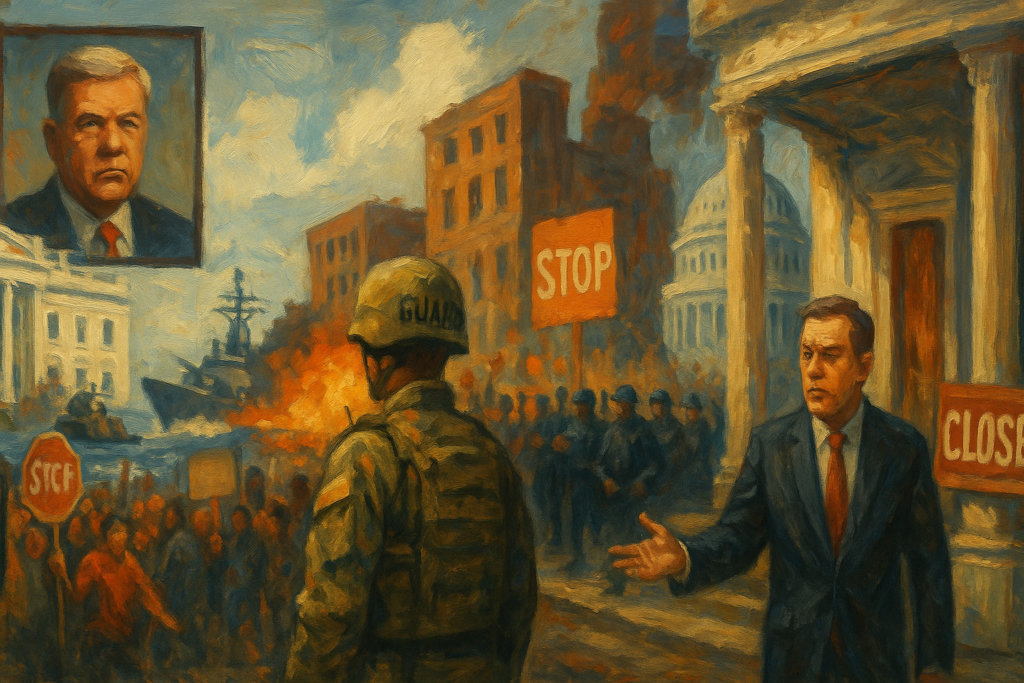
- Domestic military power met sustained judicial resistance — The administration kept trying to move troops into Portland and Chicago, while judges in Oregon and Illinois repeatedly blocked or narrowed those efforts and tested the factual basis for emergency claims.
- The shutdown was used as leverage, not just a budget impasse — As the Senate failed repeatedly to reopen the government, the administration used the shutdown to threaten layoffs, deny back pay, and target programs and projects in Democratic-led states and cities.
- Justice Department politicization moved from warning signs to concrete cases — Oversight hearings, internal resistance, and public warnings gave way to high-profile indictments and prosecutions that critics described as politically motivated, especially against James Comey and Letitia James.
- Federal immigration enforcement widened into a broader civil-liberties conflict — Raids, citizen detentions, force against protesters and journalists, and the furloughing of detention oversight turned immigration enforcement into a larger fight over due process, local autonomy, and press freedom.
The week opened with a struggle over who controls force in American life, from disputed military actions abroad to the presence of troops and federal agents on city streets. As the administration pressed expansive theories of presidential power, governors, mayors, and judges in places like Chicago, Portland, and Illinois tried to draw lines. At the same time, a deepening government shutdown and a fight over access to Epstein-related records showed how procedural levers in Congress and the executive branch were being used to shape policy and block transparency. By week’s end, indictments of prominent Trump critics, a reoriented national security apparatus, and a Supreme Court term packed with cases on voting and civil rights underscored how much of the country’s democratic framework now runs through contested institutions.
Over the weekend, the administration’s outward projection of power set the tone. Defense Secretary Pete Hegseth announced that U.S. forces had struck a boat off Venezuela, justifying the action by treating drug cartels as enemy combatants in an armed conflict. A classified Justice Department memo surfaced supporting lethal strikes on suspected drug boats under a broad reading of presidential war powers, effectively recasting drug enforcement as a theater of war. The New York City Bar Association condemned the move as an illegal summary execution and urged Congress to reassert its authority over the use of force, but the legal theory signaled a willingness to bypass traditional checks in the name of combating cartels.
At the same time, federal courts were already pushing back against domestic uses of force. In Oregon, Judge Karin Immergut repeatedly blocked or narrowed attempts to deploy National Guard troops to Portland, warning that the administration’s justifications blurred the line between civilian policing and military operations. Other judges halted a plan to automatically move immigrant youths into adult detention when they turned 18, rebuked what appeared to be a retaliatory prosecution of an undocumented immigrant who had previously won a deportation case, and struck down an effort to end birthright citizenship as unconstitutional. Together, these rulings insisted that both troop deployments and detention policies require factual and legal grounding, not just presidential preference.
The weekend also brought the first moves in what would become a weeklong confrontation over immigration enforcement and protest rights. Around a Chicago-area detention facility, federal agents escalated force against protesters and journalists, while in Portland, officers pepper-sprayed a peaceful demonstrator in a frog costume—an incident that became a symbol of disproportionate response. Illinois’s governor ordered a review of how children were treated during a federal raid, and activists from the Global Sumud Flotilla described harsh detention conditions before being deported. Against this backdrop, Trump authorized National Guard deployments to Chicago and other cities, and Texas Governor Greg Abbott sent Guard troops to Illinois and Oregon, prompting sharp criticism from Illinois officials who saw the moves as an intrusion on state authority.
In Congress, procedural power was deployed in quieter but consequential ways. House Speaker Mike Johnson postponed the swearing-in of Arizona Democrat Adelita Grijalva and kept the House in recess, steps widely interpreted as aimed at preventing Democrats from reaching the 218 signatures needed to force a vote on releasing Epstein-related records. Survivors and bipartisan sponsors continued to press for the Epstein Files Transparency Act, but without a full House and with floor time tightly controlled, their efforts stalled. A Senate report released at the same time detailed how the Department of Government Efficiency had gutted services and oversight, underscoring how structural changes inside the bureaucracy can weaken accountability even when they attract little public attention.
The justice system itself showed signs of strain. Reports over the weekend revealed that 139 immigration judges had been fired, pushed into early retirement, or involuntarily transferred under Trump, disproportionately affecting those with higher asylum grant rates. In South Carolina, Judge Diane Goodstein faced death threats and an arson attack on her home after she temporarily blocked the release of voter files to the Justice Department, prompting a state investigation. These developments, combined with Trump’s social media attacks on New York Attorney General Letitia James, Rev. Al Sharpton, and media companies, and his partisan speech to Navy personnel alleging the 2016 election was rigged, illustrated how legal and media critics were being singled out in ways that could chill independent judgment.
By Monday, the domestic militarization fight had shifted squarely to Illinois. After weekend rulings against Guard deployments in Oregon, the administration tried a new route: sending 300 California Guard troops to Portland and authorizing 300 Illinois Guard members to “protect” federal facilities. Illinois responded by suing to block deployments to Chicago, arguing that they were unconstitutional and part of a broader “war” on the state. Judge April Perry declined to immediately halt the Chicago deployment but said she needed more time, setting up a high-stakes hearing later in the week that would help determine how easily presidents can insert military forces into local law enforcement over state objections.
The Supreme Court opened a term that will shape the rules of democratic life for years. The justices prepared to hear challenges to Section 2 of the Voting Rights Act, which guards against racially discriminatory election maps; to state rules for counting mail-in ballots; and to bans on conversion therapy for minors. Other cases questioned Trump’s tariff authority under emergency economic powers and his attempt to remove Federal Reserve Governor Lisa Cook, testing how far presidential control extends over trade and independent economic institutions. The docket signaled that questions about who can vote, how elections are run, and how insulated key agencies are from the White House would be decided in the courts rather than through legislation.
On the same day, Attorney General Pam Bondi appeared before the Senate Judiciary Committee and faced pointed questions about the Justice Department’s direction. Senators pressed her on dismantling the Foreign Influence Task Force, shrinking the public integrity section, dropping corruption probes, and failing to produce the Epstein client list. Allegations that staff had been instructed to flag records mentioning Trump, combined with selective releases from the Jack Smith investigations and stonewalling over records related to border czar Tom Homan, fueled concerns that DOJ was shielding allies while targeting enemies. Those concerns were echoed in Virginia, where senior prosecutor Elizabeth Yusi told colleagues she saw no probable cause to charge Letitia James with mortgage fraud, despite pressure from newly installed U.S. Attorney Lindsey Halligan. Career staff prepared to decline charges and feared retaliation, but within days Halligan would secure an indictment, highlighting the clash between professional norms and political demands.
Meanwhile, the government shutdown was being reshaped into a tool of leverage. The Office of Management and Budget issued a draft memo arguing that furloughed workers were not automatically entitled to back pay, despite a 2019 law, and quietly revised guidance to remove references to guaranteed compensation. Director Russ Vought touted plans to use the shutdown to impose $26 billion in cuts to infrastructure and climate projects in Democratic-led states and to lay off federal employees. ICE kept most enforcement offices open but furloughed the Office of Detention Oversight, reducing scrutiny of detention conditions even as enforcement continued. These moves made clear that the shutdown was not just a lapse in funding but a vehicle for permanent policy changes and selective weakening of the federal workforce.
Public health and law enforcement institutions were also being reoriented. The CDC released a new immunization schedule that removed the universal COVID-19 vaccine recommendation and altered other guidance in ways that aligned with Trump’s public calls more than with established science, complicating access for children in programs like Vaccines for Children. At the same time, reports emerged that the FBI had fired at least two special agents involved in Trump-related investigations and reassigned nearly one in four agents in major field offices to immigration enforcement. Combined with the earlier firing of national security prosecutor Michael Ben’Ary, these staffing moves suggested a broader effort to purge officials tied to prior probes of Trump and to redirect investigative capacity toward his immigration agenda.
On Tuesday, Chicago became the central stage for the confrontation between local autonomy and federal power. As Texas National Guard troops arrived in the region under federal orders, Mayor Brandon Johnson signed an executive order barring ICE and other federal immigration agents from using city-owned property as staging grounds, his third such order aimed at limiting ICE’s footprint. The White House accused him of aiding crime, while Illinois Attorney General Kwame Raoul filed suit to stop the federalization of the Illinois Guard and the import of troops from other states. Judge April Perry again declined to immediately block the Texas deployment but left the door open for further relief, illustrating both the possibilities and limits of local resistance once troops are on the ground.
The shutdown stalemate hardened. The Senate again failed to pass competing Republican and Democratic funding bills: Republicans backed a short-term extension already passed by the House, while Democrats insisted on extending Affordable Care Act premium tax credits and reversing Medicaid cuts. Trump openly supported continuing the shutdown to force cuts to “popular Democrat programs,” particularly in Democratic-led states and cities. Speaker Johnson, under fire for keeping the House in recess and for his role in broader efforts to roll back the ACA and Medicaid, offered no clear path forward. The impasse underscored how basic government operations and social safety nets were being used as bargaining chips.
At the Supreme Court, the justices heard arguments in a case challenging Illinois’s law allowing mail ballots postmarked by Election Day to be counted for two weeks. Representative Mike Bost argued that extended counting forced candidates to keep campaigning and spending, claiming a legal injury. The outcome will affect not only Illinois but other states with similar postmark rules, potentially narrowing access for mail voters and increasing post-election litigation. In a separate case, Chiles v. Salazar, a majority of justices appeared skeptical of Colorado’s ban on conversion therapy for minors, treating it as a restriction on speech rather than professional conduct. A ruling against the ban could invalidate similar protections in more than 20 states and expand First Amendment defenses for practices widely condemned by medical organizations.
Elsewhere, the legal system continued to absorb politically charged disputes. Two Trump-appointed appeals judges paused a closure order for Florida’s Alligator Alcatraz immigration detention facility, allowing it to remain open despite findings of environmental violations and inhumane conditions. Detainees sued over being denied timely access to lawyers and being transferred without notice, while FEMA’s $608 million reimbursement for the facility bolstered arguments that it functions as a federal project requiring environmental review. New reporting also detailed how Trump and Speaker Johnson were pushing to roll back the Affordable Care Act, slash Medicaid, and even consider selling portions of the federal student loan portfolio to private markets, moves that would shift more risk onto low-income, sick, and indebted Americans.
By Wednesday, the shutdown’s effects were visible in everyday life. The FAA reported staffing shortages at major airports and air traffic control centers, causing delays nationwide. Air traffic controllers and TSA screeners continued working without pay, while unions and the transportation secretary warned of mounting strain. OMB memos casting doubt on back pay and Trump’s comments about selectively compensating workers deepened anxiety among federal employees, raising questions about the long-term attractiveness of public service in critical safety roles.
Inside the national security apparatus, the pivot toward immigration enforcement accelerated. DHS reassigned hundreds of national security specialists to immigration work, warning employees they could lose their jobs if they refused. Data compiled by Senator Mark Warner indicated that nearly one in four FBI agents in major field offices had been moved to immigration-related assignments, affecting cybercrime, terrorism, and other investigations. The shift suggested not just a temporary surge but a structural reorientation of federal law enforcement priorities around migration, with potential gaps in addressing other threats.
Press freedom and internal dissent came under new pressure. The Pentagon expanded efforts to crack down on leaks and investigated nearly 300 employees for online comments critical of conservative activist Charlie Kirk. New Defense Department restrictions on reporters drew a sharp rebuke from the Pentagon Press Association, which warned that the rules could criminalize routine journalism. Trump and Hegseth intensified efforts to identify and punish leakers, narrowing the space for both internal whistleblowing and independent coverage of national security. In the public health sphere, six former U.S. surgeons general from both parties issued a joint statement condemning HHS Secretary Robert F. Kennedy Jr. for spreading misinformation and mismanaging the department, warning that politicized CDC guidance and anti-vaccine rhetoric risked major health crises and a collapse in public trust.
The political backlash to cross-state troop deployments also grew. Illinois and Chicago’s lawsuit against Guard deployments moved forward, with a hearing set for Thursday. Governors J.B. Pritzker and Gavin Newsom called on Republican governors to oppose sending their Guard units into other states and threatened to leave the National Governors Association if it remained silent. Oklahoma’s Republican governor, Kevin Stitt, who chairs the NGA, publicly criticized the Texas Guard deployment to Illinois, marking a rare intra-party rebuke and signaling bipartisan concern that such practices threaten federalism. In the courts, former FBI Director James Comey appeared and pleaded not guilty to charges of lying to Congress and obstructing a proceeding, with his lawyers signaling plans to argue selective and vindictive prosecution and to challenge U.S. Attorney Lindsey Halligan’s appointment. The case, following Trump’s repeated demands that his enemies be indicted, became a test of whether high-profile prosecutions could be insulated from political pressure.
Thursday brought decisive judicial interventions on domestic militarization. In Chicago, Judge April Perry issued a two-week order halting the deployment of 200 Texas and 300 Illinois Guard troops, finding no credible evidence of a rebellion or similar emergency to justify such force. Another federal judge, Sara Ellis, imposed a preliminary injunction limiting federal agents’ use of pepper balls, rubber bullets, and physical force against protesters and journalists in northern Illinois, and required visible identification for agents. In Portland, a separate judge again blocked National Guard deployments, rejecting the White House’s portrayal of the city as “war-ravaged” as unsupported by the record. These rulings showed that courts could still enforce legal thresholds for using troops and crowd-control weapons, even when the executive framed protests as insurrection.
On the same day, the Justice Department’s politicization reached a new stage. A federal grand jury led by Lindsey Halligan indicted New York Attorney General Letitia James on bank fraud and false-statement charges tied to a Virginia mortgage, despite earlier findings by career prosecutors that there was no probable cause. James denounced the case as baseless and politically motivated. Halligan also delivered an indictment against James Comey, who had already pleaded not guilty. Coming after Trump’s public attacks on both officials and his calls for their prosecution, the twin indictments deepened fears that federal charging power was being used as a weapon against those who had previously held him to account.
In the Senate, efforts to rein in presidential war powers faltered. Lawmakers voted 48–51 against a measure that would have required presidents to seek congressional approval before using deadly force against drug cartels. Only two Republicans joined most Democrats in support, while one Democrat voted with Republicans. The defeat effectively endorsed the administration’s broad reading of war powers used to justify lethal strikes on suspected drug boats, leaving future presidents with wide latitude to conduct such operations with minimal oversight. Meanwhile, Trump escalated his rhetoric at home, calling on social media for the arrest of Governor Pritzker and Mayor Johnson for allegedly failing to protect ICE officers. Pritzker warned that the administration might try to militarize polling places in Illinois ahead of the 2026 elections, and inside the White House, aides including Stephen Miller discussed invoking the Insurrection Act to deploy troops domestically. Miller publicly claimed the president has “plenary authority” to use the military to suppress unrest, normalizing talk of troops around elections.
The shutdown and the Epstein files fight remained intertwined. As the shutdown entered its eighth day, Trump embraced it as a way to force cuts to Democratic programs, particularly in blue states and cities. Speaker Johnson kept the House in recess and continued to block Adelita Grijalva’s swearing-in, preventing Democrats from reaching the votes needed to force a floor vote on releasing Epstein files. House Republicans attacked upcoming “No Kings” protests as terrorism and “Hate America” rallies, framing dissent as a threat rather than a response to perceived overreach. In public health, the CDC moved toward recommending separate measles, mumps, and rubella vaccines despite an ongoing measles outbreak, complicating immunization logistics. In a cabinet meeting and public remarks, Trump again falsely linked vaccines to autism and cited the Amish as supposedly autism-free because they avoid vaccines, while RFK Jr. acknowledged ongoing efforts to “prove” a connection, despite scientific consensus to the contrary.
Friday closed the week with economic and foreign-policy tools being wielded as instruments of presidential leverage. Trump announced a “most-favored-nation” drug-pricing deal with AstraZeneca that traded lower Medicaid prices for relief from threatened tariffs, following a similar arrangement with Pfizer. He simultaneously unveiled plans for sweeping new tariffs on Chinese imports, sending markets tumbling, and rolled out a $20 billion currency swap with Argentina’s central bank just weeks before that country’s midterm elections. Commerce imposed 92 percent tariffs on Italian pasta manufacturers after a dumping probe. Concentrating tariff threats, drug pricing, and currency support in the executive branch allowed the White House to reshape global markets and potentially influence foreign elections with limited oversight.
The backlash against cross-state troop deployments continued as a bipartisan federalism issue. Governors Pritzker and Newsom escalated their campaign against federal use of the Guard, urging Republican governors to oppose sending their units into other states and threatening to leave the National Governors Association if it remained silent. Governor Stitt’s criticism of Texas’s decision to send Guard troops to Illinois underscored that concerns about precedent and state sovereignty cut across party lines. At the same time, the administration confirmed that Qatar would establish an air force base at Mountain Home Air Base in Idaho, hosting Qatari F-15s and pilots. Critics pointed to Trump’s personal business ties to Qatar, including a private jet and a multibillion-dollar golf project, and questioned the optics of welcoming a foreign military presence on U.S. soil while American troops went unpaid during the shutdown.
Civil liberties pressures surfaced in more personal ways as well. Mark Bray, a Rutgers professor known for his work on anti-fascism, was blocked from boarding a flight to Spain at Newark airport shortly after a White House event where Trump threatened action against antifa activists. Bray, who has faced death threats and accusations of being a “domestic terrorist professor,” was told his reservation was canceled at the gate but later managed to leave the country with his family. The opaque nature of the travel interference suggested that security or administrative tools could be used to punish dissent outside formal legal channels. In the courts, right-wing conspiracy theorist Alex Jones petitioned the Supreme Court to block a $1.4 billion defamation judgment over his false claims that the Sandy Hook shooting was a hoax, arguing that the award threatened journalistic freedom. The Court agreed to discuss the appeal in private conference, adding another free-speech dispute to a docket already heavy with cases on voting, LGBTQ protections, and executive power.
Taken together, the week’s events traced a pattern of concentrated executive authority meeting layered resistance from courts, states, and civil society. National Guard deployments and immigration crackdowns tested the boundaries of federal power in cities like Chicago and Portland, even as judges insisted on legal thresholds for using troops and force against protesters and press. The shutdown, far from a neutral budget impasse, became a tool to weaken worker protections, reshape social programs, and block transparency on elite misconduct. Inside the justice system, indictments of Letitia James and James Comey capped a series of moves that sidelined career prosecutors and reassigned investigators, while a new Supreme Court term promised to redefine the rules of voting, rights, and economic governance. In this contested landscape, democratic guardrails did not disappear, but they depended increasingly on the willingness of individual judges, governors, officials, and citizens to assert them.