This week’s throughlines
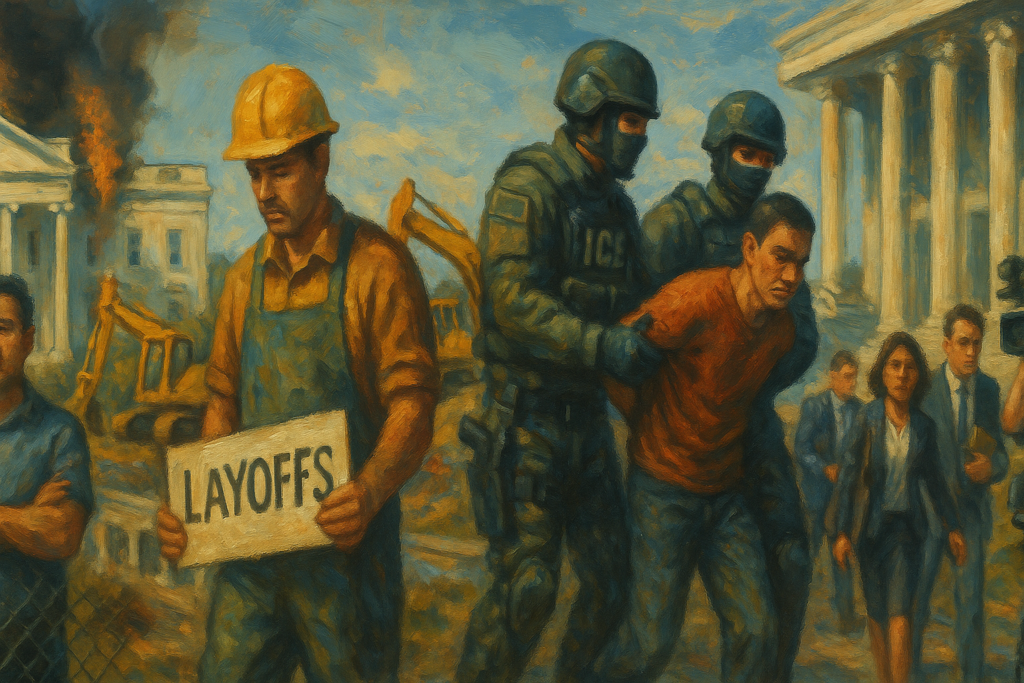
- The shutdown became a tool of executive pressure — What began as congressional deadlock widened into layoffs, hiring controls, partisan messaging, selective funding freezes, and contested spending maneuvers that shifted the burden of the shutdown onto workers, agencies, and disfavored jurisdictions.
- Dissent was increasingly framed as extremism — The week linked protest and opposition to terrorism, disorder, or foreign-backed subversion, from the Antifa designation to repeated attacks on the upcoming No Kings protests and proposals to use criminal law against protest organizers and funders.
- Immigration enforcement kept colliding with courts and civil liberties — Aggressive enforcement in Chicago and beyond produced arrests, raids, fines, and speech-related visa actions, while judges repeatedly imposed limits through restraining orders, warrant rules, and body-camera requirements.
- Independent institutions resisted direct political pressure — Universities rejected funding-for-compliance deals, major news organizations refused Pentagon reporting restrictions, unions sued over layoffs, and courts blocked or narrowed several executive actions.
- Representation and election rules came under renewed strain — Mid-cycle redistricting plans in North Carolina and pressure on other states coincided with a major Supreme Court voting-rights case and a fight over seating an elected House member.
The week unfolded under the shadow of a federal government shutdown nearing its third week. What began as a budget standoff hardened into a broader struggle over who controls the machinery of the state: the workforce, the money, the police powers, and the flow of information. As the White House used layoffs and funding freezes to exert pressure, it also expanded immigration enforcement and tightened its grip on media access, while courts, states, universities, and civil society tried to draw lines that could not be crossed.
Over the weekend, the administration moved from threatening to acting on plans to shed thousands of federal workers. Officials announced or initiated layoffs affecting more than 4,000 employees across agencies such as Education, Health and Human Services, and the Centers for Disease Control and Prevention. They described the cuts as a “reduction in force” necessitated by the shutdown and framed them as leverage to force Democrats to negotiate. Unions and legal analysts countered that the moves appeared to be illegal, both because reductions in force must follow specific procedures and because the pattern of cuts suggested political targeting rather than neutral budget management. The threat to the civil service was not just economic; it signaled that job security for career officials could be tied to partisan conflict.
At the same time, the administration hardened its immigration posture on several fronts. It announced a steep $100,000 fee on H‑1B visa applications, sharply raising the cost of hiring high‑skilled foreign workers. It signaled plans to slash refugee admissions to 7,500 per year, with preferences for white South Africans, and granted U.S. Citizenship and Immigration Services agents full law‑enforcement powers. These policy shifts were paired with more overtly political moves: officials discussed revoking visas of foreigners who criticized conservative activist Charlie Kirk after his killing and floated a national strategy to investigate “domestic terror networks” on the left. Immigration status was being used not only as a gatekeeping tool but also as a potential instrument against speech and association.
Illinois quickly became a focal point for how these enforcement strategies would play out on the ground. Federal judges in the state and at the Seventh Circuit limited the administration’s attempt to deploy federalized National Guard troops in Chicago, finding no evidence of the “rebellion” that would justify such a move. Another judge ordered the removal of an eight‑foot fence outside an ICE facility that had blocked a public street and shielded operations from view, even as Illinois senators were again denied access to inspect the site. These rulings underscored that federal power to militarize responses to protest and to cloak immigration facilities in secrecy was not unlimited, at least where courts were willing to intervene.
The weekend also brought the first direct clash between federal agents and the press in Chicago. During an ICE raid, agents arrested a local television journalist and used force against demonstrators. In response, a federal judge issued temporary restraining orders barring arrests or the use of riot‑control weapons against journalists, protesters, and religious practitioners absent probable cause. Narrow in scope but significant in principle, the orders reaffirmed that even amid aggressive immigration enforcement, constitutional protections for speech, assembly, and religious practice still applied.
Beyond law enforcement, the White House continued to use official communications channels to shape public perception of the shutdown. Automated out‑of‑office replies from government email accounts blamed Democrats for the closure, and Homeland Security Secretary Kristi Noem recorded partisan videos for airport screens. Major airports and transit hubs refused to air the spots, citing concerns about the Hatch Act, which restricts political activity by federal employees. The episode illustrated how the administration was willing to blur the line between governance and campaigning, and how other institutions—airport authorities and media companies—could act as gatekeepers.
On the cultural front, the president issued a Columbus Day proclamation celebrating Christopher Columbus as the “original American hero,” advancing a white Christian nationalist framing of U.S. history. While largely symbolic, the proclamation fit into a broader pattern of using holidays and monuments to elevate narratives of conquest and marginalize Indigenous perspectives, even as more concrete policy battles raged over budgets and enforcement.
By Monday, the shutdown’s impact on specific services became clearer. The Education Department laid off most of its special‑education staff—466 positions, including much of the Office of Special Education and Rehabilitative Services—citing lapsed funding. State officials warned that millions of children with disabilities could lose access to services that federal law requires schools to provide. Because special education is one of the clearest examples of a federal commitment to protect vulnerable students, gutting its administrative backbone during a funding standoff raised alarms about whether legal guarantees would be honored in practice.
In Chicago, immigration enforcement escalated. Border Patrol and other federal agents carried out a military‑style raid on an apartment complex, bursting through doors without visible warrants as part of a broader urban deployment. Legal experts and advocates pointed to potential Fourth Amendment and due‑process violations, noting that tactics more associated with counterterrorism or drug raids were being used in residential neighborhoods. Veterans who protested ICE operations faced felony charges, highlighting how aggressive enforcement was colliding with civic resistance. A federal judge expanded earlier protections, again barring riot‑control weapons against journalists, protesters, and religious practitioners, but the pattern of confrontation was set.
On Capitol Hill, the ninth Senate vote to end the shutdown failed, leaving federal workers and military families facing disrupted pay. In a partial check on executive power, a federal judge issued a temporary injunction blocking more than 4,000 planned layoffs, siding with unions that argued the administration was using the shutdown as a pretext for illegal reductions in force. The stalemate thus had two layers: a legislative impasse over funding and a legal struggle over whether the executive could reshape the federal workforce unilaterally under cover of that impasse.
Tuesday’s developments showed how foreign policy, domestic ideology, and money were increasingly intertwined. The administration formalized a sweeping security guarantee for Qatar, declaring that any attack on it would threaten U.S. peace and security, shortly after Qatar provided a luxury jet for presidential use. A UAE state fund bought $2 billion of a Trump‑connected stablecoin ahead of its public launch, and the White House agreed to a $142 billion arms sale to Saudi Arabia following major Saudi investments in ventures linked to the president. These moves did not just raise ethics questions; they suggested that large foreign policy commitments and financial flows were tracking closely with personal or family business interests.
Domestically, the administration advanced the sale of the Wilbur J. Cohen Federal Building, long associated with Social Security, and promoted an ideological shift away from the Social Security model toward “rugged individualism.” Selling off a building does not by itself change benefits, but paired with rhetoric that cast social insurance as outdated, it signaled a retreat from the New Deal vision of government as guarantor of basic economic security. The physical and symbolic dismantling of Social Security’s legacy prepared the ground for potential policy changes.
In North Carolina, Republican leaders announced plans for mid‑decade redistricting expected to add a GOP congressional seat and potentially eliminate a district currently held by a Black representative, despite the state’s roughly even partisan split. The move came as the president urged state legislatures to defend the Republican House majority. Mid‑cycle map changes of this kind are unusual and, when designed to entrench one party, weaken the link between voter preferences and representation, especially for minority communities. They also set the stage for legal challenges that would intersect with national debates over voting rights.
Courts continued to push back on coercive uses of federal power. A federal judge ruled that the Department of Homeland Security had violated a prior order by tying FEMA preparedness grants to state cooperation with immigration enforcement, reinforcing that Washington could not use disaster funds as leverage to force local participation in immigration crackdowns. Another ruling criticized ICE for repeated warrantless arrests and highlighted a fatal shooting during a traffic stop in Chicago, adding to the legal pressure on the agency. Meanwhile, reporting showed that since the shutdown began, the administration had frozen or canceled over $27 billion in federal funds for projects in Democratic‑led districts, compared with under $1 billion in Republican areas, and had canceled funding for the Gateway Tunnel between New York and New Jersey despite a binding agreement. Federal spending, in other words, was being used as a partisan tool.
Wednesday brought the structural stakes of these fights into sharper focus. At the Supreme Court, justices heard arguments in Callais v. Louisiana and related cases involving Section 2 of the Voting Rights Act, which bars electoral maps that dilute minority voting power. The conservative majority appeared sympathetic to arguments that current protections were unconstitutional or too expansive. If Section 2 is narrowed or struck down, minority communities would lose a central legal tool for challenging gerrymanders and vote dilution, reshaping representation for years. The case unfolded against the backdrop of North Carolina’s redistricting plans, tying courtroom doctrine to concrete changes in who gets a voice in Congress.
Back in the executive branch, the president signed an order titled “Ensuring Continued Accountability in Federal Hiring,” which in practice tightened political control over who could enter the civil service. Agencies were barred from filling or creating most civilian positions without approval from new Strategic Hiring Committees and central review, and they were required to submit staffing plans and quarterly updates to the Office of Personnel Management and the Office of Management and Budget. By centralizing hiring decisions in political hands, the order eroded the independence and expertise of career officials and made agencies more responsive to partisan priorities than to their statutory missions.
Foreign economic policy followed a similar pattern of concentrated discretion. Treasury Secretary Scott Bessent announced that the U.S. would double its bailout for Argentina from $20 billion to $40 billion. The president acknowledged that the package would not significantly benefit the United States, and reporting tied the deal to the interests of a hedge fund investor close to administration insiders. Senators led by Elizabeth Warren introduced legislation to block the bailout, arguing that tens of billions in public funds should not be deployed primarily to protect a connected investor. The episode illustrated how international financial policy could be shaped by private relationships rather than transparent national interests.
Universities and the press found themselves on the front lines of information control. Brown University, followed by Penn and USC, declined to sign a federal “Compact for Academic Excellence” that promised preferential funding in exchange for curbs on diversity, equity, and inclusion programs and limits on international students. University leaders cited threats to academic freedom and institutional governance, signaling that they were willing to forgo money rather than accept ideological conditions. At the Pentagon, new media rules required journalists to pledge not to obtain unauthorized material and to accept strict escort limits. Major outlets refused to sign, turned in their badges, and walked out, ending decades of in‑house Pentagon coverage. The walkout, combined with earlier refusals to accept similar agreements, marked a rare collective stand by the press against government efforts to condition access on compliance. Separately, the watchdog group CREW sued the Department of Homeland Security and the National Archives over missing text messages, alleging systemic gaps in record‑keeping that could erase key communications about policy and enforcement decisions.
On Thursday, the administration moved to weaken internal checks on its own power. It fired independent inspectors general and other watchdogs viewed as disloyal, while issuing pardons for January 6 rioters who had assaulted police officers. These actions came alongside broader efforts to purge career officials and install loyalists across agencies, building on the earlier hiring order. Removing watchdogs and rewarding those who used violence against Congress sent a clear signal about which loyalties were valued: not to institutions or laws, but to the president personally.
National security policy was also turned inward. A National Security Presidential Memorandum redefined certain beliefs—such as being “anti‑Christian” or holding strong migration views—as indicators of potential violence, directing agencies to investigate and disrupt groups whose members held them. Labor unions sued to block social‑media surveillance of visa holders and related record purges, arguing that the government was monitoring lawful political and religious expression. Treating beliefs as security flags expanded surveillance into areas traditionally protected by the First Amendment and risked chilling dissent and association.
In Illinois, the running conflict over immigration enforcement and protest oversight took another turn. Following reports that federal officers had used tear gas and other riot‑control measures against protesters and local police, a federal judge ordered immigration officers in the Chicago area to wear body cameras during operations. The order aimed to document future encounters and enforce compliance with earlier rulings limiting force. Mandating body cameras for federal agents is rare and reflected judicial recognition of serious accountability problems in immigration enforcement.
The shutdown itself remained unresolved. The Senate failed for a tenth time to pass a short‑term funding bill, and a separate vote on Pentagon funding also failed. The House adjourned without progress, leaving federal workers unpaid. The president claimed authority to pay furloughed troops using research and development funds appropriated for fiscal year 2026, a move budget experts called illegal under the Antideficiency Act, which bars spending money not yet appropriated for current obligations. The combination of legislative paralysis and unilateral budget maneuvers further eroded Congress’s power of the purse.
Elsewhere, institutions wrestled with ideology and racism in their own ranks. New York’s Republican Party disbanded its young Republican group after racist chats were exposed, while leaked messages showed similar content in other pro‑Trump circles. In Texas, a new law disbanded faculty senates at public universities, centralizing governance under administrators and weakening faculty voices. Penn and USC joined Brown in rejecting the federal higher‑ed compact, reinforcing a line of resistance to ideological conditions on funding. Environmental and disaster funding decisions also reflected regional inequities: the administration’s earlier cut of a $20 million flood‑protection grant for the Alaska Native village of Kipnuk came into sharper relief as the region reeled from a deadly typhoon, while a federal judge blocked the revocation of $34 million in anti‑terrorism funds for New York City’s transit system, calling the move arbitrary and capricious.
By Friday, the shutdown had become both a symptom and a tool of broader executive assertiveness. The White House announced it would pay furloughed troops using Pentagon research and development funds appropriated for fiscal year 2026, despite warnings that this violated appropriations law. Reporting reinforced that more than $27 billion in funds had been canceled or frozen in Democratic districts versus under $1 billion in Republican ones, confirming that the shutdown strategy included targeted financial punishment. Rewriting appropriations on the fly and allocating pain along partisan lines challenged constitutional spending rules and turned federal resources into weapons in partisan conflict.
A group of more than 340 former U.S. intelligence officers, organized as Steady State, released a report concluding that the United States was drifting toward “competitive authoritarianism,” a system in which elections continue but the playing field is tilted. The report cited consolidation of executive power, firing of watchdogs, politicization of the civil service, and Congress’s failure to check the president as key drivers. Coming from former national‑security professionals, the assessment framed the week’s disparate developments—shutdown tactics, hiring controls, pardons, and surveillance policies—as parts of a systemic shift rather than isolated controversies.
The confrontation in Illinois over immigration enforcement and protest reached the Supreme Court’s doorstep. The administration filed an emergency appeal seeking to lift lower‑court blocks on deploying federalized National Guard troops in the state, arguing for broad authority to use military forces in response to domestic unrest. Meanwhile, organizers prepared thousands of “No Kings” protests against gerrymandering and authoritarianism, and Illinois state police detained at least 15 protesters outside the Broadview ICE facility. The planned demonstrations linked concerns about voting rights, executive overreach, and militarized enforcement, echoing the themes of the Steady State report.
Information control remained a central battleground. White House Press Secretary Karoline Leavitt claimed that Democrats’ main constituency included “Hamas terrorists, illegal aliens, and violent criminals,” language that portrayed political opponents as aligned with enemies and criminals. The president refiled and expanded a $15 billion defamation suit against the New York Times and other outlets, after an earlier complaint was dismissed. Combined with the Pentagon press walkout earlier in the week and the use of official channels for partisan messaging, the lawsuit underscored a coherent campaign to delegitimize independent media and to condition access and safety on favorable coverage.
Finally, the human cost of earlier funding decisions became visible in Alaska. The governor requested a major disaster declaration after Typhoon Halong displaced 1,500 people and devastated southwest villages, including areas near Kipnuk. The plea came months after the administration had cut a $20 million flood‑protection grant for the Native village as “wasteful spending.” The sequence illustrated how defunding preventive infrastructure can magnify the human and financial costs of climate‑driven disasters, and how federal choices about who receives protection and who does not can have life‑and‑death consequences.
Taken together, the week’s events traced a pattern in which the tools of democratic governance—budgets, civil service rules, law enforcement, and information policy—were increasingly used to reward allies, punish opponents, and insulate the executive from scrutiny. Courts, states, universities, the press, and organized citizens pushed back in various ways: blocking some funding cuts, ordering body cameras, rejecting ideological compacts, walking out of controlled press rooms, and planning mass protests. The Steady State report’s warning about a drift toward competitive authoritarianism captured this tension: formal institutions remain in place, but the struggle over how power is exercised within them is intensifying, and the outcome will shape the resilience of American democracy in the years ahead.