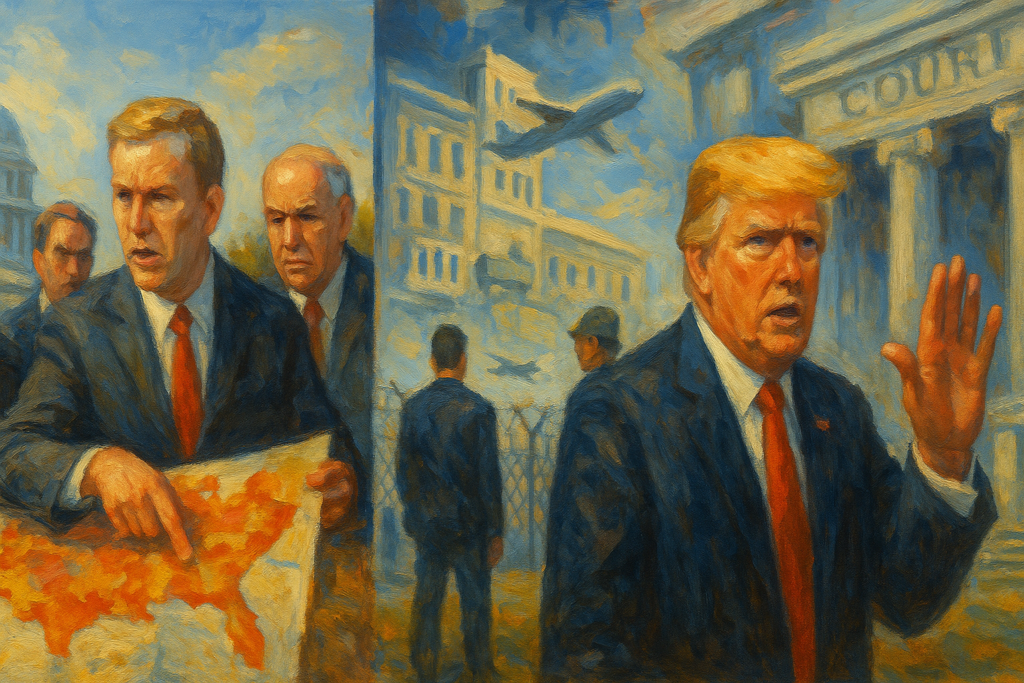
This week’s throughlines
- The Callais aftershock spread through state politics — The Supreme Court's weakening of Voting Rights Act protections continued to trigger rapid redistricting and election changes across Southern states, with Tennessee, Louisiana, Georgia, Alabama, and South Carolina all implicated by midweek.
- Immigration enforcement became more militarized and less constrained — The administration paired aggressive enforcement rhetoric with structural changes to immigration adjudication, expanded detention, and cases suggesting faster, harsher, and less transparent use of state power.
- Executive pressure reached regulators, courts, and public information — Trump and allied officials pressed agencies, criticized or warned courts, and escalated attacks on the press and political opponents, often while using spectacle or misinformation to redirect attention.
- Public money and legal discretion were repeatedly tied to presidential or allied interests — From the Lincoln Memorial project and ballroom funding to a proposed IRS settlement structure and a reported DOJ charging decision, the week repeatedly raised questions about patronage, favoritism, and blurred lines between governance and private advantage.
The week opened with the aftershocks of a weakened Voting Rights Act already moving through Southern politics, even before the biggest map fights arrived. At the same time, the White House and its allies were pressing on several other fronts: regulators faced reports of political interference, immigration enforcement grew harsher and less transparent, and Congress was drawn into spending disputes that mixed public policy with presidential priorities. By week’s end, the clearest story was how quickly changes in election law and executive practice were being turned into new facts on the ground.
Over the weekend, one early line of concern ran through the federal health agencies. Reports said President Trump had pushed FDA Commissioner Marty Makary to approve fruit-flavored vapes despite opposition from agency scientists, while also backing a plan to remove him. Separately, another report said the FDA had halted publication of vaccine-safety research. Taken together, those developments suggested more than an ordinary policy disagreement. They raised the question of whether scientific and regulatory judgments were being bent to political demands—a problem that can outlast any single decision because it weakens confidence in the agency itself.
The administration was also using executive power to relax protections in other areas tied directly to public health. It paused Clean Air Act compliance for more than 180 facilities on national-security grounds, then proposed cutting overdose-prevention funding and ending federal support for fentanyl test strips. These were different policy domains, but the pattern was similar: protections designed to reduce harm were being loosened or withdrawn by executive action. Communities with the least political leverage often bear the greatest cost when environmental and health safeguards are treated as expendable.
A separate weekend dispute centered on public money, symbolism, and process. Trump awarded a no-bid contract for work on the Lincoln Memorial Reflecting Pool, prompting immediate questions about transparency, favoritism, and cost. By Saturday, former Justice Department employees had sued over the alterations, arguing that required historic-preservation procedures had been bypassed, and reports said the project’s price had climbed. The fight was not only about a famous public site. It was also about whether ordinary contracting and preservation rules would still constrain politically charged projects tied to presidential image-making.
Other weekend developments pointed to themes that would continue through the week. Trump floated a federal gas-tax holiday as inflation and war-related fuel pressures mounted, with allies in Congress moving to turn the idea into legislation. Immigration enforcement, meanwhile, remained both deadly and contested, as reports described an intensified mass-deportation campaign that had already produced fatal confrontations while local and state fights over ICE access continued in Arizona and North Carolina. Even before the week’s larger immigration stories emerged, the basic conflict was visible: aggressive federal enforcement on one side, growing concern about force, due process, and local autonomy on the other.
By Monday, the week’s central democratic story came into clearer view. The Supreme Court’s recent Callais ruling had weakened protections long used to challenge maps that diluted Black voting strength, and states moved quickly to test the new terrain. Alabama was allowed to use a congressional map that lower courts had blocked for diluting Black representation. In Tennessee, the ACLU sued over a new map targeting Memphis. These were not isolated legal skirmishes. They showed how a court ruling could rapidly change the incentives for state officials, especially in the South, where mapmaking has long been a central instrument of political power.
Monday also brought a sharper turn in immigration enforcement. House Democrats demanded answers about secretive ICE deportation flights, while the Board of Immigration Appeals fast-tracked Mahmoud Khalil’s case in a process his lawyers said was effectively predetermined. In a contrasting act of judicial intervention, a federal judge ordered the release of a detained couple trying to reach their dying son. The juxtaposition mattered. It showed an enforcement system moving toward speed and secrecy while courts were still, in some cases, acting as a last check against its harshest consequences.
Trump’s own rhetoric added another layer of pressure. In a burst of weekend and Monday postings, he suggested using the National Guard or ICE at voting locations, accused the media of treason over Iran coverage, and repeated false claims about election fraud and political enemies. The message fused intimidation, disinformation, and demands for prosecution. It was not simply inflammatory language in the abstract. It touched core democratic institutions at once: voting, the press, and the legitimacy of opposition.
Congress, meanwhile, opened a fight that linked immigration policy to presidential self-interest. Senate Democrats said they would oppose a reconciliation bill that included $1 billion for security tied to Trump’s planned White House ballroom, while Republicans advanced the funding inside a broader immigration-enforcement package. Lawsuits also widened around the Reflecting Pool project as preservation groups sued the Interior Department and National Park Service, and a separate Freedom of Information Act case sought records from Interior tied to another symbolic initiative. The recurring issue was the same one raised over the weekend: symbolic presidential projects were colliding with the rules meant to govern public contracting, budgeting, and disclosure.
On Tuesday, Tennessee’s redistricting fight became a struggle over legislative power as well as representation. After protests over the new congressional map, House Speaker Cameron Sexton stripped Democratic lawmakers of committee assignments, reducing the influence of members representing 24 districts. Memphis officials formally opposed the map, describing it as an attack on the city’s political voice and Black representation. That made Tennessee a distinct case within the week’s broader map story. The issue was not only that a map had been redrawn; it was that dissent over the map was itself punished inside the legislature, weakening representation twice over.
The same day, Senate Republicans advanced a $72 billion reconciliation package for ICE, Customs and Border Protection, and related enforcement while preserving funding tied to Trump’s ballroom project. The package bundled together a major expansion of enforcement capacity and a presidential construction priority, then moved through a fast-track budget process that limited ordinary scrutiny. In practical terms, it showed how procedural tools in Congress can be used to speed controversial spending while narrowing the space for oversight and amendment.
Trump also widened his pressure campaign from social media to the courts. He publicly attacked the Supreme Court over its tariff ruling and warned the justices to rule his way on birthright citizenship. Coming just after his calls to prosecute opponents and his threats around voting and the press, the comments extended the week’s pattern of direct pressure on institutions meant to operate independently. Tuesday brought another use of federal power into a sensitive private sphere when a Texas federal prosecutor subpoenaed NYU Langone Health for records on minors who received gender-affirming care and the names of providers involved. In Congress, oversight hearings exposed a more basic problem: lawmakers said the administration was withholding documents in the Epstein matter, while Pentagon officials faced questions about the rising and poorly documented cost of the Iran war. Across these disputes, the common issue was whether institutions outside the White House could still obtain the information needed to check executive action.
By Wednesday, the redistricting aftershocks had become a regional cascade. Georgia’s governor called a special session to redraw maps, Mississippi’s governor adjusted the timing of his own redistricting plans, and Tennessee’s committee purge remained central to the fallout from its new map. What had begun with Alabama and Tennessee was now spreading across the South as a broader strategy. Once one state moved, others had reason to move quickly too, before courts, election administrators, or voters could fully respond.
Wednesday also brought one of the week’s starkest immigration developments: the administration expanded the use of Guantánamo Bay for migrant detention. That shifted part of immigration enforcement into an offshore setting long associated with reduced visibility and weaker safeguards. It fit the week’s larger pattern of harsher and less transparent enforcement, following reports of secretive deportation flights and fast-tracked removal proceedings. Offshore detention does not merely change geography. It can make legal access harder, public scrutiny thinner, and ordinary accountability more difficult to sustain.
Elsewhere on Wednesday, the White House and its allies used federal leverage in two different directions. JD Vance threatened to cut health funding for states that did not comply with anti-fraud demands, while Interior Secretary Doug Burgum refused to provide Congress with requested information. One move aimed downward at states by tying compliance to money; the other aimed upward against congressional oversight by withholding records. The Senate then rejected a war powers resolution that would have ended U.S. involvement in Iran, leaving military action in place without a clear new authorization. That vote reinforced a broader theme of the week: even where Congress possessed formal tools to check the executive, it often failed to use them effectively. Trump’s disinformation barrage also continued, with attacks on Barack Obama, the 2020 election, and other enemies persisting as outside reporting and data challenged some of the administration’s claims about crime and election law. The information fight had become a sustained condition of the week, not a passing episode.
Thursday brought the week’s clearest climax in election administration. In Louisiana, Governor Jeff Landry declared a state of emergency to halt the state’s congressional primary after ballots had already been sent and cast, while lawmakers advanced a map that would eliminate a Black-majority district. Louisiana’s story was related to Tennessee’s but distinct from it. Tennessee showed how remapping could be paired with legislative punishment of dissent. Louisiana showed something even more destabilizing: emergency power used to interrupt an election already underway. Once voting has begun, changing the rules or stopping the process altogether strikes directly at public confidence that elections will be administered consistently and fairly.
By the end of midweek, the remap campaign had spread across much of the South. Georgia moved toward a special session. South Carolina weighed returning to redistricting. Alabama sought to preserve a map with fewer Black-opportunity districts. Tennessee’s new map and committee purge remained in force. In Virginia, the state’s high court stood by its decision striking down a voter-approved redistricting plan. The details differed from state to state, but the cumulative effect was unmistakable: a court decision had opened space for a multi-state restructuring of representation, and officials were moving quickly to occupy it.
Routine governance did continue in the background. House leaders announced a bipartisan task force on sexual misconduct, and agencies issued the usual stream of notices on records, surveys, permits, and rulemaking. But those ordinary actions mostly served as contrast. They showed that the machinery of government had not stopped; what changed was which parts of it dominated the week and how aggressively power was being used in the most politically charged arenas.
Friday was quiet in the record, leaving Thursday’s surge in redistricting and election disruption as the week’s closing image. Looking back across the full sequence, the week’s significance lay in the way several forms of institutional strain reinforced one another. A weakened voting-rights framework produced rapid map fights and, in Louisiana, an interrupted election. Executive pressure touched regulators, courts, Congress, and the states. Immigration enforcement moved further toward secrecy and offshore detention. Symbolic presidential projects kept colliding with contracting rules, budget procedure, and transparency law. Taken together, these developments showed how democratic erosion often proceeds: not through one decisive break, but through a series of linked moves that alter representation, weaken oversight, and make the exercise of power harder to see and harder to stop.