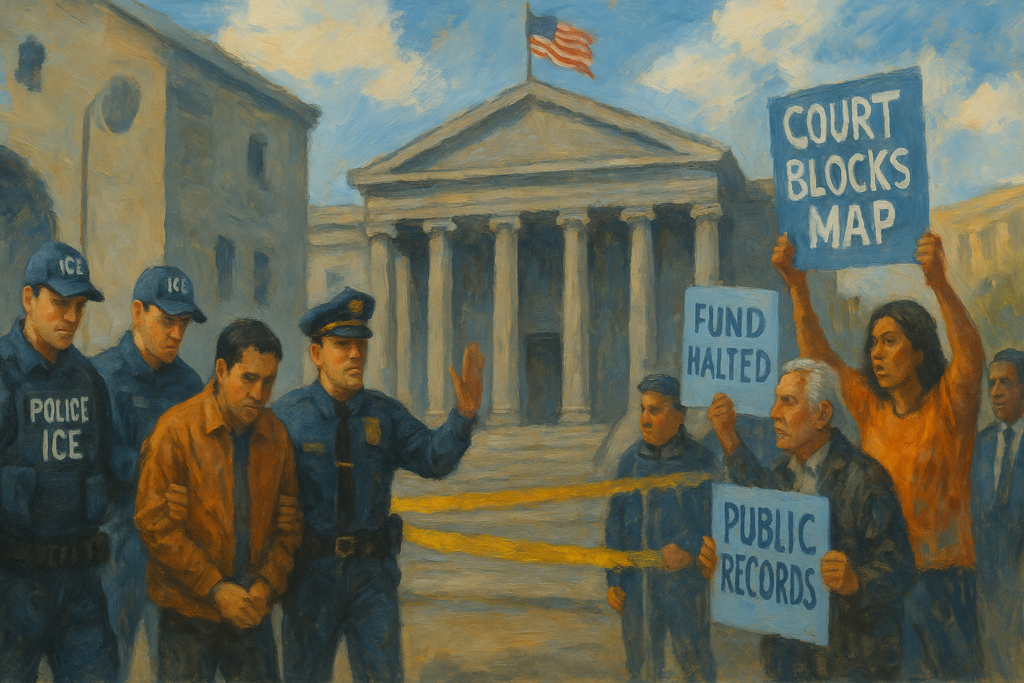
This week’s throughlines
- Immigration pressure broadened from detention to lawful-status pathways — The week began with detention-related scrutiny and ended with a formal USCIS memo forcing many applicants to leave the country for green-card processing, while DHS also floated punitive measures against sanctuary cities and clashes at Delaney Hall intensified.
- Patronage and self-dealing moved from allegation to institutional challenge — Reports of self-enrichment, donor influence, and insider-friendly contracting were followed by a House bill, lawsuits from former judges, and court orders freezing Trump's anti-weaponization fund while scrutiny expanded to Pentagon loans and public spending decisions.
- Control over public memory and official narratives intensified — The administration and its allies fought over what the public should see and remember: January 6 records were scrubbed, federal workers faced proposed NDAs, Bondi's Epstein testimony became a transparency fight, and symbolic projects sought to place Trump more visibly into national space and iconography.
- Courts repeatedly acted as the main brake — Across voting rights, detention, speech, racial bias, and disputed spending, judges and appellate courts repeatedly slowed, blocked, or narrowed executive and state actions, even as some conflicts remained unresolved.
The week unfolded along four connected lines: immigration policy became more coercive in both procedure and enforcement; courts repeatedly checked efforts to redirect public institutions and money toward presidential allies and symbols; fights over secrecy and the public record intensified; and new examples of donor influence and political favoritism surfaced inside ordinary governance. By Friday, those strands had converged into a picture of mounting pressure on rights and oversight, met unevenly by judges, states, and local officials trying to hold institutional boundaries in place.
Over the weekend, one of the clearest examples of ordinary emergency government came from California, where a dangerous chemical tank crisis at an aerospace facility in Garden Grove forced evacuations affecting tens of thousands of residents. Governor Gavin Newsom declared a state of emergency and mobilized state resources as officials worked to prevent an explosion or spill. It was a reminder that emergency powers can still be used in the conventional way: to move people out of danger, coordinate agencies, and stabilize a public-safety crisis.
The same weekend also brought sharper democratic warning signs. In North Carolina, the state’s newly MAGA-led elections board took steps that could wrongly purge legitimate voters, while the state Senate voted to cut early voting from 17 days to 10. The two moves worked together. If voter rolls become less reliable just as the early-voting window narrows, the burden of correcting mistakes falls more heavily on voters themselves, especially those who depend on same-day fixes or re-registration. Before any campaign reaches its final stretch, rules like these can already shape who gets to participate.
The federal government also moved against the public record itself. The Justice Department removed website press releases tied to January 6 criminal cases, including cases involving assaults on police officers. At the same time, federal officials issued subpoenas to Hasan Piker and Medea Benjamin in a Cuba sanctions investigation, widening concern about scrutiny of activists and critics. The removal of January 6 case materials mattered not because it changed the underlying prosecutions, but because official archives help determine what remains visible to the public about attacks on democratic institutions and how the state responded.
Immigration concerns were already broadening before the workweek began. The release of Rodney Taylor after prolonged detention drew attention to harsh conditions and medical deterioration inside ICE custody, while another report warned that new ICE funding could be used not only for deportation operations but for political targeting. Alongside that, President Trump continued to use office and symbolism in increasingly personal ways, issuing executive orders targeting Andrew Weissmann and promoting a triumphal arch near Arlington. Elsewhere, oversight and deregulation collided: the DHS inspector general opened an audit into a $38 billion detention-warehouse scheme involving questionable purchases and contractors, while reports said crypto enforcement was being weakened and officials who raised concerns about Trump-linked firms were being sidelined.
By Monday, the immigration story had moved from warning signs to a formal pressure campaign. The administration announced that many temporary visa holders seeking green cards would have to leave the United States and apply from abroad rather than adjust status while remaining here. This was not a minor technical revision. It disrupted a long-standing pathway used by workers and families, and it did so without new legislation. A process that had allowed people with lawful footholds in the country to regularize their status now became a mechanism of forced departure, with all the uncertainty that entails for employers, households, and pending cases.
Monday also began the week’s most sustained confrontation on the ground, outside the Delaney Hall detention center in Newark. Federal agents used pepper spray and other force against protesters demonstrating over detainee conditions and a hunger strike. Senator Andy Kim, who had planned an oversight visit, was among those affected and was denied access. That combination mattered: force against demonstrators on one side of the fence, obstruction of elected oversight on the other. Delaney Hall was no longer only a story about what was happening inside detention. It was becoming a test of whether the public, the press, and public officials could safely monitor a coercive federal site at all.
Questions about public money and political favoritism sharpened as well. Reports described a proposed $1.776 billion “anti-weaponization” settlement structure as a vehicle that could reward allies while shielding Trump and his family, and Representative Brian Fitzpatrick introduced legislation to block federal payments into the fund. At the same time, construction began on the White House lawn for a UFC event tied to Trump’s birthday, extending a pattern of using public property and presidential symbolism for leader-centered spectacle. A federal court, meanwhile, blocked Alabama from using a new 6R-1D congressional map for the 2026 midterms and restored the earlier 5R-2D map, showing that courts were still willing to intervene when representation itself was at stake.
On Tuesday, the immigration push widened beyond green cards. A Transportation Department rule limiting commercial licenses for many immigrant truck drivers drew scrutiny, showing how immigration policy was reaching into lawful work and economic life. An appeals court temporarily blocked the re-detention of activist and green-card holder Mahmoud Khalil, and a court extended oversight in an asylum case after USCIS had frozen adjudications. Taken together, these developments showed that the week’s immigration story was not confined to border enforcement or detention beds. It touched work authorization, legal status, and the ability to remain in the country while cases were still being decided.
Tuesday also brought a more direct attempt to tighten secrecy inside government. The Office of Personnel Management proposed nondisclosure agreements for federal workers that included possible penalties and post-employment restrictions. Critics said the plan would chill disclosures to journalists and make it harder for employees to reveal misconduct. Coming just days after the removal of January 6 case materials, the proposal fit a broader pattern: not simply controlling what government says publicly, but narrowing what insiders may safely tell the public when official channels fail.
The same day produced a cluster of patronage stories across agencies and industries. A tobacco company donation was followed by a reported FDA policy reversal on flavored vapes and the resignation of the FDA commissioner. The chairman of a major government contractor gave $1 million to MAGA Inc. Trump promoted an unregulated online casino whose co-owner had also donated to his political network. None of these episodes, on their own, proved a single scheme. Together, though, they reinforced the week’s recurring question: whether access, donations, and personal ties were increasingly shaping regulatory outcomes and official promotion.
Political pressure also reached the upper ranks of national security and law enforcement. Tulsi Gabbard resigned as director of national intelligence amid reports she had been pushed out, and FBI Director Kash Patel fired another senior official tied to a politically sensitive intelligence assessment. In Congress, Speaker Mike Johnson reportedly sent members home early to avoid a war powers vote over Trump’s military action in Iran, using procedure to blunt debate over a core constitutional power. Courts, however, continued to deliver narrower checks, blocking West Point from enforcing a prior-approval policy on civilian faculty speech and extending an injunction requiring continued gender-affirming care for affected federal prisoners.
Wednesday was one of the week’s densest days, as several threads hardened at once. USCIS formally announced and clarified the new rule requiring many permanent-residency applicants to leave the country and apply abroad. Separately, DHS Secretary Markwayne Mullin threatened to withdraw customs agents from airports in sanctuary cities to pressure local governments into immigration cooperation. The administration was no longer only changing paperwork rules. It was using operational leverage against disfavored cities, turning federal capacity itself into a bargaining tool.
At Delaney Hall, the conflict escalated again. Federal officers once more used force against protesters while detainees continued a hunger and labor strike. DHS denied that the strike was real and cast the unrest as political theater. That denial was significant in its own right. The week’s transparency fights were not only about documents and hearings; they were also about who gets to define reality around detention conditions, protest, and official force. By midweek, Delaney Hall had become a struggle over narrative control as much as physical access.
Wednesday also broadened the election story beyond voting rules. An investigation found that Lead Left, a super PAC spending in Democratic primaries, was tied to a Republican operative. Another report warned that AI-generated political influencers were being used in campaigns without clear disclosure. These were different kinds of election problems from voter purges or shortened early-voting periods. They concerned hidden sponsorship and disguised persuasion: whether voters can tell who is trying to influence them, and by what means.
On the same day, reports said a $620 million Pentagon loan to Vulcan Elements, a startup linked to Donald Trump Jr., had been expedited at the request of White House adviser Peter Navarro. That became the week’s clearest cronyism story, because it involved a large public financing decision, a family connection, and alleged White House pressure in the same transaction. Economic warning signs added to the strain, with inflation reaching its highest level in three years and GDP growth revised downward, while courts continued to check overreach by dismissing charges against Kilmar Ábrego García and allowing other litigation over fair-lending protections and education policy to proceed.
Thursday brought the sharpest legal pushback. A federal judge temporarily blocked the creation and funding of Trump’s anti-weaponization fund, while additional lawsuits and filings from Allison Gill and a bipartisan group of retired federal judges argued that the underlying settlement was unlawful and potentially a fraud on the court. What had begun earlier in the week as an allegation and a legislative objection had now become a live judicial barrier. The immediate effect was practical: disputed public money could not move while courts examined whether executive power and judicial process had been manipulated.
The same day, Trump’s symbolic projects met resistance as well. The administration pushed Congress to approve a $250 bill bearing Trump’s image, but a federal judge ruled that the Kennedy Center could not be renamed for Trump without an act of Congress. That ruling did not settle every symbolic fight, but it drew a clear line around one of them. National institutions and symbols are not simply available for unilateral personalization by the executive. The White House UFC spectacle, the proposed bill, and the Kennedy Center fight all belonged to the same pattern: efforts to fuse public space and national imagery with one leader’s brand, and efforts by other institutions to say no.
Thursday’s transparency disputes widened too. The proposed federal-worker nondisclosure regime remained under scrutiny, while Pam Bondi faced questions before House investigators about the Epstein files and acknowledged redaction errors amid complaints about incomplete disclosure. In election law, Judge Nichols denied preliminary injunction requests in three separate cases challenging Executive Order 14399, leaving the directives in place for now on standing and ripeness grounds even as a coalition of attorneys general sued to protect state control over election administration. And the Pentagon loan story widened further, with new reporting tying the Trump Jr.-linked financing more directly to White House pressure and raising additional questions about Trump’s stock purchase in UFC’s parent company ahead of the White House event. By then, the week’s patronage concerns were no longer isolated anecdotes. They were accumulating into a pattern of overlap between official action, family-linked business interests, and personal financial gain.
Friday closed several of these arcs without resolving them. After days of clashes outside Delaney Hall, New Jersey officials said state police would replace federal officers outside the facility and create a protected protest zone. The Justice Department, however, also filed charges against a protester tied to the unrest. The state’s intervention showed one way local authorities can try to lower the temperature around a federal detention site: by restoring safer access for demonstrators and reducing the chance of repeated confrontations with federal agents. But it also underscored how far the conflict had already escalated.
Chicago, for its part, openly prepared to resist federal immigration raids. Mayor Brandon Johnson signed an executive order directing city departments to protect residents’ rights and resist aggressive federal immigration enforcement, including possible militarized raids or National Guard deployment. That was a direct answer to the week’s broader immigration hardening. As Washington used immigration procedure, detention, and operational threats to increase pressure, some cities moved to build their own legal and administrative shields.
The anti-weaponization fund remained frozen on Friday as scrutiny widened. A Virginia judge kept the fund on hold, while retired judges continued pressing claims that the underlying IRS settlement manipulated the judicial process and amounted to a fraud on the court. By the end of the week, this had become more than a dispute over one pot of money. It was a test of whether courts would stop an arrangement that critics said could turn public funds into a political reward system under the cover of settlement practice.
The transparency fight also ended the week in a more openly adversarial posture. Bondi appeared before the House Oversight Committee but refused to testify under oath or answer some questions about Trump’s role, while a DOJ lawyer intervened and lawmakers argued over the terms of the hearing. New reports also showed super PACs presenting themselves as progressive while being linked to House Republicans and using shell structures to obscure their backers. In Utah, a voter-roll audit found that nearly all registered voters were confirmed citizens amid a Trump administration lawsuit over voter data, extending the week’s fight over election administration, federal leverage, and claims of fraud. And in a final contrast that captured much of the week’s tone, a federal jury convicted three anti-ICE protesters of felony conspiracy in Washington state, while in a separate case an ICE agent was arrested over the shooting of a Venezuelan man in Minnesota. Protest activity faced swift criminal consequences; accountability for federal officers remained comparatively rare.
What made the week consequential was not any single headline, but the way the pieces fit together. Immigration authority was used not only to detain and deport, but to reorder legal pathways, pressure cities, and confront dissent. The public record came under strain through deleted archives, proposed secrecy rules, official denials, and evasive testimony. Money and access repeatedly appeared near regulatory decisions, contracts, and financing. Against that, courts and some state and local officials still acted as counterweights, blocking maps, freezing funds, protecting speech, and drawing lines around public institutions. The week did not settle those contests. It showed where they now are: in detention centers, courtrooms, hearing rooms, campaign finance structures, and the everyday machinery of government.