This week’s throughlines
- The Voting Rights Act ruling quickly became a redistricting campaign — A Supreme Court ruling weakening protections against racial vote dilution was followed almost immediately by calls to redraw maps, expedited court action in Louisiana, Tennessee's rushed remap, and new moves in Alabama, Mississippi, and other states.
- Immigration enforcement widened from legal conflict to human consequences — The week linked court-defying arrests, detention expansion, budget funding, court closures, mass-deportation rhetoric, and new reporting on children and detainees harmed by enforcement practices.
- Pressure on information and accountability intensified — Federal power was used or threatened against broadcasters, journalists, researchers, and public records, while the Iran conflict generated disputes over hidden imagery, suppressed evidence, and underreported costs.
- Courts both enabled and checked executive action — The judiciary weakened voting-rights protections and briefly destabilized abortion-pill access, but also blocked some voter-data demands, found retaliatory investigations likely unlawful, enforced limits on immigration arrests, and scrutinized trade and construction actions.
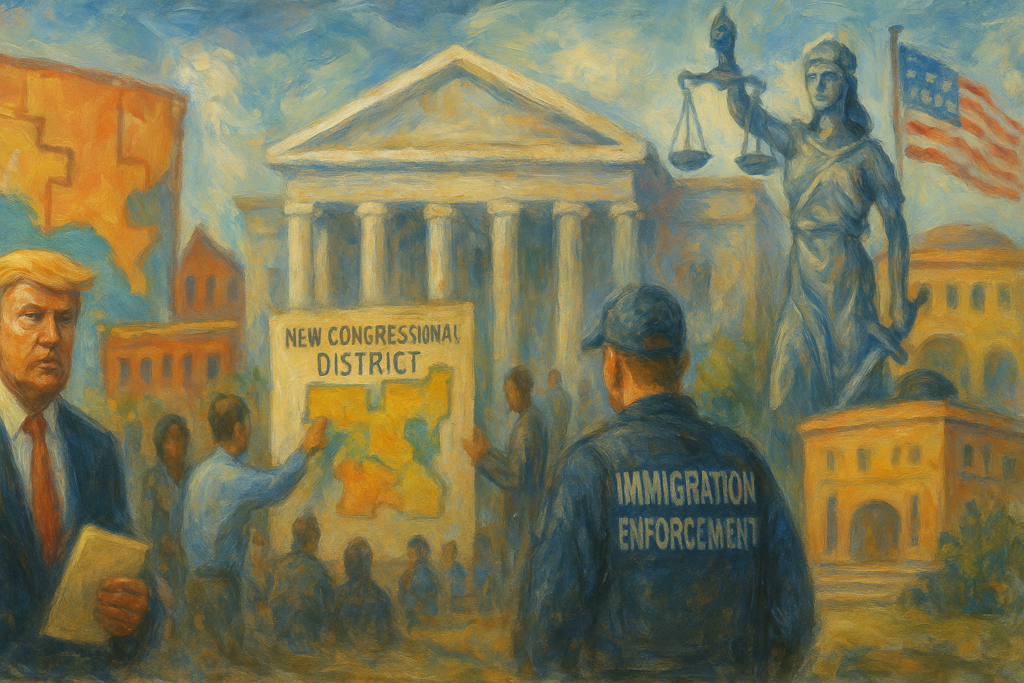
The week’s central development came from the Supreme Court, and its effects were visible almost immediately. A ruling that weakened protections against racial gerrymandering did not remain a matter of legal doctrine for long. Donald Trump quickly urged states to redraw congressional maps, including in places where voting had already begun, turning a court decision into an invitation for immediate political action. From there, the week unfolded as a series of tests of how quickly institutions could be bent: election rules, district lines, immigration enforcement, press freedom, war oversight, and even federal resources for a presidential construction project.
Over the weekend, the administration also pressed for greater federal leverage over elections. Trump issued an executive order aimed at limiting mail voting by tying ballot delivery to a national voter file, a significant assertion of national control in an area usually run by states and localities. At the same time, a federal judge rejected a separate Justice Department effort to force Arizona to hand over voter-roll data. Taken together, the moves showed both the administration’s appetite for centralizing election authority and the unevenness of judicial resistance. That pressure also extended to the people who administer elections: the groundwork was laid for later fights over federal demands for personal information about election workers in Georgia.
Immigration enforcement supplied another early test of legal limits. ICE re-arrested the El Gamal family shortly after a judge had ordered their release, prompting another emergency court intervention. The episode was not just about one family’s status. It raised the broader question of whether court orders still meaningfully constrain immigration agencies once enforcement decisions are made. At the local level, community groups also succeeded in blocking proposed ICE detention warehouses, showing that resistance was not confined to courtrooms. Even so, the weekend pointed toward a larger story that would grow through the week: more aggressive enforcement, more pressure on detainees, and more evidence of harm.
Retaliatory uses of law and regulation also appeared early. A North Carolina grand jury indicted former FBI director James Comey over an Instagram post interpreted as threatening Trump. The FCC accelerated review of ABC station licenses after Jimmy Kimmel joked about Melania Trump. Trump, for his part, publicly accused former attorney general Eric Holder of treasonous conduct. These were different kinds of actions—criminal, regulatory, rhetorical—but they pointed in the same direction. Criticism, satire, and opposition could draw official scrutiny even before any case was tested on the merits.
The weekend also brought signs of broader executive consolidation in national security and presidential prerogative. New reporting showed Defense Secretary Pete Hegseth had dismissed or forced out 24 generals and senior commanders since February 2025, deepening a purge of senior military leadership. After the recent assassination attempt on Trump, prosecutors filed charges against the alleged gunman, while the Justice Department pressed to resume White House ballroom construction on security grounds. That ballroom dispute would remain a secondary story all week, but it mattered as an example of how security arguments and public resources were being used to advance a project closely tied to Trump personally.
By Monday, the Supreme Court had acted again, this time in a different area. After a lower court blocked access to mifepristone by mail, the justices issued an administrative stay that temporarily restored telehealth, mail, and pharmacy access. The order did not resolve the larger case, but it reversed an immediate disruption in access to a widely used FDA-approved medication. In a week dominated by the expansion of executive and partisan power, it was one of the clearer examples of the Court stepping in to preserve the status quo rather than unsettle it further.
But Monday’s main movement remained in redistricting. Florida’s governor signed a new congressional map expected to help Republicans in four additional races, making concrete what the weekend’s voting-rights ruling had opened up. The significance was not only that one state changed its lines. It was that a legal opening had become a practical campaign to alter representation mid-cycle. The week’s redistricting story would soon center on Tennessee, but Florida showed how quickly the new doctrine could be translated into partisan advantage.
Election administration remained under pressure as well. Fulton County moved to quash a Justice Department subpoena seeking names, addresses, and other personal details for 2020 election workers and volunteers. County officials described the demand as intimidation aimed at people who had simply done the work of running an election. That mattered because election systems depend on ordinary workers willing to serve. If those workers come to expect federal scrutiny or harassment years later, the damage is not only personal; it reaches the basic machinery of future elections.
Immigration enforcement spilled further into local civic life on Monday. An ICE arrest in Brooklyn led to a protest outside a hospital and arrests by the NYPD, raising questions about compliance with sanctuary laws and about the role of local police in federal immigration actions. Reporting also showed that ICE still had not resumed payments for outside medical care for detainees, even as deaths and medical crises mounted. The week’s immigration story was therefore not just about border rhetoric or deportation numbers. It was also about detention conditions, access to care, and the way federal enforcement decisions reverberated through cities, hospitals, and families. Monday also brought reports of antisemitic vandalism at synagogues and homes in Queens, a reminder that equal civic standing depends not only on formal rights but on basic safety for minority communities.
Tuesday mixed ordinary electoral life with sharper institutional pressure. Indiana and Ohio held primaries, and Michigan held a special election, preserving the normal calendar of voting even as map fights elsewhere threatened to change the rules around those elections. In Tennessee, protesters gathered at the Capitol against a special session to redraw the state’s map. The contrast was striking: ballots were being cast under existing rules in some places while, in others, political actors were moving to rewrite representation before the cycle was complete.
The Georgia election-worker fight intensified on Tuesday when Fulton County formally asked a federal court to quash the subpoena for poll-worker contact information. County lawyers argued that the request was politically motivated harassment that could deter future election service. The administration’s pressure on independent institutions widened in another direction as well. Trump’s EEOC sued The New York Times over a promotion decision the paper called politically motivated. Coming after the FCC’s action against ABC, the suit added another federal pressure point on a major news organization. The pattern was becoming harder to dismiss as isolated enforcement. Different agencies were being used in ways that could narrow the space for independent reporting and criticism.
Tuesday also brought a different kind of institutional strain in public health. The FDA blocked publication of taxpayer-funded studies that had found Covid-19 and shingles vaccines to be safe, saying the conclusions were not supported by the data. Critics saw the move as part of a broader pattern of withholding information that would support vaccine confidence. Whatever the merits of the agency’s stated rationale, the democratic consequence was clear enough: public trust in health institutions depends not only on decisions but on whether evidence is released openly and consistently.
A Senate Republican proposal on Tuesday previewed how immigration politics and Trump-centered spending would be linked. The package combined major immigration-enforcement funding with $1 billion in security-related money for Trump’s White House ballroom project. Budget bills often reveal priorities more clearly than speeches do. Here, the message was that long-term enforcement expansion and a presidential construction priority could be bundled together as part of the same governing agenda.
Wednesday was the week’s densest day. Tennessee lawmakers convened the special session aimed at redrawing the state’s congressional map, especially the Memphis-based majority-Black district. The use of a special session mattered in itself: it compressed debate, limited public input, and made it easier to move quickly once legal barriers had fallen. What had begun with a Supreme Court ruling and a presidential call for new maps was now becoming a direct state-level effort to dismantle an existing form of minority representation.
At the same time, Senate Republicans advanced a reconciliation package with $72 billion for ICE and Border Patrol through 2029, alongside major cuts to health and nutrition support. The same budget push included the $1 billion for White House security tied to the ballroom project. This was more than a one-year appropriations fight. Long-term funding on that scale would entrench enforcement priorities well beyond the immediate political moment, making future reform harder even if political control changed.
Immigration enforcement itself escalated on Wednesday. The Justice Department closed the San Francisco immigration court after already hollowing out its bench, and Tom Homan announced that mass deportations were imminent. HHS also reported a drop in Affordable Care Act coverage after rule changes, underscoring how administrative decisions were tightening pressure on vulnerable populations across systems. Enforcement power was being built not only through arrests and detention beds, but through court capacity, access to health care, and the weakening of basic supports.
Pressure on the press sharpened further when FBI Director Kash Patel ordered polygraph tests for staff to identify leakers, while the bureau opened, or was reported to have opened, a criminal leak investigation tied to reporting on Patel’s conduct. The focus was not a classic national-security breach but contact with a reporter. That distinction mattered. Leak investigations aimed at ordinary reporting can deter sources from exposing misconduct and make journalists more vulnerable to state pressure. By midweek, the administration’s approach to dissent and scrutiny was visible across several institutions at once: broadcast regulation, employment law, criminal investigation, and internal loyalty enforcement.
Wednesday also widened the gap between executive war-making and democratic oversight. A confidential CIA assessment contradicted public claims that Iran was near collapse, while the United States struck Iranian targets and the administration shifted from one military operation label to another before Trump paused the new phase. Questions mounted over whether the conflict was proceeding without meaningful congressional authorization. The issue was not only whether military action was justified, but whether the public and Congress were being given a truthful account of what was happening and under what legal authority.
On Thursday, Tennessee provided the week’s clearest example of how quickly the new redistricting opening could be exploited. Republicans passed and Gov. Bill Lee signed a new congressional map splitting Shelby County across three Republican districts and effectively dismantling the state’s only majority-Black district. State troopers cleared protesters from the Capitol gallery, and the NAACP quickly filed an emergency challenge. In one day, the week’s main pattern came into focus: a Supreme Court ruling weakened protections, a state moved with unusual speed, public opposition was physically removed from view, and litigation followed after the fact.
Thursday also brought a direct effort to use federal power to protect Trump personally. Acting Attorney General Todd Blanche said the Justice Department would seek Supreme Court intervention in E. Jean Carroll’s defamation case against Trump, a move that could effectively end the case if the federal government took over his defense. The significance lay in the line it threatened to erase. If the Justice Department can absorb a president’s personal legal exposure, then public office becomes a shield against private accountability.
The week’s pressure campaign against the press and other critics continued on Thursday. Patel sued The Atlantic as the FBI leak investigation tied to reporting on him remained active. At the same time, federal judges partly enjoined FTC investigative demands against the Endocrine Society and WPATH, finding likely retaliation against advocacy groups. That combination captured an important feature of the week: retaliatory pressure was expanding, but courts still sometimes acted as a check. The same was true in the ballroom dispute, where the National Trust for Historic Preservation rebutted Justice Department claims and said construction had continued despite an injunction, keeping alive the question of whether legal process could still constrain a president’s preferred project.
By Friday, the redistricting push had spread beyond Tennessee into a broader campaign. Alabama’s governor called for redistricting despite a federal injunction. Louisiana’s governor suspended a congressional primary already underway to allow map changes. Reporting showed coordinated efforts expanding across multiple Republican-led states, while in Virginia a state supreme court ruling striking down voter-approved maps continued to reshape the electoral landscape. What had begun as a single court decision was now a multi-state effort to reopen representation rules in the middle of an election cycle.
Friday also brought the clearest documentation yet of the human toll of immigration enforcement. A lawsuit forced release of arrest records showing that the parents of at least 27,000 children had been arrested over seven months. Reporting documented children injured by tear gas or pepper spray during immigration encounters. Homan promised intensified arrests, and ICE still had not paid outside providers for detainee medical care. By the end of the week, the immigration story had moved from court defiance and local protest to measurable family separation, injury, and neglect, backed by plans for long-term funding and mass deportation.
The administration also tried on Friday to redefine the Iran conflict in legal terms, declaring that the war had terminated. That framing could reduce congressional leverage under the War Powers Act. Yet new reporting again challenged official cost figures and public claims about Iran’s condition, reinforcing the sense that legal labels and factual reality were diverging. Oversight of war depends on access to facts—costs, intelligence, imagery, and a stable description of what operations are underway. When those are contested or withheld, executive discretion expands.
The ballroom fight, though secondary to the week’s larger arcs, ended the week with a new dimension. Environmental data showed toxic contamination at a golf course used as a dump site for debris from the White House East Wing demolition. What had already been a dispute over injunctions, spending, and presidential preference now also implicated environmental compliance and public health. Friday also included a few smaller accountability stories outside the main sequence, including California’s continued enforcement push against State Farm over wildfire claims and General Motors’ settlement over selling drivers’ location and driving data.
Taken together, the week showed how quickly changes in law can be converted into changes in power. A voting-rights ruling became a rush to redraw maps. Immigration enforcement moved from contested court orders to budget entrenchment and documented harm. Pressure on the press and other critics spread across agencies and legal tools. War powers were stretched through shifting labels and disputed facts. And again and again, public institutions were asked to serve personal or political protection. The week did not produce a single constitutional rupture. It showed something more cumulative: how representation, accountability, and oversight can be weakened through a sequence of fast, concrete decisions.