This week’s throughlines
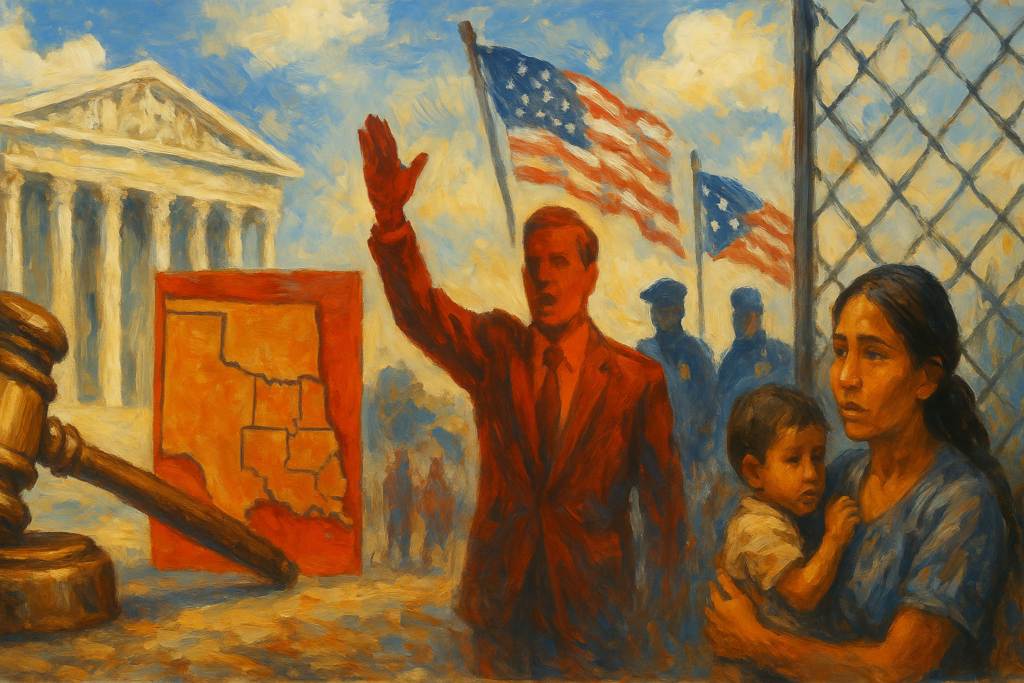
- The Voting Rights Act ruling became the week's main accelerant — After the Supreme Court weakened Section 2 in Louisiana v. Callais, Florida moved quickly on a new map, Tennessee and other states signaled similar plans, and Louisiana suspended primaries while lawsuits followed.
- Immigration enforcement widened through policy, funding, detention, and courts — The administration tied immigration status to political speech, planned more family detention, pushed major new enforcement funding, defended TPS terminations, and faced lawsuits and emergency court interventions.
- Pressure on independent institutions and information channels intensified — The FCC's moves against ABC, the lawsuit for Epstein records, the Fed chair succession fight, and the extension of Section 702 all reflected a week of conflict over who controls information, oversight, and institutional independence.
- War powers and domestic fallout stayed linked — The administration continued to justify military action against Iran while Congress failed to impose a clear check, and the conflict's domestic effects showed up in fuel prices and political backlash.
The week turned on a Supreme Court ruling that weakened one of the country’s central voting-rights protections—and on how quickly political actors moved to exploit the opening it created. Around that judicial shock, other lines of power were also hardening: immigration enforcement widened through speech rules, detention, funding, and court fights; Congress advanced surveillance and border money while struggling to check presidential war-making; and the administration pressed a legal and political campaign to force through Trump’s proposed White House ballroom.
Over the weekend, the administration opened a new immigration front by tying lawful political expression to immigration status. New green card guidance said applicants could face penalties for criticizing Israel or taking part in pro-Palestinian campus protests. That pushed immigration screening beyond criminal conduct or fraud and into viewpoint and association, raising immediate questions about free expression and due process for people seeking to remain in the country lawfully. At the same time, faith groups challenged the end of protections for places of worship in immigration enforcement, underscoring that the week’s immigration story was not about one policy alone but about a broader expansion of state reach.
Enforcement pressure was also visible in detention. ICE moved ahead with plans for a family detention site on contaminated land in Louisiana despite health concerns, while an Egyptian family was taken back into custody before a judge blocked deportation. Those cases showed how families and children were being drawn deeper into a system already under strain, and how removal efforts could move faster than judicial review. Even before Congress acted, the weekend pointed to an enforcement apparatus growing more aggressive and less restrained by ordinary cautions about health, family unity, or process.
The other major weekend development began with the shooting at the White House Correspondents’ dinner. Trump quickly argued that the incident proved the need for a new White House ballroom, turning a security scare into a rationale for a contested construction project. The Justice Department began pressing the National Trust for Historic Preservation to drop its lawsuit against the plan, and the administration pushed to reschedule the dinner while presenting the episode as evidence that the ballroom should proceed. What might have remained a political talking point instead became the start of a coordinated effort to use security language, legal pressure, and public attention to advance a presidential priority.
The weekend also carried a smaller but telling media thread. Early inaccurate reporting about the shooter drew criticism, and Trump separately attacked CBS journalist Norah O’Donnell over an edited interview. These episodes did not carry the legal weight of later actions, but they reinforced a climate in which politically sensitive reporting was met not just with rebuttal but with sustained presidential hostility. That atmosphere would matter once regulators entered the picture.
By Monday, the ballroom fight had moved from pressure to open legal threat. The Justice Department demanded that the National Trust abandon its lawsuit and warned that it could move against the injunction blocking construction if the group refused. At the same time, Republican lawmakers advanced proposals to fund the project with public money. The combination mattered: a dispute over preservation and executive authority was becoming a test of whether the federal government would use both its legal machinery and congressional allies to clear obstacles for a project closely identified with the president himself.
Monday also widened the administration’s use of national-security reasoning. Trump defended military action against Iran without congressional approval, while House Democrats called for Congress to reassert its constitutional role over war. In a separate arena, the administration declared glyphosate production a national-security issue, extending emergency-style logic into domestic regulatory policy. The common thread was not the subject matter but the method: national-security framing was being used to enlarge executive discretion, whether in military affairs or in shielding a controversial product from ordinary scrutiny and debate.
Immigration moved in the same direction. The Senate advanced a budget resolution tied to roughly $70 billion for ICE and Border Patrol without adding the accountability measures Democrats sought. The same day, the Supreme Court prepared to hear challenges to the administration’s effort to end Temporary Protected Status for Haitians and Syrians, while family detention resumed at Dilley and protests spread against warehouse-style detention expansion. Funding, detention policy, and legal doctrine were all moving at once. The week’s immigration story was becoming cumulative: more money for enforcement, more detention capacity, and more uncertainty for people whose lawful status depended on executive decisions.
Monday also brought the week’s clearest example of regulatory pressure on the press. After Trump and allies demanded that Jimmy Kimmel be fired, FCC Chair Brendan Carr ordered accelerated scrutiny of ABC station licenses, officially linking the move to a Disney investigation but widely understood as retaliation. That transformed political anger at a comedian into a federal licensing problem for a broadcaster. In a system where broadcast licenses depend on government approval, such moves carry a warning beyond any single network.
Environmental and contracting decisions added another layer. The administration issued a no-bid $17.4 million contract for Lafayette Park fountain repairs under an urgency exception, while EPA Administrator Lee Zeldin defended sweeping deregulation and faced questions about contacts with Bayer. Alongside the glyphosate order, these decisions suggested a pattern in which emergency rationales and executive discretion were increasingly serving favored industries and politically connected interests.
Tuesday was dense but transitional, with symbolic and legal moves setting up the week’s larger consequences. The State Department announced limited-edition passports featuring Trump’s image as part of America250, a personalization of state symbolism that stood out even amid a week of more consequential fights. On the policy side, the administration blocked two permitted wind projects and steered compensation toward oil and gas reinvestment, showing how presidential priorities were shaping not just rhetoric but the direction of energy policy.
The Supreme Court then opened a major immigration case by hearing arguments over the administration’s attempt to end TPS for Haitians and Syrians. The case could affect hundreds of thousands of people and test whether courts retained meaningful authority to review executive decisions about temporary lawful status. Elsewhere, transparency fights deepened as a journalist sued the Justice Department over withheld Epstein files, and lower-court rulings kept several challenges to Trump-era actions alive. The day’s legal disputes were different in subject, but they shared a common question: how much room remained for courts and disclosure laws to check executive control over information and status.
The Senate’s budget vote on Tuesday reinforced that concern. It set up a fast-track path for major new ICE and Border Patrol funding while transparency disputes with the Justice Department continued. More enforcement money without stronger disclosure rules meant that any future abuses would be harder to detect and harder to correct. By the time the Court’s voting-rights ruling arrived the next day, several of the week’s other institutional trends were already in motion.
Wednesday became the hinge point. In Louisiana v. Callais, the Supreme Court struck down Louisiana’s second majority-Black district and sharply weakened Section 2 of the Voting Rights Act as a tool against racial vote dilution. The ruling did not remain abstract for long. Florida passed a new map, Tennessee Republicans were urged to redraw a Black-majority district, and officials across the South began preparing for fresh redistricting fights. One of the main federal protections for minority representation had been narrowed, and partisan mapmakers immediately understood the opportunity.
The same day, the Justice Department escalated the ballroom fight again. After days of demands, Acting Attorney General Todd Blanche moved to dissolve the injunction blocking construction. That step made clear that the administration was not merely defending the project in public or leaning on outside litigants behind the scenes. It was using the department’s formal legal authority to try to clear the way. The question was no longer whether the ballroom would be promoted as a presidential priority, but whether the Justice Department would act as a neutral legal institution when that priority met resistance in court.
Wednesday also brought a quieter but important institutional struggle over the Federal Reserve. The Senate Banking Committee advanced Kevin Warsh’s nomination for Fed chair on a party-line vote, shortly after the criminal investigation into Jerome Powell ended. Democrats argued that the sequence threatened the central bank’s independence from presidential pressure. In a week full of more visible confrontations, this one concerned a different kind of safeguard: the insulation of monetary policy from direct political control.
Another thread running through Wednesday was the administration’s rhetoric about national identity and legitimacy. In a White House speech welcoming King Charles III, Trump described American identity in terms of ancestry and heritage rather than civic equality. Meanwhile, the FCC’s review of ABC licenses remained active. The pairing mattered because rhetoric and regulation were working in tandem: one narrowing the language of belonging, the other increasing the costs of criticizing power.
By Thursday, the consequences of the voting-rights ruling were already concrete. Louisiana postponed its primaries and suspended its congressional election calendar, while Alabama and Mississippi moved toward new redistricting processes under the Court’s weakened standard. What had been a legal decision on Wednesday became an administrative scramble on Thursday, with election calendars, candidate plans, and representation itself suddenly in flux. The speed of the response showed how much election law now depends on rapid interaction among courts, governors, legislatures, and election officials.
Congress, meanwhile, struggled to check the administration on national security. The White House told Congress that hostilities with Iran had effectively ended even as U.S. forces remained engaged, a position that sought to avoid the War Powers Act deadline. On a parallel track, Congress passed a short-term Section 702 extension and moved toward broader reauthorization, preserving expansive surveillance powers with only limited new safeguards. War powers and surveillance are often debated separately, but this week they were linked by the same institutional problem: Congress was being asked to accept limited information and limited control while executive claims of necessity expanded.
Pressure on journalism also widened beyond government. A private project called Objection AI launched a service claiming to adjudicate complaints against journalists with an AI “jury,” publishing rulings and proposing mechanisms that would pressure reporters toward source disclosure. In another week this might have looked like a novelty. In this one, arriving after presidential attacks on journalists and FCC pressure on ABC, it fit a broader pattern in which both public and private actors were testing new ways to intimidate or discipline the press.
Questions about public money and private benefit kept surfacing as well. Reports showed Trump Jr. and Eric Trump taking a stake in a mining venture backed by administration financing, while taxpayers were set to fund major upgrades to a luxury Qatari jet for Trump. These were not the week’s central stories, but they echoed the ballroom fight by raising the same basic issue: whether public resources and official decisions were being bent toward family or personal advantage.
Friday brought the week’s immigration arc into full view. The House approved a budget resolution paving the way for roughly $70 billion more for ICE and Border Patrol, while reports said the Justice Department was replacing immigration judges with less experienced appointees. At the same time, a federal judge paused the termination of Yemen’s TPS in two cases, showing that courts still offered some check even as the enforcement system expanded. Taken together with the weekend’s speech-based green card guidance, the resumption of family detention, and the TPS case heard earlier in the week, Friday showed an immigration system growing larger, harsher, and less professionally constrained.
The human cost of that system became harder to ignore when ICE notified Congress of the death of a Cuban immigrant at Stewart detention center after he had been placed in solitary confinement. It was another death in custody in a year already marked by mounting concern over detention conditions. Coming alongside reports of inexperienced new immigration judges, the death linked two parts of the same machinery: confinement and adjudication. A government that detains more people assumes a greater duty to keep them safe and to provide fair hearings; this week suggested strain on both fronts.
Friday also turned Louisiana into the first major legal battleground over the voting-rights ruling’s fallout. After the state halted its congressional primaries, the ACLU, voting-rights groups, and candidates filed state and federal suits to restore the election calendar and protect ballots already cast. The issue was no longer only how maps would be drawn under the Court’s new standard. It was whether officials could suspend an election already underway in order to redraw the rules midstream. That made Louisiana the clearest early test of how far state actors would go, and how quickly courts would respond.
Congress ended the week by deepening the national-security pattern. The House renewed Section 702 for three years, while Senate Republicans blocked a Democratic measure that would have required Trump to end military action in Iran. At the same time, satellite imagery undercut Trump’s claims about damage to Iran’s oil infrastructure, adding a factual dispute to an already weak oversight environment. When Congress extends surveillance authority and declines to force a vote on military disengagement, it leaves both intelligence collection and armed conflict more dependent on executive assertions than on sustained legislative control.
The ballroom fight, too, reached a new stage on Friday when Senate Republicans formally proposed $400 million in public funding for Trump’s project. In less than a week, the administration had moved from citing a security incident to pressuring a plaintiff, asking a court to dissolve an injunction, and seeking taxpayer money. What looked at first like a symbolic dispute over a building had become a revealing contest over legal process, appropriations, and the use of state power for a president’s own priorities.
Two other Friday developments rounded out the week’s institutional picture. The Fifth Circuit imposed nationwide restrictions on mifepristone by blocking mail distribution and restoring in-person dispensing requirements, threatening access even in states where abortion remains legal and prompting an emergency appeal to the Supreme Court. And reporting showed that more than 1,500 scientists and experts had been laid off, reassigned, or pushed out of the EPA’s research arm, with remaining work required to align with administration priorities. One ruling narrowed practical access to reproductive healthcare across the country; one administrative campaign weakened the government’s independent scientific capacity. Both showed how national policy can be reshaped not only by Congress but by courts and executive management of institutions.
By week’s end, the pattern was clear. A Supreme Court ruling on voting rights quickly changed the behavior of states and threatened to reorder elections in the South. Immigration policy hardened through ideology, detention, money, and personnel. Congress proved more willing to fund enforcement and renew surveillance than to insist on stronger oversight of war or executive secrecy. And the administration treated a security scare as an opening to press a presidential construction project through the courts and into the appropriations process. The week did not produce a single constitutional crisis. It showed something more cumulative and more durable: institutions being tested all at once, with courts, Congress, agencies, and state officials each helping determine whether power would be checked, redirected, or simply absorbed.