This week’s throughlines
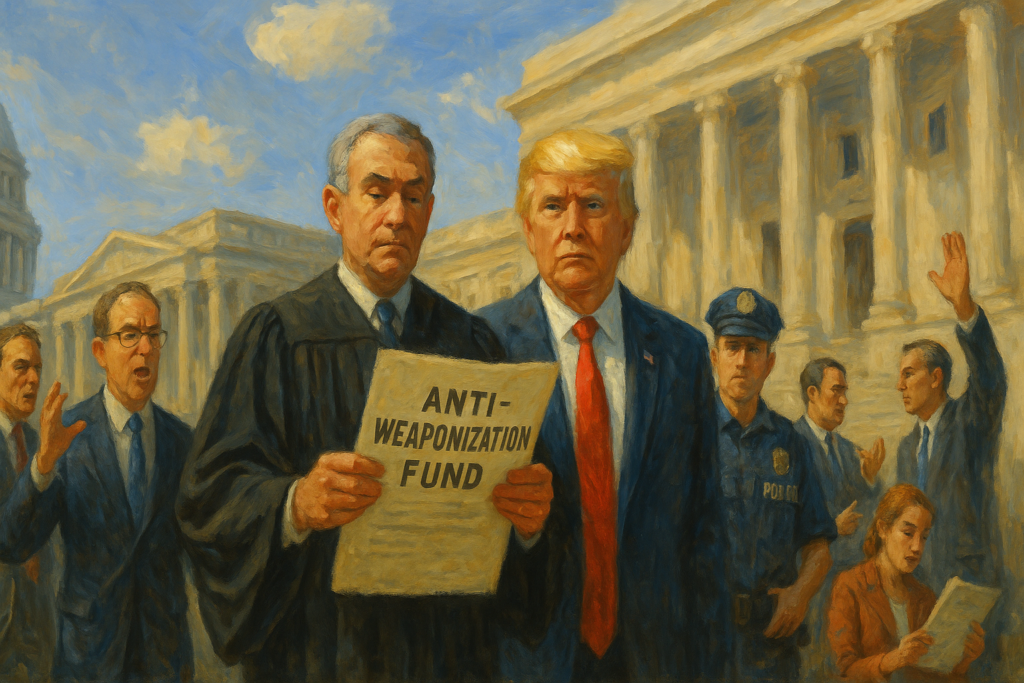
- The DOJ fund became the week’s main institutional crisis — What began as the announcement of a large Justice Department compensation fund quickly widened into a broader fight over executive spending, transparency, and favoritism. Hearings, hostile meetings, proposed amendments, and new legislation turned it into a cross-branch confrontation by midweek.
- Voting-rights retrenchment moved from court rulings into state action and public response — The weakening of Voting Rights Act protections did not remain a court story. It fed directly into redistricting plans, election-rule fights, remanded cases, and a visible civil-society response centered in Selma and Montgomery.
- Congress tried to reassert itself, unevenly — The Senate showed some willingness to check the executive branch on war powers and spending, but those efforts were partial and unstable. By week’s end, House leaders had delayed a direct vote on Iran, and appropriations politics were tangled up with Trump-linked projects and the DOJ fund.
- Immigration pressure intensified through policy, detention, and retaliation claims — The week combined hardening policy with evidence of harm and selective judicial pushback. New barriers to status adjustment, reports of abusive detention conditions, raids on activists, and deportation-related rulings showed immigration enforcement operating across multiple fronts.
- Public office, public memory, and personal gain kept blurring together — Several developments pointed to the same pattern: presidential financial conflicts, symbolic building projects, and the takeover of national commemorations all pushed public institutions toward personal branding and ideological messaging.
The week turned on a single executive move and the resistance it provoked. What began as a Justice Department plan to create a $1.776 billion compensation fund for alleged victims of “lawfare,” tied to the collapse of Donald Trump’s IRS lawsuit, quickly widened into a fight over public money, tax enforcement, congressional oversight, and the limits of presidential power. Around that central conflict, courts were active on several other fronts: voting rights, immigration arrests and detention, White House recordkeeping, and war powers. By Friday, the picture was clear: a government pressing its authority in multiple directions at once, and institutions struggling, unevenly, to answer back.
Over the weekend, the first effects of the Supreme Court’s recent voting-rights ruling were already visible in state politics. In South Carolina, the governor called a special session to consider redistricting that could weaken Black representation. In North Carolina, the state elections board prepared to vote on another set of restrictive election rules. Those moves gave immediate practical meaning to what might otherwise have remained an abstract legal decision: a change in doctrine at the top was now being translated into maps, rules, and access on the ground. Voting-rights advocates responded not only with legal concern but with public mobilization, including a large gathering in Selma and Montgomery that linked the week’s disputes to a much longer history of contested representation.
At the same time, the Justice Department’s new fund came into view as more than a settlement device. By the weekend, the department had established it with commissioners appointed by the attorney general and removable by the president, a structure that immediately raised questions about who would control the money and who might receive it. House Democrats moved to challenge any arrangement that could route taxpayer funds to Trump or his allies. The issue was not simply whether the government could settle a dispute, but whether a grievance framed as official persecution was being converted into a pool of money under executive control, with weak transparency and obvious political implications.
Other weekend developments reinforced the sense that public office and private interest were becoming harder to separate. New disclosures and reporting showed extensive presidential stock trading without a blind trust, including thousands of trades involving companies with ties to the administration. The Senate parliamentarian blocked a ballroom funding provision from a Department of Homeland Security bill, while Trump’s social-media promotion and the continuing cost of his golf travel added to a broader picture of a presidency mixing official power, personal branding, and private benefit. Immigration also remained a visible throughline from the start of the week: Texas’ buoy barrier on the Rio Grande stayed in place as part of the administration’s border posture, while organizers and advocacy groups prepared protests and campaigns against the expansion of ICE enforcement.
By Monday, the fund had moved from announcement to active controversy. Senate Democrats pressed Acting Attorney General Todd Blanche over its secrecy, its legal basis, and whether the public would ever know who was paid. Conflicting accounts emerged on that last point, deepening suspicion rather than resolving it. Once the structure became public, the central questions sharpened: Was this a lawful use of federal money? Could the executive branch create a compensation mechanism of this scale with so little clarity? And if the recipients remained hidden, what meaningful oversight would be possible?
Monday also made clear that the fund was only half of the arrangement. Blanche signed an order barring the federal government from pursuing tax-related claims against Trump, his family, and affiliated companies. That meant the end of the IRS dispute was not just about money; it also carried protection against future scrutiny tied to past filings. In practical terms, the government was not merely dropping a case. It was stepping back from ordinary tax enforcement where the president and his network were concerned. That raised a more basic constitutional problem than any single settlement term: whether executive power was being used to place the president and his associates outside the normal reach of the law.
Elsewhere on Monday, the administration used public ceremony to recast national history in its own image. The White House’s takeover of America250 planning came into fuller view through a “Rededicate 250” event on the National Mall, where Trump and allied officials promoted a Christian-nationalist account of the country’s founding. Reporting also showed Freedom 250 seeking corporate sponsorship tied to access to Trump. This was not the week’s largest institutional fight, but it was a revealing one. Control over civic commemoration is a form of power: it shapes public memory, defines who speaks for the nation, and blurs the line between state ceremony and partisan ideology when used for leader-centered branding.
Immigration enforcement, meanwhile, met some of the week’s clearest accountability measures. A federal judge barred routine ICE arrests in or around three Manhattan immigration courthouses, protecting access to hearings by limiting the government’s ability to turn court appearances into arrest opportunities. California’s Justice Department documented severe overcrowding, poor medical care, and abuse in ICE detention facilities. A Brookings report estimated that more than 145,000 U.S. children had experienced parental detention during Trump’s second term. In Minnesota, an ICE officer was charged in the shooting of a Venezuelan man after video evidence contradicted initial claims. Taken together, these developments showed immigration not just as a policy domain but as a field of coercive state action increasingly tested by courts, state investigators, and evidence that challenged official narratives.
Monday also brought quieter but still important fights over regulation and oversight. The administration eased refrigerant rules for grocery stores and air-conditioning companies and proposed weakening or delaying PFAS drinking-water protections, presenting both moves as cost relief while shifting environmental and health risks onto the public. The New York Times sued the Pentagon over a policy requiring official escorts for journalists on Pentagon grounds, arguing that the restrictions were unconstitutional and retaliatory. In Georgia, Geoff Duncan testified in the racketeering case against Trump and his allies. These were separate stories, but they shared a common theme: access to information, whether about military institutions or past attempts to overturn an election, remained contested and consequential.
Tuesday was the week’s densest day of institutional reaction. The Justice Department formally tied the fund to Trump’s dropped IRS lawsuit, and Blanche defended the arrangement before senators. By then, critics were openly calling it a slush fund, and the first legal and political countermeasures were taking shape. The controversy had crossed a threshold. It was no longer a disputed announcement; it had become a live test of whether Congress or the courts could force disclosure, limit payouts, or challenge the executive branch’s authority to create and control the fund.
The tax protections also became more explicit. The Justice Department amended its agreement to bar the IRS from auditing Trump’s past tax returns and related entities, making plain that the government was giving up future tax claims as part of the broader deal. That clarity mattered. It removed any lingering ambiguity about whether the administration was merely settling one case or creating a wider shield. The answer, as the documents came into view, was the latter. Equal enforcement depends on the government applying tax law to powerful officials as well as ordinary citizens; Tuesday’s developments suggested the opposite.
Courts and lawmakers were colliding on several other fronts as well. Federal judges in Maine and Wisconsin dismissed Justice Department lawsuits seeking sensitive voter data, limiting a federal push into state election administration. The Senate advanced a bipartisan war powers resolution aimed at forcing congressional authorization for continued military operations in Iran. A coalition of states sued the Education Department over new graduate borrowing limits. And Judge John Bates ordered the White House and the vice president’s office to comply with the Presidential Records Act, including preserving records sent on unofficial platforms. These disputes differed in subject, but they turned on the same institutional question: whether executive action would be constrained by statutes, courts, and Congress, or whether those checks would be delayed, narrowed, or bypassed.
Tuesday also widened the week’s financial-conflict story. Reporting connected Trump’s stock purchases more directly to his public praise of companies, while new health-policy initiatives such as TrumpRx and a Medicare obesity-drug pilot raised fresh concerns because they could benefit firms tied to his investments. The issue was no longer just disclosure. It was whether presidential policy choices and public messaging were becoming entangled with personal financial gain. A Pentagon inspector general inquiry into whether commanders followed proper procedures before lethal boat strikes during Operation Southern Spear added another line of oversight, this time inside the national-security apparatus.
By Wednesday, the fund had begun to disrupt governance itself. Bipartisan lawmakers drafted legislation to block it, Senate Republicans denounced it behind closed doors, and the controversy started stalling broader legislation. What had begun as a legal-financial maneuver was now freezing unrelated business in the Senate. That shift mattered because it showed the cost of the arrangement not only in ethics or legality, but in the ordinary functioning of government. When a disputed executive initiative starts jamming appropriations and legislative bargaining, it becomes a structural problem.
The response also moved decisively into court. Harry Dunn and Daniel Hodges sued Trump, Blanche, and Treasury Secretary Scott Bessent, arguing that the fund could reward January 6 attackers and exceeded legal authority. On the same day, Judge Kathleen Williams dismissed Trump’s IRS lawsuit and noted the absence of any lawful settlement record in the court file. That judicial observation was especially striking. The court handling the original case was signaling that the process itself lacked the normal documentary basis one would expect for a lawful resolution. Additional reporting and documents reinforced that the agreement released Trump and his associates from IRS claims tied to a major refund dispute, making it harder to separate settlement politics from selective non-enforcement.
Wednesday also brought more evidence that courts were still acting as a practical brake in other areas. Judge Bates’s records-preservation injunction remained a significant rebuke to White House practices, and another federal judge stayed ICE guidance that had rescinded victim-centered enforcement policies. The San Diego mosque shooting widened into a broader hate-crime and public-safety story as federal authorities examined the shooters’ online radicalization and access to weapons. Even amid the week’s dominant conflict, the judiciary and law enforcement were still making consequential decisions about records, due process, and ideologically motivated violence.
On Thursday, the Senate backlash deepened. Movement on an ICE funding bill became entangled with both ballroom spending and the fund fight, and Republican anger over the Anti-Weaponization Fund helped collapse momentum for a larger reconciliation push. Representative Jamie Raskin introduced a bill to bar taxpayer-funded settlement slush funds, while Senate Democrats demanded preservation of all records tied to the agreement. Congress was now fighting on two levels at once: over the money itself and over the paper trail needed to reconstruct how the arrangement had been made.
Thursday also extended the week’s secondary but revealing thread of public symbolism and institutional pressure. The Commission of Fine Arts approved designs for Trump’s 250-foot triumphal arch in Washington, continuing a pattern of using public space and civic process for presidential glorification. Trump, meanwhile, called for Senate Republicans to replace the Senate parliamentarian with a loyalist after earlier rulings had blocked favored spending items. The connection between those stories was not superficial. One concerned monuments, the other procedure, but both reflected an effort to bend public institutions toward personal authority and weaken gatekeepers who could slow or deny it.
Immigration and protest-related retaliation remained under legal challenge as well. A University of Michigan student sued over alleged surveillance and retaliation tied to Gaza protests. In Oregon, a federal ruling against ICE’s warrantless arrests of farm workers highlighted the use of facial recognition and force in immigration operations, while studies and reporting continued to undercut the administration’s economic case for large-scale raids. Outside the week’s main scandal, courts also left in place an injunction protecting funding for providers of gender-affirming care for minors, and Tennessee’s governor granted a one-year stay of execution in a contested death-penalty case. These were not the week’s central stories, but they showed that rights disputes over bodily autonomy, punishment, and state power continued to move through the system even as attention concentrated elsewhere.
Friday closed with another sharp illustration of immigration’s uneven legal landscape. The Department of Homeland Security announced that many green-card applicants would now have to leave the United States and apply from their home countries, a procedural change with obvious family-separation consequences. On the same day, an appeals court kept Mahmoud Khalil detained and eligible for deportation, while a federal judge dismissed the indictment against Kilmar Ábrego García as vindictive prosecution after he challenged his deportation. The contrast captured the week well: executive restrictions continued to advance, but some courts were still willing to identify and stop retaliatory uses of prosecutorial power.
Congress, by contrast, showed the limits of its willingness to confront the executive directly. After the Senate’s earlier bipartisan move on Iran, House Republican leaders pulled a vote on a war powers resolution that would have challenged Trump’s military operations, delaying a direct floor test of congressional oversight. The triumphal arch project remained on track despite public opposition, and reporting tied a $5 million Reynolds American donation to Trump’s super PAC to a favorable vape policy change. Fresh attention to Trump’s stock trades again highlighted the overlap between public praise, policy visibility, and private financial activity. The San Diego mosque attack also remained in view, with new reporting that one of the teenage shooters had previously been flagged by the FBI as a potential extremist threat.
By week’s end, the pattern was hard to miss. The administration used executive authority not only to pursue policy but to protect allies, shape public memory, and test the boundaries of oversight. Congress pushed back, but often through letters, stalled bills, and blocked votes rather than decisive action. Courts were more concrete, issuing rulings that preserved records, limited some immigration tactics, and questioned retaliatory prosecutions, even as other decisions favored the government. Democratic accountability did not disappear, but it looked strained and uneven: strongest where judges could issue enforceable orders, weakest where political institutions had to discipline themselves.