This week’s throughlines
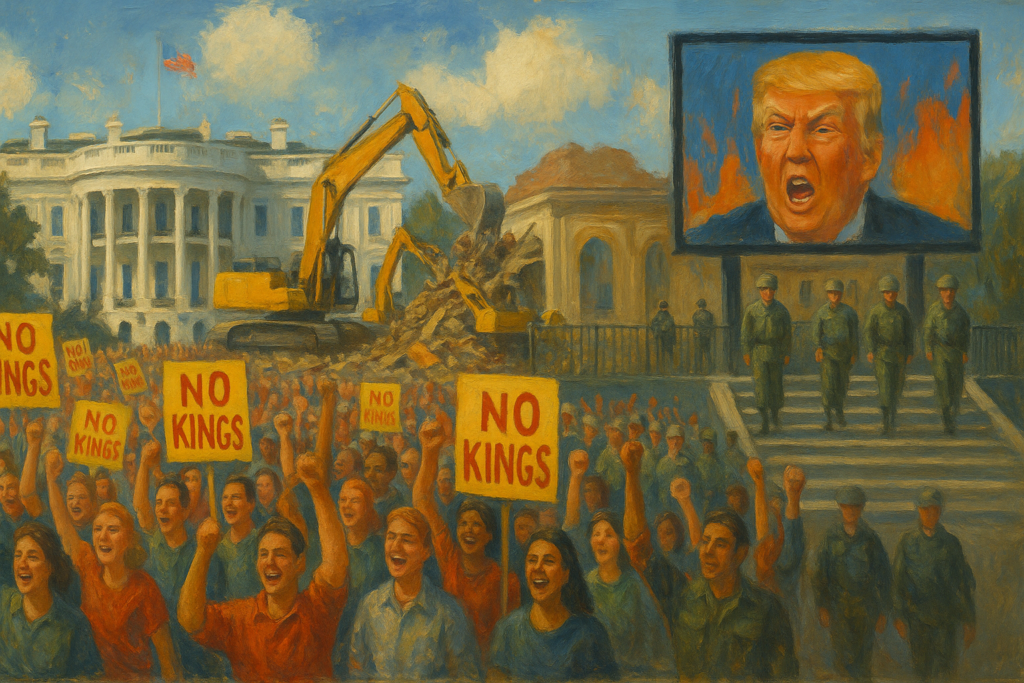
- Mass protest met with ridicule and securitized rhetoric — The weekend’s huge No Kings demonstrations set the tone for the week, followed by official mockery, claims that dissent was illegitimate, and continued organizing by protest networks.
- Government dysfunction became a governing condition — The shutdown dragged on while the House remained largely adjourned, essential workers and benefits were left exposed, and procedural control was used to block both oversight and representation.
- Executive power blurred into personal benefit and symbolic domination — Clemency for allies, demands for DOJ compensation, the Binance pardon, and the East Wing demolition all fed a pattern in which presidential power was used in ways that raised conflict-of-interest, accountability, and public-trust concerns.
- Immigration enforcement widened while due-process concerns deepened — The week brought detention-condition lawsuits, a high-profile Chinatown raid, school-zone raid concerns, and deportations tied to false gang narratives, showing both expansion of enforcement and mounting legal resistance.
- Information control moved from propaganda to access restrictions — Trump’s AI protest video, Treasury’s photo restrictions, and the Pentagon’s replacement of mainstream reporters with compliant far-right outlets showed a broad effort to shape what the public sees and who gets access.
The week opened with a striking split screen. In cities and towns across the United States and around the world, millions of people poured into the streets for “No Kings” protests that were large, peaceful, and often playful. At the same time, the administration and its allies answered this civic display with warnings about unrest that never came, AI‑generated propaganda mocking demonstrators, and renewed talk of using military force at home. As the days unfolded, that contrast—between public mobilization and an executive increasingly willing to treat institutions, law, and even the White House itself as personal assets—ran through fights over the demolition of the East Wing, selective clemency, immigration enforcement, and control over information.
Over the weekend, organizers under the 50501 Movement and the No Kings coalition staged what appeared to be the largest coordinated protests of the Trump era. Demonstrations took place in all 50 states, the District of Columbia, U.S. territories, and more than two dozen countries. Estimates ranged from roughly 7 to 8.7 million participants, including about 200,000 in Washington, D.C. The events mixed costumes, satirical stunts like “Operation Inflation,” and messages about defending democracy, healthcare, and social programs. Despite pre‑event rhetoric from some officials about potential violence, city police reported no arrests and described a largely peaceful, even festive atmosphere.
The political response from the president and his allies moved quickly to delegitimize what had just happened. As images of the crowds circulated, Speaker Mike Johnson and other House Republicans labeled the No Kings events un‑American and rhetorically linked them to domestic terrorism. Trump amplified that framing with AI‑generated videos depicting himself as a crowned fighter pilot dropping waste on protesters while Democratic leaders knelt before him. In Texas, Governor Greg Abbott had pre‑emptively deployed the National Guard, warning against unrest that never materialized. The effect was to recast mass, nonviolent dissent as a security problem, laying groundwork for harsher responses in the future.
Even as the protests unfolded, the administration continued to test the boundaries of executive power in other arenas. Over the weekend, Trump announced he had commuted former Representative George Santos’s seven‑year federal sentence for wire fraud and aggravated identity theft, freeing him after less than three months in prison. The commutation followed lobbying by prominent Trump‑aligned lawmakers and erased most of Santos’s punishment for deceiving donors and stealing identities. In parallel, the White House moved ahead with plans that had surfaced in recent reporting: demolishing part of the White House East Wing to build a Mar‑a‑Lago‑style ballroom, pitched as a privately funded legacy project. Preservationists and historians warned that altering a core public building for personal purposes, without clear process, raised serious questions about who controls national heritage.
The weekend also saw the government shutdown grind into its third week. Democrats insisted that any funding bill address Trump‑era Medicaid cuts and extend expiring Affordable Care Act subsidies, warning that millions could lose coverage or face steep premium hikes. Republicans resisted, the Senate again failed to pass a funding resolution, and House leaders kept the chamber largely adjourned. At the same time, the administration pressed to deploy National Guard troops in Democratic‑led cities. It filed an emergency request with the Supreme Court to allow deployment to Illinois after lower courts blocked plans for Chicago, and Trump publicly touted the Insurrection Act as a tool he could “always” use. Federal judges in multiple jurisdictions scrutinized or blocked these deployments, signaling judicial skepticism about using military forces for domestic policing.
Trade and immigration policy added to the sense of volatility. China imposed new export controls on rare earth metals and related technologies, leveraging its dominance over critical materials. Trump responded by announcing 100% tariffs on Chinese goods, then quickly backtracked with Treasury Secretary Scott Bessent, offering a truce if China eased its controls. Meanwhile, the administration deported hundreds of Venezuelan immigrants, including former informants, to El Salvador’s mega‑prison under a deal with President Nayib Bukele, even as U.S. aid to Colombia was suspended amid a counternarcotics dispute. Later reporting suggested that unsubstantiated gang allegations were used to justify revoking legal status and proceeding with deportations despite court orders. And in a separate move with long‑term implications for governance, the Supreme Court overruled injunctions that had temporarily halted large‑scale federal workforce reductions, clearing the way for mass layoffs as the White House assembled an interagency task force to “purge” perceived internal opponents across agencies.
By Monday, the East Wing project that had surfaced over the weekend became visible and concrete. Construction crews began tearing down parts of the East Wing to make way for what was now described as a $250 million ballroom. Reports indicated that required approvals from the National Capital Planning Commission and preservation bodies were incomplete or missing. Treasury Department employees whose offices overlooked the site were instructed not to share photos of the demolition, an informal gag order that underscored the project’s secrecy. Early donor information pointed to funding from firms such as Palantir and Lockheed Martin, raising concerns about private influence over a public symbol.
The shutdown’s costs deepened as well. The National Nuclear Security Administration began furloughing about 1,400 civilian staff responsible for maintaining and modernizing the U.S. nuclear arsenal, citing the lack of funding. The Senate again failed to pass a resolution, and Speaker Johnson kept the House in recess while insisting the Senate accept the House bill without policy changes. The furloughs, coming on top of earlier notices, showed how partisan brinkmanship was reaching into core national security functions. At the same time, contracting data revealed that ICE had spent over $71 million on small arms, ordnance, and related gear so far in 2025—more than six times the prior year’s level. This surge coincided with a string of violent incidents involving ICE officers, including the use of pepper balls on a pastor, mishandling of firearms around bystanders, and injuries to a Marine veteran at a protest. Civil liberties groups filed suit, arguing that ICE tactics were violating constitutional rights.
Concerns about the impartiality of the justice system also sharpened on Monday. Former FBI Director James Comey moved to dismiss charges against him as selective and driven by Trump’s animus, arguing that the U.S. attorney who brought the case was unlawfully appointed. In another case, lawyers for Kilmar Abrego Garcia subpoenaed senior Justice Department officials to support a claim of vindictive prosecution. Reporting revealed that interim U.S. attorney Lindsey Halligan had leaked grand jury details to a reporter via auto‑deleting messages, prompting watchdog complaints about potential violations of records laws. Meanwhile, immigration enforcement sweeps were ensnaring U.S. citizens: more than 170 had reportedly been detained by immigration agents, amid class‑action lawsuits over detention conditions such as constant artificial lighting and lack of natural light. Universities and regulators were not immune to pressure either. The University of Arizona rejected a Trump administration proposal tying favorable federal funding to protections for conservative voices, while the University of Virginia agreed to Justice Department demands on admissions and hiring, including years of detailed reporting. The Federal Trade Commission quietly removed blog posts from former chair Lina Khan’s tenure that had warned about AI harms, signaling a shift in the agency’s public stance.
On Tuesday, the shutdown’s use as a political tool became more explicit. Arizona Attorney General Kris Mayes and the state sued Speaker Johnson and the House to compel the swearing‑in of Adelita Grijalva, who had won a September special election. Johnson had refused to schedule her oath, citing the shutdown, even though her signature was needed to complete a discharge petition to force action on releasing the Epstein files. Johnson publicly claimed he would not block a vote on the files, but by keeping Grijalva out of office he effectively stalled the effort and denied her constituents representation. Courts also continued to wrestle with the administration’s push to deploy National Guard units in cities. A federal appeals court allowed deployment to Portland, with two Trump‑appointed judges in the majority, while district judges in Chicago blocked similar moves there. The administration asked the Supreme Court to override those blocks, citing a “pressing risk of violence,” and rulings by Judges April Perry and Karin Immergut highlighted deep judicial divisions over the scope of executive authority to send troops into cities.
Immigration enforcement remained a flashpoint. In Manhattan’s Chinatown, federal agents in tactical gear conducted a surprise raid on Canal Street targeting alleged counterfeit goods. City officials were not notified in advance, breaking with New York’s longstanding sanctuary practices. The operation caused chaos among vendors and bystanders, and the number and status of those detained remained unclear. New York leaders, including Governor Kathy Hochul and Senator Chuck Schumer, condemned the raid as indiscriminate and fear‑inducing, while the NYPD emphasized it had not cooperated. In the courts, attorneys for Mahmoud Khalil, a legal U.S. resident and pro‑Palestinian activist, appealed to the Third Circuit to prevent future ICE detentions after an immigration judge ordered his deportation despite a prior federal order barring it. Former DOJ lawyer Erez Reuveni told 60 Minutes that senior officials had vowed deportation flights would take off regardless of court injunctions, and Judge James Boasberg ordered DOJ to halt Venezuelan deportations after being misled—only to see planes depart anyway.
The administration’s broader approach to migration and refuge also came into clearer view on Tuesday. Plans advanced to cap refugee admissions at 7,500 and to prioritize white South Africans, English speakers, and applicants with certain views on free speech. At the same time, DHS used unsubstantiated claims that Venezuelan migrants were affiliated with the Tren de Aragua gang to justify deportations to El Salvador’s mega‑prison and revocation of legal status for hundreds of thousands, even after the FBI acknowledged the rumors were mistaken. Against this backdrop, the 50501 Movement held a mass national call to debrief the No Kings protests and plan next steps, including mutual aid, boycotts, coalition‑building, and a “Remove the Regime” convergence in Washington scheduled for late November—an attempt to turn one‑day marches into sustained campaigns. And in the information sphere, the Pentagon reshaped press access by installing a “new media” press corps of about 60 journalists, largely from far‑right outlets and some with links to Russian state media interests, after traditional reporters walked out over restrictive rules. Major organizations refused to sign on, citing First Amendment concerns, while the new corps agreed to limits on unauthorized material and movement. A separate study by European broadcasters and the BBC found that leading AI chatbots frequently produced inaccurate or poorly sourced answers to news questions, with about one in five responses containing major errors, even as high‑profile podcasters continued to promote false claims about vaccines, antidepressants, immigration, and conspiracy theories.
By Wednesday, the East Wing story had become a full‑scale constitutional and preservation fight. Reports confirmed that the entire East Wing had been bulldozed to make way for what was now described as a $300 million ballroom, with no approved reconstruction plans submitted to the National Capital Planning Commission. The National Trust for Historic Preservation argued that public review was legally required. New accounts detailed that major tech, defense, and crypto companies, along with billionaire Trump supporters, were financing the project. House Democrats decried the secrecy and lack of consultation, and a Virginia couple prepared a court challenge. The demolition, proceeding at speed and funded by private interests, turned the White House itself into a test case for whether a president can unilaterally remake a core public building.
The same day, Trump extended his use of clemency to another figure with direct ties to his own ventures. He issued a full pardon to Binance founder Changpeng Zhao, who had pleaded guilty to sanctions and anti‑money‑laundering violations and served prison time. Reporting highlighted Binance’s support for Trump’s crypto venture, World Liberty Financial, and suggested the pardon could be part of a broader pattern in which wealthy allies with complex financial crimes received favorable treatment. Economic policy elsewhere tilted toward fossil fuels and favored investors. The administration approved a massive LNG export terminal on Louisiana’s coast, expected to emit greenhouse gases equivalent to dozens of coal plants and export nearly 4 billion cubic feet of gas per day, while canceling approval for a 6.2‑gigawatt clean energy project in Nevada and pulling a $20 million climate resilience grant for the Alaskan village of Kipnuk. In Europe, U.S. officials pressed the EU to weaken new climate and human‑rights rules that could constrain LNG imports. New reporting also detailed how a $20 billion U.S. bailout for Argentina, announced in September, was being expanded to as much as $40 billion through additional facilities negotiated with banks and private equity. Treasury Secretary Scott Bessent structured swap lines and guarantees that critics said primarily benefited hedge fund investors, while exposing U.S. taxpayers to potential losses.
Immigration enforcement’s rapid expansion showed new cracks. NBC reported that ICE had allowed some new recruits to begin training before full vetting, later discovering failed drug tests or criminal records. This followed earlier data showing more than a third of applicants failing fitness tests and congressional moves to fund 10,000 new deportation officers. Critics warned that pressure to meet hiring targets was eroding safeguards and could increase corruption and abuse. In contrast, California Governor Gavin Newsom deployed the state’s National Guard and volunteers to support food banks as federal food benefits were delayed by the shutdown, explicitly contrasting this humanitarian mission with prior uses of Guard units for enforcement under Trump. Trump, for his part, reversed his earlier plan to send Guard troops or a “surge” of ICE agents to San Francisco, citing appeals from local friends and the political context of an upcoming redistricting vote. In the Senate, public exposure of racist texts from Paul Ingrassia, Trump’s nominee to lead the Office of Special Counsel—including his self‑description of having a “Nazi streak”—prompted Republican opposition and led to his withdrawal, a rare bipartisan rebuke. Senator Jeff Merkley used the Senate floor to warn of democratic backsliding, and a new survey found that a majority of Americans viewed Trump as a dangerous figure whose power should be limited.
On Thursday, the East Wing controversy intensified. New filings and reporting confirmed that Trump had ordered the demolition to proceed on a rapid timetable, with completion expected within days and still no approved plans or permits for reconstruction. Preservation groups reiterated that public review was legally required, and the Virginia couple moved to seek a temporary restraining order. Additional stories emphasized the project’s ballooning cost and its funding by major corporate donors, framing it as both a legal and symbolic overreach. In Congress, House Democrats led by Representatives Jamie Raskin and Robert Garcia accused Trump of orchestrating an illegal scheme to direct $230 million in taxpayer money to himself through a confidential Justice Department process. They pointed to prior claims Trump had filed over investigations into his 2016 campaign and the Mar‑a‑Lago search, and to reports that DOJ funds had already been used to pay him a settlement. Watchdog group Democracy Forward filed records requests to uncover details, casting the claim as an attempt to turn law enforcement scrutiny into a revenue stream.
Immigration abuses came into sharper focus. Civil rights groups revealed that DHS had used unsubstantiated allegations of Venezuelan migrants’ affiliation with the Tren de Aragua gang to deport them to a notorious prison in El Salvador and to revoke legal status for roughly 600,000 Venezuelans, even after the FBI acknowledged the gang claims were mistaken. These deportations followed earlier court orders that had sought to halt similar flights, which DOJ officials allegedly ignored. The ACLU and other organizations sent a detailed letter to ICE and Senate committees describing interviews with more than a dozen pregnant women in detention who experienced miscarriages, delayed or denied medical care, shackling, solitary confinement, and procedures performed without consent. They urged ICE to review and release pregnant detainees and to overhaul medical standards. At the Pentagon, the new press corps composed largely of right‑wing outlets was formally unveiled, cementing a shift toward a more compliant media environment around defense issues. And in an interview, former White House strategist Steve Bannon claimed that Trump would run for and win a third term, suggesting there was a plan to circumvent the 22nd Amendment. While no formal steps were announced, the statement normalized discussion of extending Trump’s rule beyond constitutional limits.
Shutdown politics continued to shape basic governance. The Senate failed to advance the “shutdown fairness act,” which would have ensured pay for essential federal workers and troops during the funding lapse. Democrats opposed the bill, arguing it would give Trump undue discretion over who gets paid. Speaker Johnson continued to refuse to reconvene the House or swear in Adelita Grijalva, explicitly acknowledging that doing so would relieve pressure on Senate Democrats. In Illinois, state officials moved to monitor and constrain federal enforcement abuses. Secretary of State Alexi Giannoulias launched a “Plate Watch” hotline for residents to report law enforcement vehicles using altered or invalid license plates, after a viral video showed a federal immigration officer admitting to changing plates daily. Governor J.B. Pritzker announced an Illinois Accountability Commission to document abuses and misconduct by federal agents operating in the state. New polling showed that 52% of voters in battleground districts opposed the One Big Beautiful Bill Act, a major GOP law that enacted Trump’s tax policies, funded his immigration crackdown, and reduced Medicaid for poor and disabled Americans, underscoring public unease with the law’s social and economic impacts.
Friday brought the week’s themes together. Trump formally commuted George Santos’s sentence to time served and eliminated his financial obligations to victims, and he reiterated his full pardon for Changpeng Zhao, allowing the Binance founder to return to business. In contrast, New York Attorney General Letitia James appeared in federal court in Virginia to plead not guilty to bank fraud and false‑statement charges brought by Trump‑appointed U.S. attorney Lindsey Halligan, despite objections from career prosecutors who questioned the case. The juxtaposition—leniency for allies and aggressive prosecutions of perceived adversaries—reinforced perceptions that legal tools were being used selectively. The White House, under pressure, released a list of donors funding the new White House ballroom, revealing major contributions from tech, defense, and crypto companies as well as billionaire Trump supporters. The disclosure came as lawsuits and preservation complaints mounted over the East Wing’s demolition, clarifying how corporate and wealthy donors were underwriting the reshaping of a national symbol.
Immigration enforcement remained under scrutiny. A group of Democratic senators, including Cory Booker and Ed Markey, wrote to Education Secretary Linda McMahon urging her to pressure DHS Secretary Kristi Noem to reinstate restrictions on immigration enforcement in sensitive locations like schools. They cited violent ICE actions in Chicago, including the arrest of a 16‑year‑old U.S. citizen near a school, and argued that such raids endangered students and undermined education. Further details emerged about ICE’s accelerated recruitment policies, which had allowed over 200 individuals with disqualifying backgrounds or failed drug tests into training as part of the push to hire 10,000 deportation officers. Combined with the earlier 600% increase in weapons spending and reports of violent incidents, critics warned that the agency was expanding its coercive capacity faster than its safeguards. In the economic sphere, cronyism concerns extended to defense contracting. Unusual Machines, a drone company in which Donald Trump Jr. holds a $4 million stake, secured a major Pentagon contract to supply 3,500 drone motors and components to the U.S. Army, its largest government order to date. The company’s shares jumped on the news, and more orders were expected, raising questions about the line between national security procurement and private enrichment.
Across these seven days, institutions and norms were repeatedly tested. Millions of people demonstrated that large‑scale, peaceful protest remains possible, and some courts, state governments, universities, and watchdogs pushed back against overreach—whether by blocking troop deployments, challenging the East Wing demolition, suing to seat an elected representative, or documenting abuses in detention. At the same time, the administration treated public buildings, clemency powers, immigration enforcement, and even claims against the Justice Department as tools of personal and political advantage. The struggle over who controls the nation’s story—through press access, AI‑generated propaganda, and the reshaping of physical symbols like the White House—ran alongside fights over who is protected by law and who is targeted by it. How these conflicts are resolved will shape not only immediate policies but the longer‑term balance between executive power, institutional checks, and the public’s capacity to hold government to account.