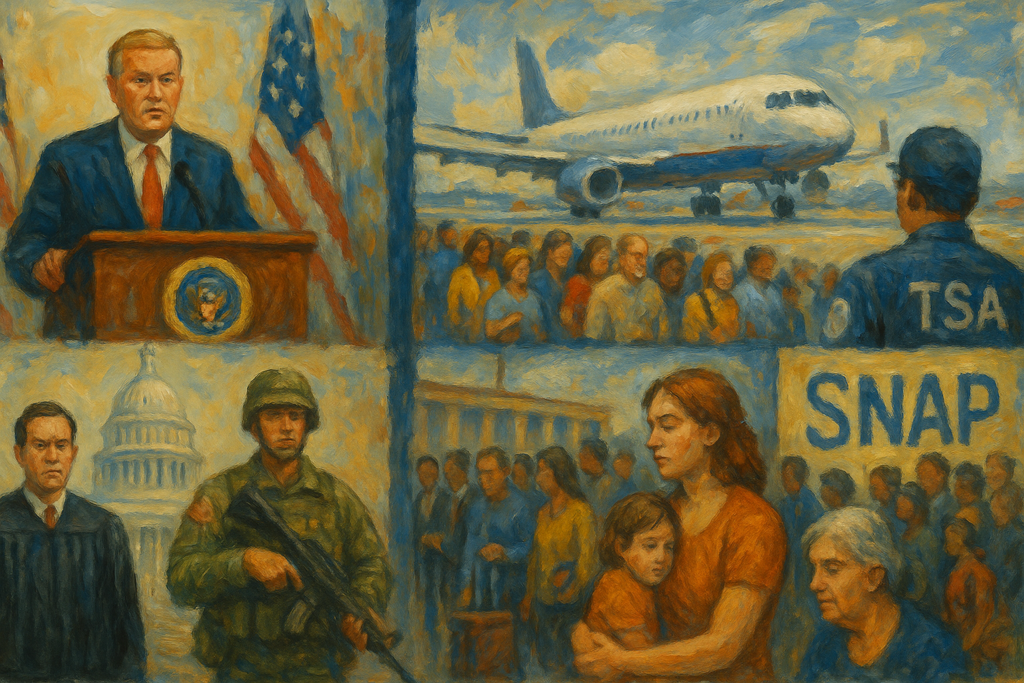
This week’s throughlines
- The shutdown became a tool of coercion — What began as a funding crisis widened into pressure on courts, federal workers, air travel, and food assistance, with the administration resisting or narrowing compliance while the economic damage mounted.
- Immigration enforcement moved toward broader force and surveillance — The week linked raids, detention, legal status rollbacks, and privatized or data-driven enforcement ideas into a more expansive immigration campaign affecting families, workers, students, and children.
- Federal power was used to pressure political and civic institutions — Trump and allies threatened local funding, attacked election legitimacy, pushed the Senate to change its rules, and used federal leverage against universities and other institutions.
- Clemency and justice powers increasingly shielded allies and targeted opponents — Controversial pardons and politically charged investigations reinforced a pattern in which presidential and prosecutorial power appeared to reward allies while pressuring adversaries.
The week opened with a shutdown already in record territory and increasingly used as a tool of leverage rather than a problem to be solved. As the days passed, that standoff reached into kitchen tables and airport control towers, while the administration pressed its advantage elsewhere: narrowing checks on war powers, hardening immigration enforcement, reshaping civil-rights baselines, and using pardons to rewrite the consequences of past political and financial misconduct.
Over the weekend, the administration moved to widen executive control over war and military oversight. The Justice Department told Congress that ongoing lethal airstrikes on small boats did not count as “hostilities” under the War Powers Resolution because the vessels could not shoot back, sharply narrowing when formal notification and congressional timelines would apply. At the Pentagon, Defense Secretary Pete Hegseth ordered that all contacts with Congress be routed through a central legislative affairs office, reducing direct, unfiltered communication between military officers and lawmakers. At the same time, in public remarks and a televised interview, President Trump threatened to invade Nigeria over violence against Christians, ordered preparations for possible U.S. operations inside Mexico against drug cartels, and suggested Venezuela’s president’s days were numbered while musing about war. He framed these possibilities in religious and security terms, without reference to congressional authorization or allied backing, reinforcing a picture of war and peace decisions driven from the top.
The same interview also reached into domestic terrain. Trump said he would consider invoking the Insurrection Act to deploy the Army or Marines inside the United States in response to civil unrest and asserted that no judge could challenge his decision. That claim, paired with DOJ’s narrow reading of war powers abroad, pointed toward an executive branch increasingly willing to treat legal constraints as malleable. Meanwhile, CBS quietly settled a lawsuit with Trump over an edited “60 Minutes” interview, paying him $16 million while it sought government approval for a merger with Skydance. The timing raised questions about how media companies balance editorial independence against regulatory risk when dealing with a sitting president.
On the ground, immigration enforcement took on a more militarized and privatized character. Over Halloween weekend, ICE and federal agents, including military troops, conducted raids in Chicago and Los Angeles that clashed with protesters, used pepper spray, and disrupted Halloween and Día de los Muertos events despite pleas from local officials. In parallel, ICE circulated plans to hire private bounty hunters, paid on performance, to track immigrants nationwide, and Texas suspended commercial driver’s licenses for non-citizens, including DACA recipients, cutting off a key avenue of work. These moves tied legal status more tightly to economic opportunity and community life, and signaled that immigration policy would lean more heavily on force and private contractors. In a smaller but telling episode, a Michigan defense lawyer publicly disputed FBI Director Kash Patel’s claim that a group of young people were plotting a Halloween terror attack, describing them as gamers and saying he expected no charges—an example of how expansive terror rhetoric can outpace the facts.
The shutdown’s reach into basic services also became clearer over the weekend. With about 13,000 air traffic controllers working without pay, the FAA warned that a surge in absences would force it to slow air traffic flows to maintain safety, foreshadowing delays and cancellations. Trump, for his part, publicly blamed Democrats for the impasse and urged Republicans to abolish the Senate filibuster so his agenda could pass with a simple majority, explicitly linking the end of the shutdown to structural rule changes in the Senate. In another assertion of personal power over legal outcomes, he acknowledged in a “60 Minutes” interview that he had pardoned Binance CEO Changpeng Zhao, who had pleaded guilty to money laundering, while admitting he did not know who Zhao was. The White House cast the move as correcting an anti-crypto “witch-hunt,” even as Binance had major dealings with a Trump family crypto venture and Zhao pledged to help make the United States the “Capital of Crypto.” The weekend thus closed with a picture of executive authority stretching across war, markets, and domestic policing.
By Monday, the use of public institutions for spectacle and patronage was on display at the White House itself. Trump ordered the demolition of the East Wing, historically home to the First Lady’s office and public-facing initiatives, to make way for a $300 million ballroom. Reporting later in the week revealed that Extremity Care, a company profiting from a delayed Medicare rule, had secretly donated $2.5 million toward the project and was allowed to remain anonymous on donor lists. The decision repurposed symbolic public space for presidential display while allowing a regulated company to underwrite the project in relative obscurity, blurring the line between public architecture and private favor.
Fiscal choices elsewhere in Washington underscored who benefited from federal policy. A major 2025 tax cut, passed with congressional support, delivered large benefits to wealthy individuals and corporations and was described as one of the biggest upward transfers of wealth in decades. At the same time, the White House froze $100 million in federal funds earmarked to help tribal communities like Nunapitchuk, Alaska, relocate from climate-threatened land, stalling urgently needed infrastructure and safety projects. The pairing of upward redistribution with withheld support for communities facing existential climate risks illustrated how budget decisions can widen existing inequalities.
The shutdown became a more explicit instrument of leverage over basic needs. On social media, Trump declared he would refuse to comply with a federal court order requiring full SNAP benefits during the shutdown, saying aid would only flow when Democrats reopened the government. In practice, officials continued sending partial benefits to about 42 million people. The next day, Senate Republicans blocked a Democratic resolution to fully fund SNAP for November, and the Senate again failed to pass a broader funding bill, prolonging the shutdown. Using food assistance as a bargaining chip and publicly scorning a court order tested the enforceability of judicial decisions and left tens of millions’ grocery budgets subject to political brinkmanship. In the electoral sphere, DOJ opened an investigation into California’s voter-approved redistricting referendum after Trump labeled it a “GIANT SCAM” and claimed, without evidence, that mail-in ballots had rigged the process against Republicans, signaling a willingness to deploy federal law enforcement against state-level reforms the president opposed.
Even as these high-profile conflicts played out, regulatory agencies continued to shape daily life in quieter ways. The FCC voted to allow prison phone and video call rates to rise by up to 83%, making permanent a temporary increase and raising caps well above levels set under a 2022 law, while reinstating a ban on kickbacks from telecom providers to prison operators but inviting further comment on whether to revisit the rule and ancillary fees. The higher rates fell on incarcerated people and their families, while the tentative nature of the kickback ban left open the possibility that profit incentives would again drive contract choices. The Census Bureau sought approval to continue the Current Population Survey’s basic demographics module, preserving a key source of labor and population data; the EPA issued rules requiring notice before certain chemicals are used in new ways; and the FDA scheduled a public advisory meeting on a heart-failure device—reminders that the statistical and regulatory infrastructure of governance continued amid political turbulence.
On Tuesday, trade and accountability questions came to the fore. Trump signed executive orders extending reduced tariffs on Chinese imports under a new economic arrangement and cutting duties on certain Chinese goods in exchange for Beijing’s commitments to curb fentanyl flows and buy U.S. agricultural products. The next day, the Senate voted 51–47 to nullify his reciprocal tariffs, with a handful of Republicans joining Democrats, though the House was not expected to act. The episode showed the president using tariff tools as bargaining chips on security and agriculture while Congress struggled to reassert its constitutional role over trade policy.
At the Justice Department, decisions about which abuses to pursue and which to close drew scrutiny. Rep. Jamie Raskin accused DOJ of a “gigantic cover-up” after the department quietly ended its investigation into Jeffrey Epstein’s alleged co-conspirators, despite testimony from nearly 50 women. A July memo had said no further charges were expected after the case files were moved to DOJ headquarters. In parallel, Arizona and Adelita Grijalva sued the House over Speaker Mike Johnson’s unprecedented 43-day delay in swearing her in after a special election, alleging the move was intended to prevent her from signing a discharge petition to release Epstein-related files and violated her constituents’ right to representation. Separately, reports detailed how Trump had pushed DOJ to bring cases against perceived adversaries, including former FBI Director James Comey and New York Attorney General Letitia James, based on thin evidence. A veteran U.S. attorney who resisted was removed and replaced with a Trump-aligned lawyer, and more than 100 former DOJ officials filed an amicus brief calling Comey’s prosecution vindictive and contrary to department norms. Together, these developments suggested that access to records and prosecutorial decisions were being shaped by political considerations at the highest levels.
Immigration enforcement continued along the harsher lines set over the weekend. Two courts issued stays blocking the deportation of Subramanyam Vedam, a legal permanent resident whose murder conviction had been overturned after more than 40 years in prison, while his decades-old drug charge kept him in immigration custody. The judicial intervention served as a backstop against compounding injustices. In contrast, ICE deported Randall Alberto Gamboa Esquivel, a Costa Rican man in a vegetative state, who later died abroad, prompting allegations of negligence and inhumane treatment. The juxtaposition highlighted both the capacity of courts to correct individual cases and the human cost when deportation machinery proceeds despite severe medical vulnerability.
Meanwhile, the shutdown stalemate deepened. The Senate rejected a government funding package for the 14th time, extending the shutdown to its 35th day. The Republican-controlled House had passed the bill, but Senate Democrats blocked it using the filibuster. The impasse disrupted services like food stamps and left hundreds of thousands of federal workers furloughed or unpaid. In more technical arenas, the EPA set pesticide residue tolerances for a fungicide on cotton, lettuce, and soybeans; the Federal Reserve injected $125 billion in short-term liquidity into the banking system over five days—its largest such move since 2020, which in turn fueled speculation in crypto markets; and Senate Republicans again blocked a Democratic resolution to fully fund SNAP. These actions showed how central bank interventions, regulatory decisions, and appropriations fights together shaped economic conditions and everyday security.
By Wednesday, the shutdown’s impact on infrastructure and rights was unmistakable. The FAA announced it would reduce flight capacity at airports by 10% starting Friday, citing unpaid, exhausted air traffic controllers and staffing shortages caused by the prolonged shutdown. The move was expected to disrupt 1,800 to 4,000 flights daily, affecting Thanksgiving travel for millions and turning a budget fight into a nationwide transportation crisis. Advocacy groups and commentators warned that Trump was using SNAP benefits as leverage against congressional Democrats, allegedly defying the Constitution and court orders by withholding food assistance from families in states like North Carolina to force political concessions, framing constitutional defiance as a bargaining tactic over basic nutrition.
The struggle over representation in Congress escalated as well. Arizona’s attorney general filed suit against the House and Speaker Johnson over the 43-day delay in swearing in Adelita Grijalva, arguing that the delay violated the Constitution by denying representation to her constituents and was intended to prevent her from accessing Epstein-related records. On the streets of Los Angeles, the LAPD released dash-cam footage showing officers weaving through traffic and driving on the wrong side of the road before fatally striking Gerardo “Jerry” Estrada, a 30-year-old skateboarder, while responding to a call. An investigation was ongoing, and the officers had not been publicly identified, raising questions about police driving practices and accountability when routine operations result in civilian deaths. In a smaller but telling incident, a police report described Rep. Nancy Mace allegedly berating airport police and TSA agents at Charleston International Airport, using profane language while being escorted to a gate during the shutdown, when TSA agents were working without pay. The clash highlighted the strain on frontline workers and the conduct of elected officials toward public servants in crisis conditions.
Thursday brought a sharper focus on enforcement and rights. In Los Angeles, heavily armed ICE agents arrested a U.S. citizen father in a Home Depot parking lot and drove away with his toddler, also a citizen, as part of a broader sweep. In Chicago, agents pursued and forcefully arrested a daycare worker inside a childcare center, allegedly slamming her into glass in front of children. ICE also announced plans for a 24/7 call center in Nashville to help law enforcement locate unaccompanied migrant children using data-enabled technology. These operations deepened fears that immigration enforcement could intrude into everyday civic spaces and family life, while new surveillance infrastructure focused on some of the most vulnerable children. In Congress, lawmakers approved $45 billion over four years for ICE to construct more detention centers for adults and children, as part of a $75 billion package to expand the agency’s capacity, locking in a carceral approach to immigration policy for years to come and reshaping local economies around confinement.
The shutdown’s human toll continued to mount. Trump reiterated that he would not disburse full SNAP funds despite a federal court order, arguing the country needed to remain “liquid” for potential crises. The decision affected more than 41 million Americans, many of them children, elderly, or disabled, who relied on SNAP for food security. The shutdown had surpassed 35 days, with roughly 1.4 million federal workers furloughed or working without pay and facing threats of withheld back pay and mass firings. Persistently defying a court order over basic nutrition tested the limits of judicial enforcement and used hunger and public-sector livelihoods as bargaining chips in a political standoff.
At the Supreme Court, the conservative majority granted the administration’s request to enforce a policy requiring that passports and other federal IDs reflect sex as defined by a January 2025 executive order recognizing only male and female based on birth certificates. The Court stayed a lower court’s nationwide block in Trump v. Orr and allowed the administration to bar transgender and nonbinary people from selecting markers that match their gender identity. The decision curtailed federal recognition of gender diversity, affecting travel, employment, and safety for those who could not obtain accurate identification. In Utah, officials announced plans to build a facility to involuntarily confine about 1,300 unhoused individuals, emphasizing rehabilitation and moral development over housing. Critics warned that treating poverty as grounds for detention raised serious civil liberties concerns and signaled a punitive turn in social policy. In contrast, Colorado voters approved Proposition MM, increasing taxes on households earning over $300,000 to fund free school meals, local food purchases, and raises for cafeteria workers, choosing progressive taxation to strengthen child nutrition and school infrastructure even as federal supports were being constrained. Trump also issued a pardon to Michael McMahon, a retired police officer convicted of acting as an illegal Chinese agent in a plot to intimidate a New Jersey family, adding to a pattern of controversial clemency in politically resonant cases.
On Friday, the use of clemency to reshape accountability for past political actions came into full view. Trump signed pardons for 77 individuals connected to efforts to overturn the 2020 election, including Rudy Giuliani, Mark Meadows, Sidney Powell, and others involved in the fake electors scheme. The pardons were signed on November 7 but announced two days later, when media attention was focused on the shutdown. Separately, seven pardons, including for Darryl Strawberry and former Tennessee House Speaker Glen Casada, were briefly posted online with identical Trump signatures before being replaced with distinct ones, which the administration blamed on technical issues. Mass clemency for key figures in an attempt to overturn an election weakened deterrence against future subversion, while irregularities in the signing process undermined confidence in how this constitutional power was being exercised.
Universities found themselves under new forms of federal pressure. Cornell University reached a settlement with the administration to restore over $250 million in research funding by sharing admissions data, paying $30 million, investing another $30 million in research, and adopting the administration’s interpretation of civil-rights law that treats diversity initiatives as unlawful race-based discrimination. Separately, the administration proposed a “compact” offering preferential federal funding to universities that commit to advancing its conservative agenda, a model already embraced by the New College of Florida. Tying research dollars and federal support to ideological conformity gave the executive branch powerful leverage over campus policy, academic freedom, and how civil rights are understood in higher education.
The Supreme Court, already having allowed the birth-sex-only passport policy to take effect, considered whether to take up Davis v. Ermold, involving former Kentucky clerk Kim Davis, who refused to issue marriage licenses to same-sex couples. Davis asked the Court to overturn a lower-court ruling against her and potentially revisit the Obergefell decision that legalized same-sex marriage nationwide. If the Court were to take the case and reopen Obergefell, it could destabilize marriage rights for LGBTQ+ couples and signal a broader rollback of equality protections. In Oklahoma, a judge granted 18-year-old Jesse Butler youthful offender status after multiple rape and assault convictions, approving a plea deal of 150 hours of community service and counseling instead of a potential 78-year prison sentence. The decision drew sharp criticism from residents and politicians who saw it as a grave injustice to victims, raising questions about how seriously the justice system treats sexual violence and whether outcomes differ based on age or perceived promise of offenders.
The shutdown’s economic and logistical costs were now fully visible. Building on earlier capacity cuts, the FAA began canceling about 700 flights per day across 40 airports due to a shortage of 3,500 air traffic controllers. The reductions affected more than 4 million passengers, with economists estimating the shutdown was costing the economy $30 billion per week. Administration officials, including the labor secretary and economic adviser, publicly attributed the downturn to the shutdown while claiming inflation and grocery prices were falling despite contrary evidence, attempting to shift blame away from trade conflicts, tax policy, and other decisions. In immigration policy, Congress’s $45 billion investment in new ICE detention centers for adults and children, debated in communities like Marana, Arizona, cemented a long-term expansion of detention infrastructure. On war powers, the Senate voted 49–51 against a Democratic resolution that would have required Trump to seek congressional approval for further military strikes in Venezuela, with only two Republicans joining Democrats, leaving broad discretion with the president. Routine governance continued at the margins: the FBI announced a December meeting of its Criminal Justice Information Services Advisory Policy Board to discuss national crime and background check systems, and Kyoto, Japan, adopted a high accommodation tax on luxury hotel stays to curb overtourism and raise revenue for urban management.
Taken together, the week traced how a prolonged shutdown can become a lever to test legal limits and reorder priorities, from food assistance and federal paychecks to air travel. It showed an executive branch pressing its advantage over war powers, clemency, and civil-rights baselines, while Congress and the courts alternated between acquiescence and sporadic pushback. Immigration enforcement and detention infrastructure expanded, rights for LGBTQ+ and unhoused people narrowed in key arenas, and universities and media organizations faced new pressures tied to funding and regulation. At the same time, state-level choices like Colorado’s school meals tax and judicial stays in individual immigration cases offered glimpses of countervailing forces. As these patterns accumulate, they reshape not only specific policies but also the expectations and guardrails that define democratic governance, accountability, and equal protection under law.