This week’s throughlines
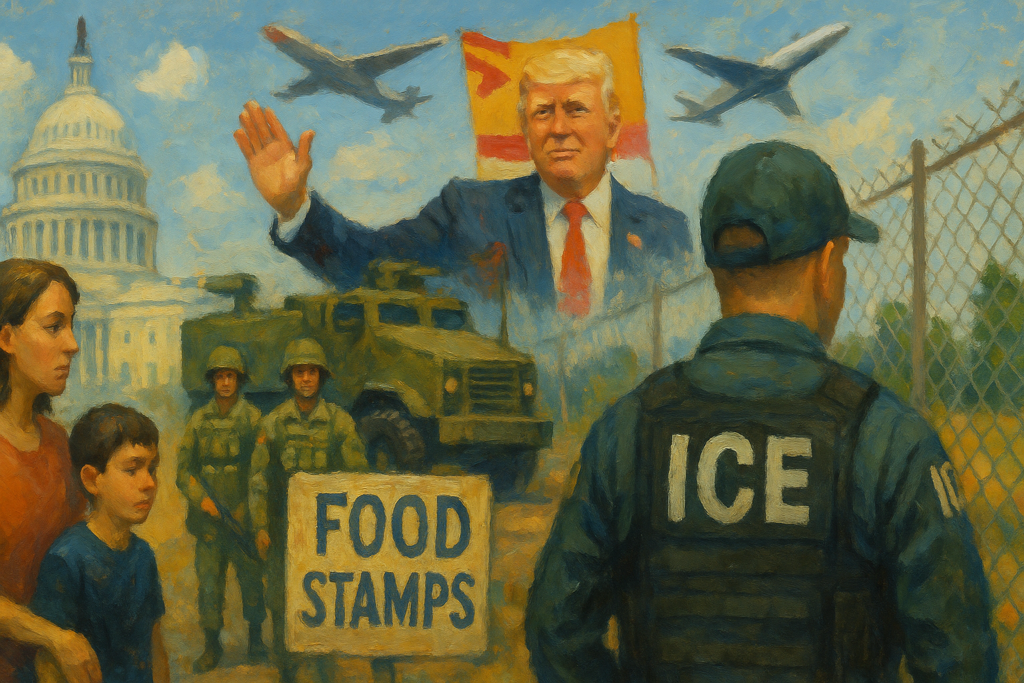
- The shutdown moved from political standoff to social and institutional damage — What began as budget deadlock kept widening into food-aid threats, unpaid federal work, air-traffic strain, delayed scientific review, and CDC layoffs, forcing courts and states to intervene.
- Immigration enforcement became more militarized, centralized, and opaque — The week linked deaths, tear gas, urban raids, leadership reshuffles, secret detention practices, and new policy machinery into a broader hardening of domestic immigration enforcement.
- Personal, political, and financial interests kept crossing into state power — The ballroom project, donor-backed military stopgaps, Trump-family-linked contracting and crypto gains, and the Zhao pardon all reinforced the week's theme of blurred lines between public authority and private benefit.
- Courts repeatedly acted as the main brake on executive overreach — Judges blocked troop deployment, voter-registration restrictions, and the SNAP cutoff, while also imposing or debating oversight on immigration enforcement and civil-service actions.
The week opened with the federal government in its fourth week of shutdown, and with it a fight over whether the administration would use its power to keep people fed. Roughly 1.4 million federal workers were unpaid or furloughed as essential staff like air traffic controllers and TSA officers continued to work without pay. Rather than treating the shutdown as an emergency to resolve, the White House and congressional leaders treated it as a battlefield. Trump left for an Asia trip—the first time a president has done so mid-shutdown—while the House largely canceled business and the Senate repeatedly failed to advance funding. Democrats tied any short-term deal to extending Affordable Care Act premium tax credits, warning that millions could lose health coverage if subsidies lapsed. The shutdown was no longer just about agency budgets; it was about whether basic services like health insurance and food assistance would be used as leverage.
Even as the shutdown deepened, the physical seat of the presidency was being remade. Over the weekend, demolition of the White House East Wing accelerated to make way for a $300 million ballroom closely associated with Trump. Treasury Secretary Scott Bessent described the project as a “judgment call,” but reporting showed how Trump had cleared the way by replacing planning commission members with loyalists and courting corporate donors to finance the construction. Historians and former staff warned that a core public building was being repurposed into a donor-financed monument to the president’s personal brand, without the usual oversight that governs changes to federal property. The project set the stage for later questions about who was paying for this new space and what they might expect in return.
Abroad, Trump’s approach to trade and alliances took another sharp turn. He abruptly terminated trade talks with Canada and announced an extra 10% tariff on Canadian goods after Ontario aired a U.S.-broadcast ad that used Ronald Reagan’s 1987 warning against tariffs. From Air Force One and later in Japan, he falsely claimed Reagan had supported tariffs and accused Canada of airing “fake ads” and meddling in a Supreme Court case on his tariff powers. The move piled new costs onto an already strained relationship, even as farmers in places like Iowa were still reeling from earlier trade and immigration policies. Trade policy, in this episode, became a tool of personal retaliation against political speech by an ally.
At the same time, the administration’s own agencies were reshaping the information landscape around the shutdown. The USDA’s Food and Nutrition Service posted banners blaming a “Radical Left Democrat shutdown” for frozen updates, and text on a USDA site went further, blaming trans people and “illegal aliens” for the crisis. Quietly, the department removed guidance that had previously stated contingency funds could be used to continue SNAP benefits during a shutdown. These changes misrepresented negotiations in Washington and obscured legal options for keeping food aid flowing. When official websites carry partisan blame and scrub inconvenient legal guidance, they stop functioning as neutral sources of public information and instead become instruments of political messaging.
Immigration enforcement over the weekend grew both deadlier and more visible. In Virginia, a Honduran immigrant, José Castro Rivera, died while fleeing an ICE raid, the third such death linked to escape attempts under intensified deportation efforts. In Chicago, federal agents used tear gas on protesters during a neighborhood Halloween parade while detaining an undocumented immigrant, exposing children and families to chemical agents. Separately, ICE detained British journalist Sami Hamdi in San Francisco after he criticized Israel, with advocates alleging retaliation for his speech. These incidents signaled a shift toward more militarized tactics and raised questions about whether immigration tools were being used to punish political expression.
The weekend also saw early moves in the long-running struggle over political maps and voting rules. In California, Proposition 50 was announced to suspend the state’s independent redistricting commission and allow Democrats to draw additional safe House seats, framed as a response to Republican gerrymanders elsewhere. In North Carolina, Rev. William Barber and allies prepared a lawsuit against new maps they argued disenfranchised Democratic voters, while a separate suit in New York challenged Staten Island’s congressional map for diluting Black and Latino voting power. At the same time, the Justice Department planned to monitor polling sites in several jurisdictions. These developments underscored how both parties were using structural tools like redistricting to entrench power, while civil rights groups and courts tried to defend fair representation.
Pressure on the information environment extended beyond government websites. Bill Owens, former executive producer of 60 Minutes, described corporate pressure to avoid controversial stories on Gaza and Trump, tying it to a pending media merger and calling it a form of censorship. A Trump-appointed regulator reportedly threatened ABC, contributing to the suspension of late-night host Jimmy Kimmel. Abroad, analyses of Russia highlighted how centralization of power and repression of LGBTQ+ people, activists, and independent media had driven talent out of the country and provided a model for other leaders. Together, these stories showed how corporate and state pressure can narrow the range of stories and identities that appear in mainstream media, weakening the informational foundation of democratic debate.
By Monday, the constitutional stakes of these trends were being spelled out in public. In a speech at the Edward M. Kennedy Institute, Joe Biden warned of “dark days” of unchecked executive power under Trump, citing the shutdown and efforts to control Congress and the courts as examples of a presidency operating without effective oversight. He framed the moment as a test of whether the United States would maintain a limited presidency, a functioning legislature, and an autonomous judiciary. His remarks connected the week’s concrete disputes—over funding, appointments, and enforcement—to a broader struggle over the balance of powers.
The same day, Trump’s use of the pardon power drew new scrutiny. He pardoned Changpeng Zhao, the CEO of cryptocurrency exchange Binance, after Zhao’s conviction for anti–money laundering failures. Reporting tied the pardon to a $2 billion investment from a UAE fund into a Trump-linked stablecoin and to lobbying by a consultant close to Trump’s son. The pardon opened the door for Binance to re-enter the U.S. market and later to list Trump-linked tokens, prompting senators to question whether financial ties had influenced clemency. When pardons appear to reward business partners of the president and his family, the idea that financial crimes are prosecuted impartially comes under strain.
Redistricting battles widened on Monday as well. In Indiana, Governor Mike Braun called a special session to redraw congressional districts mid-decade, aligning with Trump’s push for Republican-led states to shore up House seats. In New York, voters filed suit alleging that the map for Staten Island’s 11th district unlawfully diluted Black and Latino voting power under the state’s Voting Rights Act. These fights joined ongoing challenges in North Carolina and California, reinforcing that control over district lines remains one of the most contested levers of political power.
The Justice Department’s posture toward Trump’s critics hardened the same day. DOJ charged former FBI Director James Comey and indicted New York Attorney General Letitia James, both long-time antagonists of the president. At the same time, Trump filed a claim demanding $230 million from DOJ for alleged persecution by past investigations. The officials evaluating his claim are his own appointees, and he has said he would personally decide on payment, despite constitutional barriers. Using the justice system to prosecute critics while seeking personal compensation from it inverted normal accountability and raised alarms about the independence of law enforcement.
On the enforcement front, Monday’s reporting detailed plans to overhaul ICE leadership by reassigning multiple field office directors and replacing them with Border Patrol officials, as the administration pushed to meet a target of 3,000 arrests per day. The changes, driven by advisers Stephen Miller and Corey Lewandowski, reflected frustration that current ICE leadership was not meeting deportation quotas. Politicizing leadership in enforcement agencies to hit numerical targets shifted immigration policy away from case-by-case judgment toward volume-driven crackdowns.
By Tuesday, the shutdown’s human stakes sharpened dramatically. USDA announced that no SNAP benefits would be issued on November 1, citing a lack of funds and declining to use a $5–6 billion contingency account. More than two dozen states, led by New York, California, and Massachusetts, sued to compel the administration to maintain benefits for 42 million people, arguing that funds were legally available. Their lawsuits emphasized the impact on children and low-income households and challenged USDA’s sudden claim that contingency funds were off-limits. The fight over SNAP showed how executive control over technical funding decisions could be used to threaten basic food security, forcing courts to step in to preserve statutory safety nets.
At the same time, the reshaping of immigration enforcement moved from planning to deployment. ICE announced a major leadership overhaul, reassigning at least 12 field office directors and elevating Border Patrol and CBP officials into domestic roles. Simultaneously, 1,500 Border Patrol agents were deployed into cities like Los Angeles, Chicago, and New York, using Black Hawk helicopters, tear gas, and military-style tactics. Internal targets called for tripling daily arrests, and analyses projected that mass deportations could shrink GDP by up to 7.4% over three years. Embedding Border Patrol in domestic policing and setting aggressive arrest quotas militarized everyday enforcement and raised the risk of rights violations on a large scale.
Investigative reporting on Tuesday revealed how these tactics were being paired with new forms of secrecy. A Guardian investigation found that ICE had been detaining people for days or weeks in small, off-the-books holding rooms inside ICE offices and federal buildings, despite internal policy limiting such stays to three days. In parallel, reports described masked federal agents conducting street arrests in multiple cities. These practices operated with little oversight, raising concerns about unsafe conditions, coerced decisions, and blocked access to lawyers. Hidden detention spaces and opaque arrests eroded basic due process protections and made it difficult for courts, Congress, or the public to monitor how state power was being used.
Courts that day issued mixed rulings on enforcement oversight and fair trials. In one case, a federal judge issued a gag order to prevent DOJ and DHS from undermining a defendant’s right to a fair trial in the Abrego Garcia case. In another, testimony emerged that a Homeland Security agent’s shooting during a traffic stop had been omitted from official reports at a supervisor’s direction. Yet the Seventh Circuit blocked a district judge’s order requiring a senior Border Patrol official to provide daily briefings on Chicago immigration sweeps, limiting one avenue of real-time oversight. The judiciary was both stepping in to protect individual rights and stepping back from close supervision of aggressive enforcement.
The administration also used federal funding streams to shape cultural and educational content. On Tuesday it demanded that states remove references to gender identity and the existence of transgender and non-binary people from a federal sex education program, threatening to cut funding. Eleven states and two territories complied, while sixteen states and D.C. sued, arguing that the Department of Health and Human Services had overstepped Congress’s authority. A federal judge blocked the department from cutting funds to the suing states, at least temporarily. The move showed how grants could be used to pressure schools into erasing certain identities from curricula.
Wednesday brought a rare institutional pushback on Trump’s trade powers. The Senate passed bipartisan bills to block his tariffs on Brazilian imports and to strip his authority to impose global base-level tariffs via emergency declarations. Several Republicans joined Democrats in the 52–48 and 51–47 votes. Yet the measures faced a roadblock in the House under Speaker Mike Johnson and the likelihood of a presidential veto. The votes signaled that at least one chamber was willing to reassert its constitutional role over trade, even if structural and partisan barriers limited the practical effect.
On the domestic security front, a Pentagon memo following an earlier Trump executive order directed the National Guards of all 50 states, D.C., and U.S. territories to train 23,500 troops as “quick reaction forces” for riot control by January 1, 2026. Each state was told to train about 500 members in nonlethal crowd control. The directive effectively created a standing, federally influenced domestic force ready for rapid deployment to civil disturbances. Embedding permanent riot-control units in every state’s Guard expanded the executive’s toolkit for responding to protests and unrest, with implications for civil liberties and state autonomy.
Immigration policy took another restrictive turn on Wednesday. The administration announced a drastic cut in refugee admissions from 125,000 to 7,500, with a stated priority for white South Africans. This policy dovetailed with broader State Department restructuring around an “office of remigration” and mass visa revocations for students and immigrants from 19 countries, many of them nonwhite or Muslim-majority. Recasting refugee policy and visa access along racial and ideological lines narrowed who could seek protection or opportunity in the United States, reshaping both the country’s global role and its domestic demographics.
Back in Washington, the East Wing ballroom project drew new scrutiny. Led by Adam Schiff, Senate Democrats sent a letter to White House Chief of Staff Susie Wiles demanding a full accounting of donors to the $300 million project. They requested amounts, dates, and any links to federal contracts or regulatory matters, as well as any ethics guidance sought before accepting private funding. The inquiry aimed to uncover whether corporations and wealthy individuals were effectively buying influence by financing a presidential construction project on federal property.
The SNAP fight intensified midweek as more details emerged about USDA’s decisions. New reporting showed that the department had decided not to use roughly $6 billion in SNAP contingency funds despite a September 30 directive saying they could be used during a shutdown, and had removed that guidance from its website. Speaker Mike Johnson advised House Republicans to take a vacation as the shutdown passed 30 days, even as 42 million people faced potential loss of food aid. More than two dozen states filed or expanded lawsuits against the administration’s plan to suspend benefits, emphasizing the disproportionate impact on poor and minority communities. Judges in Rhode Island and Massachusetts issued orders blocking the suspension and requiring USDA to distribute contingency funds for November 1 payments, while another judge in Boston signaled skepticism about the administration’s legal arguments. Here, courts acted as a backstop to keep food assistance flowing when the executive branch refused to use available tools.
The shutdown also became a vehicle for reshaping public health institutions. A major reduction in force at the CDC terminated roughly a quarter of its workforce, including entire departments such as the ethics office, the institutional review board, and the Washington policy office that briefs Congress. A court had already ruled that earlier terminations of probationary employees went too far, leading to some reinstatements, and the federal workers’ union sued to stop further layoffs. Hollowing out the CDC’s ethics, review, and congressional liaison functions under cover of a shutdown weakened the country’s ability to respond to future health crises and to oversee that work.
Wednesday also brought further examples of immigration tools being used against critics. Nigerian Nobel laureate Wole Soyinka announced that his U.S. visa had been revoked after years of outspoken criticism of Trump. In Illinois, progressive congressional candidate Kat Abughazaleh was indicted over her role in protests outside an ICE facility, which she called a political prosecution. Together with the detention of Sami Hamdi earlier in the week, these cases suggested that immigration and criminal law were being used to constrain dissenting voices.
On Thursday, Trump used social media to announce a dramatic shift in nuclear policy. Via a Truth Social post, he directed the Pentagon to begin nuclear weapons testing “on an equal basis” with Russia and China, ending a 33-year moratorium. He repeated the announcement during his Asia trip, framing it as catching up with rivals. Experts questioned his claims about the U.S. stockpile and warned of the global security implications. Restarting nuclear testing unilaterally altered U.S. nuclear posture, risked sparking new arms races, and concentrated momentous decisions about war and peace in the hands of one office.
The entanglement of presidential power with private financial ventures deepened the same day. Following Trump’s pardon of Binance founder Changpeng Zhao, Binance’s U.S. exchange announced it would list two Trump-linked tokens, USD1 and WLFI, issued by World Liberty Financial, a venture co-founded by Trump and his sons. Trump reportedly holds a significant share of WLFI, and the token structures are designed to generate profits for their owners as trading volume grows. Allowing a platform whose CEO was just pardoned to trade tokens that enrich the president blurred the line between public office and private speculation.
Abroad, U.S. military operations continued to expand with limited congressional debate. Under Trump’s direction, the USS Gerald R. Ford strike group carried out lethal operations against fast boats in the Caribbean and Eastern Pacific, officially targeting narcotics traffickers. Colombian authorities reported civilian deaths and said the strikes focused on cocaine rather than fentanyl. Lawmakers such as Rand Paul criticized the actions as unauthorized extrajudicial killings, and the administration signaled plans to move operations ashore in Venezuela. These actions tested the boundaries of executive war powers and international law.
Domestically, ICE explored further outsourcing of enforcement. The agency began planning a privately run transportation system in Texas that would authorize contractors carrying firearms to move detained immigrants from local jails across 254 counties to ICE facilities. Shifting physical custody from government agents to private security firms reduced transparency and could weaken accountability for abuses during transport.
Courts continued to shape the rules of political participation. A federal judge blocked enforcement of a provision in a Trump executive order that would have required proof of citizenship on federal voter registration forms, ruling that the requirement was likely unlawful. The order would have added a new barrier to registration in federal elections. The ruling protected access to the ballot by preventing an untested documentation requirement that could have disenfranchised eligible voters lacking ready paperwork.
The downstream effects of trade and energy choices were visible in everyday life. New tariffs on chocolate imports from major cocoa producers drove up Halloween candy prices by at least 20% for some treats. Democratic lawmakers sent a letter to Trump highlighting an 11% rise in U.S. electricity bills since he returned to office, blaming fossil-fuel–heavy policies and cuts to efficiency programs. Separately, the Kennedy Center under Trump’s leadership saw 43% of tickets go unsold for typical productions, with critics citing mismanagement and a revenue-first approach. These stories showed how high-level decisions translated into consumer costs and the health of cultural institutions.
Amid the shutdown standoff, Trump also called for abolishing the Senate filibuster. He urged Senate Republicans to use the “nuclear option” to end the legislative filibuster in order to push through his priorities and break the impasse. Senate GOP leaders, including John Thune, rejected the idea, while some members expressed openness, exposing internal divisions. Eliminating the filibuster would fundamentally change how the Senate operates, reducing minority-party leverage and making it easier for a narrow majority aligned with the executive to reshape law.
By Friday, the legal fight over food assistance reached a turning point. Federal judges in Rhode Island and Massachusetts issued orders preventing the administration from suspending SNAP benefits during the shutdown and requiring USDA to distribute contingency funds for November 1 payments. A Boston judge ruled the plan likely unlawful and demanded a partial funding plan. These rulings came in response to lawsuits by states, cities, and nonprofits arguing that USDA had both the funds and the authority to maintain benefits. The decisions ensured continued food assistance for tens of millions and demonstrated that courts could still compel an unwilling executive to honor core welfare obligations.
Further reporting on Friday revealed how immigration policy was being run through secretive channels. Stephen Miller was reported to be running daily, closed calls with a small group of conservative diplomats to direct visa revocations and deportations, focusing on critics of Israel and other political targets. At the State Department, the Bureau of Population, Refugees, and Migration was restructured to include an “office of remigration,” and leadership of the Bureau of Consular Affairs was replaced with ideological allies. These changes sat alongside earlier decisions to slash refugee admissions and revoke thousands of visas. Running immigration policy through secret calls and newly politicized offices concentrated power in a small circle and made it easier to target people for their views rather than their legal status alone.
On the ground, states and advocates pushed back against federal enforcement tactics. In Illinois, groups including the ACLU of Illinois and the MacArthur Justice Center filed suit over conditions at the Broadview immigration facility near Chicago, alleging denial of private attorney calls, blocked access for members of Congress and journalists, and coerced signatures on documents leading to deportation. Governor JB Pritzker separately urged DHS and ICE to suspend raids over Halloween weekend after Border Patrol had used tear gas at a children’s parade. The lawsuit and the governor’s letter showed state and civil society actors trying to reassert basic legal standards and community safety in the face of increasingly aggressive federal tactics.
The USDA’s role in shaping public narratives about the shutdown also drew renewed attention. Text on a USDA website blaming trans people and “illegal aliens” for the shutdown underscored how official channels were being used to stigmatize marginalized groups. In response to broader concerns about authoritarian governance and the use of state power, organizers announced a nationwide economic boycott, “Black Out the System,” planned for late November, urging people to withhold purchases as a form of resistance. Government scapegoating risked inflaming social divisions, while the planned boycott illustrated how citizens were turning to economic pressure when they felt formal channels were failing.
Beyond U.S. borders, economic and trade policy toward poorer countries shifted. The African Growth and Opportunity Act, which had opened U.S. markets to certain African products, was allowed to expire, and the administration imposed or threatened tariffs on African countries and Pakistan. Analysts warned that these moves would hurt some of the world’s poorest and most populous countries, potentially increasing migration pressures. Policy proposals circulated calling for rich countries to fully open markets and direct aid to people rather than governments in these states. Closing off trade preferences and adding tariffs for poor countries risked undermining development and stability abroad, with long-term implications for migration and global inequality.
The week closed with a reminder of how fragile the information ecosystem has become. The Times of London apologized and retracted an article after misattributing quotes to former New York mayor Bill de Blasio that actually came from a Long Island wine importer with a similar name. The error, which had criticized a political figure de Blasio supports, was described internally as humiliating and damaging to the paper’s reputation. Even when corrected, such high-profile journalistic mistakes can erode trust in media and provide ammunition to those seeking to discredit independent reporting.
Taken together, the week’s events traced a pattern of executive power pressing against institutional limits. The shutdown was leveraged to test how far the administration could go in withholding food aid and hollowing out public health capacity before courts intervened. Immigration machinery was repurposed for speed, volume, and ideological targeting, while the National Guard and nuclear posture were reshaped to give the president more rapid tools at home and abroad. The White House itself became a site of donor influence and family enrichment, even as official channels spread partisan blame and scapegoating. Against this, courts, states, unions, and civil society mounted legal challenges, oversight efforts, and calls for economic protest. The balance between concentrated power and democratic checks remained unsettled, but the week showed both how far the executive was willing to push and how other institutions, when they chose to act, could still constrain it.