This week’s throughlines
- The DHS shutdown became a test of executive power versus ordinary appropriations — Congress failed to resolve the Homeland Security funding fight, especially over ICE, while Trump increasingly relied on executive orders and directives to pay TSA and later DHS workers.
- Election control moved from rhetoric into executive and state action — Trump's order on voter eligibility lists and mail ballots sought to pull election administration toward the federal executive, while states and DOJ battles over voter data and proof-of-citizenship rules widened the conflict.
- Courts repeatedly checked executive overreach while larger constitutional fights advanced — Judges halted the White House ballroom project, protected press and broadcasting rights, restored detention oversight, and heard the administration's challenge to birthright citizenship.
- Public dissent remained broad, while enforcement and messaging hardened around it — The No Kings mobilization showed mass civic participation, but arrests, reported plans to provoke confrontations, and terrorism-style prosecutions pointed to a harsher official posture toward protest.
- Control over information, memory, and records widened beyond day-to-day politics — The administration and allied officials pressed cultural institutions to align with a preferred national story, pushed to weaponize investigative files, and challenged the legal framework for preserving presidential records.
The week opened with people, not institutions, setting the pace. On Saturday, more than 3,000 “No Kings 3” events unfolded across all 50 states and at least 15 countries, drawing an estimated 8–9 million participants. The marches stretched from big coastal cities into small conservative towns, uniting opposition to the war in Iran, new voting restrictions, mass deportations, and efforts to sanitize American history. Most demonstrations remained peaceful, underscoring how broad and disciplined the dissent had become. But the response was uneven: in Los Angeles, local police and federal officers used pepper balls and tear gas near a federal detention center and arrested dozens after issuing a dispersal order, while other cities saw little interference. The contrast highlighted how the right to assemble now depended heavily on local and federal choices about policing.
Even as people filled the streets, the administration leaned further into unilateral power. With the Department of Homeland Security in the longest partial shutdown in U.S. history, Trump signed emergency-style directives to restore pay first to TSA workers and then, by the end of the week, to all DHS staff. Nearly 200,000 employees had gone weeks without pay, and airports were straining under attrition and sickouts. The orders eased immediate hardship and kept planes moving, but they did so by sidestepping Congress’s control over appropriations. House Republicans, influenced by Freedom Caucus hardliners, refused to advance a bipartisan Senate bill that would have funded DHS without boosting ICE and Border Patrol, leaving the underlying dispute unresolved while the White House improvised around it.
Immigration enforcement seeped further into everyday life. Over the weekend, Trump ordered ICE agents—who are not trained as screeners—to conduct security checks at 14 airports in 11 cities, ostensibly to relieve TSA shortages. The move blurred the line between border enforcement and routine travel, and Republican leaders explored using budget reconciliation to lock in ICE funding even as local governments began looking for ways to resist new detention facilities. At the same time, two grim cases underscored the human cost of enforcement: a Rohingya refugee left by Border Patrol in a Buffalo parking lot on a freezing night was ruled a homicide victim by the county medical examiner, and nine activists in Texas were convicted on terrorism-related charges after a protest at an ICE facility turned violent. Mexico prepared an amicus brief in a lawsuit over a death at GEO Group’s Adelanto detention center, signaling that detention conditions were becoming a diplomatic issue as well as a domestic one.
The weekend also revealed how the administration was trying to control not just borders but memory. A new executive order on “Restoring Truth and Sanity to American History” directed the Interior Department and the Smithsonian to emphasize a celebratory narrative and to review exhibits for “divisive” content. The National Park Service was told to align all park interpretation with this line, and the National Portrait Gallery, under White House pressure, removed references to Trump’s impeachments and 2020 defeat from his official portrait text. A federal judge had recently ordered the Park Service to restore exhibits on enslaved people at the President’s House in Philadelphia, warning against Orwellian revisionism. The clash between the order and the court’s ruling showed how museums and monuments had become contested ground for defining the national story.
Abroad, the war in Iran continued to reshape global energy markets and domestic politics. South Korea released a record 22.46 million barrels from its strategic reserves, and the Philippines declared a national energy emergency as supply disruptions and price spikes rippled through oil, gas, fertilizer, and petrochemical markets. Analysts warned there was no spare capacity to offset lost Middle East output. At home, the administration tilted policy further toward fossil fuels: support for U.S. battery factories and EV subsidies was canceled, contributing to large write-downs at Ford and GM; a Pentagon review backlog froze at least 30 onshore wind projects; and in Ohio, Cleveland-Cliffs chose to reline a blast furnace for another 15–18 years of fossil-fuel use after a $500 million hydrogen conversion grant was terminated. These choices locked in more pollution and made the energy transition harder just as war-driven shocks were pushing up prices.
By Monday, the focus shifted from protest slogans to formal orders on elections and citizenship. Trump signed an executive order directing DHS and the Social Security Administration to compile federal lists of eligible voters in each state and requiring the Postal Service to send mail ballots only to those on an approved list. States that refused to comply risked losing federal funds. The order immediately drew resistance from Democratic and some Republican officials, who called it an unconstitutional intrusion into state-run elections. It laid the groundwork for a centralized federal voter file and set off a scramble among states and civic groups to prepare legal challenges.
At the same time, the administration pressed ahead on redefining who counts as American. The Justice Department prepared to argue before the Supreme Court in a case challenging Trump’s executive order narrowing birthright citizenship for children of non-permanent residents. Trump publicly derided the Court as “stupid” and “dumb” in advance, signaling open disregard for judicial independence. The case, brought by ACLU affiliates on behalf of families whose U.S.-born children would lose automatic citizenship if the order stands, threatened to upend more than a century and a half of Fourteenth Amendment precedent. The Justice Department also sued Minnesota’s education department and athletics body, arguing that allowing transgender girls to compete in girls’ sports violates Title IX, even as a DOJ whistleblower’s lawyers told Congress that the department’s inspector general had ignored serious misconduct and court-order violations by DOJ lawyers. The combination of outward-facing civil-rights litigation and inward-facing oversight failures raised questions about the department’s neutrality.
Press freedom and war policy intersected as well. A federal judge in Washington, D.C., sharply criticized the Pentagon’s revised press credential policy, calling it “weird” and potentially unconstitutional after having previously struck down similar restrictions. The New York Times argued that the new rules, which require escorts and limit anonymous sourcing, rendered credentials meaningless and chilled reporting on military affairs. Meanwhile, analysts detailed how the Iran conflict had disrupted a significant share of global oil supply, with knock-on effects for food prices and manufacturing, foreshadowing rising costs for U.S. consumers that would undercut Trump’s earlier promises to lower energy prices.
On Tuesday, the administration doubled down on its election strategy. A new executive order, “Ensuring Citizenship Verification and Integrity in Federal Elections,” again directed DHS and SSA to build state-specific citizenship lists and ordered USPS to use a federal “mail-in participation list” to control who receives absentee ballots. It also instructed the Attorney General to prioritize election-fraud prosecutions. Democratic officials in Oregon and Arizona immediately announced plans to sue, calling the order unconstitutional and an attempt to access sensitive voter data. Layered atop existing state systems, the orders threatened to disenfranchise naturalized citizens, students, and others whose records might not match federal databases.
Courts, however, showed they were not simply bystanders. In parallel cases brought by NPR and PBS, Judge Randolph Moss ruled that Trump’s executive order directing agencies to cease funding public broadcasters was unconstitutional viewpoint discrimination and retaliation. He permanently enjoined agencies from enforcing the directive, underscoring that the executive cannot wield funding decisions to punish disfavored speech. In another case, Judge Richard Leon issued a preliminary injunction halting construction of a $400 million White House ballroom on the site of the demolished East Wing, finding that Trump lacked statutory authority to proceed without Congress. The National Trust for Historic Preservation had argued that required reviews were bypassed, and Leon emphasized that major federal building projects still require congressional blessing.
Inside law enforcement, the week brought signs of politicization. Three former FBI agents filed a class-action lawsuit against FBI Director Kash Patel and Attorney General Pam Bondi, alleging they were summarily fired for perceived political opposition to Trump and denied due process. The suit sought to represent at least 50 former employees dismissed since early 2025, amid broader claims that investigations into Trump and his allies had been shut down or punished. That same day, Trump included billionaire Elon Musk on a call with Indian Prime Minister Narendra Modi to discuss military strategy regarding Iran. Musk, a private citizen with major business interests in energy, space, and communications, had no formal national security role. His presence on the call raised questions about the influence of private wealth on war planning and the handling of sensitive information.
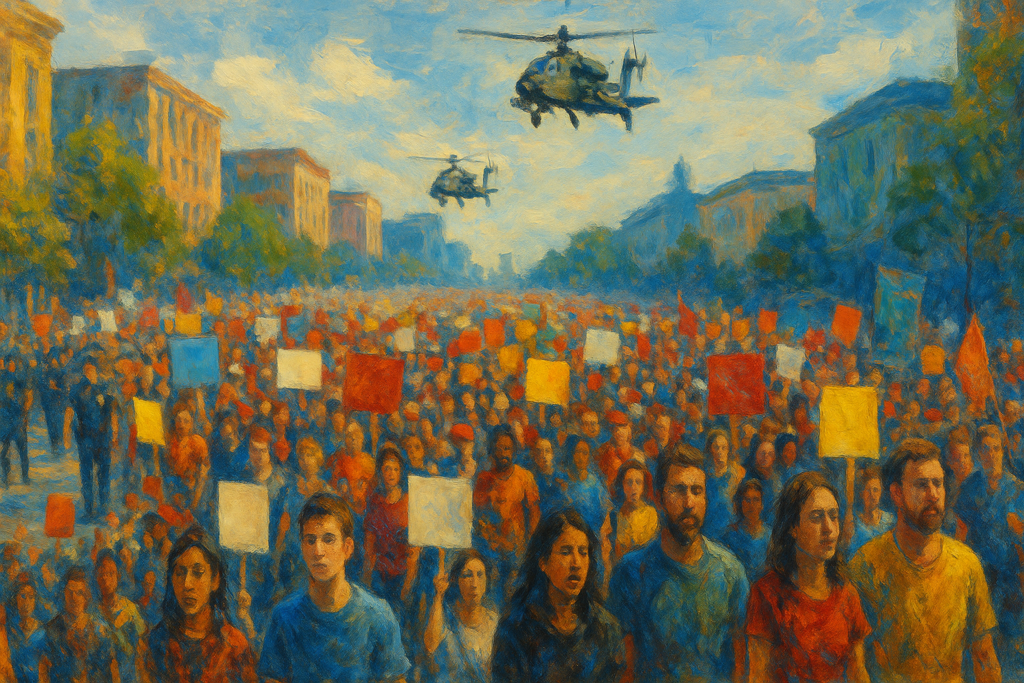
The militarization of domestic politics surfaced again in Nashville. After two Apache attack helicopters flew low over a “No Kings” protest downtown and maneuvered near musician Kid Rock’s home—an incident Kid Rock posted online—the Army opened an investigation and initially suspended the aircrew. Defense Secretary Pete Hegseth later reversed the suspension, closed the investigation, and announced that the pilots would face no punishment. The sequence, from public outcry to brief accountability to exoneration, highlighted tensions between military norms and political favoritism. Elsewhere, the administration announced that the U.S. Forest Service would move its headquarters from Washington, D.C., to Salt Lake City and consolidate research facilities in Colorado while shutting down regional offices. Critics warned that the relocation would hollow out scientific capacity and weaken the agency’s influence in national policymaking, making it easier to favor extractive interests over conservation.
Wednesday marked a peak in the clash over elections and citizenship. Trump signed yet another executive order creating federal lists of “eligible citizens” in each state and directing USPS not to send mail ballots to anyone not on those lists, again threatening to withhold federal funds from non-compliant states. Civil-rights advocates and election officials warned that errors in federal databases could wrongly exclude large numbers of eligible voters. Within hours, Democratic leaders and civic groups began preparing lawsuits, and the orders became the central target of a multi-front legal campaign that would crest the next day.
States began to mirror the federal push. Florida Governor Ron DeSantis and Mississippi Governor Tate Reeves each signed laws requiring documentary proof of citizenship to register to vote and mandating cross-checks against state and federal databases. Florida’s law also narrowed acceptable forms of voter ID, dropping several existing options. Supporters framed the measures as protecting elections from non-citizen voting; critics warned they would purge eligible voters, especially naturalized citizens and those with limited access to documents. At the Supreme Court, justices heard arguments in Trump v. Barbara, the birthright citizenship case, with Trump attending in person—an unprecedented move for a sitting president. Several justices expressed skepticism, citing the text and history of the Fourteenth Amendment and the Wong Kim Ark precedent, while families represented by the ACLU watched to see whether their U.S.-born children would remain citizens.
The war in Iran and its political fallout were never far from view. On social media and in a televised primetime address, Trump said he was “strongly considering” pulling the U.S. out of NATO because allies had not backed his unilateral war on Iran, calling the alliance a “paper tiger” and claiming Vladimir Putin agreed. He emphasized aggressive military actions and urged other countries to secure the Strait of Hormuz, offering few concrete plans for de-escalation. The remarks came as gas prices had risen more than 28 percent since he took office, contrary to his campaign pledge to cut them in half. Meanwhile, other institutions continued to push back on executive overreach: the Ninth Circuit affirmed but narrowed an injunction protecting protesters, journalists, and legal observers from DHS actions; another appellate court denied HUD’s request for a stay in a housing case, warning a stay would be “immediately destabilizing and disastrous” for plaintiffs; and House Judiciary and Oversight leaders confirmed they would continue investigating former Attorney General Pam Bondi and enforce her subpoena on the Epstein files despite her impending removal. Immigration enforcement reached into military family life as ICE announced it would station agents at Marine Corps graduation events at Parris Island to conduct “enhanced screening” and immigration status checks on attendees, raising fears that undocumented relatives of service members could be detained at family ceremonies.
Thursday brought a coordinated legal counter-offensive against the election orders and a dramatic reshaping of the Justice Department and Pentagon leadership. A broad coalition of Democratic campaign committees, party organizations, and congressional leaders sued in D.C. federal court, arguing that Trump’s election order violated the Elections Clause, commandeered state officials, and conflicted with federal law. In Massachusetts, the League of Women Voters and other nonpartisan groups filed a separate suit, while LULAC and student organizations sued the Executive Office of the President in Washington. A coalition of 23 state attorneys general and Pennsylvania’s governor filed yet another complaint, calling the order unconstitutional and warning it would disrupt election preparations. The courts became the main arena in which state control of elections and federal executive power would be tested.
At the Justice Department, Trump fired Attorney General Pam Bondi, reportedly over her handling of the Epstein files and her perceived failure to aggressively prosecute his political adversaries. Deputy Attorney General Todd Blanche—formerly Trump’s personal defense attorney—became acting Attorney General. Bondi remained under subpoena to testify before Congress about the Epstein Files Transparency Act, while Blanche quickly announced the release of all DOJ Epstein files, saying they should not be a future focus of the department. The move further blurred the line between the president’s private interests and the impartial administration of justice. In a related front on information control, Assistant Attorney General T. Elliot Gaiser issued an opinion declaring the Presidential Records Act unconstitutional, arguing it infringes on presidential autonomy. The PRA, enacted after Watergate, has governed preservation and public access to presidential records for decades. Critics warned that undermining it could allow presidents to destroy or conceal records at will, weakening future investigations and historical accountability.
The Pentagon also underwent a loyalty-driven shake-up. Defense Secretary Pete Hegseth fired Army Chief of Staff Gen. Randy George and removed two other senior officers, Gen. David Hodne and Maj. Gen. William Green, amid disputes over promotions and diversity efforts. Gen. Christopher LaNeve, a former military aide, was named acting chief. Hegseth formally closed the Apache helicopter investigation, confirming no suspensions or punishment, and reports indicated he was working to block promotions of women and Black officers while holding evangelical services at the Pentagon that framed the Iran war as a holy struggle. These actions deepened concerns about politicization and religious rhetoric at the top of the military.
Economic policy reflected the same war-first posture. Trump issued an executive order imposing a 100 percent tariff on many patented pharmaceuticals and active ingredients, with lower but rising tariffs for companies that agreed to onshore production by 2030. The administration framed the move as a national-security measure to reduce reliance on foreign supply chains, but it risked raising drug prices in the short term while giving the executive significant leverage over pharmaceutical firms. Details also emerged of Trump’s forthcoming FY 2027 budget, which would nearly double defense spending to around $1.5 trillion, funded by cuts to Medicaid, Medicare, and other domestic programs. Proposals included rebuilding Alcatraz as a secure prison, and at an Easter lunch Trump said daycare funding should be left to states, emphasizing that the federal government’s primary duty is military protection. The budget sketched a future in which war-related spending took precedence over health care and family services.
Immigration policy remained a site of both expansion and resistance. Six plaintiffs, including noncitizens under orders of supervision and their U.S. citizen family members, sued in D.C. to block an ICE memo authorizing agents to forcibly enter homes without judicial warrants, arguing it violated the Fourth Amendment and federal law. Uganda received the first U.S. deportation flight under a new third-country agreement, prompting condemnation from the Uganda Law Society and plans for legal challenges. At the same time, officials in Pennsylvania, Utah, and Georgia used environmental and infrastructure regulations to stall or block ICE’s plans to convert warehouses into massive detention centers. Pennsylvania’s Department of Environmental Protection cited water and sewage violations; Salt Lake City capped water use for new non-residential developments at levels far below what an ICE facility would need; and Social Circle, Georgia, shut off water and sewage service to an ICE-owned warehouse. These moves showed how local and state governments could weaponize infrastructure law to resist federal detention expansion even when they could not change immigration statutes directly.
Other developments on Thursday pointed to slow-burning risks. The CDC temporarily stopped testing for more than two dozen infectious diseases, including rabies and certain herpesviruses, due to workforce reductions from layoffs and departures. The pause limited the agency’s ability to support state and local labs and to monitor outbreaks, weakening early warning systems just as other crises demanded attention. And in an 8–1 decision, the Supreme Court ruled against Colorado’s law banning conversion therapy for minors, holding that it violated the free-speech rights of counselors. The case was remanded for strict-scrutiny review, but the ruling cast doubt on similar bans in 22 other states and raised questions about how far states can go in regulating harmful quasi-medical practices, particularly for LGBTQ+ youth.
Friday closed the week with further reliance on emergency-style spending powers and deepening legal fights over elections, markets, and the environment. Trump issued an executive order directing the homeland security secretary to use available funds to pay all DHS employees, extending the approach he had used for TSA as the shutdown reached day 49. The order eased immediate financial strain but again bypassed Congress’s power of the purse, normalizing unilateral workarounds instead of resolving the underlying appropriations dispute. On the election front, more than 20 Democratic state attorneys general, led by California, filed suit in Massachusetts challenging Trump’s “Ensuring Citizenship Verification and Integrity in Federal Elections” order, arguing it violated the Elections and Electors Clauses, commandeered state officials, and conflicted with federal statutes. Their complaint joined earlier suits by party committees and civic groups, making clear that nearly every major Democratic-led jurisdiction was contesting the order in court.
Regulators and states also pressed back against concentrated private power. The FTC sued Ticketmaster and its parent Live Nation for allegedly hiding mandatory fees until late in the purchase process, part of a broader crackdown on “junk fees.” Separately, DOJ reached a controversial settlement with Live Nation in an antitrust case over its dominance in live music, prompting criticism from lawmakers like Senator Elizabeth Warren. More than 30 states chose to continue their own litigation, reflecting ongoing concern about the company’s market power and its control over access to cultural and civic life. The March jobs report, meanwhile, showed the economy adding 178,000 jobs—far above expectations—and the unemployment rate falling to 4.3 percent, but the labor-force participation rate declined and February’s numbers were revised downward to show a loss of 133,000 jobs. The data suggested a hiring recession in sectors like hospitality and construction, exacerbated by the Iran conflict and broader uncertainty, even as headline figures painted a rosier picture.
As war and defense spending loomed larger, new fiscal ideas surfaced from below. Senator Bernie Sanders and Representative Ro Khanna introduced the “Make Billionaires Pay Their Fair Share Act,” proposing a 5 percent annual wealth tax on billionaires. In California, organizers gathered signatures for a one-time 5 percent wealth tax on state billionaires to offset federal cuts to hospitals, emergency services, education, and food assistance. Washington state enacted its first income tax targeting about 20,000 millionaire households to fund schools, prisons, and social services. These efforts reflected a coordinated push to counter rising inequality and to finance public goods in the face of war-driven budgets. Environmental policy, however, moved in the opposite direction: the Endangered Species Committee finalized an exemption for Gulf of Mexico oil and gas activities from key Endangered Species Act requirements, citing national security needs amid global oil shortages. The decision allowed drilling to proceed without standard consultation or jeopardy findings for species like the Rice’s whale, setting a precedent for sidelining conservation whenever energy markets tighten. In immigration oversight, a federal court struck down a Trump-era policy requiring members of Congress to give seven days’ notice before visiting ICE detention facilities, restoring the ability to conduct unannounced inspections—one of the few tools lawmakers have to monitor conditions inside closed systems.
Taken together, the week traced an escalating confrontation between an assertive executive, a mobilized public, and contested institutions. Millions marched under the banner of “No Kings” as the administration sought to centralize control over who can vote, who counts as a citizen, what history is told, and how war is waged. Courts, state governments, local officials, and civic groups pushed back in uneven but significant ways—blocking defunding of public media, halting a White House vanity project, reopening detention centers to surprise inspections, and flooding the judiciary with challenges to election orders. At the same time, personnel changes at the Justice Department and Pentagon, the weakening of record-keeping safeguards, and the expansion of security forces into civilian spaces showed how quickly institutional independence can erode when loyalty becomes the main qualification for power. In this landscape, democratic resilience depended less on any single ruling or protest than on the cumulative willingness of dispersed actors—judges, state officials, local regulators, and ordinary citizens—to insist that law, not personal rule, remains the organizing principle of public life.