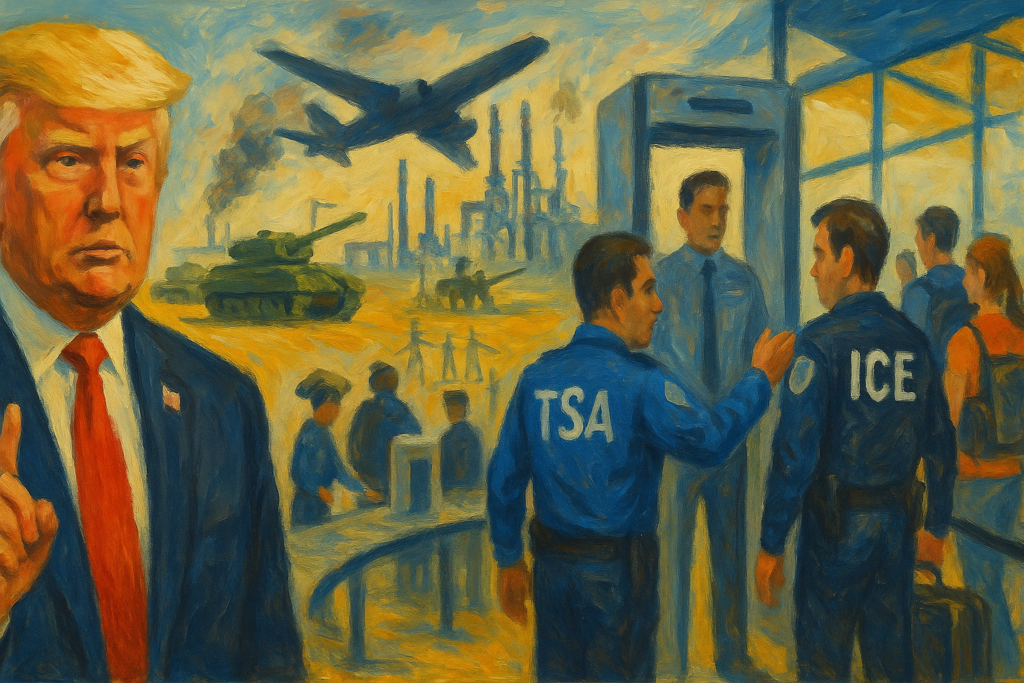
This week’s throughlines
- War abroad widened while oversight lagged — The week moved from reports of possible escalation and contradictory messaging on Iran to acknowledged military action, with Congress repeatedly struggling to obtain information or impose authorization requirements.
- The DHS shutdown turned into a test of executive improvisation — A funding standoff over immigration policy kept DHS partly shut, left TSA workers unpaid, and led the administration to move ICE agents into airports before later ordering TSA pay by executive action.
- Election restrictions and voter surveillance advanced on several fronts — The administration and Republican allies tied DHS funding to proof-of-citizenship rules, pushed SAVE Act provisions, pursued ballot-counting litigation, floated federal control over voting rules, and moved toward sharing voter-roll data with DHS.
- Immigration enforcement spread into more spaces and drew more legal pushback — Airport deployments, courthouse arrest controversies, detention cases, and state-level pressure for harsher laws all expanded the reach of immigration enforcement, while judges and plaintiffs challenged several of those moves.
- Presidential power was projected through symbols, rhetoric, and information control — The week included attacks on political opponents, curated war messaging, public-memory interventions, and new uses of national symbols and advisory roles that reinforced a more personalized style of rule.
The week opened with the United States edging closer to open war with Iran and deeper into a domestic security shutdown. Abroad, the president threatened to bomb civilian infrastructure and moved troops without new authorization from Congress. At home, airport security frayed as the Department of Homeland Security remained partially unfunded, and immigration enforcement and voting rules became tools in larger fights over who holds power and who belongs.
Over the weekend, reporting showed that the administration had considered striking Iran’s Kharg Island and was preparing thousands of Marines for deployment, even as Iran’s closure of the Strait of Hormuz began to choke off a fifth or more of global oil and gas flows. President Trump issued a 48‑hour ultimatum threatening to “obliterate” Iranian power and energy infrastructure if Iran did not reopen the strait. The targets he named were civilian systems—power plants and energy facilities—rather than strictly military sites, and he moved toward large‑scale deployments without seeking new authorization from Congress. Iraq, caught in the middle of the regional crisis, declared force majeure on some oilfields, and early signs of energy‑market disruption appeared as shippers and governments tried to adjust to the closure of a key chokepoint.
In Washington, Congress largely stood aside. Senate Democrats twice tried to require Trump to seek congressional authorization for continued operations in Iran, but Republicans blocked both efforts. Reporting indicated that Republican leaders were avoiding public oversight hearings and instead backing the president’s approach, leaving war powers effectively concentrated in the executive branch. The combination of escalating threats, troop movements, and congressional inaction set the stage for a week in which war policy would be announced and revised in public statements more than in formal processes.
Domestically, the Department of Homeland Security shutdown deepened. For the fifth time, Senate Republicans rejected a Democratic motion to take up a DHS funding bill that would have reopened the Transportation Security Administration and paid its workers. Trump, instead of seeking a compromise, publicly threatened to deploy Immigration and Customs Enforcement agents to airports to take over security, framing the move as a crackdown on Somali immigrants and on Representative Ilhan Omar. Over the weekend, he and his allies previewed plans to send ICE to major airports, raising alarms about civil liberties, training gaps, and the politicization of airport security at a moment when TSA staff were already working without pay.
The weekend also brought early moves to reshape voting rules and election administration. Trump signaled he would not agree to any DHS funding deal unless it included the SAVE America Act, a proposal that would require proof of citizenship for voter registration and voting and would tighten mail‑voting rules. Critics see the measure as a voter‑suppression bill that would make it harder for naturalized citizens, students, and others to participate. In North Carolina, the state elections board postponed action on a controversial bill widely criticized as driven by misinformation after a flood of public comments. In California, Riverside County Sheriff Chad Bianco seized more than 650,000 ballots from a 2025 election, citing fraud claims that state officials rejected; a court later allowed his recount to proceed, underscoring how law‑enforcement actors can insert themselves into election administration.
At the same time, Trump continued to personalize political conflict and public symbols. On social media he celebrated the death of former special counsel Robert Mueller, calling it “good” that Mueller could no longer “hurt innocent people,” and labeled Democrats America’s “greatest enemy” following his Iran strikes. He publicly disclosed a Republican congressman’s terminal diagnosis at a press event, raising questions about privacy and decorum. The White House installed a reconstructed Christopher Columbus statue on its grounds, a figure Trump has championed despite Columbus’s role in Indigenous oppression, signaling an effort to recast official memory and national identity around his preferred historical narrative. In the courts, there were early signs of pushback on immigration enforcement: a misidentified Minnesota protester in an anti‑ICE church case had charges dropped, and a federal judge blocked a policy that would have allowed arrest and detention of refugees who failed to obtain green cards within a year, potentially affecting more than 100,000 people.
By Monday, the DHS shutdown’s impact became visible to travelers. With TSA agents entering their sixth week without pay, the administration followed through on its threat and deployed ICE officers to assist with passenger screening at major airports including Atlanta, Chicago, Newark, New Orleans, and JFK. Agents in tactical gear appeared in terminals, though many lacked aviation‑security training. The move was presented as a response to long lines and staffing shortages, but unions and Democrats condemned it as ineffective and as a deliberate blurring of the line between border enforcement and everyday travel. The presence of armed immigration officers in civilian airports turned a funding crisis into a visible assertion of executive power over domestic space.
On the Iran front, Trump announced a five‑day postponement of planned strikes on Iranian power plants, claiming “productive” negotiations that Iranian officials publicly denied. Markets reacted sharply: the S&P 500 surged and then fell, and oil prices dropped and then rebounded as his statements shifted. Treasury Secretary Scott Bessent avoided direct answers on troop deployments and sanctions, while the Pentagon quietly ordered thousands more troops to the region. Later in the week, Trump would extend the bombing “pause” again, but the pattern was already clear: war policy was being made and unmade in real time through presidential statements, with little transparency about strategy or end goals.
Monday also saw Republicans move on voting rules through the courts. The Republican National Committee filed suit to tighten verification and counting of mail‑in ballots, pressing for stricter standards that opponents say would lead to valid votes being discarded. At the same time, the Supreme Court agreed to hear an RNC challenge to a Mississippi law allowing ballots that arrive after election day to count, a case that could reshape mail‑voting timelines in multiple states. These legal efforts, combined with the SAVE America Act push, pointed toward a coordinated attempt to narrow when and how votes are counted, especially for those who rely on mail voting.
Other policy fronts moved more quietly. California’s attorney general sued the Energy Department over its decision to restart the Sable Offshore pipeline system—shut after a 2015 spill—under a Trump executive order invoking the Defense Production Act. The state argued the restart violated state law, prior court orders, and a federal settlement, while a federal court immediately questioned whether the case had been filed in the proper district, signaling procedural hurdles ahead. Reporting also revealed that HealthEquity, the largest administrator of health savings accounts, had donated $1 million to Trump’s super PAC and then pushed for regulatory and legislative changes to expand HSAs in ways that would primarily benefit higher‑income users and the company’s fee‑based business. Separately, Bessent defended a decision to temporarily lift sanctions on Iranian oil already at sea, allowing Iran to sell roughly 140 million barrels even as hostilities continued, illustrating how war policy, sanctions, and private economic interests were intertwined. Meanwhile, regulators at the EPA and DEA issued a series of technical decisions on air‑quality plans, chemical approvals, Superfund settlements, and drug scheduling—incremental moves that nonetheless shape environmental baselines and enforcement for years.
On Tuesday, the legal system became a central arena for contesting immigration enforcement. Michigan and the City of Romulus sued DHS over plans to convert a warehouse into a 500‑bed ICE detention center, alleging violations of environmental and intergovernmental laws. Minnesota’s attorney general, along with local officials, filed suit to force the Justice and Homeland Security Departments to release evidence about shootings by federal agents during “Operation Metro Surge,” a controversial enforcement campaign. Individual cases also moved forward: a Venezuelan immigrant filed a damages suit claiming he had been unlawfully deported and imprisoned in violation of a court order, and a DACA recipient won a ruling ordering her return after what a court described as a “flagrant” rights violation. Together, these cases tested whether states and individuals could use the courts to pry open opaque enforcement practices and seek redress for wrongful actions.
Courts delivered mixed rulings on immigration policy the same day. A federal judge blocked a Trump policy that would have allowed arrest and detention of refugees who failed to obtain green cards within a year, limiting the administration’s ability to penalize refugees over paperwork deadlines. Later in the week, another court ordered ICE to improve phone and visitation access for detainees in Minnesota, expanding access to counsel and family contact. But the Eighth Circuit Court of Appeals reversed a lower‑court ruling and held that certain interior immigrants could be treated as “applicants for admission” subject to mandatory detention without bond. The result was an uneven judicial landscape in which some protections were strengthened while other harsh detention rules were upheld.
The courts also weighed in on the relationship between national security and private speech. Anthropic, an artificial‑intelligence company, won a key injunction against a Pentagon blacklist that had labeled it a supply‑chain risk and barred the military and contractors from using its tools, reportedly after the company refused to support autonomous weapons. A federal judge first granted a temporary injunction and then a preliminary injunction blocking the ban, finding Anthropic likely to succeed on claims that the blacklist was retaliatory and violated the First Amendment, due process, and administrative law. The order was briefly stayed to allow an appeal, but it signaled judicial skepticism toward using security labels to punish companies for policy positions.
As these institutional clashes unfolded, Trump escalated his rhetoric against domestic opponents. He publicly demanded that Attorney General Pam Bondi take legal action against his political adversaries and suggested that Democratic lawmakers’ comments about unlawful military orders amounted to “seditious behavior, punishable by death.” These statements came as he continued to call Democrats the nation’s “greatest enemy” and pressed for more aggressive measures in Iran. At the same time, he called for “nationalizing” voting—shifting control of elections away from states toward the federal executive—and reiterated that any DHS funding deal must include the SAVE America Act’s strict proof‑of‑citizenship and mail‑voting limits. He urged Senate Republicans to eliminate the filibuster so they could pass these measures and DHS funding without Democratic support, signaling a willingness to weaken procedural checks to reshape who can vote.
Within DHS itself, leadership changed hands. The Senate confirmed former Oklahoma senator Markwayne Mullin as Secretary of Homeland Security, and he was sworn in at the White House. Mullin, a close Trump ally, took over a 260,000‑person department in the middle of a funding impasse, with ICE insulated from the shutdown and aggressive enforcement operations under scrutiny. In the Pentagon, Defense Secretary Pete Hegseth announced changes to the military chaplain corps, cutting religious affiliation codes from about 200 to 31 and replacing officer rank insignia on chaplains’ uniforms with religious symbols, which he framed as undoing “political correctness.” The move, and his later actions on promotions, raised concerns about infusing overt religious identity and ideological preferences into military structures that have traditionally emphasized neutrality and cohesion.
By Wednesday, Congress turned its attention back to the DHS shutdown’s human and security costs. At a House Homeland Security Committee hearing, acting TSA Administrator Ha Nguyen McNeill testified that TSA employees had missed about $1 billion in paychecks, with 40–50 percent of staff calling out. She warned of a “perfect storm” ahead of the 2026 World Cup, when international travel is expected to surge. Lawmakers learned that ICE agents had been shifted to airports despite lacking TSA training, and Democrats criticized the move as both ineffective and inappropriate. In the Senate, Democrats blocked a Republican DHS funding proposal that excluded immigration reforms, while negotiations remained stalled.
The funding impasse hardened later that day. After the Senate passed a package to fund most of DHS while withholding money from ICE and part of Customs and Border Protection, House Republicans refused to take it up and instead pursued their own plan that Democrats opposed. The Senate then left town for a two‑week recess, making a quick resolution unlikely and extending the shutdown’s impact on TSA, the Cybersecurity and Infrastructure Security Agency, the Coast Guard, and other components. The result was a standoff in which one chamber’s refusal to accept a compromise kept critical security agencies unfunded.
On voting, Trump and his allies escalated their push for the SAVE America Act and for nationalized control over elections. He publicly advocated for the bill’s proof‑of‑citizenship and mail‑voting limits and again pressed Senate Republicans to scrap the filibuster. Republican senators, led by Lindsey Graham, discussed using budget reconciliation—a process designed for tax and spending bills—to fund ICE and potentially tuck in SAVE provisions, though it was unclear whether such a maneuver would pass procedural muster. These discussions underscored how budget tools and Senate rules were being considered as vehicles for far‑reaching changes to election law.
The Iran conflict continued to reverberate through Congress and global markets. In a tense closed‑door briefing, lawmakers from both parties expressed frustration at the lack of a clear strategy, including whether ground troops would be used. Representative Nancy Mace signaled she would likely back a War Powers Resolution to block unauthorized war, while Representative Joe Morelle highlighted that nearly $30 billion had already been spent on the conflict without congressional approval. Meanwhile, Iran’s closure of the Strait of Hormuz and imposition of tolls on shipping disrupted 20–25 percent of global oil and liquefied natural gas flows. Asian countries faced fuel shortages and adopted emergency measures such as work‑from‑home orders and shortened workweeks, and in the United States the Postal Service sought an 8 percent fuel surcharge on packages to cope with rising costs.
Reporting also illuminated the role of foreign money and lobbying in U.S. war and energy policy. Saudi Arabia’s sovereign wealth fund had invested $2 billion in Jared Kushner’s firm and financed a $7 billion Trump Organization project, while Crown Prince Mohammed bin Salman lobbied Trump to continue and expand the Iran war. Trump announced plans to ease sanctions on Belarus to import fertilizer after Hormuz disruptions, and the administration paid nearly $1 billion to TotalEnergies to buy back offshore wind leases, steering the company toward U.S. oil and gas projects. These moves raised questions about conflicts of interest and whether financial ties with foreign autocracies were shaping decisions on war and sanctions. In the cyber realm, a group linked to Iran calling itself Handala Hack Team breached FBI Director Kash Patel’s personal email and published what appeared to be years of correspondence, a stark reminder of vulnerabilities at the highest levels of law enforcement during an international crisis. Against this backdrop, organizers announced more than 3,000 “No Kings” protests for later in the week, with a flagship event in the Twin Cities and options for remote participation, signaling a broad civil‑society response to perceived authoritarian drift.
On Thursday, with Congress deadlocked and DHS still partially unfunded, Trump turned again to unilateral action. He announced and then signed an executive order directing Secretary Mullin to immediately pay roughly 60,000 TSA agents, citing an “unprecedented emergency.” DHS began processing paychecks expected by March 30. The order eased immediate pressure on workers and airports but left other DHS components unpaid and did not resolve the underlying disputes over ICE funding and immigration policy. It also reinforced a pattern in which the executive branch used emergency‑style orders to patch over legislative stalemates rather than negotiate durable solutions.
The president also used executive power to reshape civil‑rights and technology policy. One order required federal contracts to include clauses banning what it called “racially discriminatory” diversity, equity, and inclusion activities, with violations punishable by contract cancellation and debarment. Another, issued in December but highlighted this week, directed the Commerce and Justice Departments to identify and challenge state AI laws deemed burdensome, threatening states with loss of broadband funds and federal lawsuits over regulations like Colorado’s AI discrimination law. These moves aimed to chill DEI programs and preempt state efforts to regulate AI’s impact on workers and marginalized groups, shifting power away from local experiments toward centralized federal control.
Public‑health institutions showed their own strains. The Centers for Disease Control and Prevention had gone more than 210 days without a Senate‑confirmed director, with Jay Bhattacharya serving under delegated authority from Health Secretary Robert F. Kennedy Jr. A federal judge ruled that Kennedy’s vaccine advisory panel was unlawfully appointed, voiding many of its flu and COVID recommendations. The CDC then canceled a key immunization advisory meeting under a court stay, effectively leaving vaccine policy in the hands of a controversial cabinet official rather than independent experts. Meanwhile, Casey Means, Trump’s nominee for Surgeon General, remained unconfirmed more than 320 days after nomination amid bipartisan skepticism over her credentials and potential conflicts of interest, leaving another top health post vacant.
Immigration policy again intersected with economic life. The administration implemented new commercial driver’s license rules requiring English proficiency and revoking licenses for non‑citizens and non‑permanent residents, leading to thousands of drivers—many immigrants and refugees—being removed from the roads and training providers losing accreditation. A federal court later blocked interim restrictions that threatened licenses for noncitizen truckers, including Ukrainians who had fled Russia’s invasion, highlighting the legal vulnerability of the policy. In parallel, Eagle County, Colorado, sued the Interior Department over an executive order allowing certain energy projects to receive only a 14‑day environmental review without public comment, arguing that it violated federal law. The EPA authorized Florida’s revised hazardous‑waste program and sought comment on Clean Water Act financial‑capability guidance, while updating records systems to share procurement data with Treasury for fraud detection. These fights, though technical, will help determine how far the executive can go in accelerating energy projects at the expense of environmental review and local input.
Trump’s imprint on national symbols deepened. The Treasury announced that his signature would appear on U.S. paper currency, replacing the treasurer’s signature for the first time since 1861, as part of the country’s 250th anniversary. Reports also detailed his plans for a 90,000‑square‑foot ballroom, a 250‑foot arch, and replacement of historic West Colonnade pavers with black granite—changes critics said would overshadow existing monuments and recast Washington’s visual identity around his personal aesthetic. These moves, combined with earlier statue installations, signaled a shift from institutional continuity toward leader‑centered branding in the nation’s civic landscape.
By Friday, the Iran conflict and its domestic implications converged. At a Republican fundraiser, Trump referred to the Iran campaign as a “military operation” and a “tremendous success,” despite the absence of new congressional war authorization. The Pentagon informed Congress it was considering diverting weapons intended for Ukraine and redirecting about $750 million in NATO funding for Ukraine to restock U.S. supplies for the Middle East theater, even as additional troop deployments were underway. The acknowledgment that resources would be shifted from one ally to another, without a full public debate or formal authorization, underscored how far war‑making had moved into the executive’s hands.
On voting, reports surfaced of a draft executive order, promoted by Florida lawyer Peter Ticktin, that would end machine and mail‑in voting, require all voters to re‑register with proof of citizenship, and mandate hand‑counting of ballots, citing unsubstantiated foreign‑interference claims. Election experts warned that such an order would be legally dubious and logistically unworkable, but if attempted it would sharply limit voter eligibility and turnout, especially for naturalized citizens, elderly and disabled voters, and those who rely on mail ballots. The draft order, combined with the SAVE America Act and calls to nationalize voting, illustrated a broader effort to centralize control over election rules in the executive branch.
Within the military, Defense Secretary Hegseth took another step that raised concerns about politicization. He removed four Army officers—two Black and two women—from a one‑star promotion list, overruling Army leaders who had supported them. Senior officials described the move as “highly unusual,” and it followed his efforts to reshape the chaplain corps around a narrower religious vision. Blocking promotions along apparent racial and gender lines signaled that ideological or demographic criteria might influence senior military careers, challenging norms of merit‑based advancement.
Elsewhere in the federal government, oversight mechanisms stirred. The DHS inspector general opened an investigation into the department’s contracting practices, focusing on deals involving former DHS Secretary Kristi Noem and Trump ally Corey Lewandowski. The probe ordered preservation of records and will examine whether contracts were steered without full and open competition, testing whether internal watchdogs can still check favoritism and corruption in a heavily politicized department. In the courts, a Jeffrey Epstein survivor filed a putative class action against the United States and Google, alleging that the Justice Department violated the Privacy Act by releasing unredacted records that exposed personal information of about 100 survivors and that Google continued to index the data. Separately, Fulton County, Georgia, challenged an FBI seizure of roughly 700 boxes of 2020 election documents, arguing that the warrant relied on misrepresentations and showed “callous disregard” for the county’s rights. Both cases went to the heart of how federal agencies handle sensitive victim data and election records, and how those practices affect public trust.
Civil society and states also acted to reinforce norms against concentrated power. Thousands of “No Kings” protests went forward across the country, including the planned flagship event in the Twin Cities, signaling organized resistance to what participants saw as authoritarian tendencies. In California, Governor Gavin Newsom signed an executive order banning state officials with insider information from betting on prediction markets, closing a potential channel for monetizing nonpublic knowledge about government decisions. And in the emerging field of AI regulation, industry and governments continued their tug‑of‑war: Anthropic, OpenAI, and Elon Musk all emphasized existential AI risks and invested in lobbying or foundations to shape rules, Colorado delayed implementation of its AI discrimination law under industry pressure, and Texas’s Responsible AI Governance Act took effect with limited avenues for workers to seek redress. These developments unfolded as Trump’s executive order sought to preempt state AI rules, illustrating how corporate influence, state experimentation, and federal preemption are jointly shaping the regulatory landscape.
Across these seven days, the through‑line was the concentration of power in the executive branch and the varied responses of other institutions. War in Iran advanced through threats, troop deployments, and shifting “pauses” announced from the White House rather than through formal authorization, even as foreign financial ties shadowed key decisions. At home, a DHS shutdown became a vehicle for deploying immigration agents into civilian spaces and for pressing restrictive voting laws, with the president ultimately using emergency orders to selectively pay some workers. Courts, states, inspectors general, and protesters pushed back in targeted ways—blocking some policies, probing others, and taking to the streets—but their efforts unfolded within a landscape where core questions about who can vote, who can stay, and who decides on war were increasingly answered by unilateral action.