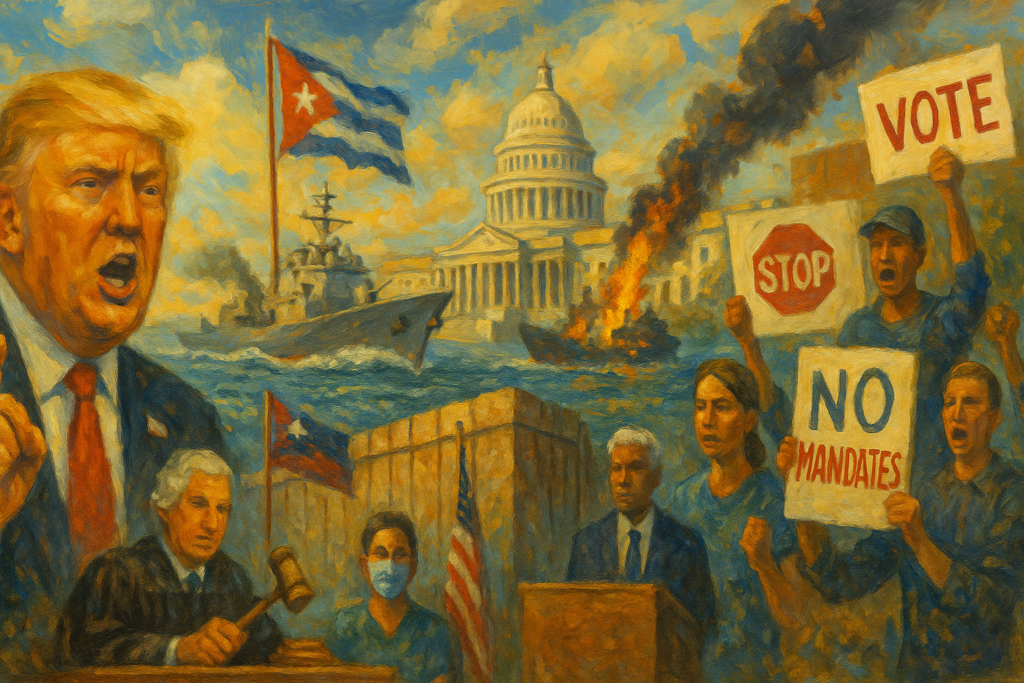
This week’s throughlines
- War-making power expanded faster than oversight — The week began with unilateral military action against Iran, followed by troop deployments, disputed intelligence claims, and a Senate refusal to curb presidential war powers.
- Election administration moved toward tighter federal and state scrutiny — Voting policy hardened through the week as North Carolina proposed citizenship challenges, DOJ sued states over voter rolls and sought voter data, and the Senate advanced the SAVE America Act.
- Immigration enforcement intensified while courts and local actors pushed back — The week featured expanded local-federal cooperation, workplace raids, prolonged detentions, family separations, a death in custody, and multiple lawsuits and release orders challenging ICE and DHS actions.
- Pressure on information systems and accountability deepened — Threats to broadcasters, attacks on reporters, disputed war messaging, and fights over Epstein records all pointed to a week of pressure on independent scrutiny and public transparency.
- Courts repeatedly served as the main institutional brake — Judges blocked health-policy changes, restored Voice of America staff, ordered records production, checked federal pressure on states, and intervened in immigration detention cases.
The week opened with a dramatic expansion of U.S. military action and a sharp turn in presidential rhetoric. From there, the consequences rippled outward: through global oil markets and household budgets, through courts and agencies wrestling over records and rights, and through immigration systems, campuses, and protest spaces where the boundaries of lawful power and dissent were tested.
Over the weekend, President Trump ordered a large-scale bombardment of Iran without seeking new authorization from Congress. He paired that decision with a public threat to “take over” Cuba, signaling a willingness to contemplate regime change against another government. Defense Secretary Pete Hegseth promised “no quarter, no mercy” for enemies, language widely read as condoning violations of the laws of war, which require humane treatment of combatants and civilians. The administration and its allies quickly moved to shape the narrative: social media feeds and fundraising emails boasted of destroying Iran’s military, wartime briefings were used to solicit donations, and skeptical coverage was attacked as disloyal. At the same time, leaders at the Federal Communications Commission floated threatening broadcast licenses for outlets accused of “fake news,” raising the prospect of using regulatory power to intimidate critical media.
The military escalation immediately intersected with global energy politics. Iranian attacks and control over the Strait of Hormuz, a narrow waterway through which a large share of the world’s oil passes, disrupted shipping and pushed prices higher. In response, the administration temporarily lifted sanctions on Russian oil shipments despite the ongoing war in Ukraine, prioritizing short-term price relief over coordinated pressure on Moscow. This ad hoc sanctions relief showed how quickly foreign policy choices can translate into higher fuel and transportation costs for households, and how efforts to manage those costs can weaken broader coalitions against aggressor states.
Even as war and energy dominated headlines, the weekend brought early moves on domestic enforcement and voting rules. In Miami-Dade County, the sheriff tripled the number of deputies deputized under ICE’s 287(g) program, which allows local officers to perform certain federal immigration functions. That expansion meant immigration checks would be more deeply embedded in routine policing, with likely chilling effects on immigrant communities’ willingness to report crimes or seek help. At the federal level, the Justice Department pursued immigration and benefits litigation, while in North Carolina the state elections board proposed rules that would make it easier to challenge the citizenship of registered voters. Analysts began warning that new federal lawsuits over voter rolls, combined with a proposed federal “SAVE Act” framework, could lead to eligible voters being wrongly removed from the rolls or deterred from registering.
Not all institutions moved in the same direction. Over the weekend, the Justice Department dropped flag-burning charges against veteran Jan “Jay” Carey, implicitly acknowledging Supreme Court precedent that protects such protest as free speech. Grassroots groups organized protest medic trainings, a “No Kings” town hall, and weekly anti-ICE demonstrations, building infrastructure for sustained dissent. At the same time, newly released records showed the Department of Homeland Security investing heavily in artificial-intelligence surveillance tools, hinting at a more technologically intensive approach to monitoring both borders and domestic activity. Trump’s decision to berate an ABC reporter on Air Force One and cut off further questions fit into a broader pattern of hostility toward critical media, even as courts and organizers tried to hold space for protest and scrutiny.
There were also early signs of institutional strain and politicization. Wyoming enacted a six-week abortion ban despite prior court rulings against similar laws, effectively inviting new legal challenges and signaling a willingness to push the limits of judicial tolerance. Reports described purges within the FBI under Director Kash Patel, with fired agents alleging political retaliation rather than performance-based discipline. DHS’s AI surveillance projects raised questions about oversight of new technologies. In Arizona, officials canceled Cesar Chavez Day as a state holiday after posthumous abuse allegations, showing how quickly states can revise official commemorations of major labor and civil-rights figures and, with them, public memory of past movements.
By Monday, the clash between executive power and judicial limits moved from the battlefield to the economy. The Supreme Court ruled that many of Trump’s 2025 import tariffs were illegal, reasserting that emergency economic powers have boundaries and that the president cannot unilaterally reshape trade policy without regard to statutory limits. Within hours, Trump responded by imposing new 10 percent global tariffs under a different legal authority and publicly claiming an “absolute right” to set tariffs despite the ruling. He also asserted that he could unilaterally withdraw the United States from NATO, testing constitutional norms around treaty withdrawal, which traditionally involve both the executive and legislative branches. The episode illustrated how a determined president can pivot among overlapping statutes to preserve contested powers and openly challenge judicial checks.
Transparency and secrecy collided in another arena on Monday. Trump signed the bipartisan Epstein Files Transparency Act, which required the Justice Department to disclose investigative records related to Jeffrey Epstein. Yet DOJ missed statutory deadlines, allegedly removed Trump-related interview pages from released files, and blocked release of a 69-page Drug Enforcement Administration memo on money laundering. These actions suggested that, even under a new transparency mandate, executive agencies could use delay, redaction, and selective disclosure to shield politically sensitive material. In response, lawmakers began preparing more aggressive oversight steps that would surface later in the week.
Courts also pushed back against overreach in health policy. Federal judges in Massachusetts and Oregon blocked RFK Jr.’s attempts to overhaul vaccine schedules and to declare against gender-affirming care, finding both procedural flaws and substantive problems. At the same time, RFK Jr. and the Department of Health and Human Services moved to reshape scientific advisory bodies, including vaccine and autism committees, in ways that elevated anti-vaccine voices. The rulings underscored that while the executive branch can appoint advisors and set agendas, it must still follow established processes and respect existing standards of care.
Pressure on voting and immigration systems deepened. The Justice Department launched lawsuits and data demands aimed at how states maintain their voter rolls, raising fears that broad data sweeps could lead to aggressive purges and privacy intrusions. Congress allowed a lapse in Department of Homeland Security funding to continue, prolonging a shutdown that disrupted Transportation Security Administration operations and pay, with knock-on effects for travel and security. New immigration and benefits cases challenged Trump-era directives on Temporary Protected Status, food assistance, and asylum, while DHS and ICE faced allegations of wrongful deportations and unlawful detentions. Together, budget brinkmanship and aggressive enforcement threatened due process and the stability of both election administration and core security services.
The personalization of power was visible in Trump’s treatment of individual lawmakers and opponents. He publicly disclosed private health information about Representative Neal Dunn, using sensitive medical data against a sitting legislator. He launched a racist tirade against Representative Ilhan Omar, falsely portraying her as an illegal immigrant and a fraud “ringleader.” At the same time, he created a White House Task Force to Eliminate Fraud in benefit programs, centralizing cross-agency data sharing and enforcement under his direct leadership. The combination of stigmatizing rhetoric and expanded data-driven enforcement tools raised concerns that investigative powers could be turned toward political or racialized targeting.
Monday also brought fresh questions about conflicts of interest. Reports showed Jared Kushner, serving as Special Envoy for Peace, seeking $5 billion from Saudi, Qatari, and Emirati sovereign wealth funds for his private equity firm. Trump allowed Kushner to retain his diplomatic role despite the fundraising, reviving emoluments and influence-peddling concerns: when senior officials simultaneously manage public negotiations and private capital, foreign policy decisions can be distorted by personal financial incentives.
As the week progressed, the economic and strategic consequences of the Iran conflict came into sharper focus. On Tuesday, reports detailed how the administration had previously retired the last U.S. mine countermeasure ships based in Bahrain without reliable replacements and cut State Department energy diplomacy staff, including sanctions-tracking experts. These quiet decisions weakened the U.S. ability to keep the Strait of Hormuz open and to coordinate responses to energy disruptions. When Iranian attacks came, the lack of minesweepers and diminished diplomatic capacity turned a foreseeable risk into a more severe shipping and price shock.
Voting access remained under pressure. The Senate voted to begin debate on the SAVE America Act, which would require documentary proof of citizenship to register to vote nationwide. For many eligible citizens—especially naturalized citizens, low-income voters, and those who move frequently—locating and producing such documents can be difficult, and errors in databases can lead to wrongful challenges. At the same time, the Justice Department continued its lawsuits and data demands framed as enforcing voter-roll accuracy. Advocates warned that shifting the burden of proof onto voters and enabling broad, data-driven challenges could suppress participation and disproportionately affect marginalized communities.
Courts again acted as counterweights in other domains. A federal judge issued summary judgments and reinstatement orders for more than 1,000 Voice of America staff, reversing Kari Lake’s restructuring and defending statutory safeguards for an independent public broadcaster. The ruling reinforced the idea that publicly funded media must retain editorial independence from partisan control. New lawsuits in Ohio, New Jersey, and Minnesota challenged warrantless ICE arrests, the siting of detention facilities, and restrictions on clergy access, reflecting judicial scrutiny of expansive immigration enforcement tactics. States and advocates also filed suits against federal agencies over climate and equity issues, contesting HUD fair-housing guidance, the Environmental Protection Agency’s reversal of its finding that greenhouse gases endanger public health, and Department of Transportation grant freezes. The Environmental Defense Fund sued Energy Secretary Chris Wright and the Archivist over missing climate-related records allegedly kept off official systems, while Chicago’s transit agency sued DOT over frozen grants tied to changes in disadvantaged-business rules. These cases showed how states and civil society can use litigation to challenge policy shifts seen as punitive, opaque, or unlawful.
Tuesday’s developments also highlighted the role of money and inequality. Reports detailed how Sergey Brin and other tech billionaires poured tens of millions of dollars into blocking a proposed California wealth tax on billionaires that would fund education and social programs. Their spending illustrated how concentrated wealth can dominate direct democracy campaigns, constraining redistributive reforms even as war spending and debt place new demands on public budgets.
By Wednesday, the economic fallout of the Hormuz crisis was measurable. Data showed rising wholesale inflation and a national debt surpassing $39 trillion, driven in part by war spending and energy shocks. Investigations revealed that there were no effective tanker escorts in place and that intelligence about Iran’s nuclear capacity had been misrepresented, with officials overstating the immediacy of the threat. These planning failures deepened the economic impact, limiting future policy options and burdening households with higher prices.
At a worldwide threats hearing, intelligence leaders faced questions about Iran and Russia. Director of National Intelligence Tulsi Gabbard and other chiefs gave evasive answers, and later reporting showed that Gabbard had removed a line from her written testimony acknowledging that Iran lacked enrichment capability after U.S. strikes. The edit aligned public intelligence with the administration’s narrative of an imminent threat. Political pressure shaping intelligence testimony undermined Congress’s ability to oversee war decisions and distorted public understanding of the risks.
In health policy, RFK Jr. continued to reshape advisory structures despite earlier court setbacks. He overhauled the Interagency Autism Coordinating Committee, reducing representation from autistic people themselves and adding anti-vaccine activists to a body that guides nearly $2 billion in federal research spending. Coming on the heels of his blocked attempt to rewrite vaccine recommendations, the move showed how politicizing scientific advisory bodies can skew research priorities and undermine evidence-based policy for years.
Wednesday also exposed structural inequities in criminal justice and labor. California’s implementation of Proposition 36 had resulted in nearly 20,000 felony drug-possession cases with minimal treatment and significant racial disparities, using incarceration rather than health services to manage addiction. Former USAID officers filed an age-discrimination suit over a reduction in force that allegedly targeted older foreign service staff, suggesting that workforce restructuring was used to sideline experienced employees and weaken institutional memory. In Arizona, the decision to drop Cesar Chavez Day as a state holiday, and in national youth politics, the appointment of Kai Schwemmer—who had a record of racist, antisemitic, and homophobic posts—as political director of College Republicans of America, both pointed to shifts in how institutions remember past struggles and what kinds of rhetoric they normalize for the next generation.
On Thursday, Congress confronted the question of war powers directly and chose not to reassert them. The Senate voted 53–47 against a resolution that would have restricted Trump’s operations against Iran, leaving his de facto war-making authority largely unchecked. Defense Secretary Hegseth requested more than $200 billion to fund expanded operations, even as Republicans struggled to assemble the necessary war funding. Congress still had not held substantive public hearings on the war’s costs or objectives. By declining to limit the conflict or demand a clear strategy, lawmakers allowed a single leader to commit vast public resources and lives to an open-ended war with limited scrutiny.
In contrast, Congress became more assertive on the Epstein records fight. Senator Ron Wyden demanded unredacted DEA documents and accused the Justice Department of obstruction, introducing legislation to force the Treasury Department to turn over Epstein-related financial records. A whistleblower alleged internal efforts to block release of unclassified but sensitive DEA files. These moves built on earlier subpoenas to Attorney General Pam Bondi over missed deadlines and alleged removal of Trump-related interview pages. The clash illustrated how determined lawmakers can use subpoenas and new legislation to challenge executive secrecy around politically sensitive investigations, even when initial transparency laws are blunted by selective disclosure.
The Hormuz crisis continued to drive economic strain. Airlines warned of potential flight cancellations due to jet fuel shortages linked to disrupted shipping. Treasury officials discussed removing or easing sanctions on Iranian oil to tame prices that had climbed above $120 per barrel, even as U.S. strikes hit Iranian energy infrastructure. These discussions followed the earlier suspension of sanctions on Russian oil shipments. Using sanctions both as tools of coercion and as levers to manage prices sent mixed signals to foreign governments and markets, complicating foreign policy while households and industries absorbed the shock.
Immigration enforcement’s human toll became stark. Nineteen-year-old Royer Perez-Jimenez died, apparently by suicide, in ICE custody at Glades County Detention Center, highlighting persistent failures to safeguard detainees’ mental health. A report documented parents deported to Honduras without being asked about their children, in violation of the administration’s own Detained Parents Directive, which is supposed to ensure that family ties are considered before removal. In response to broader enforcement fears, a New Jersey congresswoman introduced a bill to restrict ICE operations near 2026 World Cup venues, seeking to create limited safe zones around major events. These developments showed both the human cost of current policies and the piecemeal legislative efforts to mitigate reputational and rights concerns.
Civil liberties on campus and in digital spaces were also in play. Federal courts issued rulings affirming that common pro-Palestinian campus speech is constitutionally protected and rejecting some antisemitism claims against universities, reinforcing First Amendment limits on efforts to criminalize or suppress controversial political advocacy. Yet the administration prepared a civil-rights lawsuit against Harvard over anti-Israel protests, leveraging Title VI funding threats. At the same time, FBI Director Kash Patel testified that the Bureau buys commercial location data on Americans from brokers without warrants, exploiting a major surveillance loophole. He also warned of a Russian cyber campaign compromising encrypted messaging apps like Signal, threatening the privacy of officials, journalists, and activists. These revelations, combined with DHS’s AI surveillance investments earlier in the week, painted a picture of expanding surveillance capacity and foreign intrusion risks that outpaced clear legal safeguards.
Thursday closed with a glimpse of potential technological counterweights to disinformation. A study reported that AI systems like Grok and Perplexity could nudge social media users toward more accurate beliefs, suggesting that automated fact-checking tools might help counter online political misinformation. The findings pointed to emerging tools rather than a solved problem, hinting at new fronts in the struggle over information integrity.
On Friday, the administration moved from signaling to action on campus protests. It filed a civil-rights lawsuit accusing Harvard of violating Jewish and Israeli students’ rights by allowing anti-Israel protests, using the threat of losing federal funds under Title VI of the Civil Rights Act as leverage. The suit came just after courts had affirmed that much pro-Palestinian campus speech is protected expression. The timing raised concerns that civil-rights law, designed to protect students from discrimination and harassment, was being used to pressure universities to curb controversial political speech rather than to address targeted abuse.
Protest policing escalated in the streets as well. In Los Angeles, a man filed a $100 million claim alleging that the LAPD violated a court order on “less-lethal” munitions by firing a projectile that blinded him at an anti-ICE protest. Separately, federal prosecutors charged veteran Bajun Mavalwalla with conspiracy for blocking ICE vans during a protest, using heavy federal charges against a form of direct action that has long been part of protest repertoires. Serious injuries and sweeping criminal counts signaled a narrowing practical space for dissent, even as formal rights to assemble and speak remained on the books.
The week’s surveillance arc closed with a whistleblower complaint alleging misuse of sensitive citizen data. A former employee of a Department of Government Efficiency was accused of removing restricted databases containing Social Security numbers from government systems to share with a contractor. Coming on top of revelations about FBI data purchases and Russian hacking of encrypted apps, the allegation highlighted how both government and private actors can mishandle personal information, heightening risks of identity theft and eroding public trust in data stewardship.
Litigation over federal funding and corporate accountability rounded out the week. Chicago’s transit agency pressed its lawsuit against the Department of Transportation over frozen grants tied to changes in disadvantaged-business rules, arguing that the freezes were an overreach that violated separation-of-powers principles and undermined local equity programs. The Interfaith Center on Corporate Responsibility sued the Securities and Exchange Commission over its new “no-objection” policy on shareholder proposal exclusions, claiming the agency was abdicating oversight and weakening investors’ tools for holding corporations accountable on issues like climate and labor. These suits underscored how federal funding levers and regulatory stances can reshape local initiatives and the balance of power between shareholders and corporate management.
Taken together, the week traced a pattern of expanding executive action—on war, surveillance, immigration, and campus speech—met by uneven checks. Congress largely deferred on Iran, declining to limit hostilities even as costs mounted, but showed more appetite for confronting secrecy around Epstein records. Courts played a significant countervailing role, blocking overreach on vaccines and gender-affirming care, defending media independence, scrutinizing immigration detention, and affirming campus speech protections. States and advocacy groups turned to litigation to contest climate rollbacks and funding freezes. Meanwhile, voting access, immigration enforcement, and protest rights came under sustained pressure, and new technologies altered both surveillance and the fight against disinformation. In this landscape, democratic resilience depended less on any single institution than on the cumulative effect of legal challenges, civic organizing, and public scrutiny struggling to keep pace with concentrated power.