This week’s throughlines
- Iran escalation outpaced oversight — Trump's threats toward Iran intensified from rhetoric into talk of attacks on civilian infrastructure, while Congress repeatedly failed to reassert its war powers role.
- Immigration enforcement kept expanding into due-process and civil-liberties fights — The week linked immigration enforcement to family detention, detainee opacity, alleged profiling, court interventions, and claims that immigration tools were being used for political ends.
- Courts remained the main active check — Federal and other courts repeatedly slowed, narrowed, or scrutinized administration actions, especially on immigration, press access, funding disputes, and agency compliance.
- Information control and retaliation sharpened — The administration limited public information during a military crisis, threatened reporters, attacked unfavorable coverage, and faced new scrutiny over surveillance and whistleblower treatment.
- Economic and administrative fallout spread beyond the immediate political fights — Fuel surcharges, inflation, oil shocks, tariff instability, and major agency moves on climate and public lands showed the broader policy consequences of the week's executive posture.
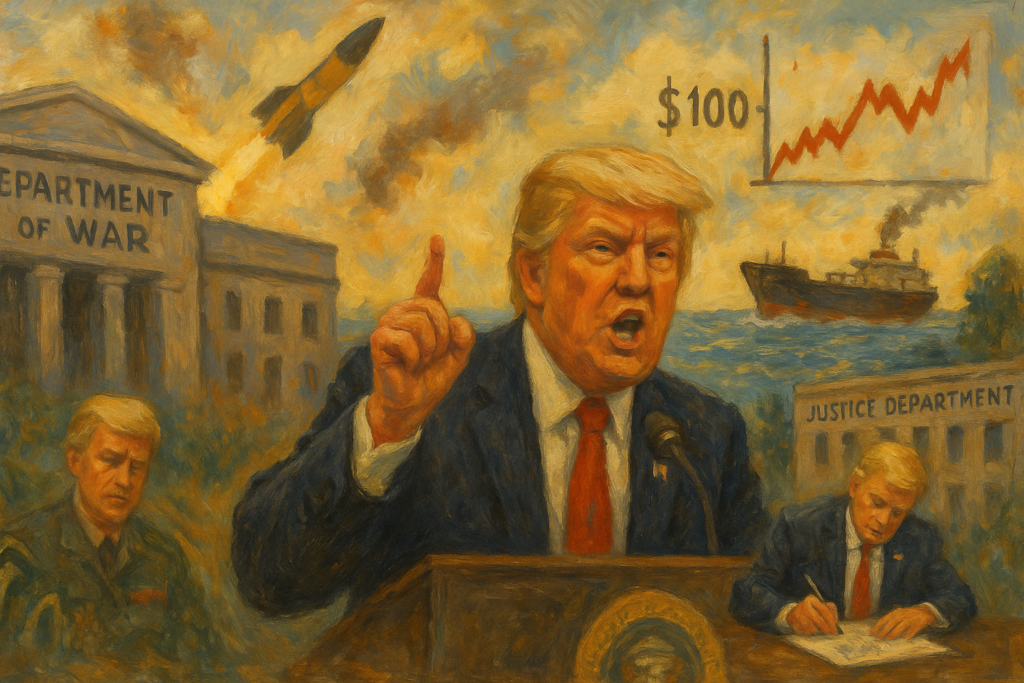
The week opened with a symbolic and substantive shift in how the United States describes its own power. Over the weekend, the administration formally renamed the Department of Defense the Department of War, a rebranding that matched President Trump’s increasingly aggressive posture toward Iran. Aides reportedly urged him to treat Iranian civilian infrastructure as a legitimate military target, and he used public appearances and social media to threaten action over the Strait of Hormuz. When pressed about the laws of war, he brushed aside questions about war crimes and suggested that bombing civilian infrastructure would not violate international law. At the same time, he berated NATO allies for failing to help reopen the strait, calling them cowardly and again threatening to pull the United States out of the alliance. The combination of a new “War” label on the Pentagon, open talk of striking civilian targets, and threats to unravel NATO signaled a week in which traditional restraints on the use of force would be tested.
Even before the shooting stopped, the economic consequences of the Iran confrontation began to show up in everyday life. Over the weekend, Amazon announced a 3.5 percent surcharge on third‑party sellers, and the U.S. Postal Service imposed an 8 percent fuel surcharge, both citing higher logistics costs tied to the conflict and disruptions around Hormuz. These were early indicators of a broader inflationary shock that would crest by Friday, as oil prices rose and supply chains adjusted to a chokepoint under pressure. The link between foreign policy decisions and domestic prices, often abstract, became concrete in shipping fees and postage.
On the same weekend, immigration enforcement illustrated how national security rhetoric can bleed into domestic targeting. Federal agents revoked green cards and detained two women described by Senator Marco Rubio as relatives of slain Iranian commander Qassem Soleimani, despite disputed family ties, placing them in Immigration and Customs Enforcement custody for deportation. In another case, a nearly blind Rohingya refugee was reportedly abandoned by border agents in a Buffalo parking lot and later died; the death was ruled a homicide. These incidents unfolded alongside a federal judge’s finding that border agents in California had violated a prior order by conducting warrantless arrests. Taken together, they showed immigration tools being used against people linked—accurately or not—to foreign adversaries, and vulnerable refugees being treated in ways that courts increasingly describe as unlawful.
While federal power concentrated, civil society began organizing its own response. Indivisible co‑founder Ezra Levin announced plans for a nationwide May Day general strike on May 1 under the slogan “No Work, No School, No Shopping,” with unions and advocacy groups starting to coordinate logistics and strike funds. The proposed action, framed as a protest against authoritarian trends, aimed to use economic disruption as a form of civic pressure. At the border, Homeland Security Secretary Kristi Noem invoked statutory waiver powers to set aside environmental and historic protections in order to push a steel bollard wall through Big Bend National Park and adjacent Texas parkland, despite local opposition. The move underscored how executive discretion can override longstanding safeguards for public lands in the name of security.
By Monday, the focus shifted from war abroad to control over who can participate in elections at home. Trump signed an executive order directing the Department of Homeland Security to use the Systematic Alien Verification for Entitlements (SAVE) immigration database to compile a list of “confirmed U.S. citizens” eligible to vote. He ordered the Department of Justice to prosecute anyone who distributed ballots to people not on that list. SAVE was built to check eligibility for public benefits, not to define the electorate, and is known to misidentify citizens as non‑citizens. The order effectively pressured states to rely on an error‑prone federal tool for voter purges, shifting practical control over the franchise toward the executive branch and raising the risk that eligible citizens would be swept off the rolls.
Congress, meanwhile, struggled to assert its constitutional role over war and presidential fitness. House Republicans shut down a pro forma session to prevent Democrats from forcing a vote to limit Trump’s war powers over Iran, continuing a pattern from earlier in March when both chambers narrowly rejected measures requiring congressional approval for Iran operations. As Trump’s rhetoric grew more extreme, Senator Chris Murphy publicly raised the possibility of invoking the 25th Amendment, and Representative Jamie Raskin, the top Democrat on House Judiciary, formally requested a cognitive exam for the president, citing his recent statements and posts. Yet procedural maneuvers kept Congress from debating either war powers or capacity in a sustained way, leaving high‑risk decisions concentrated in the executive.
The administration also moved to reshape public health policy along ideological lines. Under Health and Human Services Secretary Robert F. Kennedy Jr., the department implemented deep cuts to routine childhood immunizations and state public‑health funding, and officials spread misinformation during a measles outbreak. HHS proposed ending Medicare and Medicaid payments to hospitals providing gender‑affirming care to minors, directly targeting access to care for transgender youth. In contrast, the Centers for Disease Control and Prevention quietly renewed the charter of its immunization advisory committee, a small sign of continuity in evidence‑based practice amid politicization. Courts provided some counterweight elsewhere: a California judge ruled that border agents had violated a prior order by conducting warrantless arrests in Sacramento, a Massachusetts judge blocked the termination of Temporary Protected Status for more than 5,000 Ethiopians, and historians and transparency advocates sued over an Office of Legal Counsel opinion declaring the Presidential Records Act unconstitutional, warning that the administration planned to stop complying with preservation rules.
Press freedom came under direct pressure as well. At a Monday press conference, Trump again threatened to jail journalists who refused to reveal the source of a leak about a missing U.S. airman in Iran, invoking national security. The threat echoed a similar one reported the previous day and fit into a broader pattern of hostility toward leaks and investigative reporting. At the same time, Trump extended his influence into state politics by endorsing former Fox host Steve Hilton in the California governor’s race, promising federal help, while Wisconsin voters elected liberal Chris Taylor to their state supreme court, expanding a 5–2 liberal majority. That Wisconsin result, in a key swing state, is expected to shape rulings on redistricting, abortion, unions, and election disputes—an example of state‑level institutions adjusting the balance of power even as the federal executive centralizes it. Online, an artificial‑intelligence‑generated image purporting to show a smiling U.S. airman rescued in Iran went viral on X, illustrating how synthetic media can distort public understanding of wartime events.
On Tuesday, the Iran crisis reached a new level of volatility. Trump posted that “a whole civilization will die tonight” if Iran did not meet his demands, suggesting possible use of tactical nuclear weapons and threatening annihilation of Iranian civilization. Under the Geneva Conventions and customary international law, deliberate attacks on civilians and civilian infrastructure are prohibited, but Trump’s rhetoric treated such constraints as optional. Iran had already closed or restricted the Strait of Hormuz in response to Israeli strikes and U.S. pressure, driving up global oil prices. Later that day, after talks involving Pakistani leaders, Trump abruptly announced he would suspend bombing Iran for two weeks, claiming the United States had met its objectives and was close to a peace deal based on a 10‑point Iranian proposal widely seen as favorable to Tehran. The swing from nuclear‑tinged threats to a short ceasefire, without congressional authorization or clear terms, underscored how decisions about war and peace were being made in a highly personalized, improvisational way.
Even as the bombs paused, the war drove a boom in speculative defense projects. The administration allocated at least $17.5 billion more to the Golden Dome space‑based missile defense system, on top of $25 billion the prior year, as part of a $1.5 trillion defense budget. Much of this spending would move through budget reconciliation, a process that allows certain budget measures to pass with a simple majority and limited debate, curbing oversight. SpaceX and Palantir—companies tied to major Trump donors Elon Musk and Peter Thiel—were expected to receive multi‑billion‑dollar contracts for satellites and software. Analysts questioned whether the system could work on the promised timeline, noting it might not be operational until at least 2035. Congress remained on recess, and Republican leaders showed no intention of recalling members despite the escalating crisis, leaving earlier narrow votes against binding war‑powers limits as the last word.
Courts and advocates continued to document and challenge immigration abuses. A Massachusetts judge postponed the effective date of ending Temporary Protected Status for Ethiopians, finding likely violations of administrative law and pretext in the government’s rationale. Another court expanded relief to require daily clergy access at an Immigration and Customs Enforcement detention facility. In New York, Latino residents filed a class action alleging that the Department of Homeland Security, Immigration and Customs Enforcement, and Customs and Border Protection had a policy of stopping and arresting people based solely on perceived Latino ethnicity. A report on the Dilley family detention center described inhumane conditions and lasting harm, which the Department of Homeland Security denied. Separately, the Department of Justice’s civil rights division opened an investigation into former White House aide Cassidy Hutchinson for allegedly lying to Congress about Trump’s role in the January 6 insurrection, an unusual assignment for that division and one that raised concerns about using enforcement tools against a key witness. Outside the courtroom, the Electronic Frontier Foundation’s analysis of 12 million searches in Flock’s license‑plate reader network showed law enforcement using the system to search around major protests, even as at least 53 cities across 20 states moved to cancel, reject, or sharply limit Flock contracts after community campaigns and revelations of unauthorized federal access.
By Wednesday, the ceasefire Trump had announced was already unraveling. Israel signaled it had not agreed to halt bombardment of southern Lebanon and continued attacks, while Iran retaliated against Saudi and Kuwaiti energy and water infrastructure and further restricted access to the Strait of Hormuz. Tehran required ships to obtain permission and pay cryptocurrency tolls, tightening its grip on a key maritime chokepoint. Oil prices climbed, and confusion grew over Trump’s claim of a joint U.S.–Iran toll venture, which Iranian officials publicly mocked. The breakdown of a hastily announced ceasefire, with no clear multilateral framework and no congressional role, showed how ad‑hoc diplomacy can fail, leaving global markets and security exposed.
The week also revealed how emerging technologies are being folded into wartime decision‑making under conditions of cronyism. Reporting showed that the Pentagon, now under the “War” label and led on technology by Emil Michael, had entered an artificial‑intelligence agreement with Elon Musk’s xAI as part of a broader push to deploy advanced AI across the department. Michael held a financial interest in xAI until shortly after the deal, raising conflict‑of‑interest concerns. On the same day, the U.S. Court of Appeals for the D.C. Circuit denied Anthropic’s emergency motion to stay a competing AI contract but granted expedited review, citing the government’s need to secure AI technology during active conflict. The combination of insider ties and judicial deference to wartime discretion highlighted how ethics and accountability can be sidelined when procurement is framed as urgent national security.
In Congress, a different kind of accountability fight played out over the Jeffrey Epstein files. The Department of Justice announced that former Attorney General Pam Bondi would not appear for a subpoenaed deposition about the handling of Epstein records, arguing she had been subpoenaed only in her official capacity. The House Oversight Committee insisted the subpoena was personal and warned of contempt. Ranking member Robert Garcia backed First Lady Melania Trump’s call for a public hearing with survivors, but survivors criticized her statement as shifting burdens onto them while the Justice Department had not fully complied with the Epstein Transparency Act. The dispute showed how high‑profile abuse cases can become arenas for narrative control, with survivor access to information and justice caught between institutional defensiveness and political positioning. Elsewhere, the Environmental Protection Agency’s administrator, Lee Zeldin, delivered a keynote at a Heartland Institute conference, attacking mainstream climate science and praising repeal of the “endangerment finding” that underpins U.S. climate regulations, moving climate denial from the fringe to the helm of environmental policy.
Wednesday also brought more evidence of how protest and dissent are policed. The Electronic Frontier Foundation’s analysis of Flock license‑plate reader data confirmed that law enforcement had searched for vehicles around major protests, while a separate report detailed how a Department of Homeland Security agent’s projectile blinded a student at the No Kings march in Los Angeles despite an injunction limiting force. Dozens of cities moved to cancel or restrict Flock contracts over privacy and federal‑access concerns, reflecting local efforts to set boundaries on surveillance tools that can chill assembly. In the information sphere, Trump escalated attacks on media narratives about Iran, labeling a CNN report suggesting Iran had achieved a significant victory as “fraud” and demanding a retraction. He lashed out at former allies who criticized his Iran policy, calling them “stupid people” and not true supporters. Branding unfavorable coverage as fraudulent and ostracizing dissenters within his own camp further narrowed the space for independent assessment of war outcomes.
On Thursday, the constitutional struggle over war powers and presidential fitness sharpened. House Democrats attempted to pass a resolution to curtail Trump’s Iran war powers using unanimous consent, but the Republican pro forma speaker refused to recognize them and ended the session. This followed earlier Republican moves to block war‑powers votes. Meanwhile, more than 85 House Democrats and two senators publicly called for invoking the 25th Amendment or impeachment after Trump’s threats to annihilate Iranian civilization. House Democratic leadership scheduled a virtual briefing on the issue, and Raskin’s request for a cognitive exam remained unanswered. Procedural control allowed a minority to shield expansive war‑making from debate even as a large bloc of lawmakers questioned the president’s capacity, deepening a constitutional standoff.
The same day, financial regulators took steps that favored politically connected markets. The Commodity Futures Trading Commission filed unprecedented lawsuits against Arizona, Connecticut, and Illinois to stop them from regulating political prediction markets run by platforms such as Kalshi, Polymarket, Crypto.com, and Robinhood, arguing that federal jurisdiction preempted state efforts. Many of these firms have business ties to Trump and have donated to his political operations. Separately, the administration quietly ended a Securities and Exchange Commission investigation into Crypto.com that had begun under President Biden, taking no enforcement action despite the company’s close ties to Trump Media. These moves suggested a regulatory environment in which federal agencies not only declined to police politically connected firms but actively sued states that tried, raising questions about impartiality and the monetization of politics.
Immigration stories continued to accumulate, forming a pattern rather than isolated abuses. A detailed report from Raíces and Human Rights First documented due‑process violations and degrading conditions at the Dilley detention center, including contaminated food and inadequate medical care. In a separate case, the Board of Immigration Appeals issued a final removal order for activist Mahmoud Khalil, who alleges political retaliation. A Canadian mother and her seven‑year‑old daughter described nearly three weeks in unsafe Immigration and Customs Enforcement facilities before release on bond with ankle monitoring. Meanwhile, the Eswatini Supreme Court ruled that four men deported from the United States have the right to meet with a local lawyer after months without in‑person counsel, an instance of a foreign court stepping in to protect rights where U.S. processes had failed. In Florida, Governor Ron DeSantis signed anti‑Sharia legislation, aligning with a “Sharia Free Caucus” that portrays Muslim immigration as an invasion aimed at imposing religious law. Writing suspicion of Muslims into statute normalized policy built on religious animus rather than concrete legal problems.
Civil society, for its part, continued to mobilize. The May Day Strong coalition held a national organizing call to coordinate May 1 actions under the theme “Workers Over Billionaires,” sharing toolkits and a map of local events. Separately, the LGBTQ advocacy group Glisten organized its 30th annual Day of Silence, encouraging students and adults to take a vow of silence to highlight anti‑LGBTQ harassment and legislative attacks in schools. These actions, alongside local moves to limit surveillance, showed communities using both economic disruption and symbolic protest to defend workers’ rights and LGBTQ students amid hostile policy environments. Transparency advocates also turned to the courts: the Democracy Forward Foundation sued the Department of Justice for failing to respond to Freedom of Information Act requests about communications and agreements related to voter registration data and election integrity efforts, while the National Health Law Program sued Health and Human Services and the Centers for Medicare and Medicaid Services for withholding records on data‑sharing with Homeland Security and Immigration and Customs Enforcement involving Medicaid enrollees. These suits aimed to uncover how sensitive data might be used in ways that affect who can safely vote or access health care.
Thursday ended with another example of how presidential rhetoric can reshape expectations of accountability. The Wall Street Journal reported that Trump told staff he would issue mass pardons for anyone who had been near the Oval Office, a statement the White House later called a joke. That evening he posted a graphic video depicting violence and attacking Haitian immigrants and Joe Biden, shortly after Melania Trump’s Epstein‑related press conference. Promising blanket pardons for insiders and circulating violent, dehumanizing content from the presidency both weakened deterrence for misconduct and normalized extreme rhetoric in political discourse.
By Friday, the economic and humanitarian costs of the Iran conflict were fully visible. With Iran tightening control over the Strait of Hormuz and charging fees for passage, oil prices rose above $100 per barrel. U.S. inflation reached 3.3 percent, the highest since 2024, with gas up 21 percent, fuel oil 31 percent, and airfares 15 percent in March alone. The University of Michigan Consumer Sentiment Index fell to a record low of 47.6, worse than during the 2008 financial crisis or the pandemic. These numbers captured how foreign policy choices and chokepoint politics were feeding directly into higher living costs and deep public pessimism about the economy. At the same time, The New York Times verified that U.S.–Israeli strikes had damaged at least 22 schools and 17 health facilities in Iran, while Iran’s Red Crescent reported even higher numbers. Under the laws of armed conflict, schools and hospitals are protected civilian objects unless used for military purposes; independent confirmation of damage to these sites underscored the humanitarian toll and strengthened calls to scrutinize potential violations of international law.
Domestically, the administration moved to centralize control over another key public resource: forests. Officials announced a sweeping restructuring of the U.S. Forest Service, closing all regional offices, consolidating 57 research facilities into one site, moving headquarters to Salt Lake City, and replacing regional offices with 15 politically appointed state directors. The federal employees’ union called the move illegal under budget restrictions and warned it would degrade public‑land management. Replacing career regional leadership with political appointees and shuttering research sites weakened professional stewardship of public lands and opened the door to partisan control over forests and fire policy. Courts and regulators, however, continued to provide partial checks in other areas. A Texas court overturned the death sentence of Clarence Curtis Jordan, a man with intellectual disabilities who had been on death row for nearly 50 years, citing constitutional standards. In Washington, a judge ordered the Pentagon to comply with an earlier ruling protecting press access and struck down a rebranded leak‑solicitation policy, rejecting an attempt to evade judicial oversight. The Federal Communications Commission finalized rules requiring licensees to disclose foreign adversary control of communications networks, and the Environmental Protection Agency published multiple Environmental Impact Statements for public comment, modest reminders that some regulatory processes still functioned in regular order.
The week closed with further signs that the presidency was being used to advance personal projects and foreign alignments. Reports revealed that Trump had used foreign steel to construct a $400 million White House ballroom, undercutting his “America First” rhetoric. On social media he pledged to use U.S. economic resources to support Hungarian Prime Minister Viktor Orbán in an upcoming election, signaling support for an illiberal foreign leader. He reiterated promises of mass pardons for staff and continued to post violent, anti‑immigrant content. These actions, combined with regulatory favors for Trump‑linked firms and the reorientation of agencies like the Forest Service and Environmental Protection Agency, pointed to a governing style increasingly oriented around personal and factional interests rather than institutional norms.
Across the week, democratic life was shaped by the interplay of concentrated executive power, partial institutional resistance, and civic mobilization. The Iran conflict showed how quickly decisions about war, made with minimal congressional input and loose regard for civilian protections, can reverberate through global markets and domestic prices. Moves to define voter eligibility through a federal immigration database, to hide or reinterpret records laws, and to tilt financial regulation toward allies all raised questions about who controls the rules of participation and accountability. Courts, state elections, local governments, and civil‑society groups did not reverse these trends, but they did mark out lines of resistance—from blocking some immigration abuses and protecting press access to organizing strikes and student actions. The week’s record is one of institutions under strain, with the balance between unilateral power and shared governance actively contested rather than settled.