This week’s throughlines
- Congress struggled to reassert authority over war and spending — The week began with lawmakers saying they had not been briefed on the Iran blockade, moved through ceasefire announcements made by the president, and ended with a failed House war powers vote and new disputes over impounded funds and undisclosed war costs.
- Immigration enforcement hardened while due process protections weakened — The administration fired immigration judges who blocked deportations, faced new evidence contradicting ICE accounts in one shooting, and then saw further controversies over raids, detention conditions, arrests, and the detention of a longtime interpreter with legal protection from removal.
- Transparency and accountability fights spread across agencies and the press — FOIA lawsuits, disputes over Epstein files, refusal to disclose war costs, and the removal of a prosecutor in the Brennan investigation all pointed to a broader contest over records, information, and whether oversight can still force answers.
- Political loyalty and money kept surfacing as organizing principles — The week linked clemency for allies, election-denier appointments, corporate tax advantages, and a high-dollar solicitation for presidential access into a broader story about who gets protection, influence, and entry into power.
The week unfolded under the shadow of two intertwined struggles: over war and over the rule of law. Abroad, the president escalated and then abruptly tried to contain a confrontation with Iran, testing the limits of unilateral war‑making. At home, he leaned on clemency and a compliant Justice Department to ease consequences for allies and January 6 leaders, even as courts, Congress, and civil society tried to reassert basic constraints.
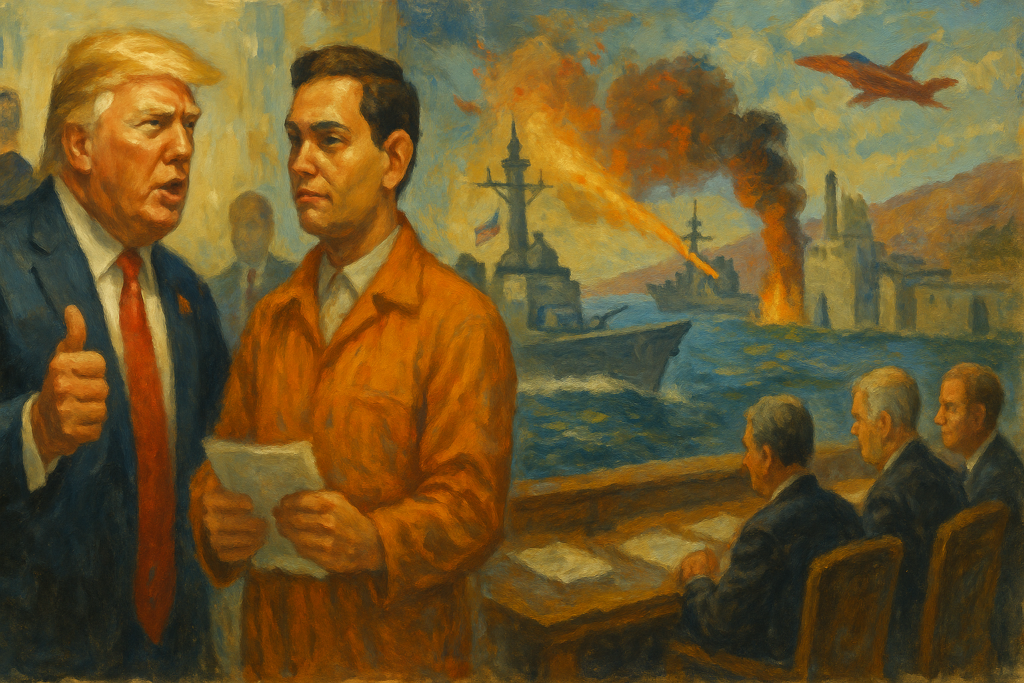
Over the weekend, the White House made clear how it now understood presidential mercy. Donald Trump commuted former congressman George Santos’s seven‑year fraud sentence after only three months and publicly highlighted his earlier pardon of Binance founder Changpeng Zhao. Reporting indicated he was privately promising mass end‑of‑term pardons for anyone who had worked near the Oval Office. The press secretary described the pardon power as “absolute,” signaling that clemency was being treated less as a tool for correcting injustice and more as a shield for insiders and favored economic actors. That same pattern would reappear later in the week as the Justice Department moved to undo hard‑won convictions from the January 6 attack.
At the same time, Trump escalated sharply against Iran. Over the weekend he warned that “a whole civilization will die tonight” if Iran defied him, language widely read as genocidal. He then announced a U.S. naval blockade of Iranian ports and the Strait of Hormuz, claiming other countries would join even as NATO allies declined. He later boasted that U.S. forces had “completely obliterated” the Iranian navy, saying 158 ships were destroyed, and threatened to sink any remaining vessels approaching the blockade. Undertaken without new congressional authorization, these moves put enormous pressure on global shipping and energy markets and set the stage for a week of improvised diplomacy and contested war powers.
Domestically, the weekend also brought signs of politicized justice in the immigration system. The Justice Department abruptly fired six immigration judges, including two Biden appointees who had recently blocked deportations of pro‑Palestinian students from Tufts and Columbia and who had higher‑than‑average asylum grant rates. The dismissals, coming alongside surveillance footage that undercut ICE agents’ accounts in a Minneapolis shooting case and led to dropped charges, raised alarms that immigration adjudication was being reshaped to favor enforcement outcomes over legal independence.
States continued to pull power upward from local communities. In Missouri, Republicans mandated that Kansas City devote a quarter of its budget to policing and returned St. Louis’s police to state control, limiting local authority over public safety. In North Carolina, the state supreme court declined to enforce the long‑standing Leandro school‑funding precedent despite years of underfunding, while lawmakers steered millions to crisis pregnancy centers and expanded private‑school vouchers. Educators began organizing rallies and advocacy days in response, seeing public education funding and local control as central to democratic self‑government.
Congress, meanwhile, showed both its capacity and its limits. Over the weekend the House passed a bill, 224–204, to allow roughly 350,000 Haitians to retain Temporary Protected Status for three years after DHS terminated it, with a handful of Republicans joining Democrats. The vote directly defied the administration’s deportation agenda and asserted legislative authority over immigration status, even as the bill faced an uncertain future in the Senate and a looming Supreme Court case on TPS terminations.
Civil society activity threaded through these institutional battles. The We Are America March set off on a 160‑mile trek from Philadelphia to Washington to build sustained, visible opposition to authoritarianism. Bruce Springsteen opened a Los Angeles concert with a call to defend democracy and the Constitution. Indivisible prepared a national day of action against ICE warehouse detention, while Bernie Sanders and New York City councilmember Zohran Mamdani launched the Union Now initiative to boost union density and support strikes. Abroad, large protests in Hungary targeted Viktor Orbán’s authoritarian rule. These efforts, alongside housing reform advocacy and a decision by AI firm Anthropic to delay public release of a powerful model over security concerns, showed citizens and private actors trying to shape the conditions of daily life where formal politics seemed constrained.
By Monday, institutional pushback became more visible. The California Supreme Court formally disbarred John Eastman for deceptive work in efforts to overturn the 2020 election, ordering him off the roll of attorneys and imposing financial penalties. In Washington, a federal judge, acting on an appellate remand, narrowed an injunction against Trump’s plan for a 90,000‑square‑foot White House ballroom, allowing only underground construction deemed necessary for security and blocking the above‑ground addition. Together, these rulings signaled that courts were still willing to enforce professional and legal limits on attempts to subvert elections and on efforts to reframe personal projects as national security needs.
At the same time, the administration moved to weaken economic oversight and expand unilateral trade power. It sought to end the Consumer Financial Protection Bureau’s headquarters lease years early and asked a court to approve cutting its staff to about one‑third of prior levels, sharply reducing federal capacity to police consumer‑finance abuses. After a Supreme Court ruling against parts of his tariff regime, Trump claimed authority to reimpose tariffs under a different statute, Section 122 of the Trade Act of 1974, testing how far a president can go in reshaping trade without Congress. These moves built on earlier legislation that had cut corporate taxes and oversight, shifting power toward large firms and the executive branch.
Transparency advocates turned to the courts as agencies stalled. Environmental and watchdog groups sued EPA Administrator Lee Zeldin for failing to issue required fine‑particle pollution designations, sued the Office of Management and Budget over FOIA delays, and filed cases seeking records on the “Gold Card” visa program. Other suits targeted the Election Assistance Commission for FOIA delays tied to election integrity. These cases underscored how, when agencies ignore statutory duties, FOIA and environmental litigation become central tools for enforcing transparency and environmental protections.
Economic strain was increasingly visible. Labor Department data showed inflation rising to 3.3 percent, with wholesale inflation at 4 percent, the highest in three years, driven in part by war‑related energy prices. The White House staged a photo opportunity with a DoorDash driver dubbed “DoorDash Grandma” to promote a “no tax on tips” policy allowing up to $25,000 in tips to be deducted from taxable income. Critics noted that the event highlighted deeper failures in health care, labor rights, and retirement security, as the worker relied on gig work to support her family. The symbolism of a narrow tax tweak for tipped workers contrasted with the broader impact of earlier laws that had cut Medicaid and corporate taxes, and with the inflationary pressures tied to trade wars and Middle East conflict.
On Tuesday, concerns about presidential fitness moved from commentary into legislative form. In response to Trump’s extreme rhetoric about Iran and his self‑depiction as Jesus, House Democrats led by Jamie Raskin introduced legislation to create a standing commission to assess presidential capacity under the 25th Amendment. A related proposal with 50 Democratic co‑sponsors sought a formal mechanism to evaluate a president’s ability to discharge the duties of office. Raskin also requested a comprehensive neuropsychological assessment from Trump’s physician. In a House controlled by the president’s allies, these measures were unlikely to advance, but they marked an attempt to operationalize constitutional tools for addressing questions about presidential stability and judgment.
The Justice Department’s approach to January 6 shifted further. DOJ lawyers asked an appeals court to dismiss seditious‑conspiracy convictions of Proud Boys and Oath Keepers members and moved in district court to vacate similar convictions, invoking the “interests of justice.” At the same time, prosecutors filed new terrorism‑related charges against the suspect accused of planting pipe bombs near party headquarters on January 6. The contrast suggested a narrowing of accountability for organized insurrectionists closely tied to Trump, even as other strands of January 6 violence continued to be prosecuted.
Elsewhere on Tuesday, the D.C. Circuit granted a writ of mandamus to halt a district court’s criminal‑contempt inquiry into officials who had defied a deportation temporary restraining order, citing separation‑of‑powers concerns. New litigation challenged a mid‑decade partisan gerrymander, and Democracy Forward sued the Election Assistance Commission over FOIA delays. Additional suits targeted agencies over the treatment of pregnant youth in federal custody and environmental decisions. These cases illustrated how courts can both shield executive deliberations and serve as venues to contest gerrymanders, secrecy, and rights violations.
Economic and health‑care pressures deepened. Reporting revisited Trump’s 2025 law cutting roughly $900 billion from Medicaid over a decade, affecting nearly 12 million people, and highlighted state decisions to end or restrict Medicaid coverage for GLP‑1 weight‑loss drugs. A Farm Bureau survey found that 70 percent of U.S. farmers could not afford enough fertilizer due to soaring costs, which analysts tied to trade disruptions and conflict. Producer price inflation reached 4 percent, reinforcing the link between earlier fiscal choices—deep health‑care cuts and corporate tax breaks—and current foreign policy in driving up costs and reducing care for low‑income people and farmers.
Questions of secrecy and elite accountability surfaced in another arena when Acting Attorney General Todd Blanche announced that DOJ would stop releasing documents related to Jeffrey Epstein, despite a congressional subpoena and ongoing public interest. House Democrats moved toward holding former Attorney General Pam Bondi in contempt for failing to appear before the Oversight Committee about the files and pressed for a new deposition. The decision to halt releases in such a high‑profile case raised concerns about selective secrecy and the enforceability of congressional subpoenas.
By Wednesday, the Iran confrontation took a sudden turn. After days of threats and a naval blockade, Trump announced a ceasefire and proposed a framework under which the U.S. and Iran would jointly manage the Strait of Hormuz. In Congress, Senator Bernie Sanders and allies pushed resolutions to block bomb and bulldozer sales to Israel, while House and Senate leaders scheduled war powers votes aimed at requiring Trump to seek authorization for further military action in Iran and other countries. Sanders’s resolutions ultimately failed but drew support from 40 Democrats, signaling a shift away from unconditional military aid. War powers resolutions in both chambers sought to limit Trump’s authority to continue Operation Epic Fury, reflecting growing unease with open‑ended conflicts driven by presidential discretion.
Domestic oversight of security and health policy intensified. Testimony revealed that budget director Russell Vought had slashed global health funding, including the PEPFAR program, and inconsistently released appropriated funds, prompting a Government Accountability Office finding of impoundment violations. Vought defended a $1.5 trillion defense budget request and denied illegal fund withholding. In a separate House hearing, Health Secretary Robert F. Kennedy Jr. faced questions about a Trump‑Vance initiative on health‑care fraud and alleged pardons for fraudsters tied to campaign contributions, highlighting how budget and pardon decisions can redirect resources from public health to defense and potentially reward politically connected offenders.
Civil society marked Tax Day with organizing and protest. The ACLU’s California arm held a rapid‑response training to prepare participants to respond to threats against rights and institutions. Across the country, Tax Day protests highlighted oligarchy, billionaire influence, war spending, and the gap between public needs and political priorities. Democracy Docket published an opinion urging close tracking of litigation that shapes election rules and democratic access. These actions showed citizens building skills and narratives to contest concentrated wealth and defend voting rights outside formal party structures.
In a notable public intervention from the judiciary, Justice Ketanji Brown Jackson used a speech at Yale Law School to criticize the Supreme Court’s conservative majority for repeatedly using unexplained emergency orders to allow controversial Trump policies to take effect despite lower‑court findings that they were likely illegal. She argued that this “shadow docket” practice undermines transparency and affects real people without full briefing or opinions. Her remarks underscored how opaque Supreme Court procedures can quietly reshape policy and weaken checks on executive power.
Thursday brought the sharpest test of congressional war powers. A resolution by Democrat Greg Meeks to block further military action against Iran under the War Powers Act failed in the House by a single vote, 213–214. Republican Thomas Massie broke with his party to support it, while Democrat Jared Golden opposed it. A related resolution to block Operation Epic Fury also failed by one vote. The razor‑thin margin showed how close Congress came to reasserting its constitutional role and how a handful of members can determine whether large‑scale military operations proceed without explicit authorization.
On the same day, the Justice Department announced it would move to vacate seditious‑conspiracy convictions of Oath Keepers and Proud Boys leaders involved in January 6, following Trump’s earlier commutations of their sentences. Prosecutors again invoked the “interests of justice.” Combined with the president’s prior clemency for 14 leading members of these groups, the move effectively unwound much of the accountability for organized insurrection. It also tied back to the weekend’s talk of mass pardons, reinforcing a through‑line in which loyalty to the president could outweigh the legal consequences of attacking the transfer of power.
House Democrats responded to the administration’s military posture by filing six articles of impeachment against Defense Secretary Pete Hegseth. The articles accused him of unauthorized military action against Iran, deadly strikes on suspected drug‑smuggling boats, mishandling classified information, concealing civilian casualties, and punishing a senator for reminding service members of their rights. In a Republican‑controlled House, the effort was unlikely to succeed, but it marked a formal attempt to hold a senior security official accountable for uses of force and retaliation against oversight.
Oversight of public health policy also sharpened. RFK Jr. testified before House committees, defending his decision to end CDC pro‑vaccine messaging and facing criticism for promoting misinformation and controversial comments about Black children. Lawmakers questioned his proposed cuts to medical research and his use of HHS resources, including a video with musician Kid Rock. A separate hearing probed his role in the health‑care fraud initiative and alleged pardons for politically connected fraudsters. The hearings highlighted how public health can be reshaped by misinformation and political favoritism, with direct consequences for vaccine uptake and trust.
Beyond Washington, higher education and civil rights came under strain. Hampshire College in Massachusetts announced it would permanently close after the upcoming fall semester due to low enrollment and financial pressure, advising faculty and staff to seek unemployment. At the same time, the Coalition for Action in Higher Education organized a National Day of Action to defend accessible, politically independent universities, building on prior campus teach‑ins and protests. In the political arena, some Republicans, including Representative Andy Ogles and House Speaker Mike Johnson, escalated Islamophobic rhetoric, with Ogles saying Muslims “don’t belong in American society” and Johnson warning about Sharia law. The comments, aimed at mobilizing parts of the base, stigmatized a religious minority and deepened social divisions.
The week’s Iran arc looped back to economic leverage. Despite the U.S. naval blockade, Iran shipped nine million barrels of crude from floating storage in the Gulf of Oman, challenging the blockade’s effectiveness. Simultaneously, the U.S. and Iran negotiated the release of up to $20 billion in frozen Iranian funds for humanitarian purposes, up from an earlier $6 billion offer, as part of efforts to end the war and address Iran’s enriched uranium stockpile. The developments underscored both the limits of unilateral sanctions and blockades and the centrality of financial tools in war‑ending diplomacy.
Money and access intersected in domestic politics as well. Reporting revealed a confidential email from Sinan Kanatsiz, a figure in Trump’s political network, soliciting $500,000 contributions to Turning Point USA’s PAC in exchange for a “one‑on‑one meeting and private photo with President Donald Trump.” Kanatsiz confirmed the solicitation, calling it a “big request,” and said no one had yet accepted. The offer, if taken up, would formalize a pay‑to‑play dynamic in which six‑figure donations buy personal access to the president, deepening the role of money in political influence.
On Friday, attention turned to the independence of key institutions and the long tail of earlier policy choices. Trump threatened to remove Federal Reserve chair Jerome Powell, whose term was nearing its end, while Powell was under criminal investigation over alleged cost overruns on Fed building renovations. Powell has said he will remain on the board until the investigation concludes. The threat fit a pattern of presidential efforts to influence monetary policy and personnel at the central bank, blurring the line between legitimate oversight and political retaliation.
Congress, still divided over surveillance and civil liberties, approved a 10‑day extension of FISA Section 702, the warrantless surveillance authority used to collect foreign intelligence, just days before its scheduled sunset. Internal Republican divisions and opposition from a coalition of progressive Democrats and hardline Republicans demanding reforms—such as warrants for Americans’ communications—blocked a longer renewal. The stopgap preserved broad surveillance powers while postponing decisions on stronger privacy safeguards, keeping civil liberties and national security in unresolved tension.
Environmental protections suffered a significant setback when the Senate voted 50–49 to repeal a 20‑year ban on mining near Minnesota’s Boundary Waters Canoe Area Wilderness, following earlier House approval. The resolution, expected to be signed by Trump, cleared the way for Twin Metals Minnesota, a subsidiary of Chilean mining giant Antofagasta, to pursue copper‑sulfide mining upstream of the wilderness. Environmental groups warned of serious pollution risks to a major protected area and to local economies built around a pristine landscape, illustrating how short‑term extraction and foreign corporate interests were being prioritized over long‑term environmental safeguards.
Oversight efforts continued on other fronts. House Democrats opened an investigation into Jared Kushner’s Middle East dealings, focusing on potential conflicts of interest between his business ventures and U.S. policy. Oversight Democrats also pressed for a new deposition of Pam Bondi over the Epstein files after she skipped a subpoenaed appearance, as the committee moved toward holding her in contempt. These probes tested whether Congress could meaningfully investigate conflicts of interest and potential cover‑ups involving powerful insiders.
Civil society closed the week with a visible win and continued organizing. After employees and customers protested Philz Coffee’s decision to remove Pride flags—gathering more than 7,300 petition signatures and engaging with San Francisco Pride leaders—the company reversed course, reinstated the flags, and issued an apology. The episode showed how coordinated employee and customer pressure can defend visible support for marginalized groups. Meanwhile, the National Day of Action for higher education proceeded, and Tax Day and labor initiatives continued to build momentum, keeping democratic engagement alive in workplaces and on campuses.
Beneath the headline fights, regulators quietly advanced a raft of environmental, health, and safety rules. EPA issued notices on Environmental Impact Statements and approved air‑quality plan revisions in Virginia, decisions that will shape local pollution levels. OSHA assumed safety authority at certain Department of Energy sites and revoked an obsolete marine‑terminal standard, affecting workplace protections. The FDA announced public meetings and rule changes on animal drugs, vaccines, and research oversight, influencing drug access and safety. The National Archives invited public comment on proposed records schedules from multiple agencies, giving the public a say in what government records are preserved or destroyed and, by extension, what future generations will be able to know about this period.
Taken together, the week showed U.S. democracy straining under concentrated executive power in war‑making, clemency, and economic policy, even as other institutions tried to respond. Congress came within a single vote of reclaiming war powers and used hearings and investigations to probe pardons, public health, and conflicts of interest. Courts disbarred a key election lawyer, constrained a presidential construction project, and heard challenges to secrecy and environmental inaction, while a Supreme Court justice warned about the Court’s own opaque practices. At the same time, civil society—through marches, campus actions, union organizing, and local campaigns—worked to defend public education, vulnerable communities, and basic norms of inclusion. The balance between these forces, and the records they leave behind, will shape how this era is judged and what tools remain for those who come after.