This week’s throughlines
- Minnesota immigration crackdown became a national institutional crisis — Federal operations in Minnesota triggered protests, lawsuits, judicial intervention, congressional scrutiny, and a budget fight over DHS funding.
- Courts increasingly acted as the main check on immigration enforcement — Judges preserved evidence, blocked deportations and refugee detentions, and documented repeated ICE noncompliance with court orders.
- The administration and its allies fought over narrative control — DHS and the White House pushed disputed accounts, used manipulated or AI-generated imagery, restricted press access, and benefited from platform actions that limited anti-ICE information.
- Congress tied immigration accountability to must-pass funding — Senate Democrats and some Republicans turned DHS appropriations into a vehicle for oversight, reform demands, and shutdown brinkmanship.
- Executive power widened beyond immigration — The administration also moved on environmental deregulation, emergency powers, election-related pressure, and symbolic control of public institutions.
The week opened with Minnesota at the center of a widening confrontation over immigration enforcement and federal power. Reporting on secretive ICE tactics and child detentions there quickly gave way to a lethal shooting by federal agents, mass protests, and a scramble by courts, state officials, and Congress to respond. At the same time, federal authorities moved aggressively into the terrain of past elections, seizing Fulton County’s 2020 records and redirecting intelligence leadership toward election‑fraud claims, while the White House and major platforms fought over who controls information about these actions.
Over the weekend, detailed reports from Minnesota described a pattern of increasingly aggressive immigration enforcement. ICE agents were found to be operating under a secret memo authorizing warrantless entries into homes, conducting raids near schools and churches, and detaining a five‑year‑old boy, Liam Ramos. Senator Richard Blumenthal denounced the warrantless entry policy as unconstitutional, but the operations continued. In the background, the Justice Department cut funding for child sex‑trafficking investigations, and Congress’s earlier Epstein Files Transparency Act remained only partially fulfilled, underscoring a contrast between the intensity of enforcement against vulnerable immigrant families and the relative leniency toward elite offenders.
Civil liberties concerns were not confined to Minnesota. The State Department revoked the visa of Tufts student Rümeysa Öztürk and detained her after she co‑authored an op‑ed calling for a Gaza ceasefire, signaling a willingness to use immigration tools against speech. At the same time, the administration broadened its domestic terrorism framework in ways that could encompass peaceful protest. Monks in North Carolina organized a Peace Gathering to protest the branding of demonstrators as terrorists, and a federal judge ordered the release of anti‑ICE protesters arrested at a church, reinforcing that courts still recognized limits on how far authorities could go in criminalizing dissent.
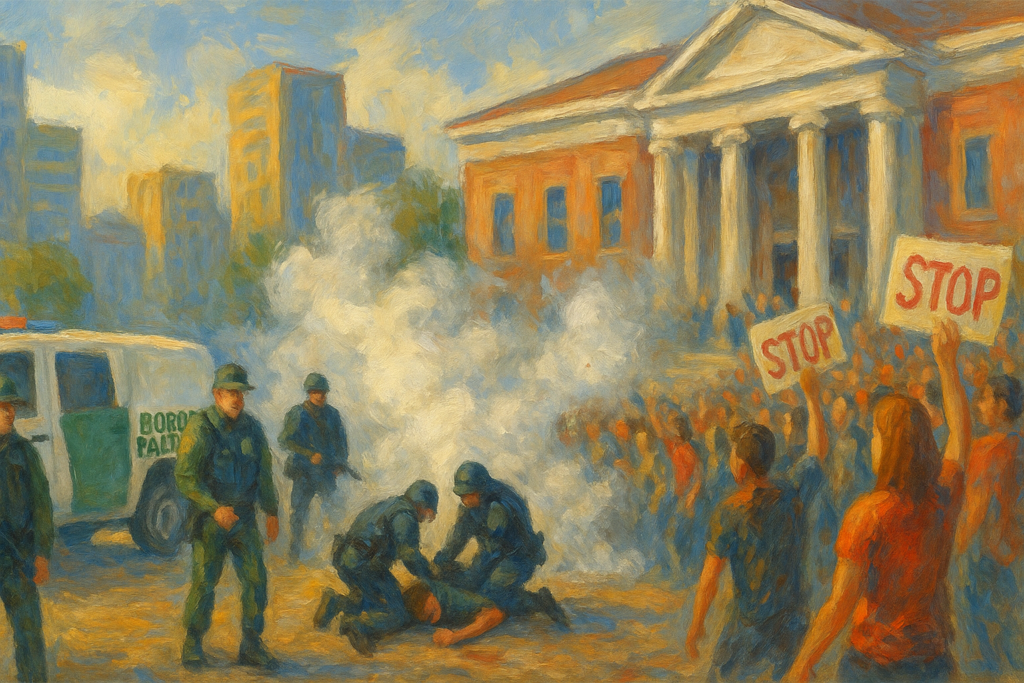
The situation in Minnesota then turned deadly. During a protest in Minneapolis, federal agents shot and killed ICU nurse Alex Pretti after pepper‑spraying and tackling him. DHS quickly framed the shooting as defensive and labeled protesters as rioters, but video footage and eyewitness accounts contradicted key parts of the official story. The killing followed weeks of aggressive ICE activity in the region and immediately triggered outrage. Protests spread from Minneapolis to New York, San Francisco, Boston, Providence, and Washington, D.C., with demonstrators calling for the abolition of ICE and an end to Operation Metro Surge, the 3,000‑agent deployment in Minnesota.
Minnesota officials and courts moved quickly to preserve their ability to investigate. Attorney General Keith Ellison sued DHS officials and secured a restraining order preventing the destruction or alteration of evidence related to the Pretti shooting. Federal Judge Kate Menendez questioned the legality of the broader immigration crackdown, while another judge ordered ICE’s acting director to appear in court over repeated defiance of release orders—96 ignored directives in 74 cases. Even as federal agents operated aggressively on the ground, judges and state officials signaled they were prepared to use litigation and injunctions to check them.
On the streets, the protests continued to grow. In Minneapolis, federal agents used teargas to clear demonstrators outside a hotel believed to house ICE personnel. DHS issued a statement about the shooting that Minnesota officials and many observers described as misleading, while the state’s prison system launched a website to rebut federal claims about the operation’s targets. The clash of narratives—federal claims of rioting and justified force versus local accounts and video evidence—became a central feature of the crisis. In Washington, congressional Democrats responded by threatening to use the power of the purse. Senate Majority Leader Chuck Schumer and House Democrats including Amy Klobuchar and Adam Schiff announced they would oppose or block DHS funding in response to the shootings of Alex Pretti and another Minnesotan, Renee Good. They demanded reforms to ICE and DHS and raised the prospect of a partial government shutdown. Committees summoned ICE, Border Patrol, USCIS leaders, and Homeland Security Secretary Kristi Noem to testify about the operations.
The White House, for its part, tried to manage the political fallout while keeping the enforcement campaign intact. President Trump announced he was sending former ICE director Tom Homan, a hard‑line immigration figure, to Minnesota to “mediate” after the shooting. Homan’s assignment underscored that the administration viewed the crisis primarily through an enforcement lens, even as Minnesota officials were suing over the legality of the federal presence. This set the stage for the week’s later battles over funding, oversight, and public messaging.
By Monday, Minnesota escalated its legal challenge. Attorney General Ellison filed a lawsuit arguing that Operation Metro Surge violated the Tenth Amendment by coercing state policy through the mass deployment of federal agents. In Minneapolis, Judge Menendez heard arguments over whether the surge amounted to an unlawful occupation. Chief Judge Patrick Schiltz ordered acting ICE head Todd Lyons to appear in court over the agency’s repeated violations of release orders, highlighting the depth of institutional defiance. These cases tested how far the federal government could go in flooding a state with agents and ignoring court directives before running afoul of constitutional limits.
In Washington, House Democratic leaders threatened to impeach Secretary Noem, introducing a resolution with more than 100 co‑sponsors that cited her role in Minnesota operations. Other Democrats signaled plans to investigate her and force Republicans to take public positions. At the same time, several Republican senators—Bill Cassidy, Lisa Murkowski, Thom Tillis, and Rand Paul—joined calls for investigations into Pretti’s killing, with Paul scheduling a February hearing on DHS actions. Impeachment threats and bipartisan hearings showed Congress groping for ways to impose accountability on a powerful security department without yet agreeing on remedies.
The administration pursued other controversial uses of power and resources. Trump granted clemency to a new round of individuals convicted of fraud and other white‑collar crimes, many with financial ties to pro‑Trump political committees, reinforcing perceptions that the pardon power was being used to reward allies. He also defended adding a ballroom to the White House amid a preservation lawsuit, claiming national security justifications. Meanwhile, DOJ moved to freeze billions in childcare and family assistance funds to five Democratic‑led states, citing alleged fraud. Those states sued and won a temporary block, but the episode showed social‑service funding being used as leverage in partisan disputes. At the same time, Amazon Web Services, AT&T, and Citizens Bank deepened their ties to ICE and DHS through data hosting, communications, and private prison financing, illustrating how corporate infrastructure underpinned the enforcement surge.
Civil society in Minnesota and beyond shifted from spontaneous protest to organized resistance. Residents formed community patrols, food networks, and legal assistance teams to support those targeted by federal actions. The group Indivisible hosted a mass “Eyes on ICE” call to train people to document and resist ICE activities. The 50501 Movement announced a National Day of Lobbying for Trump’s impeachment and a broader National Shutdown, while nurses in Durham planned a vigil for Alex Pretti. The National Basketball Players Association issued a statement condemning federal actions in Minnesota, and influencers and non‑political online communities amplified criticism. Polling showed Trump’s immigration approval rating falling to a record low, suggesting that opposition to the crackdown was spreading beyond traditional activist circles.
On Tuesday, Trump tried to project both control and defiance. He claimed to have had a “very respectful” conversation with Minnesota Governor Tim Walz and a productive call with Minneapolis Mayor Jacob Frey about ending Operation Metro Surge, while publicly blaming Democratic officials for Pretti’s killing and echoing calls to invoke the Insurrection Act. He defended the broader immigration operations as part of a “big investigation” and reaffirmed his support for Secretary Noem. The contrast between conciliatory private messaging and public blame‑shifting highlighted how presidential rhetoric could inflame tensions even as the administration sought to avoid formal concessions.
Trump also signed executive orders that expanded federal reach in other domains. One order overrode state and local permitting to speed post‑wildfire rebuilding in Los Angeles, allowing builders to self‑certify compliance and ordering audits of California’s use of federal funds. Another declared a national emergency over perceived threats from Cuba, authorizing tariffs on countries that supply it with oil. He expressed support for Chinese automakers building factories in the United States, signaling a willingness to reshape industrial policy through executive influence. These moves showed the presidency using emergency and regulatory powers to override state authority and reconfigure trade and investment with limited congressional input.
In Congress, Senate Republicans moved to bundle remaining government funding bills, including $10 billion for ICE, defying Democratic demands to separate DHS appropriations. Even as lawmakers debated funding, civil rights attorneys filed federal lawsuits over U.S. military boat strikes that killed civilians in the Caribbean, and a Texas judge blocked the deportation of five‑year‑old Liam Ramos and his father, both arrested in Minneapolis. Another judge in Minnesota later halted the detention of lawfully resettled refugees swept up in a re‑vetting operation. Separately, Chief Judge Schiltz’s summons of acting ICE director Lyons and a class‑action lawsuit over detainees’ lack of confidential access to lawyers underscored how courts were being used to confront systemic detention practices and agency defiance.
Election law advocates were also mobilizing. Democracy Docket highlighted litigation challenging DOJ efforts to influence how states manage voter rolls, warning that federal pressure could lead to improper purges. The group launched a live redistricting tracker and opinion coverage to monitor legal changes affecting election rules and representation. These efforts formed a quieter but important backdrop to the more dramatic election‑related developments that would emerge midweek.
Wednesday marked a turning point on two fronts: environmental policy and election intervention. Under Administrator Lee Zeldin, the EPA announced that it had initiated 66 rollbacks in Trump’s second term, loosening limits on mercury and soot, cancelling renewable‑energy grants, and moving to rescind the “endangerment finding” that underpins climate regulation. The agency said it would stop weighing certain health costs from air pollution, focusing instead on industry compliance expenses. This represented a significant shift in regulatory priorities away from public health and long‑term climate concerns toward short‑term industry costs.
More immediately explosive were the federal raids on Fulton County’s election records. The FBI and DOJ executed search warrants at the county’s election hub and warehouse, seizing all 2020 ballots, tabulator tapes, ballot images, voter rolls, and 700 boxes of records. The operation followed the quiet removal of the Atlanta FBI field chief who had questioned the renewed investigation. Director of National Intelligence Tulsi Gabbard appeared at the scene and was later reassigned to focus on election‑fraud claims. Local officials and Democrats denounced the raids as unjustified political retribution, noting that multiple recounts had already confirmed Joe Biden’s win in Georgia. Seizing and centralizing control over past election records under a politicized narrative raised fears that law enforcement and intelligence tools were being repurposed to relitigate settled results.
Back in the immigration arena, federal authorities expanded their surveillance capabilities while constraining public oversight. ICE officers were equipped with new technologies, including biometric trackers and drones, to monitor anti‑ICE protest networks. At the same time, Meta removed a large Facebook group used to share ICE sightings and blocked links to a site documenting DHS employees, following DOJ pressure. Apple and Google removed ICE‑tracking apps from their stores, and TikTok users reported being unable to upload anti‑ICE videos after the platform’s U.S. operations were acquired by a Trump‑aligned consortium. These moves tilted the informational balance: the state’s ability to watch activists grew, while activists’ ability to watch the state shrank.
Trump’s rhetoric continued to escalate. In a speech in Iowa, he described those arrested by federal agents as “hardened, vicious, horrible criminals” and singled out Representative Ilhan Omar, further inflaming tensions around the Minnesota crackdown. Attorney General Pam Bondi announced new arrests of alleged “rioters” accused of assaulting federal officers, reinforcing a narrative that framed protest as criminality. Casting immigrants and local officials as dangerous enemies helped justify harsh enforcement and normalized the use of extraordinary powers against political opponents.
On Thursday, the confrontation over DHS funding came to a head. Senator Lindsey Graham blocked a late‑night vote to avert a shutdown over a provision affecting senators’ ability to sue DOJ, heightening tensions. The Senate then failed to advance a broader funding bill amid concerns about ICE’s conduct. By day’s end, Senate Democrats and Republican leaders reached a deal to separate DHS funding from other appropriations, extending DHS funding for two weeks at current levels while negotiations over reforms continued. The short‑term patch kept the government open but left the underlying oversight fight unresolved, using the threat of a shutdown as leverage in the struggle over immigration enforcement and civil liberties.
Outside Congress, organizers finalized plans for a national strike and hundreds of protests for January 30–31, calling for a “national shutdown” to defund and dismantle ICE and CBP. The actions built on Minnesota’s economic blackout and clergy‑led protests and were coordinated with the 50501 Movement’s broader campaign culminating in a March mobilization. A coordinated national shutdown aimed at a federal agency is rare in U.S. history and signaled deep public discontent with current enforcement practices.
The information battle intensified as well. The White House’s social media accounts showcased a series of AI‑generated images: Trump as pope, as a king on a fake magazine cover, a “golden age” White House dripping with coins, a Studio Ghibli‑style deportation meme, and racist depictions of Democratic leaders Hakeem Jeffries and Chuck Schumer in sombreros. An earlier altered image of Minneapolis activist Nekima Levy Armstrong was also highlighted. These posts often coincided with policy announcements or enforcement news, blurring the line between official communication and propaganda and normalizing extremist and racist tropes in state messaging. At the same time, Meta’s removal of the 80,000‑member ICE‑sightings group and blocking of links to the DHS‑employee database, combined with Apple and Google’s earlier removal of ICE‑tracking apps, drew criticism from civil liberties advocates. Developer Joshua Aaron sued Trump officials, alleging First Amendment violations. Together with ICE’s expanding surveillance tools, these platform decisions showed how government pressure could lead private companies to weaken public oversight.
Thursday also brought a partial fulfillment of Congress’s Epstein transparency mandate. Under the Epstein Files Transparency Act, DOJ released more than 3 million pages of documents, videos, and images from the Epstein investigation—only about half of the total archive and with heavy redactions. The files revealed previously unknown ties between Epstein and figures like Elon Musk and Commerce Secretary Howard Lutnick, including emails arranging a visit to Epstein’s island. A section detailing allegations against Trump was briefly removed and then restored, raising concerns about selective disclosure and political interference in the release of information about elite wrongdoing. In a separate but related illustration of money and power, the administration approved $500 million in Venezuelan oil deals involving trading houses with histories of bribery and close ties to major campaign donors. In the private sector, Uline employee Laura Wittmann resigned in a company‑wide email over the owners’ heavy donations to Trump and MAGA causes, saying she could not work for people she believed were undermining democracy.
By Friday, the planned national shutdown began to materialize on the ground in Minnesota. Hundreds of businesses closed in a coordinated economic blackout to protest federal actions and the killing of Alex Pretti. At the Minneapolis airport, 100 clergy members were arrested during a protest against federal violence. These actions showed that opposition to the enforcement surge had moved beyond activist circles into the economic and religious mainstream, with business owners and faith leaders willing to incur costs and legal risk to register their dissent.
In the election arena, Trump escalated his rhetoric online. He used his social media account to promote debunked claims that Italian military satellites and China hacked U.S. voting machines to install Joe Biden and accused Barack Obama of orchestrating a coup. These posts came just days after the federal raids on Fulton County’s 2020 election records and the reassignment of the Director of National Intelligence to focus on election‑fraud claims, tying presidential messaging directly to ongoing federal interventions in election administration. When a sitting president repeatedly endorses disproven election conspiracies, it corrodes public trust in democratic processes and can be used to justify further intrusive “integrity” measures.
Trump also turned to the courts in his personal capacity. He, his two eldest sons, and the Trump Organization filed a $10 billion lawsuit against the IRS and Treasury, alleging that a former IRS employee leaked his tax returns to the press. The leaked documents had shown that he paid no income tax in most of twenty years. The suit followed a separate case over the FBI’s search of his residence for classified documents and highlighted the unusual spectacle of a president suing federal agencies he oversees over disclosures that informed the public about his finances.
Courts continued to shape high‑profile criminal and immigration cases. In New York, Judge Margaret Garnett dismissed death‑penalty‑eligible firearm murder charges against Luigi Mangione in the killing of UnitedHealthcare’s CEO, ruling them legally incompatible with remaining stalking counts, though Mangione still faced a potential life sentence. In Minnesota, judges enforced limits on ICE by blocking deportations of families and ordering the release of lawfully resettled refugees detained under new re‑vetting programs. These rulings showed courts both constraining the harshest criminal penalties and acting as a backstop against overbroad immigration enforcement, even as the broader political conflicts remained unresolved.
Taken together, the week’s events traced a pattern of intensified federal assertion—through immigration raids, election‑record seizures, emergency orders, and AI‑driven propaganda—met by a patchwork of institutional and civic resistance. State attorneys general and federal judges used lawsuits, injunctions, and evidentiary orders to slow or reshape enforcement campaigns. Congress wielded funding threats, impeachment talk, and hearings to seek accountability, even as it struggled to agree on concrete limits. Tech platforms, under government pressure, narrowed the tools available for public oversight, while activists, businesses, and clergy experimented with new forms of protest, from encrypted organizing to economic shutdowns. In this contested landscape, the basic questions at stake were about who controls force, information, and the rules of elections—and whether existing checks are strong enough to keep those powers within democratic bounds.