This week’s throughlines
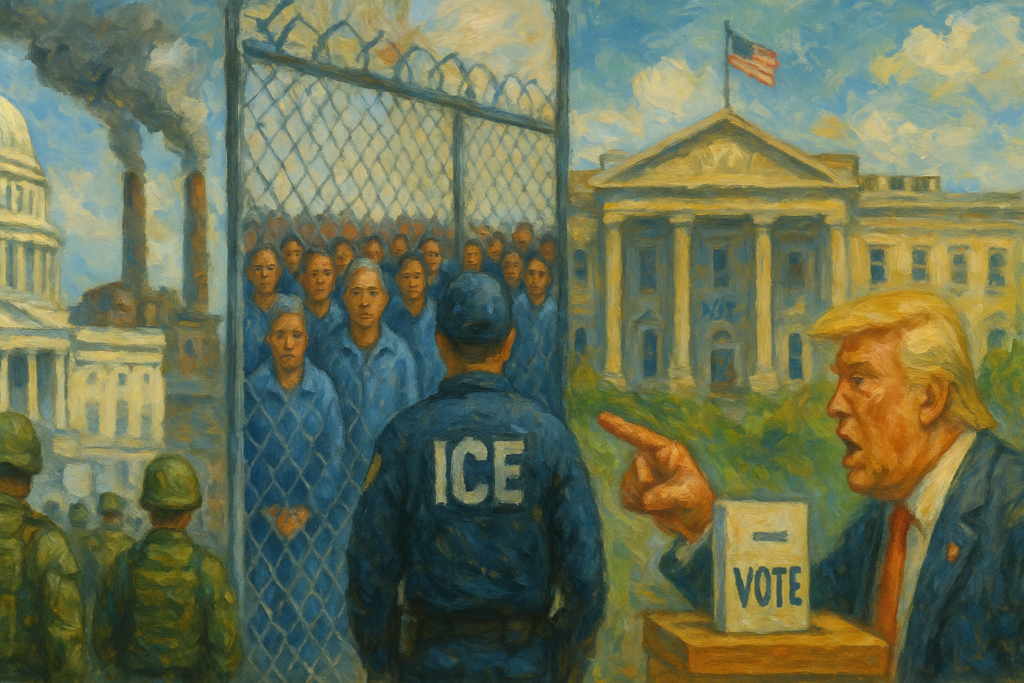
- Immigration enforcement widened from raids into infrastructure — What began as continued arrests and court fights over detention conditions became a larger story about permanent capacity: new detention facilities, warehouse conversions, record detainee counts, and new plans for mass processing centers.
- Election restriction efforts moved from rhetoric into lawmaking and administration — The week opened with pressure for proof-of-citizenship voting rules and threats to federalize elections, then escalated as the House passed the SAVE America Act and North Carolina advanced voter-challenge rules.
- Oversight of the Epstein files turned into a separation-of-powers fight — Congressional efforts to obtain testimony and records ran into Maxwell's silence, DOJ redaction disputes, Bondi's combative testimony, and revelations that the department tracked lawmakers' searches of the files.
- Courts repeatedly checked executive action, especially on immigration and dissent — Judges blocked or narrowed several administration actions, including unlawful detentions, retaliation against lawmakers and protesters, denial of counsel to detainees, and harsh detention conditions.
- Public memory and public institutions were reshaped from above — The administration and allied institutions moved to control records, symbols, and public narratives through archive changes, symbolic removals, donor-backed patriotic programming, and selective historical messaging.
The week opened with a sharp turn in how the federal government treats climate, immigration, and the vote. At one end, the administration moved to dismantle the legal foundation for regulating greenhouse gases and to bind the military to coal. At another, it expanded immigration detention to record levels and pressed courts to accept mass no‑bond confinement. And in Congress and at the White House, leaders advanced a voting bill that would make it harder to register and threatened to seize control of state‑run elections if it stalled. Running through the week was a deepening struggle over the Epstein files and the Justice Department’s relationship to oversight, alongside a quieter but consequential effort to weaken civil service protections and tilt key agencies toward political loyalty.
Over the weekend, the administration took a structural step toward politicizing the federal workforce. The Office of Personnel Management finalized a new employment category that strips civil service protections from roughly 50,000 federal employees. A companion “Schedule Policy/Career” rule makes it easier to remove nonpartisan staff and shifts whistleblower handling from an independent office into the agencies themselves. In practice, more career officials can now be fired or sidelined for resisting political pressure, and employees who witness misconduct must report it through chains of command that may be implicated. It is a quiet change in job classifications with large implications for how neutrally laws are administered.
The same weekend, the White House used critical infrastructure funding as a bargaining chip. The administration had frozen $16 billion for the Gateway/Hudson rail tunnel, central to rail traffic in and out of New York City, after reports that Trump had conditioned the money on renaming Penn Station and Dulles Airport after him. A federal judge called the freeze arbitrary and ordered the funds released so construction could proceed, but the administration immediately appealed, keeping the dispute alive. The episode underscored how control over large public works can be leveraged for personal branding and political concessions rather than allocated on technical or safety grounds.
On voting, House Republicans advanced the SAVE America Act, a sweeping bill that would redefine what documentation Americans must show to participate in elections. The measure would require documentary proof of citizenship to register and vote and impose a nationwide photo ID rule that excludes student IDs. Analyses cited in debate suggested that up to 21 million eligible citizens lack the necessary documents, including many women who changed their names after marriage, transgender people whose IDs do not match their lived identity, and low‑income voters who have never needed a passport or birth certificate. For ordinary voters, the bill would turn registration into a paperwork exercise that many cannot easily complete, even if they have lived and voted in the same community for years.
Immigration enforcement intensified at the same time. Over the weekend, ICE carried out aggressive operations in cities across the country, using rapid street arrests, sweeps at day‑labor sites, and detentions during routine check‑ins. DHS secured funding for large new detention facilities near Philadelphia and San Antonio, and reports surfaced of warehouse purchases for future camps. Conditions at existing sites, such as Camp East Montana, drew scrutiny for severe violations. A Fifth Circuit panel upheld a mass no‑bond detention policy that allows broad categories of noncitizens to be held without the possibility of release, helping push the detained population above 70,000. Courts did intervene in some cases: a judge ordered the release of Venezuelan asylum seeker Joswar Torres after seven months in custody and criticized ICE for ignoring individual circumstances, and another judge in Washington, DC limited ICE’s use of teargas and projectiles on protesters in Portland. But the pattern was clear: systemic detention powers were expanding faster than courts could correct individual injustices.
The weekend also set the tone for the week’s battles over information and accountability. The State Department announced it would remove all pre‑2025 social media posts from public view, keeping them only in internal archives accessible through formal records requests. That broke with the practice of maintaining continuous public archives of official communications and gave current leaders more control over how the recent past is seen. At the same time, the fight over the Epstein files moved into a new phase. Representative Ro Khanna warned that Ghislaine Maxwell planned to invoke the Fifth Amendment broadly in her upcoming congressional deposition and circulated detailed questions about her past statements and ties to Jeffrey Epstein. Maxwell’s lawyer confirmed she would refuse to answer unless granted clemency by Trump, highlighting how a key witness in a major abuse case could use constitutional protections and the prospect of a presidential pardon to limit what Congress and the public learn.
The president’s own use of media added to the strain. Trump’s account posted a video depicting Barack and Michelle Obama as apes alongside debunked claims about the 2020 election. After condemnation, including from some Republicans, the video was deleted, but Trump admitted approving it and refused to apologize, alternately blaming a staffer and minimizing the racism. The episode showed how the presidency’s communication channels can be used to normalize racist imagery and recycle election disinformation, with consequences for public trust that outlast any single post.
By Monday, the courts were more deeply entangled in the administration’s immigration strategy. Two Fifth Circuit judges upheld the new no‑bond policy, effectively endorsing the idea that entire categories of noncitizens can be detained indefinitely without a hearing on their individual risk or flight likelihood. That ruling helped cement the record‑high detention numbers. Yet in the same period, other judges ordered releases and criticized ICE for failing to consider personal circumstances, illustrating a split between broad judicial deference to policy and case‑by‑case corrections. In Minnesota, “Operation Metro Surge” continued, with more than 2,700 federal agents deployed in the Twin Cities. Aggressive arrests disrupted immigrant neighborhoods and local businesses, and the state’s attorney general compared the federal presence to an occupation. Hearings in Washington began probing deaths of U.S. citizens during encounters with immigration officers, underscoring how the campaign’s reach extended beyond undocumented residents.
Congress’s confrontation with the Justice Department over the Epstein files escalated on Monday as well. Members of the House and Senate Judiciary Committees were granted controlled access to unredacted records at DOJ headquarters, with 24‑hour notice and logged searches. After reviewing the files, Representative Jamie Raskin accused DOJ of over‑redacting the names of alleged abusers while exposing survivors, and vowed to question Attorney General Pam Bondi about the process. The same day, DOJ asked a federal judge to dismiss, with prejudice, the criminal case against Steve Bannon for defying the House January 6 committee, arguing that dropping the conviction was in “the interests of justice.” Coming after Trump’s earlier pardon of Bannon and mass pardons of January 6 rioters, the move signaled a broader effort to unwind legal consequences for those involved in attempts to overturn the 2020 election and to weaken Congress’s ability to enforce subpoenas.
Outside Washington, thousands of high school students in multiple states walked out to protest ICE’s presence and tactics in their communities, showing how immigration policy was being contested in classrooms and streets as well as courts. Economic data added another layer of uncertainty: revisions to 2025 employment figures revealed nearly one million fewer jobs than initially reported, turning several months of supposed gains into losses and raising questions about the reliability of official statistics that voters and policymakers rely on.
On Tuesday, the administration turned decisively against federal climate regulation. Officials announced plans to repeal the 2009 “endangerment finding” that greenhouse gases threaten public health, the legal foundation for regulating climate pollution under the Clean Air Act. In parallel, Trump signed executive orders directing the Defense Department to purchase billions of dollars in coal‑generated electricity and to treat coal plants as critical national defense assets. The Department of Energy committed $175 million to extend the life of aging coal facilities. By tying coal to national defense and binding the military to long‑term coal contracts, the administration made future shifts toward cleaner energy more difficult and deepened the political clout of fossil‑fuel interests inside the security state.
The same day, the administration moved to reshape the scientific landscape. Federal research grants previously authorized by Congress were rescinded, and new rules required that funded work align with right‑wing ideological priorities and avoid references to race or gender. Projects already underway were disrupted, and some researchers began seeking positions abroad. Conditioning research funding on ideological conformity undermines academic freedom and weakens the evidence base for public policy, especially in areas like public health and climate where data and analysis are central to informed decision‑making.
In the Senate, Democrats tried to push accountability in another direction by introducing Virginia’s Law, named for Epstein survivor Virginia Giuffre. The bill would eliminate statutes of limitations for civil sexual abuse cases and close jurisdictional loopholes that allow traffickers to evade accountability by moving victims across borders. At the same time, Commerce Secretary Howard Lutnick’s own ties to Epstein came under sharper scrutiny. Under questioning, he admitted having lunch with Epstein on his private island in 2012, contradicting earlier claims that he had severed ties in 2005. Documents showed continued business dealings after Epstein’s conviction, prompting bipartisan calls for his resignation. The contrast between legislative efforts to expand survivors’ access to justice and the continued presence of officials with deep Epstein connections in high office framed the week’s broader debate over elite accountability.
Courts also weighed in on the boundaries of political speech and military authority. Judge Richard Leon issued orders blocking the Defense Department from reducing retired Senator Mark Kelly’s rank and pension over his appearance in a video reminding troops to refuse unlawful orders. A grand jury declined to indict Kelly and five other Democrats after the administration labeled the video “seditious.” The rulings affirmed that retired officers serving in Congress retain First Amendment protections and limited the executive’s ability to criminalize or punish political speech about military obedience to law. In a different register, the National Park Service removed a large Pride flag from the Stonewall national monument under a new Interior Department memo limiting non‑agency flags on federal property. Local officials in New York City quickly re‑raised the flag in a public ceremony, asserting Stonewall’s historic role in LGBTQ+ rights and highlighting ongoing battles over which histories are visibly honored at national sites.
By Wednesday, the administration’s use of clemency and prosecutorial discretion to reshape the legacy of January 6 became more explicit. Trump granted a pardon to Andrew Paul Johnson, one of roughly 1,500 people charged in the Capitol attack, as part of a broader wave of clemency for rioters. Combined with DOJ’s move to erase Bannon’s contempt conviction, the action signaled a systematic effort to roll back legal consequences for those involved in efforts to overturn the 2020 election, weakening deterrence against future political violence.
The struggle over the Epstein files and oversight deepened that day in a House Judiciary hearing. Attorney General Pam Bondi was photographed holding a document titled “Jayapal Pramila Search History,” listing which Epstein files the congresswoman had accessed in DOJ’s secure system. DOJ later confirmed it logs all member searches. Representatives Pramila Jayapal and Jamie Raskin announced plans for formal letters and an inspector general investigation into what they called improper surveillance of Congress. In testimony, Bondi refused to explain why survivor names were exposed while alleged perpetrators were redacted, attacked Democratic members personally, and declined to apologize to victims present. Lawmakers accused her of lying under oath and using chaos to avoid substantive answers about DOJ’s non‑compliance with the Epstein Files Transparency Act. The spectacle underscored how an attorney general treating oversight as partisan combat can erode trust in the justice system’s willingness to police elite wrongdoing.
Energy policy and national security remained intertwined. Trump signed an executive order titled “Strengthening United States National Defense With America’s Beautiful Clean Coal Power Generation Fleet,” directing the Departments of War and Energy to secure long‑term coal‑fired power for military installations and defense‑industrial bases. By formally embedding coal in defense planning, the order made it harder for future administrations to pivot toward lower‑carbon energy sources without revisiting national security justifications. Meanwhile, courts continued to push back on some aspects of the administration’s approach to dissent and immigration. A federal judge dismissed charges against Los Angeles protester Jonathon Redondo‑Rosales, citing government bad faith, and another ordered improved medical care, attorney access, and oversight at the California City immigration detention center. A grand jury again refused to indict six Democratic lawmakers over their video urging troops to refuse illegal orders, and Judge Leon’s earlier orders protected Senator Kelly from Pentagon retaliation. These decisions showed that even as the executive sought to criminalize or discipline protest and political speech, parts of the judiciary remained willing to enforce constitutional limits.
Other developments on Wednesday highlighted how senior officials were testing the boundaries of democratic norms. Defense Secretary Pete Hegseth reposted a video advocating “household voting,” effectively suggesting that women should not cast individual ballots. The post fit a pattern of provocative signaling by senior officials, floating ideas that would roll back long‑settled rights. And in foreign policy, the State Department imposed visa sanctions on five individuals involved in European digital regulation efforts, including U.S. permanent resident Imran Ahmed, accusing them of coercing American platforms to censor content. A federal judge issued a temporary restraining order blocking Ahmed’s deportation while he challenges the sanctions, raising questions about the use of immigration tools against foreign regulators and a U.S. resident over speech and content rules.
Thursday brought the climate pivot to its legal conclusion. EPA Administrator Lee Zeldin formally rescinded the 2009 endangerment finding, dismissing it as a “con job.” Without that finding, federal agencies lose a central tool for limiting greenhouse‑gas emissions from vehicles and power plants under the Clean Air Act. States and environmental groups prepared immediate legal challenges, but unless courts reverse the move, responsibility for climate action will shift more heavily to state governments and private actors. At the same time, an analysis of EPA records would later show that enforcement against major polluters had already dropped sharply under Trump’s second term, with only one Clean Air Act consent decree filed in a year, compared with dozens in prior administrations.
On elections, the House passed the SAVE America Act by a narrow 218–213 margin. The bill’s proof‑of‑citizenship requirement for registration, restrictions on mail voting, and national photo ID rule that excludes student IDs would, if enacted, change the experience of voting for millions. Citizens who have long relied on utility bills or student cards to prove identity would need to secure passports, birth certificates, or other documents that many do not have readily available. The bill also sets the stage for more frequent challenges to voters’ eligibility. Trump amplified the stakes by publicly threatening to issue an executive order to “federalize” elections in 15 states if the bill stalls in the Senate, accusing Democrats of cheating and demanding stricter ID laws. That threat challenged not only access to the ballot but also the constitutional division of election authority between states and the federal government.
Immigration policy remained at the center of a funding showdown. Senate Democrats blocked a DHS appropriations package, demanding reforms such as body cameras and visible identification for ICE agents and limits on operations near schools, churches, and other sensitive locations. With both chambers leaving town, DHS prepared for a partial shutdown at midnight, though ICE operations would continue using prior‑year funds. The standoff illustrated how Congress can use the power of the purse to press for changes in enforcement practices, even at the risk of disrupting a major security agency. Meanwhile, ICE’s detained population hit a record high, with most detainees held in for‑profit facilities. CoreCivic’s revenue from ICE contracts more than doubled, and the agency advanced a $38.3 billion plan to convert at least 16 warehouses into regional processing centers and build eight large detention hubs, funded by a sweeping spending law. Locking immigration enforcement into long‑term, profit‑driven infrastructure will make mass detention harder to unwind, regardless of future policy shifts.
There were signs of resistance and correction. In New Jersey, Governor Mikie Sherrill signed an order barring immigration agents from entering non‑public areas of state‑owned property without a judicial warrant and from using state sites as bases for enforcement operations. The state also launched an online portal for residents to upload photos and videos of ICE activity for review by the attorney general, creating new channels to document potential abuses. In federal court, ICE Director Todd Lyons admitted that officers lied under oath in a case accusing two men of attacking an ICE officer. DOJ moved to dismiss the charges based on newly discovered evidence contradicting the original affidavit, and both officers were placed on leave. And after weeks of protests, economic disruption, and documentation of abuses—including the deaths of two U.S. citizens during enforcement actions—border czar Tom Homan announced that “Operation Metro Surge” in Minnesota would be wound down, with agents returning to normal duties or reassigned. The drawdown showed that sustained local resistance and political pressure can force changes in federal enforcement campaigns, even after significant harm has been done.
The week closed on Friday with further evidence of deregulation and institutional capture. An analysis of EPA records from January 2025 to January 2026 confirmed a steep decline in enforcement actions: only one Clean Air Act consent decree in a year, and similar drops in Superfund and Clean Water Act cases, as the agency emphasized “compliance” over penalties amid staffing cuts. Weak enforcement reduces deterrence for major polluters and shifts environmental and health costs onto affected communities, especially those already burdened by industrial facilities.
ICE, for its part, detailed its $38.3 billion plan to convert warehouses into detention centers and build eight large facilities, dramatically expanding capacity to detain and deport immigrants. The plan relies heavily on private contractors and follows earlier purchases of massive warehouse properties in multiple states. Individual cases illustrated what this infrastructure means in practice. Leqaa Kordia, a Palestinian activist arrested at a pro‑Palestine protest in 2024, remained in ICE custody at Prairieland detention center after nearly a year, even though a judge twice ruled she posed no threat and could be released on bond. Advocates reported that her health had deteriorated and that she had been denied adequate medical care and religious dietary accommodations. Using immigration detention to hold a protester long after a judge approves release blurred the line between immigration enforcement and punishment for political speech.
Civil liberties and press freedom were also tested. Former CNN anchor Don Lemon appeared in federal court and pleaded not guilty to conspiracy and civil‑rights charges stemming from his livestream coverage of an anti‑ICE protest at a Minnesota church. Prosecutors alleged he interfered with worshippers’ rights; Lemon maintained he was present as a journalist documenting a demonstration after an ICE shooting. Criminally charging a reporter for covering a protest risked chilling press scrutiny of law enforcement and public dissent. At the same time, forty‑eight Democratic lawmakers sent a letter to the Administration for Children and Families asking how Trump’s immigration raids and terminations of Temporary Protected Status were affecting the childcare workforce, which relies heavily on immigrant labor. They warned that enforcement policies may be driving up childcare costs and limiting availability, showing how security decisions ripple into everyday economic life.
Inside the Justice Department, the balance between corporate power and competition policy shifted. Gail (or Abigail) Slater, head of DOJ’s antitrust division, was pushed out after clashing with Attorney General Bondi and Vice President JD Vance over her opposition to a $14 billion Hewlett Packard Enterprise–Juniper Networks merger. DOJ had already dropped its suit in favor of a settlement after national security officials intervened. Removing an antitrust enforcer for challenging a major merger signaled that corporate and political interests could override competition policy inside the department. In the health sphere, advocacy group Protect Our Care called for Health Secretary Robert F. Kennedy Jr.’s resignation after he downplayed COVID‑19 risks and discussed past cocaine use on a podcast, citing his anti‑vaccine record, handling of measles outbreaks, and new dietary guidelines as evidence he was undermining public health. The call highlighted how public confidence in health guidance depends on credible leadership.
The Epstein files continued to reverberate globally. Following the latest releases, Goldman Sachs’ top lawyer Kathryn Ruemmler resigned over her long‑term personal relationship with Epstein, and Sultan Ahmed bin Sulayem of DP World was forced out. The Council of Europe lifted former Norwegian prime minister Thorbjørn Jagland’s immunity so Norway could charge him with corruption tied to Epstein. In contrast, U.S. officials with similar ties, such as Commerce Secretary Lutnick, remained in office. The disparity between consequences for European and U.S. figures underscored uneven accountability norms for those named in the files and sharpened questions about whether American institutions are willing to fully confront elite‑linked crimes.
Taken together, the week’s developments showed U.S. institutions under sustained pressure on multiple fronts. Climate authority was hollowed out as coal was woven into national defense, even as enforcement against major polluters waned. Immigration enforcement hardened into a long‑term, profit‑driven detention system, with courts alternately enabling mass no‑bond policies and exposing abuses in individual cases. Voting rules moved toward tighter documentation and ID requirements, paired with open threats to override state control of elections. The Justice Department’s handling of the Epstein files, its surveillance of congressional oversight, and its tilt toward corporate consolidation raised doubts about equal justice under law. Yet state officials, judges, lawmakers, students, and activists also used the tools available to them—court orders, funding leverage, executive orders, walkouts—to contest these shifts. The balance between executive power and democratic accountability remained unsettled, with the week’s actions likely to shape the terrain for years to come.