This week’s throughlines
- The immigration crackdown met resistance but did not meaningfully recede — Minnesota's federal operation survived in court, protests spread nationally, and even after a partial drawdown announcement, reports of aggressive enforcement and community disruption continued. Congress, cities, and courts all tried to impose limits or accountability.
- Election administration became a new target of federal pressure — Trump and allies repeatedly called for nationalizing elections or using immigration enforcement around voting, while the Justice Department sought voter rolls from states and sued those that refused. The week showed a shift from rhetoric to legal and administrative pressure.
- Courts repeatedly checked executive immigration actions — Judges ordered releases from detention, blocked the termination of Haitian TPS, and limited federal force against protesters. These rulings did not stop the broader enforcement campaign, but they created some of the week's clearest institutional brakes.
- Political control widened into culture, academia, and the civil service — The administration removed a slavery exhibit, threatened Harvard with a massive damages claim, canceled arts grants, and issued a rule making it easier to fire federal workers. The pattern was not just policy change but pressure on institutions that traditionally retain some independence from partisan command.
- The Epstein files became a rolling transparency and competence crisis — The Justice Department released millions of pages, exposed victims through failed redactions, pulled files back down, and faced bipartisan demands for fuller disclosure. The result was a weeklong story about both selective transparency and institutional failure.
The week opened in Minneapolis, where a massive federal immigration surge continued to reshape daily life and politics. Operation Metro Surge, a 3,000‑agent deployment of ICE and other federal officers, had already produced the deaths of Renee Good and Alex Pretti. Over the weekend, a federal judge rejected Minnesota’s attempt to halt the operation, allowing the surge to continue despite local objections and mounting public anger. Video evidence undercut the White House’s effort to brand Pretti a “domestic terrorist,” forcing officials to retreat from that claim, but it did not alter the underlying enforcement posture. Agents used tear gas and projectiles on mourners and neighbors, arrested minors and bystanders, and intensified operations near schools in Columbia Heights. In Chicago, the mayor responded by ordering city police to document and investigate alleged illegal ICE activity, asserting a measure of local oversight over federal agents even as the courts deferred to Washington.
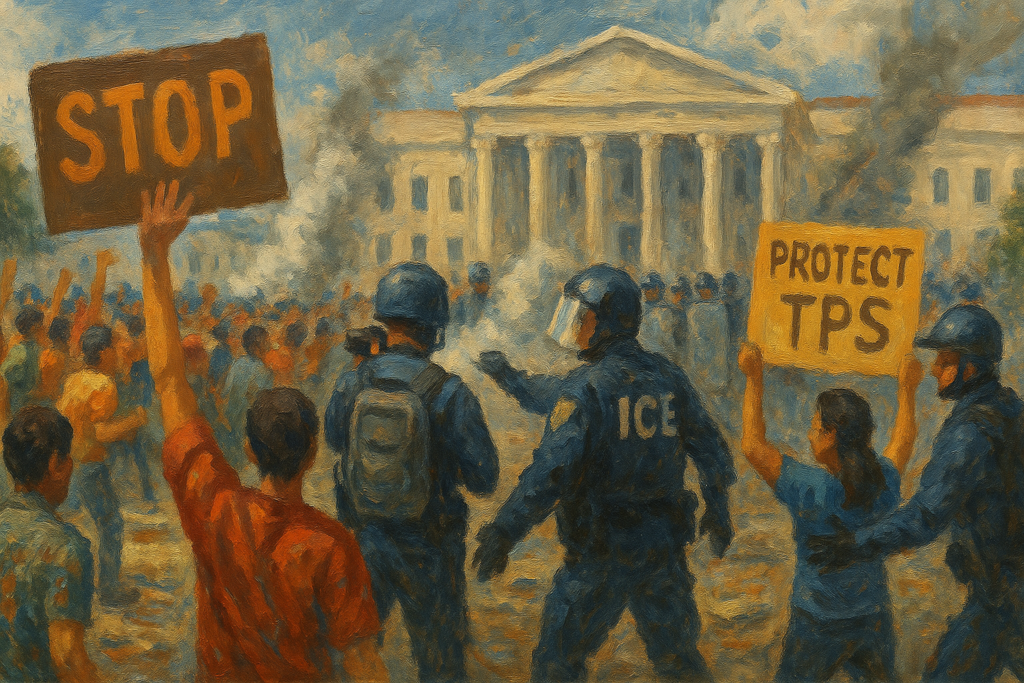
Those scenes in Minneapolis fed into a broader wave of resistance. Tens of thousands of people joined coordinated anti‑ICE protests and strikes across the country, from New York and Los Angeles to Portland and back to Minneapolis. Demonstrators targeted ICE facilities and corporate partners, sometimes taking their actions into retail spaces. Federal agents in Minneapolis and Portland again turned to tear gas, projectiles, and mass arrests. At least four Black journalists were detained while covering the protests, and high‑profile reporters Don Lemon and Georgia Fort were arrested and charged under the FACE Act for filming a protest near a church. Press‑freedom advocates condemned the charges as an attempt to criminalize documentation of public dissent, underscoring how immigration enforcement was colliding not only with community protest but also with norms that protect the press.
As protests grew, the federal government slipped into a partial shutdown when a funding deadline passed. Senate Democrats refused to support a Department of Homeland Security bill in the wake of the Minneapolis killings, using the threat of a shutdown to demand changes in ICE practices. The Senate advanced broader spending bills and a short‑term DHS measure, while narrowly rejecting Senator Bernie Sanders’s proposal to claw back a $75 billion ICE funding increase and redirect it to Medicaid. Negotiations focused on demands for an ICE code of conduct and independent investigations of abuses, setting up a two‑week window to resolve DHS funding and tying the fate of a core security agency to civil‑rights safeguards.
Even as one federal judge upheld the Minneapolis surge, others moved in the opposite direction on individual immigration cases. In Texas, Judge Fred Biery ordered the release of five‑year‑old Liam Conejo Ramos and his father, sharply criticizing officials for ignoring constitutional protections. Their case, and similar rulings for other detained children, showed how individual judges could still check the harshest enforcement practices even as large‑scale operations continued elsewhere. The weekend also brought the first major release of records under the Epstein Files Transparency Act. The Justice Department disclosed about 3 million pages of documents, including videos and images, but withheld roughly half the files and heavily redacted many of those it did release. Survivors and lawmakers accused DOJ of shielding powerful figures while exposing victims, and the release came more than a month past Congress’s deadline, setting the stage for a week of further controversy over how the government handles evidence of elite wrongdoing.
Beyond U.S. borders, new reporting detailed how China was accelerating efforts to reduce its reliance on the dollar system. Beijing was building yuan‑based payment networks, intervening to weaken its currency to boost exports, and stockpiling gold, moves partly shaped by Western sanctions on Russia. These steps pointed to a long‑term strategy to erode U.S. financial leverage. At home, early signs of strain inside the national security apparatus emerged. A whistleblower complaint against Director of National Intelligence Tulsi Gabbard remained blocked from Congress on classification and privilege grounds, prompting accusations of stonewalling from the whistleblower’s lawyer. In a separate episode, a federal appellate chief judge dismissed a DOJ‑backed misconduct complaint against Judge James Boasberg over deportation litigation, signaling judicial resistance to political pressure on the courts. Against this backdrop, Trump announced a “Freedom 250 Grand Prix” auto race in Washington, D.C., as part of the nation’s 250th anniversary celebrations, a patriotic spectacle that contrasted sharply with the turmoil around immigration and oversight.
By Monday, the shutdown’s practical effects were beginning to be felt, but the administration pressed ahead on other fronts. New details emerged about Justice Department letters to state officials demanding complete, unredacted voter rolls—including driver’s license and Social Security numbers—under a contested reading of the National Voter Registration Act. By January, DOJ had sued 24 states and the District of Columbia for refusing to comply, with complaints reportedly riddled with errors and mis‑citations. Framed as a campaign against noncitizen voting, the effort in practice amounted to a push to centralize sensitive voter data in federal hands, raising fears of partisan purges or intimidation and challenging traditional state control over elections.
Courts also began to grapple with the limits of federal force at protests. In Oregon, Judge Michael Simon considered a temporary restraining order on federal officers’ use of tear gas and projectiles against protesters outside a Portland ICE facility, after agents fired on largely peaceful crowds that included children. The ACLU’s class‑action suit alleged retaliatory violence, setting up a test of how far courts would go to constrain federal crowd‑control tactics. Immigration policy faced another legal challenge as a coalition of groups and individuals sued Secretary of State Marco Rubio and the State Department over an order suspending immigrant visas for nationals of 75 countries. The plaintiffs argued that the policy was discriminatory, based on false welfare claims, and violated the Immigration and Nationality Act by denying visas solely on nationality without individualized assessment.
At the state level, North Carolina’s political and fiscal choices illustrated how budget fights can shape public services. The legislature still had no 2026 budget, leaving teachers without expected raises and threatening funding for schools, Head Start, day care, Medicaid, and SNAP. Even as rural hospitals and hundreds of thousands of residents faced potential cuts, legislative leaders floated cutting the state corporate tax rate to zero, a move tied to calculations about maintaining support from the Trump‑aligned wing of the party. Inside the federal government, institutional stress surfaced in a Minneapolis‑related case when DOJ attorney Julie Le told a federal judge, “The system sucks, this job sucks,” and asked to be held in contempt so she could get 24 hours of sleep, as she was pressed on the administration’s noncompliance with court orders. Her outburst highlighted the pressure on career lawyers defending controversial policies and raised questions about DOJ’s capacity and willingness to obey judicial rulings. On foreign policy, Trump—now serving his second term as president—publicly claimed to have secured a ceasefire with Vladimir Putin that would halt attacks on Ukraine. Russia soon launched a major strike on Kyiv and other cities, contradicting his announcement and casting doubt on his influence and the accuracy of his statements about war and peace.
Tuesday brought resolution to the immediate funding crisis. After a brief shutdown, Trump signed a $1.2 trillion appropriations bill that funded most of the government through September but extended DHS funding only until February 13. The House had earlier carved out DHS for a short extension to allow more negotiation over ICE practices, and the final House vote was razor‑thin at 217–214, reflecting deep divisions over immigration enforcement. In the courts, multiple federal judges in Washington, D.C., temporarily halted DHS Secretary Kristi Noem’s move to terminate Temporary Protected Status for up to 350,000 Haitians. Judge Ana Reyes and others found that plaintiffs were likely to succeed, citing evidence of ideological hostility toward nonwhite immigrants. The rulings preserved work authorization and protection from deportation while litigation proceeds, offering a significant, if temporary, shield for Haitian communities.
The administration, meanwhile, escalated its confrontations with other institutions. Trump announced that his administration was seeking $1 billion in damages from Harvard over alleged antisemitism and civil‑rights violations, on top of an ongoing effort to cancel $2.2 billion in research grants that a federal judge had previously protected. DOJ has appealed that ruling, and the administration has threatened to withhold federal research funding and demanded changes to Harvard’s diversity programs. Critics saw the campaign as blurring the line between legitimate civil‑rights enforcement and political coercion of a prominent university. On elections, a 2025 executive order requiring proof of citizenship—such as a passport or specific IDs—for federal voter registration, including for military and overseas voters, came under renewed scrutiny. Several judges had already blocked parts of the order as unconstitutional, and critics warned that millions of eligible voters lack the required documents. The order also targeted states that count mail ballots received after Election Day, further inserting the federal executive into rules traditionally set by states.
Concerns about politicized election oversight deepened with new reporting on DNI Tulsi Gabbard’s activities. With Trump’s approval, she had been conducting her own review of the 2020 election focused on voting machines and foreign interference, separate from DOJ’s work. She was physically present at an FBI raid on Fulton County’s elections office that seized about 700 boxes of 2020 ballots and records, even though her role carries no domestic law‑enforcement authority. Georgia Democrats and local officials questioned her involvement and the legality of seizing original ballots, seeing it as a blurring of intelligence and law‑enforcement roles in a politically charged context. On the ground, immigration enforcement continued to intrude into everyday spaces: Chalkbeat reported that ICE activity had moved near schoolyards and bus stops, increasing fear among students and parents and driving absenteeism, as educators scrambled to reassure children who worried that parents might be detained during the school day. In the courts, the Supreme Court unanimously allowed California to use a new voter‑approved congressional map despite a Republican challenge alleging racial gerrymandering, a decision that could net Democrats up to five additional House seats and showed the Court permitting some state‑level counterweights to partisan maps elsewhere.
Wednesday marked a turning point in the administration’s push to centralize control over elections. At a bill‑signing and in media appearances, Trump urged Republicans to “nationalize” elections and “take over the voting” in key areas, repeating claims of widespread illegal voting by immigrants. At the same time, DOJ pressed ahead with lawsuits against states that refused to hand over full voter rolls, and allies like Steve Bannon floated deploying ICE to polling places. These moves built on the earlier proof‑of‑citizenship order and the ongoing voter‑roll litigation, knitting together rhetoric about fraud with concrete efforts to pull election authority toward the executive branch. In Portland, however, the courts drew a line on another front. Following weekend clashes, Judge Michael Simon issued a 14‑day restraining order barring ICE officers from using tear gas and projectile munitions against protesters except when there is an imminent threat of physical harm, and limiting where they can aim. The order, issued in response to the ACLU’s class action, set a clear boundary on federal use of force at protests and reinforced that crowd control must respect constitutional rights.
In Minneapolis, new video showed how far federal agents were willing to go despite official talk of “de‑escalation.” Footage captured ICE agents chasing, tackling, and pointing guns at unarmed protesters in a park, then deploying tear gas and explosive devices. In another incident, agents surrounded a vehicle with guns drawn, ordered activists out at gunpoint, and threatened reporters with pepper spray. These scenes unfolded even as the administration claimed to be shifting tactics and later announced a partial drawdown of agents in Minnesota, highlighting the gap between public messaging and on‑the‑ground behavior. Elsewhere, Florida legislators advanced the “Recognizing Judea and Samaria Act,” which would ban the term “West Bank” in K‑12 schools and state agencies, requiring “Judea and Samaria” instead. The bill mirrored a law in Arkansas and used state power to fix a particular geopolitical narrative in curricula and official communications. The Washington Post announced that it would cut roughly one‑third of its staff, a dramatic reduction in reporting capacity at a leading national outlet at a time when investigative journalism is a key check on government. And in Texas, a man sued a California doctor under a new law allowing private individuals to seek damages from anyone who mails abortion medication into the state, testing whether restrictive states can project their abortion bans across borders despite protective “shield laws” elsewhere. At a Wall Street Journal conference, Citadel CEO and major GOP donor Ken Griffin accused the Trump administration of making decisions that enrich the families of those in power, pointing to crypto‑friendly policies and a $500 million Emirati investment in a Trump‑linked crypto company that coincided with U.S. approval of advanced AI chip sales to the UAE. The day also saw the arrest in Minnesota of Jake Lang, a pardoned January 6 rioter and Senate candidate, for damaging an anti‑ICE sculpture and sign, a reminder that individuals involved in past anti‑democratic violence remain active in current conflicts over immigration and protest.
On Thursday, the administration turned inward to reshape the federal workforce. Through the Office of Personnel Management, it issued a rule reclassifying about 50,000 civil servants into a category with fewer job protections, allowing agencies to quickly remove employees deemed obstructive to presidential directives. The rule also shifted responsibility for handling whistleblower disclosures from the independent Office of Special Counsel to individual agencies themselves. Unions and watchdog groups vowed to challenge the change in court, warning that politicizing hiring and firing and internalizing whistleblower review would erode the independence of the civil service and make it harder to expose wrongdoing at the top. Immigration enforcement took a more secretive turn as well. A Guardian investigation revealed that ICE had used a private jet owned by Trump associate Gil Dezer to deport Palestinians from the U.S. to the West Bank on at least two flights. Deportees, including Maher Awad, were shackled and left at a checkpoint. The operation created a new, opaque deportation channel targeting a politically vulnerable group and raised questions about due process, family separation, and the use of private assets in government operations.
The Epstein files saga deepened. After the initial weekend release, DOJ disclosed millions more Epstein‑related emails and photos, revealing extensive ties to global elites. But redaction failures exposed the names and details of dozens of victims, including minors, prompting outrage and forcing DOJ to pull thousands of files offline. Additional documents showed past investigations into figures such as Jes Staley and David Copperfield that never led to charges. The mishandling of sensitive records both harmed survivors and reinforced perceptions that the justice system protects powerful abusers while failing their victims. In Congress, Democrats moved to use their remaining leverage over DHS. House and Senate leaders, including Chuck Schumer and Hakeem Jeffries, sent GOP leaders a detailed list of ten demands for future DHS funding, calling for judicial warrants before home entries, bans on enforcement in schools and churches, body cameras, clear use‑of‑force standards, and an end to racial profiling. Some Democrats left open the possibility of another short‑term extension, but the letter signaled that any long‑term DHS funding would be conditioned on civil‑rights reforms.
In Minnesota, border czar Tom Homan announced that about 700 federal immigration officers would be withdrawn from the state, leaving roughly 2,000 in place. The change followed public backlash against street operations under regional chief Gregory Bovino. Homan emphasized increased collaboration with county jails to notify ICE before releasing undocumented people, a practice immigrant‑rights advocates say simply moves enforcement out of public view and into the carceral system. At DOJ, reporting showed that the unit responsible for prosecuting law‑enforcement wrongdoing had lost about two‑thirds of its prosecutors and was under orders to scale back excessive‑force investigations, even as high‑profile incidents involving federal agents in Minneapolis and Portland dominated headlines. The staffing collapse and narrowed mandate reduced deterrence for abuses and signaled that misconduct would rarely face federal consequences. At the National Prayer Breakfast, Trump questioned how “a person of faith” could support Democrats and repeated false claims that the 2020 election was rigged, fusing religious identity with partisan loyalty at what has traditionally been a bipartisan event. Economic and legal anxieties intertwined as the cryptocurrency market’s loss of more than $2 trillion in value since October hit investors and Trump’s family business, which sold Bitcoin at a loss. Treasury Secretary Scott Bessent told senators that Treasury could be ordered to pay Trump up to $10 billion over leaked tax returns, and was separately caught contradicting his own past statements on tariffs and inflation, reinforcing perceptions that policy and law might be bent to serve insiders. In New York, Christopher Moynihan, another pardoned January 6 rioter, pleaded guilty in state court to misdemeanor harassment for threatening to kill House Minority Leader Hakeem Jeffries via text messages, showing that state courts remain a venue for accountability even when federal pardons have been issued. In Louisiana, lawmakers eliminated filing deadlines for childhood sexual‑abuse lawsuits, leading to a $305 million settlement for about 600 survivors of clergy abuse in New Orleans and the indictment of a former priest, evidence that some systems of accountability are strengthening even as others falter.
The week closed on Friday with a flurry of executive orders that underscored how much power the presidency can wield unilaterally in foreign and economic policy. Trump signed an “America First Arms Transfer Strategy” to centralize and expand U.S. weapons exports tied to domestic production, new tariffs on goods from countries that trade with Iran, and the removal of a 25 percent duty on Indian imports after India agreed to stop buying Russian oil and purchase U.S. energy instead. These moves showed how trade and arms policy could be used to reward allies, punish adversaries, and reshape global alignments without direct congressional approval. Another order directed DHS to access criminal history records from federal justice agencies and to share felony conviction data with Visa Waiver Program countries and other allies, deepening data‑sharing between criminal and immigration systems under the banner of keeping “dangerous individuals and goods” out of the country. DHS also issued a press release claiming that California planned to release 33,000 undocumented immigrants with criminal convictions from state prisons and urging the attorney general to honor ICE detainers. Governor Gavin Newsom disputed the narrative, saying the state already cooperates on certain transfers, but the clash fit into a broader federal campaign to portray sanctuary‑leaning states as soft on crime.
On elections, Republicans rolled out a new version of the SAVE Act requiring voters to present proof of U.S. citizenship—such as a passport or enhanced driver’s license—at the polls in federal elections. Only a handful of states issue the specified IDs, and many citizens lack them. At the same time, Steve Bannon and others continued to talk about ICE surrounding polling places, and a Trump spokesperson declined to rule out ICE presence at voting sites. Combined with the proof‑of‑citizenship registration order and DOJ’s lawsuits for full voter rolls, the proposal pointed toward a future in which strict ID rules and the specter of immigration agents at polls could suppress turnout among citizens who lack documents or fear enforcement. In the intelligence realm, Senator Ron Wyden sent an unclassified letter to CIA Director John Ratcliffe referencing a prior classified letter and expressing “deep concerns” about CIA activities, a move designed to create a public record of warning without disclosing classified details and highlighting how limited public oversight tools are when intelligence operations are shielded by secrecy. Meanwhile, federal and state regulators continued their dense technical work: EPA issued notices on environmental impact statements and approved Nevada’s regional haze plan while partially approving California’s heavy‑duty vehicle inspection program; FDA updated rules on animal drugs, color additives, and patent review periods for several medical products, and sought comment on expedited drug‑approval information collection. These quiet decisions will shape environmental quality, food safety, and access to medicines long after the week’s more dramatic conflicts fade from view.
Taken together, the week’s events traced a pattern of aggressive executive action and fragmented resistance. Immigration enforcement surged into neighborhoods, schools, and even secret deportation flights, while courts freed individual children, blocked the termination of Haitian TPS, and briefly constrained federal force in Portland. The administration moved to centralize control over elections and the civil service, seeking voter rolls, tightening citizenship requirements, and making tens of thousands of federal workers easier to fire, even as Congress used funding deadlines to demand civil‑rights safeguards and state courts and legislatures opened new avenues for abuse survivors. Information flows were contested on multiple fronts—from mishandled Epstein files and shrinking newsrooms to partisan narratives about crime and voting—leaving citizens to navigate a landscape where the formal checks of courts and legislatures still function, but often only partially and after the fact, as the presidency tests the outer edges of its power at home and abroad.