This week’s throughlines
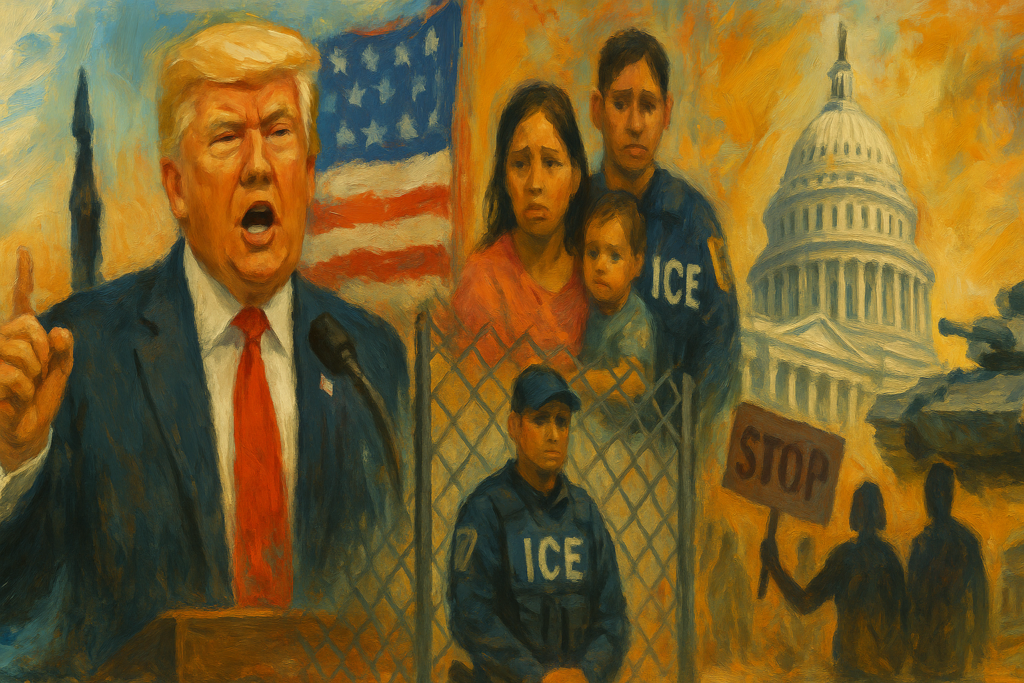
- Immigration enforcement widened across policy, policing, and detention — The week began with frozen asylum and visa processing and ended with expanded travel bans, reopened immigration cases, coercive pressure on unaccompanied children, Guantánamo transfers, and court fights over profiling, detention, and oversight.
- Executive power pressed against institutional limits — The administration used executive orders, funding leverage, personnel controls, and security claims to expand its reach, while courts, Congress, and local governments tried unevenly to reassert oversight and procedural limits.
- Transparency and public narrative became central battlegrounds — The week featured misinformation during crises, lawsuits against media, withheld military evidence, partial Epstein disclosures, attacks on critics, and efforts to reshape public memory through White House displays and the Kennedy Center.
- Political loyalty and private advantage kept surfacing inside governance — From civil-service rating limits to politically connected contracts and Trump-linked business gains, the week repeatedly blurred the line between public administration, patronage, and personal or allied benefit.
The week opened with the language of war moving into new domains. Even before the formal workweek began, the administration was recasting immigration and foreign policy as matters of civilizational conflict. By midweek it had ordered a naval blockade of Venezuelan oil and labeled that country’s government a terrorist organization. At the same time, fentanyl was formally designated a “weapon of mass destruction,” and immigration enforcement at home hardened through expanded travel bans, aggressive raids, and a Supreme Court ruling that lowered protections against racial profiling. Against this backdrop, Congress fought over health care subsidies, anti‑trans legislation advanced, and battles over scientific integrity, media independence, and the release of Jeffrey Epstein’s files showed institutions straining under political pressure.
Over the weekend, the White House released a new National Security Strategy that put immigration and “civilizational” conflict at the center of U.S. security doctrine. Drafted largely by Michael Anton, known for earlier writings about Western decline, the document revived a hard‑edged version of the Monroe Doctrine and downplayed traditional great‑power competition. European officials reacted with alarm, reading its Eurosceptic tone as a formal statement that longstanding alliances were now secondary to a worldview organized around cultural blocs and migration control. In practical terms, the strategy provided a framework for treating cross‑border movement and ideological disputes as threats akin to military ones.
That logic quickly translated into concrete policy. After an Afghan suspect was arrested in a domestic shooting, the administration froze asylum decisions at U.S. Citizenship and Immigration Services and halted visa and immigration processing for Afghans and nationals of 19 countries already subject to travel bans. Even citizenship ceremonies were stopped. Thousands of people with pending cases suddenly found themselves in limbo, their legal pathways to protection or status suspended by executive order. The move foreshadowed the broader travel‑ban expansion that would come on Tuesday and showed how swiftly the administration was willing to close off lawful channels in response to a single criminal case.
Domestic policy debates over health care also sharpened over the weekend. House Speaker Mike Johnson unveiled a Republican health proposal that omitted any extension of the enhanced Affordable Care Act marketplace tax credits due to expire at year’s end. The plan emphasized employer‑based coverage and reforms to pharmacy benefit managers but left millions of people who buy insurance on the exchanges facing steep premium increases if Congress did not act. In parallel, another health bill offered a $50 billion Rural Health Transformation Fund to encourage artificial intelligence and advanced technology in rural hospitals, while projecting roughly $911 billion in Medicaid cuts over a decade. Reporting highlighted how those cuts would fall heavily on substance‑use treatment in places like Alaska, where overdose rates are high. Together, these proposals set up a week‑long struggle over whether Congress would protect existing coverage or allow costs to rise while shifting resources toward technology and away from basic care.
The weekend also exposed strains in law enforcement and public trust. A mass shooting at Brown University left two students dead and nine injured. Federal officials, including FBI Director Kash Patel, prematurely announced that a suspect—an Army sniper—was in custody. When the man was released 48 hours later and authorities restarted the investigation, offering a reward and releasing surveillance footage, the episode underscored how false official statements in a high‑profile case can erode confidence in federal agencies at a moment when their credibility is central to contentious policy debates.
Immigration enforcement on U.S. soil was already drawing scrutiny. Reports emerged of Immigration and Customs Enforcement agents detaining U.S. citizens, insisting they carry immigration documents, and mistreating detainees. These incidents, part of a broader enforcement push, blurred the line between citizen and non‑citizen in practice, even if the law still distinguished them. Public approval of the administration’s immigration policies declined, but the reports had not yet sparked mass protest. At the same time, local politics showed that resistance to the national agenda was possible: Democrats won the Miami mayor’s race for the first time in nearly three decades, and a Democrat promising to end a local 287(g) cooperation agreement with ICE was elected sheriff in Bucks County, Pennsylvania. In Indiana, a Republican legislature rejected a Trump‑backed gerrymander that would have added two GOP House seats, signaling that even within the president’s party there were limits to how far some lawmakers would go.
The weekend also saw early moves in what would become a distinct motif of the week: the struggle over public memory and scientific authority. At a White House holiday party, Trump said his domestic policy chief’s main focus was building a triumphal arch in Washington, modeled on Paris’s Arc de Triomphe and sited near Arlington Cemetery and the Lincoln Memorial. The announcement came as health insurance premiums and living costs continued to climb, highlighting a governing focus on personal monuments and symbolic projects. In public health, Health and Human Services Secretary Robert F. Kennedy Jr. used his position to spread false claims about the measles vaccine amid a large outbreak in South Carolina and ordered the removal of Centers for Disease Control and Prevention website language stating that vaccines do not cause autism. These actions set the stage for Monday’s more sweeping reshaping of vaccine advisory bodies.
By Monday, the national security frame had expanded to the domestic drug crisis. Trump signed an executive order designating illicit fentanyl and its precursor chemicals as weapons of mass destruction. The order directed the Justice Department, the Department of Homeland Security, and the Pentagon to use national‑security and intelligence tools against trafficking networks. A related law, Bruce’s Law, created a federal working group and awareness campaign focused on fentanyl contamination. Treating a drug as a WMD opened the door to military and intelligence involvement in what had been primarily a law‑enforcement and public‑health issue, further blurring the boundary between policing and war powers.
Courts and cities, however, were not passive. Federal judges continued to strike down mandatory detention policies that denied bond hearings to immigrants, and one judge barred ICE from re‑arresting Kilmar Ábrego Garcia, a noncitizen whose case had reached the Supreme Court. The Court itself ordered the government to facilitate his return after an earlier deportation. Another judge blocked the administration’s attempt to use civil‑rights investigations as leverage to strip UCLA and the University of California system of funding, a move widely seen as an effort to coerce campus speech and governance. In Durham, North Carolina, local officials declared the city a “Fourth Amendment workplace,” requiring warrants for certain enforcement entries. These actions showed how courts and municipalities could still constrain executive overreach and protect due process, even as federal enforcement intensified.
On Capitol Hill, the House passed a bipartisan measure to restore union rights at federal agencies that Trump had previously eliminated, demonstrating that Congress could check executive labor policies when there was cross‑party agreement. Yet the same day, Speaker Johnson blocked a vote on extending ACA subsidies despite broad support and the looming deadline. This set up a confrontation with rank‑and‑file members and became the opening move in a week‑long procedural battle over health care access.
The independence of regulatory and scientific bodies came under direct challenge. In Senate testimony, Federal Communications Commission Chair Brendan Carr stated that the FCC was not an independent agency and aligned it explicitly with the Trump administration. References to independence were soon removed from the FCC’s website. At HHS and CDC, RFK Jr. followed his weekend rhetoric with structural changes: he removed all 17 voting members of the CDC’s Advisory Committee on Immunization Practices and replaced them with known vaccine skeptics, while appointing Jim O’Neill, who lacks medical training and has echoed anti‑vaccine rhetoric, as acting CDC director. These moves threatened the integrity of vaccine recommendations and the country’s ability to respond to outbreaks. Meanwhile, immigration enforcement continued to reach into everyday life: ICE stopped Representative Ilhan Omar’s son during a targeted operation against Somali communities in Minnesota, and a Massachusetts green‑card holder sued ICE over an allegedly violent, warrantless arrest of her and her U.S.‑citizen children. The same day, Trump filed a $10 billion lawsuit against the BBC over editing of his January 6 speech in a documentary, part of a broader pattern of using litigation to pressure media outlets.
Tuesday brought a major expansion of the administration’s tiered approach to global mobility. Trump signed a proclamation imposing full entry restrictions on nationals from Burkina Faso, Mali, Niger, South Sudan, Syria, and holders of Palestinian Authority travel documents, while partial restrictions hit 15 more countries. With related policy expansions, the total number of affected countries rose to 39, many of them Muslim‑majority. The broadened ban deepened a system in which nationality and perceived risk determined access to U.S. territory, with far‑reaching human and diplomatic consequences for families, students, and workers caught in the new categories.
At the same time, resistance to immigration crackdowns was becoming more organized. In cities including Los Angeles, Chicago, and New Orleans, activists and community groups shared tactics such as know‑your‑rights trainings and whistle distribution to warn residents of ICE presence. Organizations like the ACLU and Democratic Socialists of America coordinated across state lines to support targeted communities, offering legal assistance and rapid‑response networks. These efforts did not stop federal operations but showed how local networks could mobilize to protect residents and assert community norms against raids.
Pressure also mounted over transparency in the Jeffrey Epstein case. Senators Jeff Merkley and Ben Ray Luján announced they would block pending civilian nominations until the administration provided a required briefing on the release of Epstein files under a new transparency law. Their move signaled that some lawmakers were willing to use confirmation powers to enforce disclosure about elite wrongdoing. Elsewhere in the bureaucracy, regulators at the Drug Enforcement Administration, Environmental Protection Agency, and Food and Drug Administration continued routine but consequential rulemaking on synthetic cannabinoids, pesticides, and investigational drug safety reporting, as well as exempting a CRISPR‑related protein from certain tolerance requirements in citrus. These technical decisions, though far from the headlines, shaped how new substances and technologies entered the market and how risks were managed.
Wednesday marked a dramatic escalation in foreign policy and a deepening of domestic institutional strain. Trump announced a “total and complete blockade” of sanctioned oil tankers entering or leaving Venezuela and designated the Maduro government a foreign terrorist organization—an unusual use of a framework typically reserved for non‑state actors. The U.S. seized at least one sanctioned tanker and deployed roughly 15,000 troops near Venezuela, prompting warnings from lawmakers that the move amounted to an act of war without clear congressional authorization. In classified briefings, Defense Secretary Pete Hegseth and another senior official, Marco Rubio, declined to show lawmakers unedited video of a prior boat strike that may have killed civilians. Senator Andy Kim called for public hearings on Trump’s threatened actions against Venezuela, and the Senate passed a $901 billion defense bill requiring Hegseth to provide all strike footage, underscoring Congress’s struggle to obtain basic evidence about the use of force.
At home, the Supreme Court issued a ruling that effectively legalized racial profiling in immigration enforcement, enabling aggressive ICE and Customs and Border Protection raids that had already led to nearly 300,000 deportations and 65,000 detentions. The decision disrupted daily life in immigrant communities, with people avoiding work, school, and medical appointments for fear of being stopped based on appearance or perceived origin. This ruling connected back to the weekend’s reports of ICE detaining U.S. citizens and forward to the week’s end, when federal agencies began framing anti‑ICE activism as a terrorism threat.
In domestic politics, the fight over ACA subsidies reached a turning point. Four House Republicans broke with party leadership to sign a Democratic discharge petition to force a vote on extending premium tax credits for three years. With their signatures, the petition reached the required 218, ensuring a vote in January despite Speaker Johnson’s efforts to block action before subsidies expired. The rare use of a discharge petition showed that rank‑and‑file members could sometimes bypass leadership to protect widely used benefits, even if immediate relief would still be delayed.
The same day, the administration’s influence over media and cultural institutions became more visible. Following FCC Chair Carr’s earlier testimony, the agency formally removed “independent” from its mission statement. CBS and its parent company, after settling lawsuits with Trump, appointed a pro‑Trump ombudsman and named Bari Weiss as CBS News editor‑in‑chief, while major networks aired a partisan Trump primetime address despite having refused similar Democratic speeches in the past. At the Kennedy Center, a Trump‑appointed board voted to rename the institution the Trump‑Kennedy Center, despite lacking congressional authority, and the White House installed new plaques under presidential portraits that disparaged Barack Obama and Joe Biden, even removing Biden’s portrait in favor of an autopen image. These symbolic changes used public institutions to elevate the current president and denigrate predecessors, reshaping how history and news were presented to the public.
The administration also moved against scientific infrastructure. Officials announced plans to dismantle the National Center for Atmospheric Research in Colorado, calling its work “woke,” and moved to cancel $109 million in grants, with only vague assurances that some activities would be relocated. This threatened a leading climate and weather research hub that underpins disaster preparedness and environmental policy. On the enforcement front, ICE doubled arrests in North Carolina compared with the prior year, with agents in tactical gear patrolling neighborhoods and shopping centers, while in Chicago a senior Border Patrol official led aggressive operations in Latino neighborhoods, captured on video mocking residents and using chemical agents. These tactics heightened fear and distrust in immigrant communities and raised questions about proportionality and accountability.
In a primetime address, Trump promised a one‑time $1,776 payment to about 1.45 million service members, branding it a “warrior dividend” tied rhetorically to tariffs. Subsequent reporting showed the money would come from funds originally allocated for housing allowances, not new appropriations, and that the payment was not authorized in the new defense bill. Repurposing housing funds for a branded bonus used the military budget as a political tool while potentially worsening an existing housing shortfall for troops. Meanwhile, from the White House podium, spokesperson Abigail Jackson said the country would be “lucky” to have Trump serve a third term, echoing reports that he had consulted attorney Alan Dershowitz about whether the 22nd Amendment truly barred it. The comments contradicted the consensus of constitutional scholars but normalized public discussion of breaching presidential term limits.
Thursday concentrated several major domestic shifts. The House approved a bill by Representative Marjorie Taylor Greene making gender‑affirming care for anyone under 18 a federal felony punishable by up to 10 years in prison, with three Democrats joining Republicans. A separate bill to ban Medicaid coverage for such care was queued for a vote. At the Pentagon, the TRICARE program finalized 2026 changes that explicitly excluded hormone therapy for treating gender dysphoria in minors, affecting an estimated 6,000 to 7,000 military dependents. The change was announced quietly while Trump continued to promote the “warrior dividend.” Together, these moves embedded discrimination against transgender youth into both criminal law and core defense health benefits, illustrating how culture‑war priorities were being written into federal policy.
Not all developments moved in a restrictive direction. Trump signed an executive order directing the Attorney General to reclassify marijuana from Schedule I to Schedule III, easing research restrictions and regulatory burdens on legal cannabis businesses. A companion order launched a pilot to reimburse Medicare patients for CBD and called for more research on long‑term health effects. Rescheduling marked a significant shift in federal drug policy, potentially reducing criminal penalties and opening the door to more evidence‑based regulation, even as other parts of the week’s agenda tightened controls on vulnerable groups.
Congress enacted the $901 billion National Defense Authorization Act for fiscal year 2026, codifying parts of Trump’s effort to eliminate diversity, equity, and inclusion programs in the military and requiring delivery of all boat‑strike footage to lawmakers. The law did not authorize the $1,776 “warrior dividend,” raising further questions about how that payment would be funded. In the Justice Department, resistance to transparency became more explicit. Facing a statutory deadline under the Epstein Files Transparency Act, DOJ released only “several hundred thousand” Epstein‑related documents, many heavily redacted, instead of the full unclassified record required. House Democrats had just released new photos from Epstein’s estate to maintain pressure, and lawmakers began weighing legal action over what appeared to be a violation of the law. In a separate court filing, DOJ lawyers argued that it was constitutional to distribute federal funds only to Republican‑led states while withholding them from Democratic‑led ones, defending a policy that openly tied grants to partisan control. If accepted, this theory would normalize using federal money as a weapon against disfavored states and their residents.
Environmental and health protections were also weakened. Alongside the planned dismantling of NCAR, the EPA proposed nearly doubling the formaldehyde exposure level considered safe, reversing Biden‑era findings that any exposure carried cancer risk. Critics said the change reflected industry influence over risk assessments, and taken together with the climate research cuts, it reduced the government’s capacity to understand and prevent environmental harm. On the legislative front, despite the successful discharge petition, Speaker Johnson adjourned the House until January without allowing a vote on extending ACA subsidies. Between 22 and 24 million Americans rely on these subsidies for affordable coverage, so the maneuver delayed relief for millions facing higher premiums and highlighted how procedural control can override majority support.
The national security frame extended into domestic dissent as well. The Justice Department charged 18 people as a “North Texas antifa cell” with terrorism‑related offenses after a protest at a Texas detention center, while an FBI memo showed domestic terrorism investigations into anti‑ICE activity in at least 23 regions under a Trump directive targeting anti‑fascist organizing. Using terrorism frameworks against protest movements risked criminalizing dissent and deterring lawful opposition to government policy. In the private sector, Trump Media announced a $6 billion merger with a speculative fusion energy company lacking commercial plants and dependent on Department of Energy approvals and grants. The stock rose about 30 percent on the news despite the company’s losses, raising serious questions about whether federal policy might be used to benefit the president’s personal business interests.
By Friday, the struggle over transparency in the Epstein case had come to a head. The Justice Department’s partial release of heavily redacted documents included FBI notes describing Epstein’s demands for underage girls, revealing disturbing details even as the department failed to meet the law’s requirement for full unclassified disclosure within 30 days. Lawmakers from both parties criticized the move and considered legal remedies, underscoring how crimes involving powerful figures can remain shielded even under a transparency statute designed to force disclosure.
Immigration enforcement and its critics were increasingly treated through a security lens. A court filing revealed a Customs and Border Protection advisal given to unaccompanied minors that threatened prolonged detention and possible legal action against sponsors if they did not agree to return to their home countries. Advocacy groups argued the advisal was coercive and misleading, targeting children with intimidating language to secure “consent” to self‑deport. An internal FBI report showed “criminal and domestic terrorism investigations” into threats against immigration enforcement in at least 23 regions, following Trump’s memo calling for a national strategy against anti‑fascist activity. Civil rights groups warned that casting anti‑ICE activism as a terrorism threat risked chilling protest and normalizing surveillance of political opponents.
Abroad, the U.S. seizure of a sanctioned oil tanker off Venezuela’s coast disrupted the so‑called dark fleet that moves Venezuelan oil, further implementing the blockade announced midweek. The action escalated economic pressure on the Maduro government and threatened to destabilize regional energy markets and migration flows. At home, civil society continued to respond to inequality and corporate influence. The group Indivisible urged primary challenges to Democratic incumbents seen as too close to corporate donors, with Representative Valerie Foushee facing a challenge from Nida Allam. The National Union of the Homeless organized Longest Night vigils to remember those who died from poverty, while environmental activists pressed North Carolina’s governor to deny permits for a major gas project. Meanwhile, thirty members of Congress demanded internal documents from Dollar General and Family Dollar over widespread price discrepancies and forced arbitration, and regulators advanced a range of technical actions on drugs, pesticides, and data collection, even as India and Japan pursued major economic reforms abroad.
Taken together, the week showed federal power being used aggressively across multiple fronts: to blockade a foreign state and label it a terrorist entity, to redefine drugs and migration as national security threats, to narrow health care and rights for vulnerable groups, and to test the limits of transparency and institutional independence. Courts, cities, lawmakers, and civil society mounted counter‑currents—blocking some enforcement tactics, forcing future votes on health care, demanding documents, and organizing communities—but these efforts operated within a landscape increasingly shaped by executive decisions. As the year neared its end, the central questions for U.S. democracy were not only about individual policies but about whether legal and civic institutions could still set boundaries on how power is justified, deployed, and remembered.