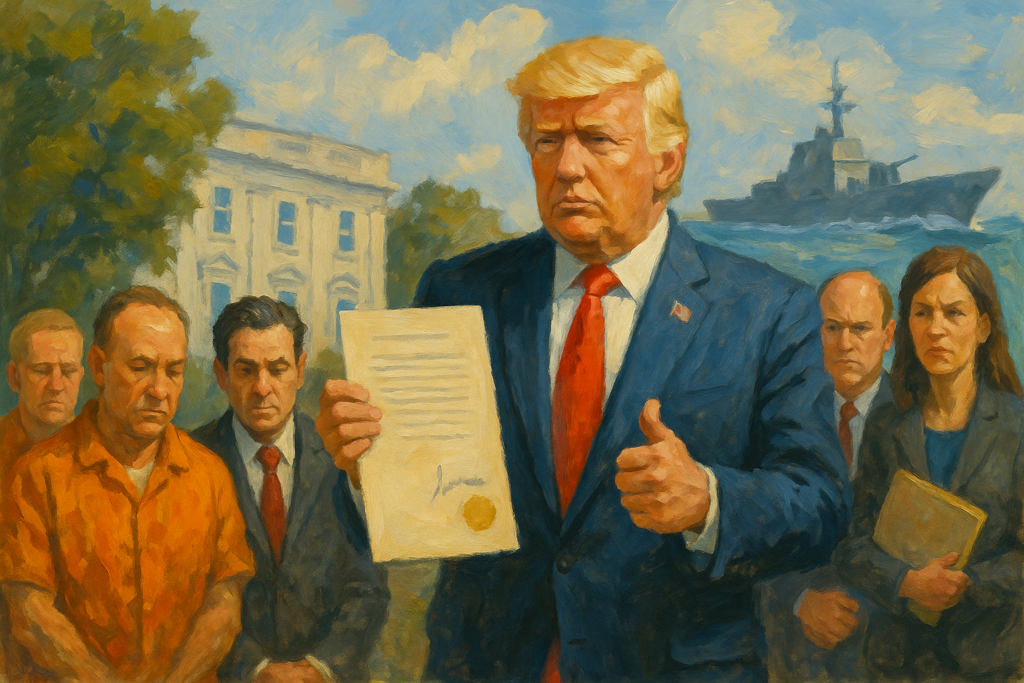
This week’s throughlines
- Immigration restrictions widened from rhetoric to system-wide policy and street-level enforcement — The week began with anti-immigrant rhetoric and threats to citizenship, then moved into suspended asylum processing, freezes on applications from 19 countries, expanded reviews of already approved cases, and visible enforcement operations in multiple cities.
- Clemency kept functioning as a tool of selective relief for elites and allies — Trump’s pardon and commutation decisions accumulated through the week, from a convicted former Honduran president and a fraud executive to an indicted member of Congress and another well-connected executive, while reporting highlighted the broader scale of his clemency use.
- Military and national-security controversies drew sustained oversight — Questions about the September boat strikes and Pete Hegseth’s handling of sensitive information kept building, with congressional inquiries, former military lawyers calling for prosecution, White House defenses, classified briefings, and inspector general findings all feeding the same accountability fight.
- Courts and oversight bodies repeatedly tested executive overreach — Judges and investigators challenged unlawful appointments, blocked warrantless immigration arrests, questioned federal control of the California National Guard, and forced transparency fights over Epstein records and other politically sensitive matters into the open.
- Control over information and public narrative became more explicit — The White House and allied officials targeted the press, used official channels to amplify stigmatizing narratives, faced lawsuits over access rules, and stopped publishing key economic indicators, while watchdogs and lawmakers pressed for records that officials appeared reluctant to release.
The week opened with the president wielding some of his most powerful constitutional tools in ways that raised basic questions about accountability and equal justice, even as Congress and watchdogs began probing whether the United States has crossed legal lines in the use of lethal force at sea. As the days unfolded, those themes of impunity and scrutiny were joined by a hardening immigration regime, new fights over who counts as an American, and a reshaping of public‑health and security institutions along more ideological lines.
Over the weekend, Donald Trump set the tone with a pair of clemency decisions that underscored how the pardon power was being deployed. He pardoned former Honduran president Juan Orlando Hernández, convicted in U.S. court of running a cocaine pipeline into the country, and commuted the sentence of private‑equity executive David Gentile, who had only just begun serving a seven‑year term for orchestrating a $1.6 billion fraud that harmed thousands of investors. Both were high‑status offenders with relatively recent sentences, and the White House offered no detailed public rationale. The decisions suggested that serious drug and financial crimes could be wiped away for the well‑connected, previewing a broader pattern of elite‑focused clemency that would surface again later in the week.
At the same time, early reports emerged of a very different kind of power being exercised at sea. Journalists and former military lawyers described allegations that Defense Secretary Pete Hegseth had ordered lethal strikes on survivors of a boat attack off Venezuela, and that Admiral Bradley had authorized a second strike that killed two men clinging to wreckage. A group of former Judge Advocate General officers, organized as the Former JAGs Working Group, publicly stated that if those accounts were accurate, the orders would constitute war crimes under the laws of armed conflict, which protect shipwrecked survivors. The Senate and House Armed Services Committees signaled they would investigate, setting up a confrontation between Congress’s oversight role and the Pentagon’s conduct of a campaign that had already claimed dozens of lives.
The weekend also saw the administration escalate its rhetoric on immigration and citizenship. Trump used social media to propose stripping citizenship from certain naturalized Americans and halting migration from what he called “Third World Countries,” tying an isolated shooting by an Afghan national to calls for a sweeping immigrant “purge.” In a Thanksgiving message that doubled as a political attack on Minnesota’s governor, he again raised the prospect of revoking citizenship. These statements framed citizenship as conditional and suggested that entire communities could be held collectively responsible for individual crimes, laying rhetorical groundwork for more concrete policy moves that would follow.
On the ground, those tensions were visible in New York’s Chinatown, where roughly 200 protesters physically blocked a large immigration raid involving ICE, Customs and Border Protection, and the Department of Homeland Security. Demonstrators used makeshift barriers to obstruct federal vehicles and ultimately forced agents to abandon the operation. New York City police officers assisted the federal agents and arrested several protesters, despite city rules that are supposed to limit local cooperation with immigration enforcement. The clash highlighted how local communities and sanctuary‑minded jurisdictions are colliding with an increasingly aggressive federal enforcement posture.
The administration also opened a new front against critical media. A new section of the official White House website debuted as a “media offenders” portal, naming outlets such as the Boston Globe and CBS News and accusing them of bias and malpractice. The site included an “Offender Hall of Shame” and a searchable database cataloging alleged distortions. By using government infrastructure to single out and stigmatize news organizations, the White House was not just criticizing coverage but attempting to formalize distrust of independent reporting among its supporters.
Even as executive power was being used assertively, other institutions pushed back in more traditional ways. A Reuters investigation documented what it described as a broad retaliation campaign inside the federal government, identifying at least 470 individuals and organizations that had been targeted for retribution since Trump returned to office. The report portrayed a public administration increasingly organized around punishing perceived enemies. In the courts, a federal judge in Alabama adopted a state senate map drawn by students to remedy Voting Rights Act violations, while the Third Circuit Court of Appeals upheld the disqualification of Alina Habba as interim U.S. attorney in New Jersey, finding that the administration’s attempt to bypass Senate confirmation was unconstitutional. These rulings showed judges acting as a check on both racial vote dilution and irregular legal appointments, even as other parts of the system bent toward politicization.
By Monday, the administration’s anti‑immigrant rhetoric had translated into sweeping policy. Following the shooting involving an Afghan national, officials announced a pause on asylum decisions for roughly 1.5 million pending cases at U.S. Citizenship and Immigration Services, halted visas for Afghans who had assisted U.S. forces, and began re‑evaluating green card applications from countries deemed “of concern.” This marked a sharp break from prior efforts to reduce asylum backlogs and turned what are supposed to be individualized protection claims into a mass discretionary hold, leaving vulnerable people in legal limbo and concentrating enormous power in the executive branch.
Elsewhere on Monday, the House Oversight Committee released documents from the estate of Jeffrey Epstein and new images of his private island, while pressing Attorney General Pam Bondi to meet a December 19 deadline for full disclosure of federal files. Later in the week, a Florida judge, acting under a new transparency law, ordered the release of Epstein grand jury materials. Together, these moves suggested that Congress and the courts were willing to force open records in a politically sensitive abuse case that has long raised questions about whether powerful figures receive special protection. The day also saw the launch of a Cyber Monday boycott organized by the 50501 Movement, urging consumers to avoid Amazon, Target, and Home Depot in protest of their collaboration with the administration and to redirect spending to local and minority‑owned businesses—an example of market behavior being used as a form of political expression.
On the economic front, the administration approved export permits for four new liquefied natural gas terminals, reversing a prior pause. The Energy Information Administration projected a 16 percent rise in wholesale gas prices the following year due to increased exports, with the United States already the world’s largest LNG exporter. The decision prioritized export revenue and geopolitical energy leverage over domestic affordability and climate concerns, locking in fossil‑fuel infrastructure that will shape energy markets for years. Meanwhile, questions about the integrity of federal law enforcement deepened when a leaked 115‑page report compiled by current and former FBI personnel described the bureau under Director Kash Patel as “internally paralyzed by fear” and “rudderless,” citing his lack of investigative experience and focus on social media. House and Senate Judiciary Committees scheduled hearings to examine the findings, reflecting worries that politicization and mismanagement could erode the FBI’s capacity to investigate serious crime.
Tuesday brought those concerns about executive power into sharper relief. At a televised cabinet meeting, Trump praised Defense Secretary Hegseth despite the unresolved allegations of extrajudicial killings at sea, boasted falsely about ending wars and cutting drug prices, and presided over discussions of economic and military policy that observers said echoed autocratic practices. His public embrace of a defense chief under war‑crime scrutiny, combined with repeated false claims about policy achievements, signaled a willingness to normalize both aggressive force and narrative manipulation at the highest levels of government.
In the courts, however, there were notable checks on efforts to weaponize federal prosecutions. A federal judge ruled that Lindsey Halligan’s appointment as U.S. attorney in the Eastern District of Virginia was illegal, dismissing cases she had brought against former FBI director James Comey and New York Attorney General Letitia James. A federal appeals court separately upheld the earlier ruling that Alina Habba’s appointment as acting U.S. attorney in New Jersey was unlawful. By invalidating these irregular appointments and the politically charged prosecutions they launched, the judiciary limited attempts to turn federal criminal law into a tool against perceived enemies.
Immigration enforcement also met judicial resistance. In Washington, DC, Judge Beryl Howell issued a preliminary injunction barring widespread immigration arrests without warrants or probable cause. Under her order, agents must document specific facts supporting any warrantless arrest and share that documentation with plaintiffs’ attorneys. The ruling reasserted basic constitutional protections in the immigration context and curtailed emergency‑based dragnet tactics in the nation’s capital, even as other parts of the country braced for intensified raids. Congress, meanwhile, passed and the president signed a law directing the Interior Secretary to allow unique, one‑time arrangements for displays on the National Mall and at the Washington Monument between the end of 2025 and early January 2026. Control over such high‑profile public space can shape national narratives and mass mobilization at a politically sensitive moment, particularly as the country approaches the 250th anniversary of its founding. Labor tensions also flared, with Starbucks Workers United expanding its strike to about 2,500 baristas across 120 stores in 85 cities, citing stalled contract talks and alleged unfair labor practices. Hundreds of unfair labor practice charges have been filed with the National Labor Relations Board, testing the strength of existing labor law in protecting organizing rights in the service sector.
On Wednesday, Trump took the unusual step of announcing that all documents signed by Joe Biden using an autopen—including pardons and executive orders—were “null and void.” Legal experts quickly noted that the Constitution does not require a president to physically sign documents and that there is no mechanism to retroactively cancel a predecessor’s pardons. If taken seriously, the claim would destabilize continuity of government by allowing successors to erase settled presidential decisions at will, but for now it remained a political assertion without clear legal effect.
The clemency pattern continued as Trump issued a pardon to Texas Democratic Representative Henry Cuellar, who was under indictment for a $600,000 bribery scheme involving Azerbaijani officials and a Mexican energy company. By short‑circuiting an ongoing corruption case against a sitting member of Congress, the president again signaled that political ties could override public‑integrity prosecutions. That same day, the Supreme Court, in a 6–3 decision, allowed Texas to use a redrawn congressional map that adds up to five Republican‑leaning districts, overturning a lower‑court ruling that had found the map racially gerrymandered. The majority held that the lower court had improperly intervened during an active primary campaign. The ruling locked in a map likely to boost one party’s representation for years, illustrating how the Court’s current majority is shaping the electoral playing field.
Immigration policy hardened further. USCIS issued a memo halting immigration applications and placing an “adjudicative hold” on asylum and other benefits from 19 already‑restricted countries, while ordering re‑review of approvals granted since 2021. In parallel, ICE and DHS intensified enforcement in cities such as New Orleans and Minneapolis, with reports of racial profiling and mistaken targeting of U.S. citizens. These blanket holds and nationality‑based re‑reviews, combined with aggressive field operations, moved the system away from individualized adjudication toward origin‑based exclusion. Within the Justice Department and FBI, there were mixed signals: a federal grand jury in Norfolk refused to indict New York Attorney General Letitia James on mortgage‑fraud charges after a prior case had been thrown out due to an unlawful U.S. attorney appointment, showing resistance to politicized prosecutions. At the same time, DOJ sought to re‑incarcerate pardoned January 6 defendant Taylor Taranto after he again appeared near lawmakers’ homes, and the FBI arrested a suspect in the long‑unsolved January 6 pipe‑bomb case, underscoring that security risks from that day’s events remain active. Local governments, by contrast, focused on economic relief, with New York City announcing plans to cut fines and fees for small businesses and speed permits, and San Francisco eliminating some permits and fees for sidewalk seating and signage while requiring agencies to publish permitting timelines.
By Thursday, the immigration crackdown had become more visible and more confrontational. Federal agents launched “Operation Catahoula Crunch” in New Orleans, deploying about 250 agents with a stated goal of 5,000 arrests. The operation prompted widespread fear and business closures in immigrant neighborhoods. In Boston, ICE deported 19‑year‑old student Any Lucia López Belloza to Honduras less than 48 hours after her arrest, despite a federal judge’s 72‑hour order barring her removal. DHS also announced plans to send more agents to target Somali residents in Minneapolis. Carrying out deportations in defiance of court orders raised serious questions about due process and judicial authority, while the focus on specific communities deepened concerns about discriminatory enforcement.
The Pentagon faced new scrutiny as well. A report from the Defense Department’s inspector general concluded that Secretary Hegseth had violated policy by sharing secret operational details of planned airstrikes in Yemen via an unapproved Signal chat, potentially endangering U.S. forces if the messages were intercepted. Some of the messages had auto‑deleted, complicating the investigation. Lawmakers from both parties called for his resignation, adding concerns about basic security practices to the existing allegations about unlawful boat strikes. In Texas, a sweeping new law took effect allowing residents to sue anyone suspected of making, distributing, or mailing abortion pills into the state, including providers in other states, with minimum penalties of $100,000 per violation. The statute directly challenged “shield laws” in states that protect abortion providers from out‑of‑state lawsuits, setting up likely interstate legal conflicts and extending Texas’s post‑Roe strategy of deputizing private citizens to enforce abortion restrictions.
Questions about conflicts of interest in defense policy also sharpened. The Pentagon awarded a $620 million loan to Vulcan Elements, a rare‑earth magnet producer funded by 1789 Capital, where Donald Trump Jr. is a partner. The deal, part of a $1.4 billion package, included warrants giving the Defense Department a future equity stake. Trump Jr. has also been involved in screening Pentagon personnel and advocating for increased drone spending. While the loan was framed as part of a broader effort to secure critical supply chains, the size of the public financing for a company tied to the president’s son blurred the line between national‑security policy and family enrichment. On the immigration front, DHS Secretary Kristi Noem announced plans to expand the U.S. travel ban to more than 30 countries, affecting both immigrants and non‑immigrant visitors such as students and tourists, with countries to be evaluated based on perceived stability and cooperation in vetting. And in the clemency arena, Trump granted a full pardon to Tim Leiweke, an executive indicted for allegedly rigging a public‑university arena bid, while reports noted that he had issued over 2,000 pardons and commutations this year, far exceeding his first term. Critics argued that many of these actions rewarded political allies and wealthy offenders, turning a constitutional safeguard into a tool of impunity. Finally, reports indicated that the administration had stopped releasing several core federal economic statistics, forcing analysts to rely on private data even as job cuts reached 71,000 in November and nearly 1.2 million for the year. Withholding official economic data made it harder for the public and lawmakers to evaluate government performance and policy impact.
Friday brought a shift to public‑health and domestic‑security institutions. After two delays and contentious debate, the CDC’s Advisory Committee on Immunization Practices—now dominated by appointees of Health Secretary Robert F. Kennedy Jr.—voted to restrict the long‑standing recommendation that all newborns receive a hepatitis B shot within 24 hours of birth. For decades, universal newborn vaccination had sharply reduced hepatitis B transmission by ensuring that infants were protected regardless of whether their mothers’ infection status was known or accurately recorded. The new guidance suggests that most parents should consult a doctor to determine eligibility, a change likely to reduce hospital availability of the vaccine and increase confusion. Public‑health experts warned that rolling back a routine infant vaccine could lead to lower coverage, more infections, and greater mistrust in vaccination policy, illustrating how scientific advisory structures can be reshaped by political appointments.
At the Justice Department, Attorney General Pam Bondi issued a memo directing prisons and jails to stop being held accountable for violations of standards designed to protect LGBTQ+ people from sexual abuse under the Prison Rape Elimination Act. Inspectors were told to cease auditing facilities for compliance with these protections. PREA was enacted with broad bipartisan support to address pervasive sexual violence in detention, and LGBTQ+ people are among those at highest risk. Removing enforcement of these specific protections left a particularly vulnerable group with fewer safeguards and signaled that their safety was contingent on shifting political priorities. Bondi also instructed law enforcement to investigate antifa and other groups labeled “domestic terrorists” for potential tax violations and to consider revoking tax‑exempt status for left‑leaning organizations, following an executive order designating antifa as a domestic terrorism organization. Using tax and terrorism labels to target ideologically defined groups blurred the line between law enforcement and political retaliation, threatening the independence of civil‑society organizations.
The Supreme Court added another major immigration and citizenship question to its docket by agreeing to hear Trump v. Barbara, a challenge to the president’s executive order seeking to heavily restrict birthright citizenship. Lower courts had blocked the order as likely unconstitutional under the 14th Amendment and longstanding precedent that nearly all children born on U.S. soil are citizens. By granting review, the Court put that core guarantee under direct scrutiny, with far‑reaching implications for national identity and immigration law. Meanwhile, reports indicated that under Director Kash Patel and White House influence, the FBI had deprioritized investigations into right‑wing extremist groups such as the Base, instead targeting political opponents and anti‑fascist activists. This followed the earlier internal criticism that the bureau was “rudderless.” Redirecting counter‑extremism resources away from violent far‑right groups risked leaving genuine threats under‑policed while using federal power against political adversaries.
Foreign‑policy documents reflected similar ideological shifts. A new National Security Strategy signed by Trump warned of Europe’s “civilisational erasure” due to migration and European Union integration and called on the United States to “cultivate resistance” within Europe. The document aligned with “great replacement” conspiracy rhetoric and explicitly endorsed nationalist far‑right parties, embedding extremist demographic narratives in official strategy and straining traditional alliances built on shared democratic norms. On the military front, the Pentagon announced another lethal strike on a boat in the eastern Pacific, killing four alleged “narco‑terrorists” and bringing the total to at least 22 such strikes and 87 deaths since September. In classified briefings, lawmakers viewed unedited video of a September 2 Caribbean strike that showed two survivors clinging to wreckage for 41 minutes before being killed in a second attack. The footage prompted members of Congress to question whether the United States was committing war crimes, even as the administration continued the operations and publicly defended their legality without releasing supporting evidence.
Taken together, the week’s developments showed an executive branch pressing its advantages across multiple fronts—clemency, immigration, security, and information—while courts, Congress, inspectors general, and local governments offered uneven resistance. The use of pardons to shield elites, the continuation of lethal boat strikes amid war‑crime allegations, the hardening of immigration rules and rhetoric up to and including birthright citizenship, and the politicization of public‑health and law‑enforcement institutions all pointed to a system in which formal powers remain intact but their purposes are being contested. How effectively other institutions can enforce legal limits, preserve transparency, and protect vulnerable populations will shape not only immediate outcomes but the longer‑term health of American democracy.