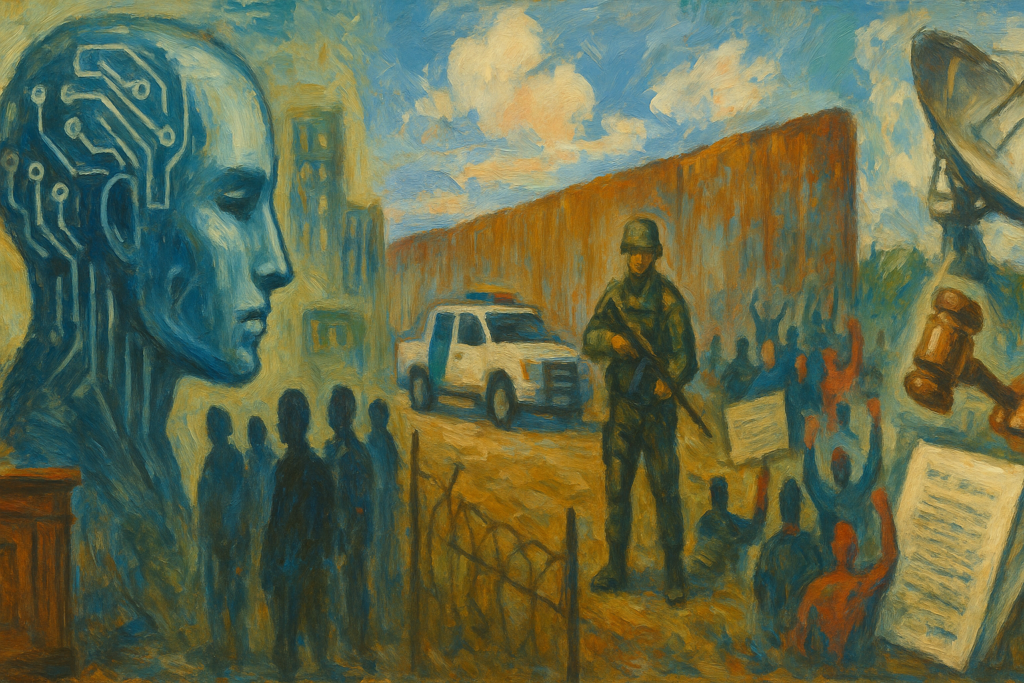
This week’s throughlines
- Immigration enforcement widened from policy to infrastructure — The week began with nationality-based restrictions and expanded into deportation capacity, arrests of asylum seekers, pressure on non-citizen veterans, and cases suggesting due-process violations and speech-based targeting.
- Military secrecy and executive war power met sustained oversight pressure — Questions around Pete Hegseth's conduct and a deadly Caribbean strike evolved into a weeklong fight over transparency, congressional authority, and whether the Pentagon could investigate lawmakers who challenged potentially unlawful orders.
- Presidential power was tested against agencies, states, and courts — The administration pushed for more direct control over independent agencies, threatened states over redistricting, and moved to preempt state AI laws, while judges and some state institutions pushed back.
- Media and information systems came under political and commercial pressure — The Pentagon press lawsuit, White House media-bias campaign, prediction-market news partnerships, and the Paramount-Warner fight all pointed to a week in which information channels were being reshaped by state pressure, ownership incentives, and speculative business models.
The week opened with the federal government moving to consolidate control over emerging technologies, borders, and international accountability, while courts, states, and some members of Congress tried to draw lines. An executive order to preempt state artificial intelligence rules, a major investment in deportation infrastructure, and threats against the International Criminal Court set the tone. Around these moves, fights over healthcare subsidies, student debt, voting maps, and media ownership showed how economic security and information itself are being reshaped by policy choices and power struggles.
Over the weekend, immigration policy hardened sharply. After a shooting involving an Afghan national, the administration halted asylum decisions for Afghans and paused immigration applications from 19 non‑European countries, with USCIS suspending Afghan immigration requests entirely. At the same time, reports surfaced of an ICE dog mauling an unresisting man in Washington state and of intensified ICE activity in Somali communities in Minnesota. Together, these developments signaled a shift toward national‑origin‑based restrictions at the policy level and more aggressive tactics on the ground, especially in already vulnerable neighborhoods.
The weekend also brought a significant change in public health guidance. The CDC’s Advisory Committee on Immunization Practices, reshaped by anti‑vaccine appointees, voted to end universal newborn hepatitis B vaccination when mothers test negative, moving to case‑by‑case decisions. Pediatricians warned that this would create confusion and reduce access, particularly for low‑income families who rely on clear, universal schedules. Because many state vaccination policies track ACIP recommendations, the decision foreshadowed broader efforts to weaken routine childhood immunization and the infrastructure that supports it.
Abroad, the administration released its 2025 National Security Strategy, which recast U.S. foreign policy away from NATO and the post‑war rules‑based order. The document emphasized sovereignty, hostility to immigration, and a pivot toward Russia, while envisioning U.S. dominance in the Western Hemisphere through commercial diplomacy. A related text explicitly called for ending the perception of NATO as a permanent organization. This strategic turn set the backdrop for later fights over war powers, arms exports, and international courts.
Within the national security apparatus, oversight and secrecy collided. A Defense Department inspector general report found that Defense Secretary Pete Hegseth had shared sensitive operational details about upcoming airstrikes over the unclassified Signal app, in violation of security and records policies. Hegseth denied wrongdoing even as the New York Times sued the Pentagon over new press rules that restrict access and favor ideologically aligned media figures. At the same time, reporting emerged that a U.S. anti‑drug campaign in the Caribbean, justified as part of a fentanyl crackdown, had included follow‑up strikes that killed survivors clinging to wreckage, with at least 87 people reported killed across 22 attacks. These revelations raised questions about both the legality of the strikes and the ability of the press and Congress to scrutinize them.
Domestically, the weekend highlighted how executive power can reshape representation and accountability. President Trump pardoned Democratic Representative Henry Cuellar and his wife on bribery charges tied to foreign payments, even as Cuellar sought reelection. Almost simultaneously, the Supreme Court allowed Texas to use a congressional map that a lower court had found likely discriminatory, shoring up Cuellar’s district and other Republican advantages for 2026. The combination of clemency for serious corruption charges and judicial tolerance of skewed maps underscored how tools of law and redistricting can entrench political power.
Immigration enforcement extended into unexpected corners of federal service. After rescinding an ICE directive that had protected non‑citizen veterans from deportation, the administration directed the Department of Veterans Affairs to compile an urgent internal report on its non‑citizen workforce, including many veterans. House members responded by launching an investigation into the deportation of non‑citizen veterans and demanding data from DHS. The move suggested that service‑related records could be repurposed as inputs to deportation machinery, challenging long‑standing expectations that military service confers a measure of security and belonging.
Even as these executive moves accumulated, early signs of institutional pushback appeared. A federal judge temporarily blocked prosecutors from accessing materials from a James Comey ally, citing likely Fourth Amendment violations, and another judge in New York scrutinized search and Miranda issues in a high‑profile homicide case, sealing some evidence over media objections. In Congress, Democrats demanded release of video from a lethal Caribbean boat strike, beginning a transparency fight that would grow more intense as the week went on. These actions did not reverse policy, but they showed courts and legislators still willing to assert procedural limits on investigations and uses of force.
On Monday, the struggle over war powers and oversight moved into the open. Hegseth publicly argued that President Trump could order military strikes, such as those on small boats off Venezuela, without congressional approval. In response, lawmakers from both parties discussed subpoenaing video of a controversial September strike and drafted language for the National Defense Authorization Act that would withhold a quarter of Hegseth’s travel budget until unedited footage was provided to oversight committees. Congress’s use of budget leverage against a sitting defense secretary became one of the clearest examples this week of a branch using its remaining tools to demand transparency.
Other fights over the scope of executive power played out in quieter policy arenas. House Speaker Mike Johnson removed a bipartisan provision from the defense bill that would have provided IVF coverage to active‑duty service members, aligning with anti‑abortion and religious objections despite earlier promises to expand access. The decision used must‑pass national security legislation to restrict reproductive care for military families. At the same time, the Pentagon opened an investigation into Senator Mark Kelly and five other Democrats after they released a video urging service members not to follow illegal orders. Trump suggested their behavior might be “seditious,” even as Kelly explored subpoenas for strike footage. Investigating legislators for speech about legal obligations risked chilling oversight and blurring the line between loyalty to the Constitution and loyalty to individuals.
The information environment shifted as markets and the White House moved into newsrooms. CNN and CNBC announced partnerships to integrate Kalshi’s prediction market data into their programming, turning political and policy events into tradable bets. Reporting noted that the CFTC, which oversees Kalshi, does not police insider trading as strictly as securities markets, raising concerns that those with privileged information could profit and shape narratives. Meanwhile, the White House launched a public portal to collect complaints about media bias, a government‑run database that critics feared could be used to target disfavored outlets and individual journalists, especially as other efforts to reshape media ownership advanced.
Economic policy and judicial review intersected as Trump unveiled a $12 billion aid package for farmers hurt by his tariffs, funded from tariff revenues and heavily targeted at row‑crop producers. Critics described the package as a bailout for a key political base rather than a structural fix for trade disruptions. The announcement came as the Supreme Court weighed the president’s use of emergency economic powers to justify broad tariffs, and Trump publicly pressured the Court to uphold his approach. The combination of emergency authorities, targeted compensation, and public pressure on the judiciary blurred the line between economic management and political patronage.
AI and chip policy emerged as another arena where branches diverged. The House Select Committee on China opposed selling NVIDIA’s advanced H200 AI chips to China, warning of national‑security risks, while DOJ unsealed a guilty plea in an AI chip smuggling case. Later reporting would show that Trump agreed to allow such sales in exchange for a revenue share, highlighting a split between congressional security concerns and executive trade deals. Behind this, lobbying by OpenAI and Andreessen Horowitz to preempt state AI laws laid the groundwork for the week’s later executive order, and a $100 million AI‑backed political group, Leading the Future, prepared to support candidates favorable to industry interests. Money, policy, and elections were thus tightly linked in the emerging AI governance regime.
Tuesday shifted attention to domestic legal structures and economic security. The Department of Education announced a settlement with Republican‑led states to shut down the SAVE income‑driven repayment program, halting new enrollments, denying pending applications, and planning to transition existing borrowers to other plans, pending court approval. Millions of borrowers faced uncertainty about future payments and protections. By dismantling a major repayment program through litigation and settlement rather than legislation, the administration reshaped the social contract around higher‑education debt while sidestepping open congressional debate.
At the Supreme Court, representation and regulatory independence were on the docket. The Court allowed Texas to use a congressional map that a lower court had said likely discriminated by race, bolstering Republican prospects in 2026. On the same day, justices heard arguments over Trump’s firing of FTC Commissioner Rebecca Slaughter, with the administration arguing that presidents must be able to remove independent agency heads at will. Several justices signaled openness to expanding presidential control, potentially weakening the insulation of regulators from partisan pressure. Together, these cases touched both who gets represented in Congress and how robustly federal agencies can enforce rules without fear of dismissal.
Former staffers of the Justice Department’s Civil Rights Division added another layer to concerns about institutional neutrality. More than 200 former employees released a letter accusing the administration of purging career experts, abandoning core civil rights enforcement, and redirecting resources toward voter‑fraud narratives and political priorities. They cited dismissed cases, altered mission statements, and removal of career managers. In parallel, the administration accused several political figures, including Federal Reserve Governor Lisa Cook, of mortgage fraud for claiming multiple primary residences, even as reporting noted that Trump himself had signed similar documents in the 1990s without scrutiny. The juxtaposition of weakened civil rights enforcement and selective fraud accusations reinforced perceptions that legal tools were being applied unevenly.
Not all state‑level actors acquiesced. In Indiana, Republicans joined Democrats to defeat a mid‑decade redistricting bill pushed by Trump and Governor Mike Braun, despite threats that failure would lead to loss of federal funding and political retribution. Conservative figure Tim Chapman of the Heritage movement later called such threats unconstitutional and coercive. The Indiana Senate’s 31–19 vote against the gerrymandered map marked a rare intra‑party rebuke of federal pressure and showed that some legislators were still willing to resist electoral manipulation, even at potential political cost.
Media ownership and AI governance continued to intertwine with politics. Jared Kushner’s private equity firm helped line up $24 billion from Middle Eastern sovereign wealth funds to support Paramount’s hostile takeover of Warner Bros. Discovery, outbidding Netflix. Paramount structured the deal to claim it avoided formal foreign governance rights and thus CFIUS review, even though the committee could still intervene. Trump signaled opposition to the Netflix deal and personal involvement in the decision, raising questions about regulatory favoritism toward an ally‑linked, foreign‑financed bid. At the same time, reporting detailed how OpenAI and Andreessen Horowitz had lobbied Congress to preempt state AI laws, including a failed proposal for a 10‑year moratorium on state regulation. These efforts set the stage for the coming executive order that would centralize AI rulemaking in Washington and align it with industry preferences.
Wednesday brought healthcare brinkmanship and a visible build‑out of deportation capacity. In the Senate, both a Democratic bill to extend Affordable Care Act premium subsidies for three years and a Republican alternative that would redirect funds into health savings accounts with restrictions on abortion and gender‑affirming care failed. Analyses warned that letting subsidies expire could double premiums on average and cause nearly 5 million people to lose coverage, especially in non‑expansion states. President Trump publicly supported allowing subsidies to lapse, arguing for direct payments instead. Combined with the move against the SAVE student loan plan, the subsidy cliff underscored how executive and legislative choices were reshaping economic insecurity for households.
On immigration, DHS signed and then confirmed a nearly $140 million contract with Daedalus Aviation to purchase six Boeing 737s dedicated to deportation flights, part of a $170 billion border and immigration budget. Officials described the planes as supporting the largest deportation operation in U.S. history. This investment in physical infrastructure—aircraft that will outlast any single operation—signaled a long‑term commitment to large‑scale removals. It came as ICE increased arrests of Afghan asylum seekers and non‑citizen veterans faced renewed deportation risk, tying policy design to concrete capacity.
Courts and states pushed back on other fronts. A federal judge ordered that California’s National Guard troops deployed in Los Angeles be returned to the governor’s control, rejecting the administration’s claim that immigration‑related protests amounted to a “rebellion” justifying federalization. Although the injunction was temporarily stayed, it marked a significant limit on using federal authority to commandeer state military forces in domestic political conflicts. Separately, Commerce Secretary Howard Lutnick announced a proposed “Trump Gold Card” program that would allow individuals to purchase U.S. citizenship for $1 million, formalizing a wealth‑based path to membership distinct from existing merit or humanitarian channels. The proposal highlighted a stark contrast between the treatment of wealthy applicants and the intensified enforcement against asylum seekers and long‑time residents.
International accountability also came under pressure. Administration officials signaled plans to push the International Criminal Court to amend its founding statute to bar investigations of President Trump and top U.S. and Israeli officials, threatening new sanctions if the court proceeded. The move followed concerns that the ICC might pursue cases against U.S. personnel by 2029. At home, House Speaker Mike Johnson admitted he had skipped a classified Gang of Eight briefing, citing focus on healthcare, even as national security issues—including controversial strikes and ICC tensions—intensified. Representative Marjorie Taylor Greene reported hundreds of threats from both left and right after Trump labeled her a “traitor,” illustrating how heated rhetoric can translate into personal risk for officials and complicate oversight.
Thursday crystallized the week’s central theme: the centralization of AI and corporate governance rules in the executive branch, and the use of congressional power to counterbalance security policy. Trump signed an executive order establishing a national AI policy framework that preempts conflicting state regulations, directs a new AI Litigation Task Force to challenge state laws, and conditions certain federal funding on state compliance. The order closely tracked the lobbying agenda of major AI firms and investors, aiming for a “minimally burdensome” standard that favors rapid deployment over local safeguards. Coupled with the launch of the $100 million AI‑funded political group Leading the Future, the order showed how industry money, federal preemption, and electoral spending are converging to shape the rules for a transformative technology.
On the same day, Trump issued another order targeting proxy advisory firms and ESG guidance. It directed the SEC to revisit rules governing proxy advisors, especially on diversity, equity, inclusion, and climate‑related issues, and instructed the FTC to examine potential antitrust violations. The order threatened to weaken tools investors use to pressure companies on governance and environmental risks. Yet Congress asserted its own priorities through the $900 billion National Defense Authorization Act, which exceeded the president’s request, locked in troop levels in Europe and South Korea, authorized $400 million annually for Ukraine, and withheld part of Hegseth’s travel budget until unedited strike footage is released. The defense bill thus became a vehicle both for sustaining traditional alliances and for enforcing transparency on contested military operations.
State‑level resistance continued to surface. After days of lobbying and threats from Trump, Vice President J.D. Vance, and Donald Trump Jr. to withhold federal funds, the Indiana Senate formally rejected the gerrymandered congressional map, with conservative co‑founder Tim Chapman criticizing the funding threats as unconstitutional and coercive. In Illinois, Governor JB Pritzker signed HB 1312, restricting civil immigration arrests in and around courthouses, hospitals, campuses, and daycares, and allowing lawsuits against officers who violate rights. DHS denounced the law as dangerous, but it represented a deliberate attempt by a state to carve out spaces where federal immigration enforcement would be constrained.
At the border, the administration expanded military involvement in migration control. It transferred 760 acres of public land in San Diego and Imperial counties to the U.S. Navy to establish a National Defense Area along the southern border. The designation allows military personnel to capture migrants and enforce stricter penalties, despite a significant decrease in border arrests. Officials framed the move as closing security gaps, but it further blurred the line between defense and domestic law enforcement and normalized extraordinary measures in routine border control. Meanwhile, a UCLA survey of more than 600 high school principals found that ICE crackdowns had created a “culture of fear” among immigrant students, with increased bullying, absenteeism, and anxiety. Reports also documented ICE increasingly arresting Afghan asylum seekers who had complied with check‑ins and detaining DACA recipient and Muslim photojournalist Ya’akub Vijandre over social media posts. Policy design at the top thus translated into fear in classrooms and risks for compliant migrants and critics.
Information and historical memory remained contested. The House Oversight Committee, led by Democrats, released a trove of photographs from Jeffrey Epstein’s email and computer, including images with Trump, Clinton, and Steve Bannon. Senator Ruben Gallego announced that DOJ had one week to release its Epstein files, while survivors’ attorney Arick Fudali criticized the administration’s lack of transparency and Ghislaine Maxwell’s lenient conditions. Republicans accused Democrats of selective release for political gain. How these files are handled will shape public trust in the justice system’s willingness to confront abuse involving powerful figures, and whether the record is curated or complete.
By Friday, the week’s themes converged in economic messaging, healthcare, accountability, and symbolic resistance. With approval of his economic management at 31 percent, Trump launched a nationwide tour in Mount Pocono, Pennsylvania, to defend his tariff policies and reassure Americans about Republican economic priorities. He blamed former President Biden for rising prices and rated the economy “A‑plus‑plus‑plus‑plus‑plus,” dismissing contrary data. At the same time, House and Senate Republicans resisted extending ACA premium tax credits. Speaker Johnson rejected an extension, prompting Republican Brian Fitzpatrick to file a discharge petition that would require Democratic support, while Senate Republicans voted down a Democratic measure to extend the credits for three years, with only four GOP senators in favor. Together with the earlier Senate gridlock, this left millions of enrollees facing steep premium hikes, highlighting the gap between broad public support for subsidies and legislative outcomes.
Courts continued to serve as venues for accountability. In Maryland, a federal judge issued a temporary restraining order preventing ICE from detaining Kilmar Ábrego García ahead of a hearing, reinforcing earlier findings that his detention was likely unlawful. Separately, 81 women filed a civil suit against Army gynecologist Blaine McGraw over alleged sexual assault and secret filming at Fort Hood, building on criminal charges, and a Louisiana pastor, Milton Otto Martin III, was convicted of indecent behavior with a juvenile and ordered to register as a sex offender. These cases, spanning immigration detention, the military, and religious institutions, showed survivors and judges using civil and criminal law to check abuses by powerful entities.
The presidency itself became the subject of a preservation fight. The National Trust for Historic Preservation filed a federal lawsuit accusing Trump of illegally demolishing the East Wing to build a $300 million White House ballroom without required environmental and planning reviews or congressional approval. The suit seeks a temporary restraining order to halt construction, citing violations of the National Capital Planning Act, the National Environmental Policy Act, and the Constitution’s property clause. The case will test whether a president can unilaterally alter historic federal property for self‑aggrandizing projects or must submit to statutory oversight like other federal actors.
Civil society and local politics offered their own responses to federal immigration policy. Churches across the country deployed provocative nativity scenes—such as a handcuffed baby Jesus or Mary in a gas mask—to protest aggressive ICE enforcement, particularly in cities like Chicago and New York. Some church authorities and ICE officials complained, but the displays highlighted faith‑based resistance and reframed immigration enforcement in moral terms. An independent project published a comprehensive archive of Trump’s 2025 Truth Social posts, including AI‑generated images, calls for prosecuting critics, and conspiracy theories, to preserve a factual record for journalists and historians. In North Carolina, the state Board of Elections decided to share voting data, prompting activists to urge citizens to write board members over privacy and misuse concerns. And in Miami, voters elected Eileen Higgins, a Democrat running on a pro‑immigrant platform, as mayor by a 19‑point margin—the city’s first Democratic and first woman mayor in nearly 30 years—signaling potential backlash in immigrant‑rich areas against the administration’s hardline agenda.
Taken together, the week showed a federal government intent on centralizing control over AI, borders, and information, often in alignment with well‑funded private interests, while courts, states, local governments, and civil society sought to preserve space for rights, oversight, and alternative visions. Executive orders and litigation reshaped who sets the rules for technology and markets; deportation planes and militarized zones expanded the state’s capacity to remove and deter; and pressure on international and domestic courts tested the durability of legal constraints. At the same time, state laws like Illinois’s HB 1312, Indiana’s rejection of a gerrymander, congressional conditions on defense spending, and local elections in places like Miami reminded that democratic power in the United States remains dispersed, with multiple institutions and communities still contesting how authority is used and to whom it is ultimately accountable.