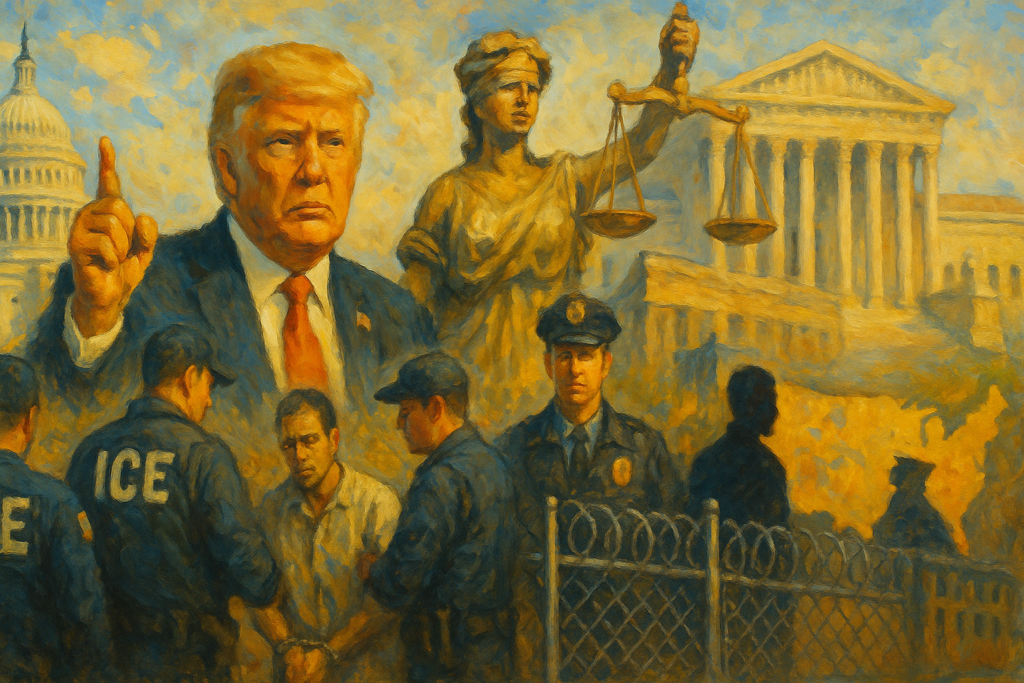
This week’s throughlines
- Immigration enforcement widened even as backlash grew — The week moved from the DHS funding fight and fallout from Minnesota operations to expanded detention infrastructure, surveillance of ICE critics, refugee rescreening detentions, and housing penalties for mixed-status families, while cities, courts, and activists tried to slow or block the campaign.
- Courts and states kept checking executive overreach, but the administration kept testing new routes — Judges ordered restorations, enforced detention rights, and the Supreme Court struck down Trump’s tariff theory, yet the administration quickly appealed, delayed compliance, or shifted to alternative authorities.
- Election and media rules were used as instruments of control — Trump floated unilateral voting changes, DHS used flawed citizenship data in election contexts, lawmakers advanced measures involving ICE at polling places and the SAVE Act, and FCC guidance and investigations chilled candidate interviews on major TV platforms.
- Public memory, symbolism, and personal glorification became recurring institutional fights — Historic exhibits and sites became legal battlegrounds while airport renamings, trademark filings, and monument plans tied public infrastructure and national symbolism more closely to Trump’s personal brand.
The week opened with a clash over immigration enforcement that quickly rippled through multiple branches of government. As funding for the Department of Homeland Security lapsed and a limited shutdown began, the administration’s aggressive tactics in Minnesota and beyond set the tone for a seven‑day struggle over who controls the machinery of enforcement, how far executive power can reach, and what protections remain for dissent, voting, and public health.
Over the weekend, Congress allowed DHS funding to expire. House Democrats had passed a bill to keep the department open, but Senate Democrats blocked it, insisting that any extension include reforms to Immigration and Customs Enforcement and Customs and Border Protection. They sought body cameras, visible identification for agents, warrants for home entries, and explicit bans on racial profiling. With no agreement and lawmakers leaving town, a partial shutdown took effect. The impact was uneven: ICE and CBP continued operating on prior‑year funds, underscoring how immigration enforcement has been insulated from the budget brinkmanship that can constrain other agencies. The standoff highlighted how basic government operations are now used as leverage in fights over civil rights and oversight of security forces.
At the same time, the administration intensified its confrontation with Minnesota, which had resisted federal immigration raids after lethal incidents in Minneapolis. A letter signed by Attorney General Pam Bondi demanded extensive state records on social programs and voter rolls and pressed Minnesota to drop limits on cooperation with immigration agents. The Justice Department issued subpoenas to senior state officials, even as ICE operations in the Twin Cities had already resulted in two citizen deaths and thousands of detentions. Protests grew, and amid the public outcry the White House signaled it might scale back the crackdown, but the message was clear: a state that challenged federal tactics could face legal threats, data demands, and opaque investigations.
Beyond Minnesota, the scale of the enforcement system came into sharper focus. Reports over the weekend detailed ICE’s rapid expansion: new facilities, plans for tens of billions of dollars in warehouse‑style processing centers, and record detention levels. Reuters found that immigration judges had ruled ICE detentions unlawful more than 4,400 times since October, generating over 20,000 lawsuits. At the same time, DHS’s SAVE database, originally designed to verify immigration status for benefits, was being used to flag supposed noncitizen voters. The system misclassified many naturalized citizens, triggering investigations that reached into the voting system and raised the risk of eligible voters being chilled or wrongly targeted.
Individual cases showed what those numbers meant in human terms. In Chicago, immigration courts ruled that Ruben Torres Maldonado’s arrest during a surge of ICE operations was illegal and later blocked his deportation on hardship grounds. Civil rights groups in Georgia asked a federal court to stop the misuse of voter data seized in an FBI raid on Fulton County’s elections office, arguing that the information was being repurposed to question legitimate ballots. These rulings did not change the overall trajectory of enforcement, but they demonstrated that, case by case, courts could still intervene—often only after significant harm had already occurred.
The weekend also brought new assertions of presidential power over elections. On social media, Donald Trump claimed he could unilaterally change voting rules without Congress, promising to impose nationwide voter ID and eliminate mail‑in ballots on the grounds that Democrats were cheating. The Constitution assigns most authority over election law to Congress and the states, not the president. The statement had no immediate legal effect, but it signaled an intent to narrow access to the ballot and to frame voting rules as something the executive could dictate.
Questions of accountability for the powerful surfaced in another arena as House Democrats on the Oversight Committee pressed for full disclosure of Jeffrey Epstein‑related files. They subpoenaed the Justice Department, alleging that roughly half the records remained withheld despite a transparency law. DOJ released some investigative documents, including communications involving talent agent Casey Wasserman and emails showing Epstein’s interest in Brett Kavanaugh’s confirmation. Survivors condemned the releases for exposing victims’ identities while redacting the names of alleged co‑conspirators, arguing that the pattern protected elites while endangering those who had come forward. The dispute foreshadowed a week in which transparency would be partial and contested.
Economic and environmental policy shifts rounded out the weekend. A Ford‑backed battery plant in Kentucky was idled, costing 1,600 jobs, with executives blaming federal policy changes that had dampened demand for electric vehicles. Home builders warned that immigration crackdowns were driving away workers and raising construction costs. At the Environmental Protection Agency, officials extended a delay on restrictions for the solvent trichloroethylene and moved toward rescinding the core legal finding that greenhouse gases endanger public health, along with vehicle emissions standards. These moves suggested a federal tilt toward short‑term industrial interests over climate and labor protections, with local economies already feeling the strain.
By Monday, resistance to the administration’s direction took on more symbolic forms. Representative Ami Bera and other Democrats announced they would boycott Trump’s upcoming State of the Union address, citing what they described as constitutional abuses and self‑enrichment. Senator Jon Ossoff used a Presidents’ Day speech to warn against accepting false narratives about the 2020 election and a government driven by vengeance. In Washington, Broadway dancers staged a memorial for Renée Good and Alex Pretti—citizens killed in federal operations—at the Lincoln Memorial. When they moved the performance to the Kennedy Center, 23 officers stopped them, invoking federal property rules. The episode illustrated how even commemorations of those killed by state violence were being tightly controlled.
Meanwhile, DHS turned its attention to critics online. The department issued hundreds of administrative subpoenas to platforms such as Google and Meta, seeking identifying data for social media accounts critical of ICE. These subpoenas did not require judicial approval, raising concerns that the government was using administrative tools to unmask dissenters without the safeguards of a warrant. In a related development, Pentagon officials considered severing ties with AI company Anthropic because it resisted using its technology for domestic surveillance. Together, these moves suggested a growing expectation that private firms would support government monitoring, and that reluctance could carry financial consequences.
The battles over information extended to history and memory. Survivors of Epstein’s abuse continued to criticize DOJ’s handling of the files, arguing that the department’s choices about what to redact and what to reveal shielded alleged enablers while exposing victims. Separate reporting showed that the FBI had interviewed a victim who accused Trump of sexual assault, but related DOJ records had disappeared from public databases. In a parallel fight over public memory, the National Trust for Historic Preservation sued to block unreviewed demolition at the White House for a new ballroom, arguing that the administration was bypassing normal review processes. In Pennsylvania, a federal judge ordered the restoration of a slavery exhibit that had been removed from Independence National Historical Park. These disputes underscored how decisions about archives, exhibits, and buildings shape which stories are told and which are erased.
States and cities also pushed back against federal opacity. Chicago’s mayor directed local police to document federal immigration agents—names, badge numbers, and actions—to build potential misconduct cases. In Minnesota, the FBI formally told the state’s Bureau of Criminal Apprehension that it would not share evidence in the Alex Pretti shooting, despite state officials’ demands. Governor Tim Walz and others protested the refusal, arguing that it undermined state investigations into fatal shootings by federal officers and reinforced the perception that those officers operated beyond local accountability.
Public health governance began to shift more visibly. The Food and Drug Administration removed longstanding warnings against unproven and dangerous autism “treatments” such as chlorine dioxide and raw camel milk, despite past harms to children. The change came as Health Secretary Robert F. Kennedy Jr. moved to overhaul vaccine policy and as Jay Bhattacharya, a critic of prior COVID‑19 measures, prepared to take on a dual role at the National Institutes of Health and the Centers for Disease Control and Prevention. The combination suggested a reorientation of federal health guidance away from prior scientific consensus, with potential consequences for families seeking trustworthy information.
On Tuesday, citizen groups tried to use formal channels to respond to these shifts. Coordinated by organizations including Citizens’ Impeachment, FLARE, and the 50501 Movement, constituents in nearly 100 House districts participated in a National Day of Lobbying. They visited or attempted to visit their representatives’ offices to demand impeachment of Trump and top officials and the abolition of ICE. Organizers provided scripts and talking points; in some districts, such as South Carolina’s 1st, offices did not respond, prompting outdoor press conferences instead. The effort showed how, even when impeachment prospects were dim, citizens were still turning to traditional lobbying to press for accountability.
Inside Congress, Democrats escalated their own challenge to the enforcement apparatus. House Democrats filed articles of impeachment against Homeland Security Secretary Kristi Noem, citing fatal shootings by federal immigration officers in Minneapolis, obstruction of congressional oversight, and alleged financial self‑dealing in a DHS advertising campaign. Impeaching a sitting Homeland Security Secretary is rare, and the move tested whether Congress would hold senior security officials responsible for lethal abuses and misuse of public funds, or whether partisan loyalties would shield them.
The Epstein saga returned to the center of congressional oversight, but in a selective way. House Oversight Republicans compelled filmed depositions from Hillary and Bill Clinton and named billionaire Les Wexner as a co‑conspirator in newly unredacted files, leading to his testimony before the committee. At the same time, Chair James Comer refused to hold hearings on Trump’s ties to Epstein, arguing that released documents exonerated the president. Survivors and Democrats accused the majority of running a one‑sided investigation that targeted some high‑profile figures while explicitly shielding others, illustrating how oversight can be weaponized rather than applied evenly.
ICE’s technological buildout continued apace. Documents showed that the agency had tripled the data it stores in Microsoft’s Azure cloud in six months, as part of a mass deportation campaign backed by a $75 billion budget and expanded surveillance tools. In Texas, federal agents raided the Dilley detention facility to confiscate letters from detained children that had described hunger and illness and been published by ProPublica. The combination of massive data infrastructure and efforts to silence detainees’ accounts made the system harder to scrutinize from the outside.
The human cost of that system was starkly illustrated by the case of two‑month‑old Juan Nicolás. Detained with his family at the South Texas Family Residential Center, he was hospitalized for serious respiratory illness. The same day he was discharged, ICE deported him and his family to Mexico with minimal resources. Lawmakers and advocates seized on the case as emblematic of an enforcement regime in which rigid rules and quotas could override basic humanitarian considerations, especially for the most vulnerable.
Voting rules and political messaging hardened along racial lines. In Arizona, Senate Republicans advanced a bill to station ICE agents at polling places, raising fears of voter intimidation, particularly in communities with large immigrant populations. In Kentucky, Congressman Andy Barr released a Senate campaign ad using a phrase associated with white supremacists, funded by major corporations. Utah Republicans struggled to advance a pro‑gerrymandering ballot measure amid fraud claims, while House Democratic leader Hakeem Jeffries invested in redistricting efforts in other states. These developments showed how immigration enforcement, racialized rhetoric, and map‑drawing were being used to shape who votes and whose votes count.
At the same time, the Trump family deepened its business ties to foreign and defense interests. Reports detailed a $500 million investment from UAE royal Sheikh Tahnoon into the Trump family’s World Liberty Financial crypto venture shortly before Trump took office. Eric Trump announced a new investment in Extend, an Israeli drone company with a Pentagon contract. In a CNBC appearance, Eric and Donald Trump Jr. openly discussed leveraging presidential power in financial arenas and framed their actions as “retribution” for past grievances. The overlap between foreign capital, defense contracts, and presidential influence raised fresh conflict‑of‑interest concerns.
Wednesday brought a major institutional check on executive power from the Supreme Court. In a series of 6–3 decisions, the Court ruled that Trump had exceeded his authority by using the International Emergency Economic Powers Act to impose sweeping tariffs on imports from China, Canada, Mexico, and other countries. IEEPA was enacted in 1977 to allow presidents to regulate financial transactions and property in response to national emergencies, particularly involving foreign threats. The Court held that using it to impose broad tariffs amounted to levying taxes, a power the Constitution reserves to Congress. The rulings invalidated a signature economic tool of Trump’s second term and reasserted that even a strong presidency cannot bypass Congress on core taxing authority. Reactions split Republicans: some decried the decision as judicial overreach, while others praised it as a victory for separation of powers. Trump attacked the justices and vowed to impose a new 10 percent global tariff under a different statute, signaling that the struggle over trade authority would continue.
On the regulatory front, EPA formalized its earlier signals by revoking its 2009 finding that greenhouse gases endanger public health and welfare and repealing all related vehicle emissions standards. The agency argued that the Clean Air Act does not cover global climate change, reversing more than a decade of federal climate policy. EPA also extended a delay on trichloroethylene restrictions and processed a series of pesticide actions. The rescission removed a central legal basis for federal climate regulation of vehicles, favoring short‑term industrial interests and leaving states and international partners to reassess their own plans in light of a less engaged U.S. federal government.
Economic data underscored the costs of recent policy choices. New figures showed that the U.S. added only 181,000 jobs in 2025, the weakest year since 2003 outside the pandemic, with manufacturing losing 108,000 jobs. In Florida, a 2023 E‑Verify law requiring employers to check workers’ legal status had driven many foreign farm and construction workers out of the state, leaving employers scrambling to fill positions. These trends linked national trade and immigration policies to concrete labor shortages and stagnant growth.
Public health and science policy continued to pull in opposing directions. The Advisory Committee on Immunization Practices postponed its meeting amid a legal challenge from the American Academy of Pediatrics, which questioned the committee’s legitimacy under RFK Jr.’s leadership. The challenge added to uncertainty about how national vaccine recommendations would be made. At the same time, the FDA carried on with routine regulatory work: updating device standards, issuing a priority review voucher for a rare pediatric disease drug, revoking an emergency authorization for a COVID‑era blood filter, and preparing new information collections on drug manufacturing and communication effectiveness. The contrast highlighted how technocratic agencies were still performing day‑to‑day safety tasks even as political interventions at the top threatened to undermine public confidence in their guidance.
Elsewhere, Secretary of State Marco Rubio used the Munich Security Conference to endorse white Christian nationalist themes, prompting cool reactions from European leaders. Many signaled a desire to distance themselves from U.S. influence and pursue more independent defense and foreign policies. Domestically, courts and agencies wrestled with protest and surveillance. In Texas, a federal judge declared a mistrial in a rare terrorism case against antifa protesters at an ICE facility after objecting to defense counsel’s civil‑rights T‑shirt, an unusual intervention that drew attention to judicial attitudes toward protest. In New York, the NYPD continued to defy a court order to release most of its surveillance contracts under the city’s POST Act. EPA published notices making Environmental Impact Statements available for public review, and OSHA expanded recognition of private testing labs. These actions, taken together, showed how the boundaries of dissent and transparency were being negotiated in courtrooms and agency offices.
On Thursday, state and federal governments offered sharply contrasting visions of how to use public power. In his State of the State address, Illinois Governor J.B. Pritzker said the Trump administration had cost his state $8.4 billion in withheld federal funds and condemned federal agents’ actions in Chicago as brutal and unaccountable. As a countermeasure, he announced that Illinois had purchased and erased $1 billion in medical debt for more than 500,000 residents and outlined plans to tackle housing costs. The move illustrated how a state could both document federal overreach and deploy its own fiscal tools to mitigate economic harm.
In Washington, RFK Jr. moved from signaling to action on vaccines. He removed broad federal recommendations for six routine childhood vaccines, including COVID‑19 and hepatitis B, increased support for state‑level exemptions, and cut funding for mRNA research. The American Academy of Pediatrics’ legal challenge to the CDC’s vaccine advisory committee contributed to the postponement of its February meeting, leaving a gap in national guidance. Public health experts warned that weakening national recommendations and destabilizing the advisory process could lead to lower vaccination coverage and greater vulnerability to preventable disease outbreaks.
Immigration policy took another hard turn. A new DHS memo authorized ICE to detain legal refugees indefinitely for aggressive “rescreening,” reversing Obama‑era policy and directly contradicting a Minnesota court order that had blocked further arrests of settled refugees. The initiative, dubbed Operation Parris, aimed to re‑examine thousands of cases through new background checks. Authorizing indefinite detention for a group that had already been vetted and admitted signaled a willingness to disregard judicial limits and to keep even legal status precarious. In housing policy, HUD proposed a rule that would bar families with undocumented members from public housing, potentially evicting tens of thousands of people, including nearly 37,000 U.S. citizen children. Housing authorities would be required to report ineligible tenants to immigration authorities, turning a social safety net program into an enforcement tool and threatening family unity.
Trump also announced a dramatic redirection of public funds. He declared that $10 billion in U.S. money would be transferred to his “Board of Peace,” a body under his control that he envisioned as an alternative to the United Nations. Such a transfer would normally require congressional appropriation, and the announcement raised alarms about bypassing the power of the purse and creating a large discretionary fund tied personally to the president. The move fit into a broader pattern of personalizing public institutions and symbols.
States continued to chart their own course. In California, organizers intensified signature collection for the California Billionaire Tax Act, a one‑time 5 percent levy on residents with over $1 billion in assets, designed to offset federal healthcare cuts and fund education and food assistance. State lawmakers also introduced a bill to bar ICE agents from being stationed within 200 feet of polling places and ballot processing sites and to expand voting options if immigration enforcement disrupted voting. These efforts used direct democracy and state law to counter federal austerity and protect voters from intimidation. On the transparency front, the National Archives announced a schedule of FOIA Advisory Committee meetings to finalize recommendations on improving access to government records. Yet Oversight Chair Comer reiterated that he would not hold hearings on Trump’s Epstein ties, underscoring how incremental reforms to records access coexisted with high‑profile decisions to shield the president from scrutiny.
By Friday, the personalization of institutions and the tightening of electoral rules were on full display. Trump convened the inaugural meeting of his Board of Peace at the U.S. Institute of Peace, which had been renamed in his honor. He reiterated the $10 billion commitment to the board, even as legal questions persisted about the source and authorization of the funds. Framed as a U.S.‑centric alternative to multilateral institutions like the UN, the board’s launch suggested a foreign policy increasingly routed through bodies closely identified with the president himself.
In Georgia, Trump promoted the SAVE America Act, which would require proof of citizenship to vote nationwide. He claimed the law would secure Republican victories for 50 years. The House had already passed the bill, and in the Senate, Susan Collins provided the 50th vote for a Trump‑backed measure seen by critics as undermining free and fair elections, while Lisa Murkowski remained a rare Republican opponent. Framing restrictive voting laws as a path to long‑term one‑party rule made explicit the partisan stakes of election‑administration fights and threatened broad access to the ballot.
Courts continued to push back against the immigration machinery. Federal Judge Sunshine Sykes issued a forceful ruling accusing the administration of “terrorizing” immigrants and violating her prior orders that many detainees were being illegally denied a chance for release. She ordered DHS to notify detainees of their bond eligibility and ensure access to legal counsel, directly challenging the administration’s mandatory detention policy. Her decision, building on earlier findings of unlawful detentions and cases like Juan Nicolás’s deportation, was a rare, sharp judicial rebuke and a reminder that courts can still impose procedural safeguards on mass detention.
Inside the Justice Department, internal tensions surfaced. Workers hung a banner featuring a large portrait of Trump inside the building, an unusual act of protest reflecting unease over the department’s direction and its handling of politically sensitive cases. Aboard Air Force One, Trump commented on the arrest of Andrew Mountbatten‑Windsor, expressing sympathy for the royal family and asserting his own exoneration in Epstein‑related matters. The juxtaposition of internal dissent and presidential self‑exoneration underscored how narratives about elite accountability were being contested both inside and outside government.
Universities found themselves drawn deeper into national security politics. Purdue University was accused of informally rejecting applicants from China and other “adversary” nations after a House committee demanded data on Chinese students; Purdue denied having such a policy, but students reported rescinded offers. Columbia University canceled a China exchange program, and the University of Illinois Urbana‑Champaign announced it would wind down partnerships with Chinese universities, all citing the current policy environment. These decisions suggested that congressional pressure and security concerns were reshaping academic collaboration, student mobility, and campus diversity.
Abroad, the U.S. signaled a more unilateral and militarized posture. U.S. Southern Command reported lethal strikes on three suspected drug‑smuggling boats, bringing the total to over 40 such strikes and more than 130 deaths. The military continued a major buildup around Iran, deploying additional carrier groups, warships, and air defenses. In parallel, Trump proposed a U.S.‑run alternative to the World Health Organization, at far higher cost than prior U.S. contributions to WHO. Combined with the Board of Peace, these initiatives pointed toward a foreign policy that favored U.S.‑centric institutions over multilateral ones.
On the domestic economic front, Trump’s media company expanded its foray into politicized finance. Trump Media and Technology Group launched Truth.Fi political‑themed exchange‑traded funds and accounts aligned with Trump’s agenda, announced a $2.5 billion plan to become a bitcoin treasury company now facing hundreds of millions in unrealized losses, planned a $6 billion merger with nuclear fusion firm TAE Technologies, and partnered with Crypto.com to buy large quantities of Cronos tokens, which have since plunged in value. Politically branded firms taking large speculative positions raised the risk that future policy or regulatory decisions could be shaped to rescue or favor politically connected investors.
Symbolic politics continued at home. Trump announced plans to direct agencies to identify and release files on UFOs and extraterrestrial phenomena, presenting it as a transparency initiative. In Florida, the legislature passed a bill to rename Palm Beach International Airport after Trump, pending the governor’s signature and federal approval. In Washington, Trump’s Commission of Fine Arts, now filled with loyalists, swore in his executive assistant and approved the controversial White House ballroom that preservationists had tried to block. These moves to rename airports, reshape the White House, and selectively declassify attention‑grabbing records showed how the administration curated spectacle and symbolism alongside more opaque decisions about power and money.
Taken together, the week’s events traced a contested landscape for American democracy. Courts reasserted limits on emergency economic powers and, in some cases, on mass detention. States like Illinois and California used their own authority to counter federal cuts, protect voters, and relieve debt. Yet the executive branch continued to expand immigration enforcement, redirect public funds into personalized projects, and press for voting rules that could entrench partisan advantage. Public health institutions were pulled into ideological battles, universities were drawn into security politics, and media and memorial spaces came under new forms of pressure. The result was a picture of institutions still capable of resistance, but increasingly strained by efforts to centralize power, narrow participation, and rewrite the rules of accountability.