This week’s throughlines
- Texas flood response became a story about institutional weakening — What began as a disaster response story widened into scrutiny of staffing cuts at the National Weather Service, FEMA communication failures, contract approval bottlenecks, and even plans to dismantle FEMA.
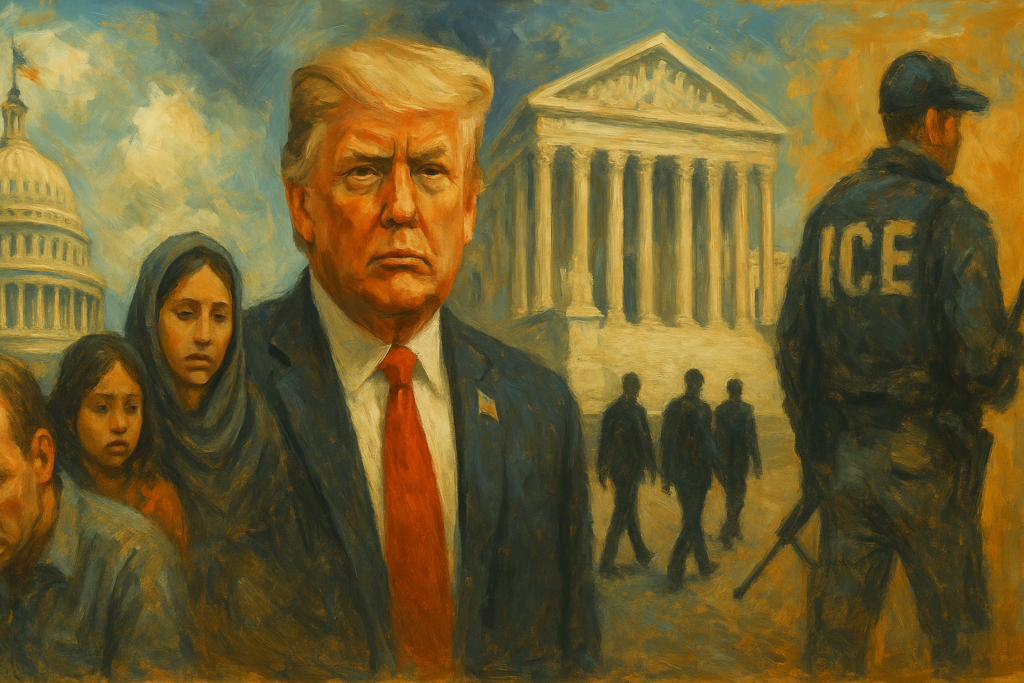
- Immigration enforcement escalated in scale, force, and legal consequence — The week moved from deportations and individual detentions to TPS terminations, military support for ICE, raids in Los Angeles and California farm country, and new legal challenges over detention, deportation, and protest suppression.
- Executive power kept pressing against oversight — The administration blocked appropriated funds, restricted information to Congress, used emergency powers for tariffs, targeted critics, and benefited from court rulings that narrowed judicial checks and allowed mass layoffs.
- Trade policy was used as a rolling instrument of pressure — Tariff deadlines, delays, and new country-specific threats kept changing through the week, culminating in new actions aimed at Brazil and more sectoral tariffs, with little stable process or clear endpoint.
The week opened with two decisions likely to shape American governance for years: a sweeping budget law that rewrote federal priorities and a Supreme Court ruling that redefined presidents’ legal exposure. Around those anchors, immigration enforcement hardened, the civil service and disaster-response systems were hollowed out, and courts struggled to define the remaining limits on executive power.
Over the weekend, President Trump signed a nearly thousand-page budget reconciliation bill that made permanent the 2017 tax cuts for corporations and high earners while cutting deeply into the social safety net. Roughly $890 billion was stripped from Medicaid and $230 billion from food assistance over the coming decade. At the same time, the law poured more than $170 billion into immigration enforcement, including over $50 billion for border wall construction and a major expansion of detention capacity. Republicans hailed the package as a signature achievement, but polling showed broad public opposition to both the tax and benefit changes. The law’s structure locked in gains for wealthier households and enforcement agencies for years, while the cuts to health care and food aid would be felt most immediately by low-income families.
The same weekend, Trump moved beyond legislation to assert direct control over spending and law enforcement. He refused to release more than $6 billion that Congress had appropriated for after-school and summer programs, effectively vetoing a line item after it had become law. He also issued pardons to supporters convicted for their roles in the January 6 attack on the Capitol, signaling leniency toward those who used violence to disrupt the transfer of power. In parallel, he directed the Justice Department to target political opponents and critics, including exploring whether Secret Service protection could be removed from some of them, and he curtailed classified briefings to Congress. Together, these moves weakened the legislature’s practical authority over both the purse and oversight, and suggested a presidency increasingly willing to use legal tools against domestic rivals.
National security institutions were also reshaped by loyalty tests rather than formal processes. Reports surfaced that in April Trump had fired the director of the National Security Agency, Gen. Timothy Haugh, his deputy, and six National Security Council staffers after receiving a list of supposedly “disloyal” officials from a pro-Trump social media influencer. The episode raised bipartisan concern that unelected activists were driving personnel decisions in some of the most sensitive parts of the government. It also foreshadowed later in the week, when the Supreme Court would clear the way for mass layoffs across the civil service, making it easier to replace career officials with those seen as personally loyal.
The courts themselves narrowed their own tools for checking the executive. Over the weekend, the Supreme Court issued a ruling limiting nationwide injunctions—orders that had allowed a single federal judge to halt a federal policy across the entire country. Under the new standard, judges will find it harder to block a policy beyond the parties directly before them, meaning controversial initiatives can often continue elsewhere while litigation drags on. In a related immigration case, lower courts and the Supreme Court allowed the deportation of eight men to South Sudan, even though only one had ties to that country, after narrowing judicial authority to stop such removals. Together, these decisions signaled a judiciary more willing to let executive actions proceed while challenges are pending, especially in immigration.
The human cost of earlier budget and staffing choices became starkly visible in Texas. Central Texas was hit by catastrophic floods after a foot of rain fell overnight, killing at least 69 to 80 people and leaving many missing. Local officials accused the National Weather Service of underestimating the rainfall and failing to provide adequate warnings. NWS leaders responded that hundreds of positions had been left unfilled or eliminated, leaving key offices without round-the-clock coverage. The same budget priorities that had expanded enforcement and cut social programs had also thinned out scientific and emergency agencies. As the week went on, the Texas disaster became a recurring example of how abstract cuts translate into lives lost.
Immigration policy tightened further at the structural level. The Department of Homeland Security announced the end of Temporary Protected Status for about 72,000 Hondurans and 4,000 Nicaraguans, protections that had been in place since 1999 for people who had fled natural disasters and instability. On the ground, ICE detained a Canadian mother of three U.S.-born children during her green card interview in California, underscoring that even long-resident families seeking legal status faced sudden detention and possible removal. These steps, combined with the budget’s expansion of detention funding, signaled a shift toward more precarious lives for millions of noncitizens.
By Monday, the aggressive enforcement posture was visible on American streets. In Los Angeles’s MacArthur Park, a heavily immigrant neighborhood, ICE and Border Patrol agents, backed by about 90 National Guard troops and armored vehicles, staged large-scale operations that were filmed by a friendly cable network. Local leaders described the raids as political theater: they produced few or no arrests but spread fear, disrupted businesses, and sent families into hiding. A federal judge later issued a temporary restraining order requiring reasonable suspicion for stops and banning racial profiling, a reminder that courts could still impose some limits even as their broader tools were curtailed.
Public health institutions were also reshaped from the top. Health Secretary Robert F. Kennedy Jr. dismissed all 17 members of a key CDC vaccine advisory panel and replaced them with several vaccine skeptics, despite earlier assurances that he would not alter the committee. He and his allies promoted discredited claims linking vaccines to autism and suggested unproven vitamin regimens for measles, even as the United States recorded 1,277 measles cases, surpassing the 2019 high. A pregnant physician and major medical associations sued HHS, arguing that Kennedy’s guidance against Covid vaccination for pregnant women and children bypassed scientific review and endangered public health. The episode showed how personnel changes and guidance from political appointees could quickly undermine long-standing, evidence-based practices.
The Texas floods remained in focus as new reporting detailed the depth of cuts at the National Weather Service and FEMA. More than 600 NWS employees had been laid off or pushed into early retirement, leaving flood- and storm-prone offices unable to provide continuous coverage. At FEMA, internal orders restricted staff communication with Congress and local officials, and DHS signaled plans to dismantle the agency entirely by the end of hurricane season, arguing that states and private firms should handle disasters. Taken together with the budget law, these decisions pointed toward a federal government less capable of forecasting and responding to climate-driven emergencies, even as such events became more frequent.
Courts and states did push back on some fronts. In Boston, a trial opened challenging the administration’s policy of deporting foreign students for pro-Palestinian speech, with academic groups arguing that using immigration powers to punish political expression violated the First Amendment. Planned Parenthood filed suit to block provisions stripping its clinics of Medicaid reimbursements, warning that up to 200 centers could close; a federal court issued a temporary order preserving funding while the case proceeds. Separately, another court granted an injunction specifically against the new law’s defunding clause, allowing Planned Parenthood to continue serving low-income patients. These cases showed that while Congress and the executive could move quickly, the judiciary still had the capacity to slow or modify some of the most sweeping changes.
On Tuesday, the Supreme Court took another step that reshaped the balance between the branches. In a series of emergency orders, the Court granted stays that lifted lower-court blocks on Trump’s “Department of Government Efficiency” workforce order and related reductions in force. The decisions allowed the administration to proceed with hiring freezes and large-scale layoffs across at least 19 agencies, including agriculture, commerce, HHS, and the State Department, while litigation continues. With Justice Ketanji Brown Jackson the lone dissenter in 8–1 rulings, the Court signaled that it would not stand in the way of rapid restructuring of the civil service, even when critics argued that the changes were ideologically driven.
The military was drawn deeper into domestic immigration enforcement. The administration deployed about 70 National Guard troops to a new Everglades detention facility in Florida and announced that 200 Marines would assist ICE, including through a pilot program stationing ICE agents on Marine bases. The Florida facility, quickly dubbed “Alligator Alcatraz,” was reported to lack running water, adequate food, or shelter from extreme heat and storms. These deployments came as ICE detention centers nationwide were already overcrowded and unrest was rising. The use of uniformed troops to run and support detention blurred the traditional line between military and civilian law enforcement and raised the risk that abuses would go unchecked.
Within the Justice Department, a whistleblower alleged that the executive branch was willing to go further still in testing legal boundaries. Former DOJ lawyer Erez Reuveni filed a complaint and provided text messages to the Senate Judiciary Committee claiming that senior official Emil Bove had instructed attorneys to ignore federal court orders blocking deportations to El Salvador. Bove, now nominated to the Third Circuit Court of Appeals, denied the allegations in his confirmation hearing. If substantiated, the complaint would mean that the government’s own lawyers were being told to disregard judicial authority, even as the Supreme Court was narrowing the tools available to those courts.
Trade and foreign policy instruments were also used in increasingly personal ways. Trump announced a 50 percent tariff on copper and signaled plans for a 25 percent tariff on all imports from South Korea, despite an existing free-trade agreement. He floated tariffs on Canada and other allies, and the administration continued to shift implementation dates for a broad new tariff regime now slated for August 1, with Commerce officials admitting the dates were “firm, but not 100 percent firm.” The uncertainty left importers and foreign governments guessing about the rules of the game. At the same time, a federal judge in Washington, D.C., ruled against nonprofits challenging DOJ’s rescission of hundreds of millions in violence-prevention grants, calling the cuts “shameful” but beyond his power to enjoin, underscoring the limits of judicial review over executive budget choices.
Wednesday brought the week’s most consequential legal decision. In Donald J. Trump v. United States, the Supreme Court held that a former president has absolute immunity from criminal prosecution for actions within his “conclusive and preclusive” constitutional authority and presumptive immunity for all official acts. In practice, this means that decisions in areas like foreign affairs, pardons, and certain law-enforcement directives are largely shielded from criminal accountability, even after a president leaves office. Only clearly private or unofficial acts remain fully subject to prosecution. The ruling elevated presidential acts above ordinary criminal law and made it significantly harder to hold future presidents accountable for abuses of power.
The same day, the federal government escalated its legal offensive against transgender rights. The Justice Department sued California over policies allowing transgender girls to compete in girls’ school sports, arguing that they violated Title IX. DOJ also issued more than 20 subpoenas to clinics and doctors providing gender-affirming care to minors, following a memo that equated such care with female genital mutilation. These actions came as conservative justices signaled interest in revisiting precedents on same-sex marriage and contraception, suggesting that the legal framework for LGBTQ+ rights and reproductive autonomy could face renewed challenges.
Courts, however, drew firmer lines on some immigration questions. A federal judge in New Hampshire blocked Trump’s executive order ending birthright citizenship for children of undocumented parents and certified a nationwide class, protecting babies born after February 20 while the case proceeds. The Supreme Court separately refused to lift an injunction against Florida’s SB 4-C, which criminalizes undocumented immigrants entering the state, leaving the law on hold. These rulings preserved core Fourteenth Amendment protections and reaffirmed federal primacy over immigration, even as the administration sought to narrow both through executive orders and state-level crackdowns.
On the streets, immigration enforcement grew more confrontational. Outside the San Francisco Immigration Court, an unmarked ICE SUV drove through a crowd of protesters trying to prevent a detention, injuring at least one person. Agents, some without visible badges, used rifles, batons, and pepper spray against demonstrators while local police reportedly did not intervene. The incident illustrated the escalating physical risks for protesters and the normalization of militarized tactics against people exercising their right to assemble.
Thursday showed how the Supreme Court’s workforce decisions translated into concrete institutional change. Following the Court’s lifting of prior injunctions, the State Department announced plans to lay off nearly 15 percent of its domestic staff—about 1,800 employees—as part of an “America First” restructuring. The cuts would merge or eliminate hundreds of bureaus and were to be implemented through rolling reductions in force because of internal system limits. Diplomats and advocacy groups warned that shrinking the diplomatic corps at this scale would reduce U.S. capacity to manage crises, negotiate agreements, and support citizens abroad, concentrating foreign policy even more tightly in the hands of the White House and a smaller cadre of political appointees.
At the same time, oversight of immigration detention was dismantled just as abuses mounted. DHS eliminated three key offices: the Office for Civil Rights and Civil Liberties, the Immigration Detention Ombudsman, and the USCIS Ombudsman. These bodies had provided formal channels for detainees and the public to report mistreatment and for systemic problems to be investigated. Reporting the same day described severe overcrowding, unsanitary conditions, and unrest in ICE facilities nationwide, and detailed inhumane conditions at the Everglades detention center, where detainees lacked running water, adequate food, or shelter from extreme weather. Removing watchdogs while expanding detention capacity made it harder to detect and correct abuses in a system already under strain.
The Texas floods again highlighted the consequences of centralizing power. Homeland Security Secretary Kristi Noem had imposed a rule requiring her personal sign-off on FEMA contracts over $100,000. During the floods, this requirement led to more than a 72-hour delay in deploying Urban Search and Rescue teams and other resources. Combined with earlier NWS staffing cuts, the delay became a focal point for congressional calls for investigation. The episode showed how concentrating disaster spending decisions in a political office could slow life-saving responses and raise questions about whether aid was being managed for optics rather than effectiveness.
Legal and historical debates over the Fourteenth Amendment’s legacy intensified as these cases moved through the courts. Commentary traced the amendment’s origins in overturning the Dred Scott decision and empowering the federal government, including the Justice Department, to fight the Ku Klux Klan and protect newly freed citizens. Current litigation over birthright citizenship and state immigration laws showed courts using class actions and injunctions to block the administration’s order, at least temporarily. At the same time, conservative justices’ past calls to revisit rights to contraception and same-sex marriage underscored that the amendment’s modern role as a shield for equal rights was under sustained pressure.
Abroad, Argentina offered a contrasting, if related, example of rapid institutional change. President Javier Milei continued a sweeping libertarian program: slashing public spending by about 31 percent, weakening unions, easing firings, privatizing state industries, scrapping rent controls, and devaluing the peso while lifting currency controls. The changes produced a sharp increase in rental supply and a modest drop in median rents in Buenos Aires, and official poverty fell slightly after an initial spike. Supporters touted stabilization and growth; critics warned of eroded labor protections and social safety nets. For observers in the United States, Argentina’s experiment served as a live test of how far austerity and deregulation can go before they begin to undermine democratic stability.
By Friday, several of the week’s trends had hardened into new realities. The State Department began issuing termination notices to more than 1,300 employees as part of its restructuring, turning an abstract plan into concrete losses of expertise. Immigration raids in California escalated from intimidation to lethal force: federal agents, backed by National Guard troops, raided two cannabis farms in southern California, arresting about 200 immigrant workers. Clashes with protesters involved tear gas and other crowd-control munitions, and one farmworker later died from injuries sustained during the operation. A member of Congress was denied entry to the site and condemned the use of force, raising questions about both proportionality and transparency.
In Texas, even as search and rescue operations continued, DHS canceled a $3 million grant intended to improve communication between the National Weather Service and local officials. The grant would have funded better warning systems and coordination tools—precisely the weaknesses exposed by the floods. Coming on top of NWS staffing cuts and FEMA deployment delays tied to Noem’s approval rule, the cancellation suggested that lessons from the disaster were not being translated into improved preparedness.
Trade policy continued to be wielded as a blunt instrument. Trump unveiled another set of tariffs, including a 35 percent tariff on Canadian goods and confirmation of a 50 percent tariff on copper, alongside previously announced duties on Japan, South Korea, Brazil, and several developing countries. Markets remained relatively calm, apparently betting that courts or further delays might blunt the impact, but businesses warned of higher costs across electronics, autos, and renewable energy. The pattern of announcing steep tariffs tied to political disputes, then shifting timelines, further normalized unilateral trade rule-making from the White House.
The week closed with reminders that some forms of accountability persisted. A federal appeals court unanimously upheld a $5 million civil judgment against Trump for sexual abuse and defamation of writer E. Jean Carroll, leaving him 90 days to seek Supreme Court review. The ruling showed that civil courts could still hold a former president personally liable, even as criminal immunity expanded. Separately, six Secret Service agents were suspended without pay for failures surrounding a 2024 assassination attempt on Trump, and the agency announced reforms including new drone and command systems. Meanwhile, the whistleblower’s allegations against Emil Bove continued to shadow his nomination to the federal bench, raising alarms about elevating officials accused of undermining court orders to lifetime judgeships.
Taken together, the week’s developments illustrated how legal rulings, budget choices, and enforcement tactics interact to reshape democratic life. The Supreme Court’s expansion of presidential immunity and its willingness to let mass layoffs proceed gave the executive more room to act, while cuts to social programs, public health, and disaster-response capacity shifted the burdens of risk downward. Immigration enforcement became more militarized just as oversight was dismantled, and trade and foreign policy tools were used to reward allies and punish critics at home and abroad. Yet courts at various levels still drew lines around birthright citizenship, state immigration laws, and some funding decisions, and civil litigation and public scrutiny continued to impose costs on abuses. Rather than a single rupture, the week showed an accumulation of changes that, over time, alter how power is exercised and how effectively institutions can respond.