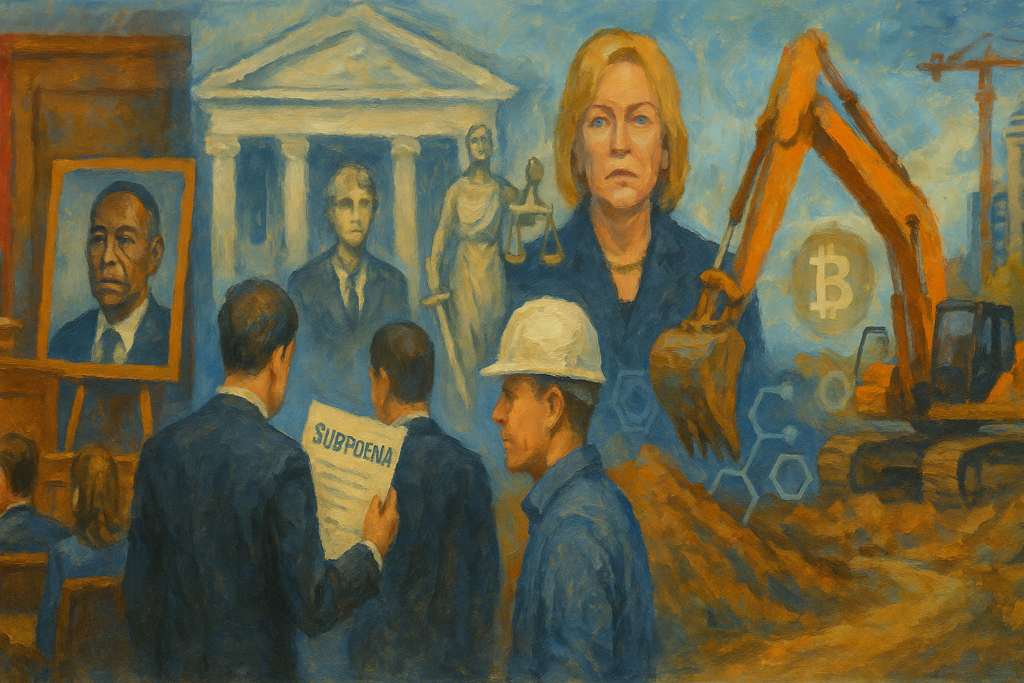
This week’s throughlines
- Epstein pressure spread from disclosure fights into retaliation and procedural shutdowns — What began as demands to release Epstein-related material quickly widened into lawsuits against the press, White House retaliation against the Wall Street Journal, House procedural maneuvers to avoid disclosure votes, and competing court fights over what could legally be unsealed.
- Immigration enforcement became more expansive, opaque, and punitive — The administration and allied officials expanded detention capacity, defended masked raids, tapped personal data, targeted sanctuary cities, and kept using courthouse and post-hearing arrests, while reports from Florida and New York described abusive or opaque detention conditions.
- Executive power kept reshaping agencies and public institutions — The week brought major cuts or restructuring at the EPA, State Department, and USDA, along with new AI and crypto initiatives that paired deregulation with ideological or industry-friendly policy shifts.
- Political grievance was increasingly routed through official legal and intelligence channels — Tulsi Gabbard's accusations against Obama moved from public claims to referrals, calls for a special counsel, and a DOJ strike force, showing how unsupported political allegations were converted into formal state action.
- Courts remained an uneven but important check — Judges blocked or limited some administration actions on birthright citizenship, immigrant detention, and spending transparency, even as other rulings cleared the way for mass firings and harsher immigration outcomes.
The week opened with three intertwined struggles coming into sharper focus. In Washington, a fight over transparency in the Jeffrey Epstein case escalated as Congress and the Justice Department pulled in opposite directions. At the same time, the administration accelerated a structural reshaping of government around AI, crypto, and deregulation, often in ways that overlapped with the president’s own financial and media interests. And across the country, immigration enforcement grew more militarized and expansive, even as courts repeatedly pushed back on efforts to rewrite the rules of citizenship and checked some of the harshest individual cases.
Over the weekend, the administration moved aggressively to consolidate economic and regulatory power in the executive branch. The Environmental Protection Agency eliminated its research and development office, triggering thousands of layoffs and sharply reducing the agency’s in‑house scientific capacity. That same day, Donald Trump publicly berated Federal Reserve Chair Jerome Powell for not cutting interest rates and suggested he could fire him, challenging the central bank’s traditional independence. The White House also pressed ahead with tariff hikes that will push the average effective rate above 20 percent, the highest in more than a century, while Commerce officials touted new trade deals that would hinge on either market access or fresh tariffs. Together, these moves signaled a governing approach that sidelines expert agencies and long‑standing norms in favor of direct presidential control over science, trade, and monetary policy.
The weekend also saw a dramatic escalation in the administration’s use of intelligence and law enforcement against political predecessors. Director of National Intelligence Tulsi Gabbard released a report alleging that Barack Obama and senior officials had conspired to fabricate evidence of Russian interference in the 2016 election, and referred them to the Justice Department for treason investigations. In media appearances she repeated the treason charge, contradicting years of bipartisan and intelligence‑community findings that Russia did interfere. Trump amplified the narrative, sharing an AI‑generated video depicting Obama being arrested and urging Republicans to say Obama “cheated” in 2016. The line between legal accountability and political retribution blurred further as intelligence tools and criminal referrals were turned against a former president on a theory that courts and prior investigations have already rejected.
At the same time, early skirmishes over the Epstein record began to define the week. Trump publicly demanded that Attorney General Pam Bondi seek release of Epstein grand jury testimony and ordered DOJ to pursue unsealing in New York, presenting it as a response to public pressure. Democratic senators Ron Wyden and Dick Durbin, for their part, pressed banks and DOJ for more information on Epstein’s finances and on the reported reassignment of hundreds of FBI agents to review files mentioning Trump. Trump also filed a $10 billion defamation suit against the Wall Street Journal and Rupert Murdoch over reporting on a birthday letter to Epstein, even as a federal judge dismissed his separate $50 million suit against Bob Woodward. The combination of presidential lawsuits against the press and selective calls for disclosure set the stage for a week in which transparency would be wielded as both a shield and a weapon.
Immigration enforcement and detention infrastructure were already expanding as the week began. ICE accelerated plans to reach 100,000 detention beds by year’s end, backed by a tripled budget and temporary tent structures. Reports from Florida facilities described shackling, overcrowding, and lack of medical care. Bloomberg detailed a $1.26 billion contract for a massive new detention complex at Fort Bliss, Texas. Civil‑rights groups and Democratic attorneys general responded with lawsuits aimed at protecting immigrants’ access to health care and safety‑net programs. These structural investments in long‑term confinement, combined with documented abuses, signaled that mass detention was becoming a central, normalized tool of immigration policy.
Other weekend moves reshaped America’s posture abroad and its information environment. The State Department implemented a 48 percent budget cut and reorganization that shrank or eliminated programs focused on LGBTQ+ communities, reproductive health, and minority rights, while its annual human‑rights reports were revised to remove sections on maternal health, LGBTQ+ rights, and minority protections. In parallel, the White House removed Wall Street Journal reporter Tarini Parti from the press pool for Trump’s Scotland trip, citing “fake and defamatory” coverage, and ICE continued to detain Atlanta‑area journalist Mario Guevara, known for his immigration reporting, even after local protest‑related charges were dropped. His seized and missing phone raised concerns about source protection. These steps, alongside the president’s lawsuits, underscored how access, funding, and litigation were being used to narrow both human‑rights advocacy and critical reporting.
By Monday, the focus shifted to domestic law and budgets. A Congressional Budget Office score laid out the impact of Trump’s July 4 tax bill: an additional $3.4 trillion added to the national debt over a decade, permanent extension of the 2017 tax cuts, reduced corporate rates, and removal of clean‑energy credits. The law also slashed Medicaid and SNAP by an estimated $1.1 trillion, with projections that 10 million more people would be uninsured by 2034. Analysts later in the week emphasized how the package locked in deficits while favoring high‑income households over working families, reshaping the social contract and constraining future fiscal choices.
On Capitol Hill, the Epstein fight moved from rhetoric to procedure. Speaker Mike Johnson abruptly closed the House for summer recess, canceling all business and preventing a bipartisan motion to force a vote on releasing Epstein files. The chamber had been scheduled to remain in session longer, and the early recess became a recurring tactic through mid‑week to keep Epstein transparency off the floor. Even as public and bipartisan pressure for disclosure grew, leadership used control of the calendar to block a straightforward vote, illustrating how procedural tools can be deployed to shield politically sensitive information.
Courts on Monday delivered a mixed set of rulings on immigration and civil rights. A federal appeals court allowed the administration to terminate Temporary Protected Status for roughly 22,000 Afghans and Cameroonians, while DHS separately restored TPS for Haitians under a prior court order. Another judge dismissed a Trump lawsuit attacking Maryland judges over deportation rulings, and a different court ordered immigration judges’ authority restored to appoint counsel for immigrants with severe mental disabilities. In Louisville, the Justice Department asked for a one‑day sentence for former officer Brett Hankison in the Breonna Taylor case, drawing criticism for leniency, though the judge later imposed a more substantial sentence. These decisions showed courts both enabling harsh shifts in immigration status and reinforcing due‑process protections, while DOJ’s stance in a high‑profile police case raised questions about federal civil‑rights priorities.
The Supreme Court also weighed in on the shape of the federal workforce. It lifted injunctions blocking the administration from proceeding with mass layoffs at the State Department, allowing more than 1,350 employees—about 15 percent of the domestic workforce—to receive reduction‑in‑force notices. Critics warned that the move would politicize diplomacy and drain expertise. In contrast, a federal judge in Mississippi issued a temporary restraining order halting enforcement of a new law banning diversity, equity, and inclusion programs in public schools and universities, citing potential First and Fourteenth Amendment violations. The judiciary thus simultaneously cleared the way for a purge of career diplomats and checked ideological overreach in education.
Monday also deepened the link between social services and enforcement. The Centers for Medicare and Medicaid Services finalized an agreement giving ICE access to personal records for nearly 80 million Medicaid recipients—names, addresses, and Social Security numbers—to help locate undocumented immigrants. Senators warned that the move could deter families from seeking care. Democratic attorneys general sued to block new restrictions on undocumented immigrants’ access to federal health and safety‑net programs, and a federal judge ordered the administration to restore a public spending tracker website that had been taken down. Meanwhile, school districts and advocacy groups sued over a White House freeze of $6 billion in federal education funding, and more than 20 nonprofits challenged new HUD and HHS funding requirements they said would strip support from domestic‑violence and homelessness programs. The executive branch was using funding holds and data‑sharing to reshape education and social services, while courts and states pushed back.
On Tuesday, immigration enforcement took on an increasingly militarized cast. Border czar Tom Homan announced intensified ICE operations in sanctuary cities, deploying more agents to jurisdictions seen as uncooperative. A CNN report revealed plans to mobilize about 2,000 National Guard troops to assist ICE at detention facilities. In New Jersey, judges declined to permanently appoint Trump ally Alina Habba as U.S. attorney, prompting DOJ to remove her career‑prosecutor replacement in a move criticized as political. In San Antonio, masked ICE agents detained a Cuban asylum seeker immediately after her court hearing despite a future date, part of a broader pattern of courthouse arrests that advocates say undermines due process by deterring immigrants from appearing in court at all.
The same day, the administration’s crypto agenda and the president’s business interests moved in tandem. Trump’s earlier executive order establishing a Strategic Bitcoin Reserve came into sharper focus alongside the newly signed GENIUS Act, the first major crypto law, which set standards for stablecoins and was heavily shaped by industry lobbyists. Paul Atkins, a former crypto adviser, was confirmed as SEC chair and quickly dropped high‑profile enforcement cases against major crypto firms. The White House issued ethics waivers allowing senior advisor David Sacks to keep undisclosed crypto investments while shaping policy. Trump Media & Technology Group then announced a $2 billion bitcoin purchase, effectively turning the company into a crypto holding vehicle. Federal policy, regulatory enforcement, and a presidentially linked company’s balance sheet were now closely aligned, raising conflict‑of‑interest and financial‑stability concerns.
The Epstein story continued to play out inside Congress. Representative Tim Burchett and allies on the House Oversight Committee advanced a motion to subpoena Ghislaine Maxwell to testify about Epstein’s network, even as Speaker Johnson’s recess maneuver kept a broader transparency vote off the House floor. The committee’s move set up a clash between investigative ambitions and leadership’s procedural roadblocks: committees could still seek testimony and documents, but without a full‑chamber mandate to release files to the public.
Media and regulatory power intersected again on Tuesday as Trump announced a $16 million settlement with Paramount, parent of CBS News, over claims that a pre‑election interview with Kamala Harris had been misleadingly edited. He suggested the deal would also yield favorable advertising and programming from Paramount’s buyer, Skydance Media. The settlement came as the FCC was weighing—and would later approve—the Paramount–Skydance merger after assurances about eliminating DEI policies and addressing perceived bias at CBS News. Legal settlements and merger conditions were being used not just to resolve disputes, but to influence editorial posture at major news outlets.
Wednesday brought a formal escalation of the administration’s campaign against Obama‑era officials. Building on Gabbard’s treason allegations, Attorney General Bondi announced a DOJ “strike force” to investigate claims that Obama‑era officials fabricated intelligence on Russian interference in 2016. This followed Gabbard’s 11‑page report accusing Obama and his national‑security team of a conspiracy, despite prior investigations affirming Russian meddling. Trump and allies urged Republicans to say Obama “cheated” in 2016, and the White House press secretary called for revoking Pulitzer Prizes from outlets that reported on Russian interference. Law‑enforcement resources and official messaging were thus directed at rewriting the history of a past election.
The same day, Trump unveiled a sweeping AI industrial policy. One executive order directed agencies to accelerate AI development by dismantling environmental and land‑use regulations for data centers, semiconductor plants, and fossil‑fuel infrastructure. Agencies were told to identify “categorical exclusions” under the National Environmental Policy Act—shortcuts that allow projects to bypass full environmental review—and to prioritize AI‑related projects on federal land. A companion order, titled “Preventing Woke AI in the Federal Government,” required agencies to procure only AI models deemed ideologically “neutral” and free of diversity, equity, and inclusion content. A third order created an American AI Exports Program to promote U.S. AI stacks abroad. By both loosening environmental safeguards and imposing ideological tests on government AI systems, the White House centralized control over how powerful technologies are built and what information they produce.
On Epstein, Wednesday highlighted the split between congressional leadership and committees. While Speaker Johnson kept the House in recess and Senate Republicans blocked the Epstein Transparency Act in committee, the House Oversight Committee voted to subpoena Ghislaine Maxwell and the Justice Department for Epstein files. Members signaled they might consider sentence reductions for Maxwell in exchange for cooperation. A subcommittee vote, backed by three Republicans, advanced a subpoena for DOJ records, even as DOJ announced it would not release additional Epstein files and the New York Times reported the department holds about 100,000 pages. Leadership’s avoidance of floor votes contrasted sharply with committee‑level efforts to pry documents loose.
Courts also weighed in on the boundaries of secrecy and citizenship. U.S. District Judge Robin Rosenberg denied DOJ’s request to unseal grand jury transcripts from earlier Epstein and Maxwell investigations, citing strict legal limits on disclosing such material. Multiple courts of appeals and district courts ruled against Trump’s executive order attempting to end birthright citizenship, declaring it unconstitutional and upholding nationwide blocks. Separately, the Supreme Court granted a stay in Trump v. Boyle, allowing the administration to keep three Consumer Product Safety Commission commissioners removed while litigation continues. The judiciary enforced procedural safeguards around secret proceedings and constitutional limits on citizenship, even as it deferred to the executive in other regulatory disputes.
On campuses, federal leverage reshaped governance and speech. Columbia University reached a settlement with the administration that restored over $400 million in federal grants but required new measures critics said would curb academic freedom and pro‑Palestinian speech. The agreement included a partial mask ban, placing an academic department under receivership, new vetting of international applicants, and oversight by an independent monitor. The next day, Columbia announced sanctions against about 80 students involved in a pro‑Palestinian library protest, including suspensions, expulsions, and degree revocations. Federal funding conditions were thus directly tied to speech‑related concessions and harsh protest discipline.
Individual immigration cases on Wednesday illustrated both judicial checks and aggressive enforcement. Two federal judges ordered the release of Kilmar Ábrego García from jail and barred his immediate deportation, citing lack of evidence that he posed a danger and his prior wrongful removal. In Connecticut, ICE detained an Afghan translator who had worked for the U.S. military, despite his legal entry on a special immigrant visa and a court stay. In Durham, North Carolina, ICE presence at a courthouse sparked a rapid local protest. Meanwhile, DHS directed border agents to ask detained teenagers if they wished to “self‑deport,” raising concerns about coercion of minors. These stories showed how individual judges could protect due process even as frontline tactics grew more aggressive and reached deeper into civic spaces like courthouses.
Official messaging veered into more overtly ideological territory. The Department of Homeland Security posted a tweet featuring a painting glorifying genocide against Indigenous people with text echoing neo‑Nazi rhetoric, prompting alarm about extremist narratives in government communications. At the U.S. Agency for Global Media, adviser Kari Lake locked the acting CEO out of systems and threatened the Voice of America director’s job, signaling political interference in government‑funded media. The White House press secretary’s call to strip Pulitzers from major newspapers rounded out a picture of mounting pressure on both domestic and international broadcasters.
On Thursday, the administration turned to homelessness and public order. Trump signed overlapping executive orders directing local governments to remove unhoused people from public spaces and prioritize civil commitment for people with mental illness or substance‑use disorders deemed a safety risk. The orders instructed DOJ and other agencies to help overturn precedents and consent decrees that limit forced treatment and encampment clearances, and to redirect federal funds toward “accountable” homelessness programs. Coming amid lawsuits over deadly encampment sweeps and new funding rules for shelters and domestic‑violence services, the orders reframed homelessness primarily as a law‑enforcement and civil‑commitment issue rather than a housing and services challenge.
Restructuring continued at key domestic agencies. Agriculture Secretary Brooke Rollins announced a major USDA reorganization that cut salaries, closed offices, and relocated thousands of Washington‑based employees to five other cities, reducing central capacity for farm support and food‑safety oversight. The EPA rescinded a $20 million grant aimed at connecting pesticide‑contaminated rural communities in California to clean municipal water, dismissing it as a “wasteful DEI program” despite severe contamination affecting farmworkers and residents. These changes hollowed out federal support for rural and often minority communities while weakening environmental justice efforts.
Trump also signed the Rescissions Act of 2025, canceling $8 billion in foreign aid and $1.1 billion in funding for the Corporation for Public Broadcasting, affecting PBS and NPR. The cuts were part of a broader $9 billion rescissions package. On the same day, new data from major cities including Washington, D.C., Chicago, Los Angeles, New Orleans, Philadelphia, and San Francisco showed significant declines in violent and property crime, often following bail‑reform measures—undercutting administration claims that urban crime is surging and that bail reform fuels violence. Budget choices to defund public media and foreign aid thus appeared driven more by ideology than by the evidence on crime and public safety.
The Epstein transparency battle intensified further on Thursday. DOJ formally announced it would not release additional Epstein files, citing sensitivity and victim privacy, even after Bondi reportedly told Trump his name appears multiple times in the records. The New York Times reported that DOJ holds about 100,000 pages of Epstein‑related documents. These decisions came as House committees moved to subpoena the same files and courts refused DOJ’s separate bid to unseal grand jury transcripts. The pattern of withholding current‑case records while selectively releasing historic FBI files on figures like Martin Luther King Jr. and Hillary Clinton fueled perceptions of selective transparency designed to distract from elite‑linked crimes.
Courts again rejected attempts to roll back birthright citizenship. A federal appeals court in San Francisco and a separate district court ruling blocked Trump’s executive order attempting to end birthright citizenship, reinforcing earlier decisions that the order is unconstitutional. Meanwhile, the administration sued New York City over its sanctuary policies, arguing they violate the Supremacy Clause, and filed an emergency appeal to terminate diversity‑linked grants that a judge had previously upheld. Senators Lindsey Graham and John Cornyn called for a special counsel to investigate Obama‑era intelligence assessments on Russia, extending the administration’s campaign to revisit and delegitimize prior findings.
Election systems and oversight also came under pressure. At least 10 Colorado county clerks reported receiving requests from a political consultant claiming to work with the White House and DOJ to allow federal access to their voting machines under a March executive order. State law makes unauthorized access a felony, and DHS disavowed the consultant, but the episode raised alarms about unofficial attempts to penetrate election infrastructure. In North Carolina, activists organized a protest against HB 958, a bill seen as a power grab by the Republican legislature that critics said would further entrench gerrymandering and weaken fair elections. The Federal Election Commission quietly canceled a planned open meeting for early September, adding to concerns about the robustness of federal election oversight.
Regulators continued to reshape the media and communications landscape. The FCC approved the Paramount–Skydance merger after Skydance promised to eliminate DEI practices and address perceived bias at CBS News, and finalized rules expanding the use of FM booster stations for localized content. The commission also advanced information‑collection changes affecting cable rates and incarcerated people’s communications. FCC Chair Brendan Carr faced criticism for alleged media coercion, and the administration’s rescissions package cut funding for public broadcasting. Regulatory decisions on mergers, spectrum, and prison communications were tilting the media environment toward state‑aligned owners and away from independent or public‑interest outlets.
Friday capped the week with further expansion of the detention state and fresh court checks. In Florida, Governor Ron DeSantis’s earlier agreement with DHS to train state highway patrol as immigration officers took effect against a backdrop of record‑high detention numbers. The Defense Department’s $1.26 billion contract for a 5,000‑bed tent facility at Fort Bliss moved forward. Detainees in Florida described “torturous” conditions—overcrowding, lack of food and medical care, and unsanitary environments—while DeSantis announced deportations and transfers from the “Alligator Alcatraz” camp in the Everglades. ICE prepared to ramp up sweeps and detention operations nationwide, backed by new funding. State police and the military were now deeply embedded in immigration enforcement, entrenching a punitive, carceral approach to migration.
Courts again acted as a counterweight. A federal judge issued yet another ruling blocking Trump’s birthright citizenship order, marking at least the third such decision since the Supreme Court narrowed nationwide injunctions. In related litigation, judges in Tennessee and Maryland ordered the release of Kilmar Ábrego García and barred his immediate deportation, citing due‑process concerns after his prior wrongful removal. Separately, a judge again denied DOJ’s request to unseal Epstein grand jury transcripts, keeping those records confidential. These decisions underscored the judiciary’s role in upholding constitutional citizenship guarantees and correcting individual injustices amid broad enforcement campaigns, even as other judicial rulings had enabled executive purges and regulatory removals.
The Epstein saga returned to the foreground as Trump hinted at how he might use clemency powers. Speaking to reporters, he said he had not considered pardoning Ghislaine Maxwell but emphasized that he had the authority to do so, shortly after DOJ interviewed her. The comment came as the House Oversight Committee voted 8–2, with three Republicans joining Democrats, to subpoena DOJ for Epstein investigation documents and to compel Maxwell’s testimony in August. Meanwhile, a federal judge again denied DOJ’s request to unseal grand jury transcripts. The possibility of a pardon for a central Epstein figure hung over congressional efforts to secure her cooperation and raised questions about how clemency might intersect with attempts to uncover or suppress elite wrongdoing.
Immigration enforcement’s reach into everyday life was further illustrated by new reporting. The Guardian published video of immigration agents brutally arresting a Latino teenage U.S. citizen, underscoring the risk of wrongful targeting in aggressive sweeps. Separate accounts described ICE arresting nearly 3,000 people in Los Angeles, including some citizens and lawful residents, many with no criminal history. These incidents followed weeks of courthouse arrests in New York and San Antonio and expanded use of ankle monitors and surveillance. When citizens and legal residents are swept up in immigration raids, it signals systemic problems in enforcement practices and erodes trust in law‑enforcement institutions.
There were also signs that sustained pressure could still alter executive decisions. After nearly a month of withholding billions in federal education funds, the administration announced it would unfreeze more than $5 billion for public schools, following lawsuits and public outcry from districts and advocates who argued the freeze violated congressional appropriations. And outside the federal system, the Muscogee (Creek) Nation supreme court ruled that descendants of people enslaved by the tribe are entitled to tribal citizenship, finding that the citizenship board had violated an 1866 treaty by denying their applications. The decision mandated that anyone who can trace ancestry to the Dawes Rolls or Freedmen Roll will be eligible for enrollment, expanding democratic inclusion within the tribe even as other institutions sought to narrow citizenship elsewhere.
Taken together, the week’s developments traced a democracy under strain but not without countervailing forces. The executive branch used lawsuits, executive orders, and regulatory power to shape who is detained, who is heard, and what information circulates—from AI systems and crypto markets to public broadcasting and the historical record of abuse. Congress oscillated between avoidance and inquiry, with leadership blocking votes even as committees issued subpoenas. Courts repeatedly enforced constitutional limits on citizenship and intervened in individual injustices, even while enabling purges of civil servants and deference in other regulatory fights. And outside Washington, from campus protests to tribal courts and local election offices, smaller institutions and communities continued to assert their own claims to rights, accountability, and self‑government amid a rapidly shifting landscape.