This week’s throughlines
- The Epstein controversy moved from secrecy to damage control — The week began with DOJ and FBI refusing further Epstein disclosures, then widened into backlash from Trump's own allies, repeated House votes blocking release, calls for hearings and a discharge petition, and finally a DOJ request to unseal grand jury transcripts after Trump intervened.
- Immigration enforcement became more punitive and more contested — The administration expanded force and detention authority through ICE directives, bond-hearing restrictions, detention growth, and aggressive arrests, while judges, lawmakers, protesters, and litigants pushed back over racial profiling, courthouse arrests, and detention conditions.
- The administration pressed to reshape the federal state — Across the week, the administration weakened agency capacity, removed oversight figures, pursued mass layoffs, and created new channels for political control over government staffing and expertise.
- Election and representation fights intensified — The week brought threats of partisan redistricting, new voter-roll and voter-registration pressures, and counter-mobilization by states and party committees, showing how election administration and representation are becoming more openly contested.
- Pressure on media and public information widened — The administration and its allies targeted public broadcasting, sued media outlets, withheld or degraded public information, and raised new questions about whether politically inconvenient reporting and data would remain accessible.
The week opened with immigration enforcement at the center of public life. Over the weekend, President Trump authorized ICE agents to use “whatever means” they deemed necessary for self-protection and ordered the arrest of protesters who interfered with raids. The directive blurred the line between immigration enforcement and crowd control, treating public dissent as an obstacle to be suppressed rather than a protected activity. Reporting from Florida and California described overcrowded detention facilities and the detention of many migrants with no criminal record. In Los Angeles, raids left families separated and even pets abandoned in empty homes, making visible the wider social costs of the crackdown. Yet there were limits: a Los Angeles judge temporarily blocked some ICE operations over racial profiling concerns, signaling that parts of the judiciary were still willing to check the most aggressive tactics.
At the same time, the administration moved to centralize and weaken disaster response just as climate-related emergencies mounted. Homeland Security Secretary Kristi Noem required her personal approval for any FEMA contract or expenditure over $100,000, pulling routine operational decisions up to the cabinet level. Earlier cuts to FEMA grants and a failure to renew call-center contracts after Texas floods had already left the agency understaffed and answering far fewer emergency calls. These changes came as states faced worsening storms and floods, and as the Texas legislature failed to pass a flood warning bill, shifting more risk onto local governments and residents. Abroad, the State Department’s Bureau of Democracy, Human Rights, and Labor was dismantled through mass layoffs, removing a key institutional advocate for civil liberties from U.S. diplomacy.
Economic and trade policy added another layer of volatility. Over the weekend, Trump announced 30 percent tariffs on imports from the European Union and Mexico—triple the rate negotiators had been discussing. The surprise move shocked European officials and prompted warnings of retaliation when the tariffs take effect on August 1. Separate threats of 100 percent “secondary tariffs” on Russian imports and on countries trading with Russia deepened uncertainty around U.S. trade policy. These decisions set the stage for midweek inflation pressures and political blame-shifting, as the administration sought to manage the fallout from its own economic choices.
The weekend also brought early skirmishes in what would become a running battle over the Jeffrey Epstein records. The Justice Department and FBI confirmed they would not release further Epstein materials, insisting there was no incriminating client list and that the case was closed. Trump publicly criticized the backlash and suggested law enforcement should focus elsewhere. House Democrats, unconvinced, began drafting resolutions and amendments to force release of the files. In a separate move that critics linked to the same climate of political loyalty, Attorney General Pam Bondi dropped charges against a doctor accused of vaccine fraud. Meanwhile, in Alabama, DOJ canceled a 2023 civil-rights settlement that had required the state to address a raw sewage crisis in Lowndes County, a poor, majority-Black area. Officials dismissed the agreement as an illegal DEI measure, lifting obligations to fix failing sanitation systems and run public-health campaigns, and illustrating how anti-DEI rhetoric could translate into concrete losses of basic protections.
By Monday, the focus shifted to the structure of the federal government itself. In a 6–3 decision, the Supreme Court granted the administration’s request to stay lower-court orders blocking a large reduction in force at the Department of Education, allowing the firing of roughly half the workforce. Framed as an emergency measure, the ruling followed earlier decisions that had enabled executive branch cuts and was criticized as expanding presidential power to disregard statutory protections for civil servants. This legal green light foreshadowed later moves to formalize easier purges across agencies.
On Capitol Hill, the Epstein fight moved from rhetoric to procedure. Representative Ro Khanna’s amendment to force DOJ to release Epstein files was rejected in the House Rules Committee, and a separate Republican vote blocked a similar transparency measure. Only one Republican supported release. These votes came as DOJ’s memo denying the existence of a client list and confirming suicide drew fire from both Trump supporters and Democrats. Trump publicly defended Attorney General Bondi and dismissed continued questions about Epstein, even as his own supporters demanded more disclosure. The episode underscored how control of committee agendas and rules can keep sensitive information from ever reaching the House floor.
Immigration policy hardened further on Monday. The administration implemented a policy making many undocumented immigrants ineligible for bond hearings, shifting release decisions from immigration judges to DHS officials. At the same time, it appealed a federal ruling that barred DHS from using racial profiling factors in arrests after discriminatory raids in California. Together, these moves sought to reclaim executive discretion over who is detained and how enforcement is carried out, reducing judicial oversight and increasing the risk of arbitrary or discriminatory treatment. In a related step, Attorney General Bondi issued guidance to scale back “non-essential” multilingual services at DOJ after an executive order naming English the official U.S. language. Critics warned that limiting language access would make it harder for non-English speakers to understand their rights or navigate the courts.
Information policy also shifted. NASA announced it would not publish major climate change assessments on its website, despite earlier commitments, while the Commerce Department halted work on a NOAA tool to predict extreme rainfall. Both decisions reduced public access to climate data and forecasting at a time of intensifying weather disasters. The Federal Election Commission canceled two upcoming open meetings, limiting public visibility into campaign-finance decisions. Yet courts offered some counterweight: federal judges temporarily blocked the administration from ending Temporary Protected Status for nearly 12,000 Afghans and from using a presidential proclamation to bar 80 vetted refugees, providing short-term relief to vulnerable groups. Behind the scenes, investigative reporting revealed that the IRS was developing a system to share confidential tax data, including home addresses, with ICE, after a previous counsel had rejected a similar request. That early glimpse of data-sharing would later be matched by access to Medicaid records, pointing toward a more surveillance-heavy enforcement regime.
On Tuesday, the immigration crackdown became more concrete and personal. ICE ramped up operations with more officers and detention facilities, as a new policy memo sought to end bond hearings for many immigrants who entered without legal status. Agents arrested an Iranian chiropractor, Mahdi Khanbabazadeh, outside his child’s preschool in Oregon, and held an Irish tourist for about 100 days over a three-day visa overstay. These cases showed how enforcement was reaching into schools and targeting minor infractions. Combined with plans to share IRS and, later, Medicaid data, the week’s developments pointed toward an enforcement system that could track people through workplaces, health programs, and everyday life.
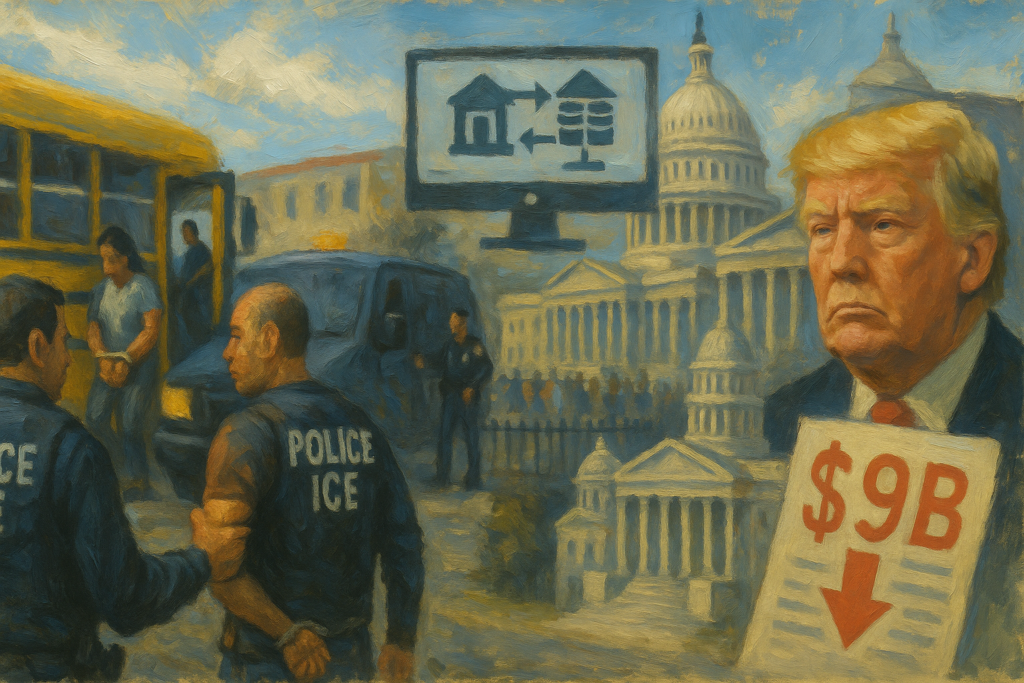
Congress, meanwhile, advanced a rescissions package that would reshape the information and diplomatic landscape. The Senate moved forward with a $9 billion bill demanded by Trump, targeting $1.1 billion for the Corporation for Public Broadcasting and about $8 billion in foreign aid. Some $400 million in cuts to the PEPFAR HIV/AIDS program were reversed after negotiations, but the core reductions remained. The House had already passed a version and would revisit the bill later in the week. These budget moves came as the administration dismantled the U.S. Agency for Global Media and sued members of the Corporation for Public Broadcasting, signaling a coordinated squeeze on independent public media and U.S. soft power.
The struggle over political representation intensified as well. Trump told Texas Republicans he wanted a “simple redraw” of the state’s congressional map to gain up to five new GOP seats, and state leaders prepared a special session to do so. Texas Attorney General Ken Paxton threatened to arrest Democrats who boycotted the session to deny a quorum, raising the stakes of legislative resistance. In response, California Governor Gavin Newsom floated the idea of redrawing his state’s 52 districts to counter Texas, even though an independent commission currently controls the process. His suggestion raised legal and constitutional questions and signaled that both parties were willing to challenge institutional guardrails in the fight over House control.
The Epstein saga returned to the House Rules Committee on Tuesday. Republicans met with Speaker Mike Johnson and agreed to vote down Democratic amendments tied to the case, preventing them from reaching the floor. Yet Johnson publicly urged DOJ to release more Epstein documents and explain its actions, creating a gap between his rhetoric and the procedural moves under his watch. Democrats demanded hearings with Attorney General Bondi and FBI Director Kash Patel, while Senator Dick Durbin sought details on the deployment of 1,000 FBI agents to the case. The contrast between public calls for transparency and private blocking of disclosure highlighted how procedural control can be used to manage politically dangerous information.
Economic pressures from the weekend’s tariffs began to surface. As higher duties on EU and Mexican imports, including Mexican tomatoes, started to feed into prices, inflation concerns grew. Rather than acknowledge the trade-offs, Trump used social media to accuse Senator Adam Schiff of mortgage fraud, a move widely seen as an attempt to distract from economic fallout. At the same time, cuts at the Bureau of Labor Statistics increased the share of prices that had to be estimated, weakening the quality of official inflation data. In the judicial sphere, more than 75 former judges urged the Senate Judiciary Committee to reject Emil Bove’s nomination to a federal appeals court, citing a record of disregarding court orders. Yet DOJ had already found ways to bypass Senate confirmation in other cases, reappointing a rejected interim U.S. attorney as a “special attorney” with similar powers and no time limit.
By Wednesday, the human toll of the immigration crackdown was unmistakable. Follow-on reporting detailed ICE raids at licensed cannabis farms in Southern California that used tear gas and less-lethal munitions, injuring workers and arresting around 200 people, including a disabled veteran. A 57-year-old farm worker, Jaime Alanís, died after falling from a greenhouse roof while trying to hide. Professor John Caravello, known for immigrant advocacy, was arrested and charged with assaulting a federal officer during a related raid. In Los Angeles, ICE used Terminal Island—a site with a history of Japanese American incarceration during World War II—as a staging ground for workplace raids that detained nearly 2,800 people. The choice of location drew protests and historical comparisons, underscoring how enforcement tactics and symbols can revive memories of past mass detentions.
Against this backdrop, Baltimore offered a contrasting model of public safety. Reports highlighted the city’s Safe Streets program, Group Violence Reduction Strategy, school-based interventions, and summer youth engagement efforts. Run in partnership with community organizations and researchers, these initiatives were associated with double-digit reductions in shootings and homicides in key neighborhoods, and sharp drops in youth victimization during summer months. The juxtaposition of militarized immigration raids in California and community-led violence reduction in Baltimore illustrated divergent approaches to security and social order.
In Washington, the Senate pressed ahead with the rescissions package, keeping in place deep cuts to the Corporation for Public Broadcasting and foreign assistance while sparing some PEPFAR funds. The narrow majority was enough to move the bill forward, signaling a durable shift in budget priorities away from public information and international engagement. Separately, the administration quietly rolled back export controls on advanced chip design software and allowed Nvidia and AMD to resume sales of certain AI chips to China. The reversal was seen as a win for U.S. chipmakers but raised questions about the coherence of U.S. strategy toward a key strategic rival. On climate and infrastructure, a coalition of 20 states filed suit against the administration over cuts to a FEMA grant program for resilience projects, arguing that the reductions unlawfully undermined disaster preparedness. The lawsuit, combined with earlier moves to halt NOAA’s rainfall tool and weaken FEMA’s call centers, showed states turning to the courts to preserve funding in the face of shifting federal priorities.
Thursday concentrated many of the week’s themes. The Justice Department abruptly fired Maurene Comey, a federal prosecutor who had worked on the Epstein and Ghislaine Maxwell cases and is the daughter of former FBI Director James Comey. Multiple accounts described the firing as unexplained and tied it to a broader pattern of dismissals of DOJ ethics and career officials. On the same day, DOJ moved to unseal Epstein grand jury transcripts with redactions, while Senator Ron Wyden pressed for access to Epstein’s financial network. Trump, meanwhile, filed sweeping libel suits against the Wall Street Journal, Rupert Murdoch, and others over Epstein-related reporting. The combination of firing a key prosecutor, selectively unsealing records, and suing media outlets raised questions about whether the justice system was being used to protect or expose powerful figures.
Congress finalized the $9 billion rescissions package, eliminating $1.1 billion for the Corporation for Public Broadcasting and slashing about $8 billion in foreign assistance, while sparing some PEPFAR funds. The bill, driven by Trump, now awaited his signature. Coming on top of efforts to dismantle the U.S. Agency for Global Media and sue public broadcasting board members, the package consolidated a broader campaign against publicly funded media and international programs. In the civil service, Trump signed and implemented an executive order creating Schedule G in the excepted service, reclassifying many policy-making and policy-advocating roles as noncareer positions that can be more easily hired and fired. Framed as improving operations at agencies like the VA, the order effectively expanded the number of positions that could be filled with loyalists and cleared out after elections, weakening the traditional firewall between political appointees and career experts.
Voting rights took another hit as the Florida Supreme Court upheld a congressional map championed by Governor Ron DeSantis that dismantled a district where Black voters had significant influence, splitting it into four majority-white districts. The court rejected challenges under the state’s Fair Districts Amendment, concluding that non-diminishment requirements could not be met without race predominating. The ruling cemented a map that diluted Black voting power and signaled judicial tolerance for aggressive partisan gerrymandering. On the immigration front, reports revealed that the administration had agreed to let ICE access Medicaid data, including addresses and Social Security numbers, to locate migrants, despite internal warnings about legal risks. This followed earlier plans to share IRS data and came as masked, out-of-uniform ICE agents conducted mass deportation raids across communities, contributing to a sharp drop in public approval for Trump’s immigration policies.
Judicial and policing decisions added to perceptions of unequal accountability. Republican senators on the Judiciary Committee advanced Emil Bove’s appeals court nomination despite a Democratic walkout and whistleblower allegations that he had advocated ignoring court orders. Separately, DOJ recommended just a one-day sentence for former officer Brett Hankison in the Breonna Taylor civil-rights case, arguing he had not injured anyone and had already suffered enough through the process. In the legislative arena, Representative Randy Fine announced plans to end the House’s subscription to the Wall Street Journal after its story about Trump and Epstein, while Trump’s libel suits against the paper and Murdoch continued. Nationwide protests under the banner “Good Trouble Lives On” honored John Lewis and called for voting rights and justice, underscoring public resistance to these trends even as institutional power was used to retaliate against critical media.
By Friday, the Epstein saga reached a partial and tactical turning point. Facing pressure from supporters, lawsuits, and congressional scrutiny, Trump ordered Attorney General Bondi to release Epstein grand jury testimony, reversing weeks of dismissing the controversy as a “hoax.” DOJ had already moved to unseal transcripts with redactions, and Senator Wyden was probing Epstein’s financial network. At the same time, Trump’s multibillion-dollar libel suits against the Wall Street Journal and Rupert Murdoch remained in play, and Maurene Comey’s firing continued to draw criticism. The sequence showed how the same actors could both open and close the record, using transparency as a tool rather than a consistent principle.
The consequences of Schedule G became visible at the Department of Veterans Affairs. The VA banned LGBTQ+ pride flags at its hospitals, shut down an office investigating why Black veterans’ mental-health claims are more often rejected, ended gender-affirming care for transgender veterans, and removed explicit anti-discrimination language from hospital bylaws. VA leaders cited executive orders and formalities, but lawmakers and advocates warned that these changes would invite discrimination and harm vulnerable veterans’ access to care. These moves, enabled by easier reclassification and removal of policy staff, sent a powerful signal about whose needs are prioritized in federal health systems.
Immigration enforcement and information control converged again at week’s end. Reports described masked, out-of-uniform ICE agents conducting mass deportation raids across communities, deepening fears and contributing to a sharp decline in public approval for Trump’s immigration policies. In parallel, cuts at the Bureau of Labor Statistics forced the agency to estimate a much larger share of prices, weakening the reliability of inflation data. Together with earlier decisions to withhold climate reports and halt NOAA tools, these steps fueled concerns that both enforcement and information systems were being reshaped to serve political narratives rather than public understanding. Elsewhere, Congress enacted the GENIUS Act to bolster U.S. innovation and technology, while a study of California’s $20 fast-food minimum wage found a 3.2 percent employment decline in the sector, roughly 18,000 jobs. California also announced $101 million for low-income housing targeted to ex-prisoners and people leaving institutions, highlighting the complex trade-offs between growth, equity, and public acceptance.
Taken together, the week’s events traced a pattern of concentrated power and contested resistance. Immigration enforcement grew more militarized and data-driven, reaching into schools, workplaces, and health programs, even as courts and communities mounted scattered challenges. The civil service and independent institutions—from the Department of Education to the VA, from public broadcasters to climate and economic data agencies—faced politicization and budget cuts that weakened their capacity to provide neutral expertise and reliable information. Battles over maps, media, and the Epstein files showed how procedure, secrecy, and selective disclosure can shape who is represented, what the public learns, and how accountability is enforced. Against this backdrop, state lawsuits, community programs, and public protests offered countervailing forces, but the balance of institutional power continued to tilt toward an executive willing to use law, budget, and bureaucracy to redefine the terms of democratic life.