This week’s throughlines
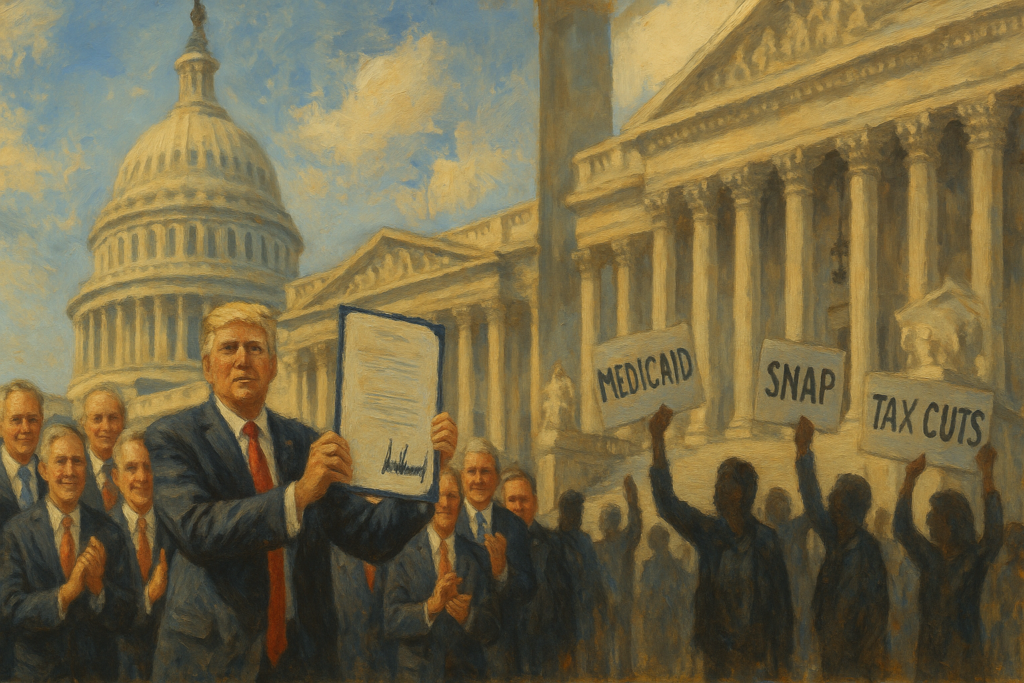
- The domestic megabill moved from procedural fight to enacted law — What began as a narrow Senate advance became the week’s central story: a sweeping bill moved through debate, rule-bending, House pressure, and final passage before Trump signed it on July 4.
- Immigration enforcement expanded in law, infrastructure, and rhetoric — The administration paired legal and rhetorical escalation with material expansion: TPS cuts, denaturalization priorities, new detention capacity, more ICE funding, and repeated high-profile detention and deportation fights.
- Judicial and procedural checks were narrowed, contested, or selectively restored — The Supreme Court reduced the reach of nationwide injunctions, Senate Republicans pushed past procedural referees, and lower courts alternately blocked firings, protected TPS holders, and struck down the asylum ban.
- Pressure spread across media, education, and public information — The administration and its allies threatened reporters, leaned on universities and schools, and removed or distorted public information, showing how political pressure was extending beyond formal lawmaking.
The week opened with a legislative gamble and closed with a signature. Over seven days, a sprawling tax-and-spending package moved from late-night Senate maneuvers through a bruising House fight to a July 4 signing ceremony. Along the way, courts narrowed the tools available to check the presidency, immigration enforcement hardened on the ground, and universities, media, and regulators felt new forms of political pressure. The result was a visible shift in how power, money, and rights are distributed in American life.
Over the weekend, Senate Republicans began the heavy lift of advancing Donald Trump’s flagship “megabill.” Using reconciliation—a process that lets certain budget-related bills pass with a simple majority and limited debate—they pushed the package forward on 51–49 votes. Early drafts extended and expanded the 2017 tax cuts, added new breaks for businesses and high earners, and proposed nearly $1 trillion in Medicaid cuts. They also boosted funding for Immigration and Customs Enforcement (ICE), imposed new taxes on renewable energy, and rewarded coal production. The Senate parliamentarian, a nonpartisan official who interprets chamber rules, warned that several provisions violated reconciliation limits, foreshadowing a clash between procedural norms and political goals.
The same weekend brought aggressive uses of executive and judicial power outside the budget arena. Following large-scale U.S. airstrikes on Iranian nuclear facilities, the Senate rejected a resolution that would have required Trump to seek congressional authorization for further escalation. The failed war-powers curb left decisions about additional military action concentrated in the White House, reinforcing a long-running drift of war-making authority away from Congress. At the Supreme Court, decisions limiting lower courts’ ability to issue nationwide injunctions—orders that block a policy across the entire country—made it harder for a single judge to halt federal actions. In one case involving Trump’s order restricting birthright citizenship, the Court declined to fully block the policy, allowing partial enforcement even as it sidestepped the core constitutional question of who is a citizen at birth.
On the ground, immigration enforcement over the weekend reflected the priorities embedded in the emerging budget. ICE raids targeted people with deep ties to the United States, including relatives of veterans and long-term residents. Reports described agents using explosive entries into homes, arresting people at routine check-ins, and deporting individuals born on U.S. military bases abroad. A 75-year-old Cuban man died in custody amid accounts of overcrowded, unsanitary detention centers. At the same time, a Senate budget proposal envisioned dramatically expanding ICE’s funding and jail capacity, signaling that these tactics were not temporary surges but part of a planned, larger system.
Other institutions also felt the weight of executive direction. With no confirmed director at the Centers for Disease Control and Prevention, Health and Human Services Secretary Robert F. Kennedy Jr. assumed direct control over the agency. He dismissed 17 independent vaccine advisers and installed less-experienced replacements, who quickly voted to ban a preservative from some flu vaccines. Public health experts warned that sidelining independent scientific advisers in favor of political appointees undermined the CDC’s credibility and could invite legal challenges. Meanwhile, economic data showed the U.S. dollar having its worst first half since 1973 and GDP contracting by 0.5% in the first quarter of 2025, complicating administration claims that large tax cuts and spending hikes would pay for themselves through growth.
By Monday, the use of executive orders to reshape policy had accelerated. Trump signed an order pledging federal legal resources and indemnification for law enforcement officers facing civil or criminal claims, directing enhanced sentences for crimes against them, and encouraging federal prosecution of officials seen as obstructing police. In a separate order, he revoked major sanctions on Syria and ended a longstanding national emergency, shifting U.S. policy toward the new Syrian government with little congressional input. Both moves strengthened coercive state power—shielding officers from accountability and centralizing foreign economic policy in the presidency.
The Justice Department, for its part, issued a memo directing attorneys to prioritize civil denaturalization cases against naturalized citizens accused of certain crimes. Because denaturalization is a civil process, the government can proceed under a lower burden of proof and defendants are not guaranteed counsel. Reporting emphasized that millions of naturalized Americans could face heightened scrutiny, effectively creating a more fragile tier of citizenship. This came against the backdrop of the Supreme Court’s narrowing of nationwide injunctions and partial green light for Trump’s birthright citizenship order, together making citizenship status more contingent and harder to defend in court.
Inside the Senate, Republicans began to override their own procedural referees to keep the megabill alive. After the parliamentarian informed members that several Alaska-focused Medicaid and spending provisions violated reconciliation rules, party leaders chose not to pare back the bill. Instead, they moved toward bypassing the parliamentarian and adopting a “current policy baseline” that treated trillions in existing tax cuts as if they were already permanent and therefore costless. This accounting shift laid the groundwork to ignore traditional deficit constraints and weakened internal checks designed to keep budget law honest.
Elsewhere on Monday, universities and schools came under new financial and political pressure. The House passed a budget that would raise the endowment tax on wealthy universities like Stanford from 1.4% to as high as 21%, potentially costing hundreds of millions of dollars annually. The administration sent Harvard a letter accusing it of failing to address antisemitism and threatening to withdraw federal funding, while the University of Pennsylvania agreed to bar transgender women from women’s sports under federal pressure. Sixteen Democratic attorneys general sued over the termination of more than $1 billion in school-based mental health funding created after the Uvalde shooting, and the Education Department began withholding nearly $7 billion in K–12 and adult education funds despite statutory requirements to disburse them. These moves tied university and school finances to compliance with contested political demands, testing the limits of executive discretion over congressionally appropriated money.
Tuesday marked a turning point in the legislative fight. After an all-night “vote-a-rama” of amendments, the Senate approved Trump’s sweeping megabill on a 50–50 vote, with Vice President JD Vance breaking the tie. The package permanently extended and expanded prior GOP tax cuts, imposed work requirements and deep cuts on Medicaid and the Supplemental Nutrition Assistance Program (SNAP), allocated roughly $170 billion for immigration enforcement and border wall construction, and phased out incentives for green energy. Two Republicans joined Democrats in opposition, citing concerns about deficits and policy substance, but the narrow victory set the stage for final enactment.
On the same day, Florida Governor Ron DeSantis announced the opening of the “Alligator Alcatraz” migrant detention center in the Everglades. Initially designed to hold 1,000 detainees with plans to expand to 5,000, the facility sits on environmentally sensitive land and is built for harsh conditions. Backed by Trump and partly reimbursed by the Federal Emergency Management Agency, it quickly became a symbol of a new detention archipelago: large-scale, remote facilities with limited transparency. Environmental groups sued to halt construction, arguing that required environmental studies had been skipped, and later in the week Democratic lawmakers would be denied entry to inspect the site.
The day also illustrated how personal feuds could intersect with public policy. After Elon Musk publicly blasted the budget bill as fiscally reckless and announced plans for a new “America Party” to fund primary challengers against supportive Republicans, Trump responded by suggesting cuts to federal subsidies for Musk’s companies and musing about deporting the South Africa–born billionaire. Given Musk’s deep reliance on federal contracts and subsidies, the episode showed how subsidy policy and immigration rhetoric could be wielded as tools of presidential retaliation rather than neutral instruments of economic planning.
Courts on Tuesday offered a mixed picture of constraint and deference. A federal judge temporarily blocked mass firings at the Department of Health and Human Services as “arbitrary and capricious,” and another halted the administration’s attempt to terminate Temporary Protected Status (TPS) for up to 500,000 Haitians. A federal appeals court rejected an effort to detain Georgetown scholar Badar Khan Suri during his deportation fight. Yet in another case, a judge ordered Kilmar Abrego Garcia kept in custody to prevent immediate deportation, underscoring how relief for immigrants and civil servants remained case-by-case and fragile. At the regulatory level, OSHA revoked requirements to consult its construction safety advisory committee and shrank the committee’s size, while the Labor Department announced plans to roll back more than 60 worker-protection rules, shifting the balance of rulemaking toward employers.
By Wednesday, attention shifted to the House, where Trump personally leaned on Republicans to accept the Senate bill without changes. Facing resistance from members worried about the bill’s cuts and deficit impact, he met with holdouts, threatened to back primary challengers, and urged the Freedom Caucus not to “give Democrats a win” by demanding amendments that could slow or derail the process. House leaders kept a procedural vote open for more than two hours while searching for flipped votes, and reporters described frantic efforts to locate Rep. Brian Fitzpatrick after he unexpectedly voted no. The episode showed how presidential pressure and procedural tactics could override substantive concerns among lawmakers about a bill that would reshape taxes, healthcare, and climate policy for a decade or more.
In the background, the Supreme Court’s earlier decision in Trump v. United States loomed large. Reporting revisited the 2024 ruling, which granted presidents absolute immunity from criminal prosecution for official acts. Combined with the Court’s new limits on nationwide injunctions and its willingness to allow partial enforcement of Trump’s birthright citizenship order, the decision significantly weakened legal tools for holding presidents accountable. On the same day, a coalition of 20 states led by California sued the administration for releasing Medicaid data to the Department of Homeland Security for immigration enforcement, arguing that the data-sharing violated privacy laws and would deter people from seeking care. Separately, federal courts struck down Trump’s “invasion” proclamation and resulting asylum ban, and blocked a January asylum ban, finding that the president had exceeded his authority. These cases tested whether health and asylum laws could be repurposed for enforcement without breaching statutory and constitutional limits.
Other developments on Wednesday pointed to a politicization of oversight and elections. In Georgia’s DeKalb County, a staunch election denier was appointed to the county elections board, raising fears about future voter challenges and certification fights. In Congress, a bill was introduced to conduct a citizens-only census and redraw House districts accordingly, a move that would reduce representation for areas with many noncitizens. At the federal level, CNN reported that Trump’s pick to lead the Office of Special Counsel, which protects whistleblowers and investigates certain misconduct, had spread 9/11 conspiracy theories and defended figures like Alex Jones. A former January 6 defendant was revealed to be advising a Justice Department “weaponization working group.” Together, these moves signaled a justice and election infrastructure increasingly staffed by loyalists and conspiracy theorists.
Thursday brought the House showdown on the megabill. House Democratic Leader Hakeem Jeffries used his “magic minute”—a rule allowing party leaders to speak at length—to deliver an eight-hour floor speech, the longest in House history. He detailed how the $4.5 trillion bill would cut Medicare, Medicaid, and nutrition programs for children and families, framing it as a transfer of wealth from the poor to the rich. The speech delayed the vote and ensured that the bill’s human impact was laid out in the congressional record before an irreversible decision.
After days of internal conflict, House Republicans ultimately swallowed the Senate bill unchanged. In a narrow vote—218–214 or 219–213, depending on the roll call—the House passed the Senate’s version without amendments. Only two Republicans, Thomas Massie and Brian Fitzpatrick, voted no. The final package made permanent many 2017 tax cuts, imposed strict work requirements and deep cuts on Medicaid and SNAP, funded mass deportations and border wall construction, and phased out green energy incentives, while raising the debt ceiling by $5 trillion. With both chambers aligned, the bill was ready for the president’s signature.
The Supreme Court also weighed in on education and LGBTQ+ rights that day. In Mahmoud v. Taylor, the Court ruled that parents in a Maryland district could opt their children out of lessons featuring LGBTQ+ themes on religious grounds. Advocates warned that the decision could encourage broader censorship and further marginalize queer students. The Court agreed to hear appeals from Idaho and West Virginia defending bans on transgender girls and women in female sports teams, setting up a major test of Title IX and equal protection. In another immigration case, the Court cleared the way for eight men held on a U.S. military base in Djibouti to be deported to South Sudan, overruling a lower court that had required an opportunity to show risk of torture or persecution. Two liberal justices dissented, warning of the dangers the men could face, but the majority deferred to executive removal decisions.
Regulatory agencies continued to tilt toward institutional and corporate interests. The Environmental Protection Agency launched a program to let the public adopt some of its 20,000 lab animals even as it pursued plans to cut at least 1,000 scientists from its research arm and shift to short-term projects. A 2024 lawsuit alleging Clean Water Act violations over sewage sludge spreading and PFAS contamination moved forward, potentially forcing stricter regulation of a widespread pollution source at a time when the agency’s research capacity was shrinking. The Federal Communications Commission announced it would suspend enforcement of a 2024 rule capping in-state prison and jail phone rates until April 2027, delaying a cut that would have reduced a 15-minute call from as much as $11.35 to $0.90. Citing “financial burdens” on facilities that had relied on kickbacks from phone providers, the commission drew criticism for siding with institutional revenue streams over the ability of incarcerated people to maintain family ties.
On Independence Day, Trump held a White House celebration to sign the One Big Beautiful Bill Act and related measures into law. The new law permanently extended the 2017 tax cuts and added new deductions, especially benefiting higher earners and certain businesses. It imposed strict work requirements and deep cuts on Medicaid, SNAP, and Medicare, including terminating coverage for many legal immigrants. It allocated roughly $170 billion for immigration enforcement and border wall construction, phased out clean energy incentives, and was projected to add at least $3.3–3.9 trillion to the deficit over a decade. In effect, it locked in a long-term shift toward lower taxes on wealth and higher barriers to basic supports, while massively expanding enforcement budgets.
The same day, incidents around immigration enforcement illustrated how those budgets and authorities might be used. In Los Angeles County, a school district demanded a federal investigation after ICE agents were filmed urinating on the grounds of Ruben Salazar High School while staging for a raid, behavior the district said could constitute lewd conduct. The episode offered a small but vivid vignette of how enforcement operations intersect with everyday civic spaces like schools. In Florida, five Democratic lawmakers were denied entry to the newly opened Alligator Alcatraz detention facility, which is managed by the state and partly funded by FEMA. The Department of Homeland Security refused to disclose how many people were being held there. The combination of everyday misconduct and structural barriers to oversight underscored the challenges of monitoring an expanding detention system.
Not every immigration story ended in continued confinement. Ward Sakeik, a stateless Palestinian who has lived in the United States since childhood, was released from ICE detention after more than four months. She had twice faced attempted deportations despite a federal court order barring her removal, and was ultimately freed after she and her American husband filed applications for permanent residency. Her case illustrated both the risks of executive defiance of court orders and the possibility of relief through persistent legal advocacy, even as broader policies moved toward more punitive enforcement.
Across the week, pressures on media and universities formed a quieter but important backdrop. Paramount’s $16 million settlement with Trump over a 2024 “60 Minutes” interview with Kamala Harris prompted Senator Elizabeth Warren to call for an investigation into whether the deal amounted to “bribery in plain sight.” Trump dropped a federal lawsuit against a prominent Iowa pollster and newspaper over an unfavorable 2024 poll, only to refile in state court, a form of forum shopping that can chill independent polling. The administration’s threats to Harvard’s funding and its leverage over Penn’s policies on transgender athletes showed how financial and regulatory tools could be used to discipline institutions that shape public debate and knowledge.
Taken together, the week’s events marked a consolidation of power in the executive branch and its allies in Congress, reinforced by a Supreme Court that has expanded presidential immunity and narrowed the reach of nationwide injunctions. The new law reorders fiscal priorities toward tax relief at the top and enforcement at the border, while cutting back on healthcare, nutrition, and environmental support. Courts and states still mounted challenges—blocking some asylum bans, protecting certain immigrants, and suing over data-sharing—but these were often narrow and reactive. As detention centers rose in remote wetlands, as universities weighed their budgets against political demands, and as oversight bodies filled with loyalists, the institutional landscape of American democracy shifted toward a model in which formal checks exist but are harder to activate, and where the consequences of policy choices are felt most sharply by those with the least power to influence them.