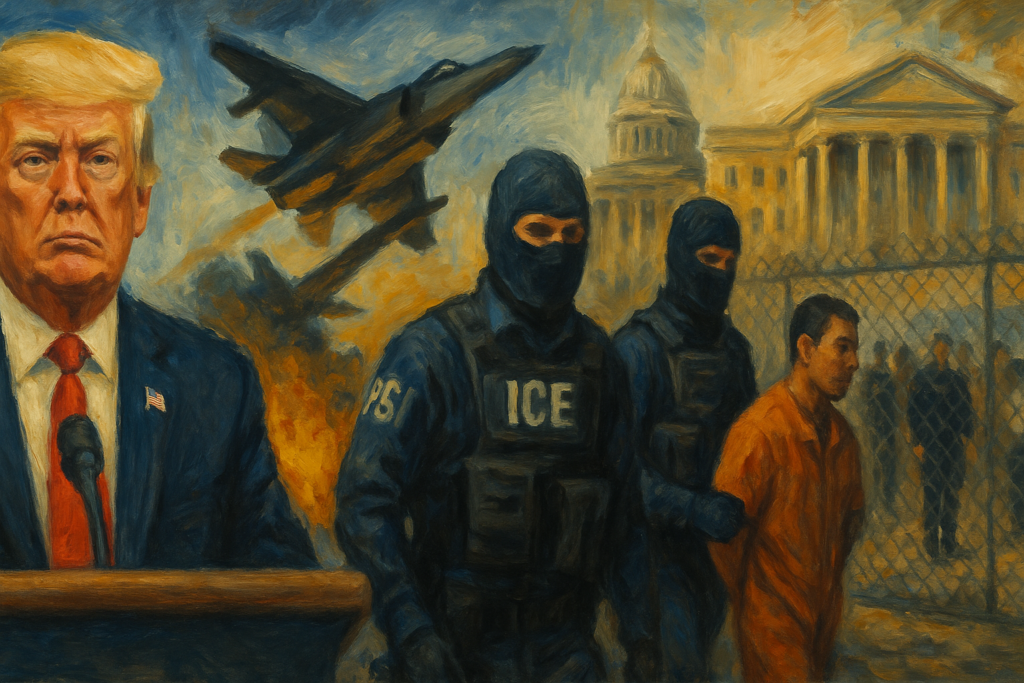
This week’s throughlines
- The Iran strike became a fight over truth and oversight — The week moved from a unilateral military strike to a sustained campaign over its justification and results: disputed intelligence, conflicting damage assessments, attacks on reporters, and new limits on what Congress could see.
- Immigration enforcement widened from raids to detention expansion and oversight conflict — Aggressive raids, courthouse arrests, detention deaths, new jail plans, TPS termination, and efforts to speed deportations all pointed in the same direction: more coercive enforcement with weaker due-process protections and more friction with courts and lawmakers.
- Courts both checked and empowered executive action — Lower courts blocked or questioned several administration moves, but the Supreme Court repeatedly narrowed those checks—most consequentially by limiting nationwide injunctions and allowing broader room for executive action while litigation continues.
- Federal pressure on institutions spread beyond immigration — The administration and its allies pressed universities, public media, and public health bodies through investigations, firings, leadership pressure, and politicized appointments, extending the week’s pattern of control into education, media, and science.
The week opened with American bombers over Iran and closed with a political assassination at home, framed by a Supreme Court term that shifted power toward the executive and a deepening immigration crackdown. Across seven days, decisions about war, borders, and information repeatedly tested how far presidential authority can stretch against the country’s legal and institutional guardrails.
Over the weekend, President Trump ordered large-scale airstrikes on Iran’s Fordow, Natanz, and Isfahan nuclear facilities without seeking congressional authorization or a formal declaration of war. B‑2 bombers and bunker-busting munitions hit sites that had been at the center of years of international negotiations. Trump immediately declared the operation a “spectacular military success,” insisting that Iran’s enrichment capacity had been destroyed. Within hours, however, international monitors and U.S. intelligence suggested that key materials had been moved in advance and that the program was likely delayed by months, not eliminated. Iran’s leadership announced that “war has begun,” threatened to close the Strait of Hormuz to Europe-bound shipping, and imposed new restrictions on maritime traffic. Freight rates to alternative ports spiked, oil companies began evacuating foreign staff from Iraqi fields, and the risk of a broader energy shock became clear.
The strikes also exposed a widening gap between professional intelligence assessments and political messaging. Over the weekend, Trump and senior officials publicly rejected the U.S. intelligence community’s March conclusion that Iran was not actively pursuing a nuclear weapon. The president dismissed his own Director of National Intelligence’s testimony as wrong, while Vice President J.D. Vance and Secretary of State Marco Rubio leaned heavily on Israeli intelligence claims to justify the attack. This sidelining of U.S. analysis set the stage for later disputes over whether the operation had been necessary or effective, echoing earlier episodes in which intelligence was reshaped to fit a desired policy.
At home, the same weekend saw a sharp escalation in immigration enforcement. Trump ordered thousands of National Guard troops and Marines into Los Angeles to support aggressive ICE raids that had already drawn protests and resistance from local officials. Reports described masked agents conducting street arrests, record detention levels, and at least one detainee death in transit amid privatized transport and thin oversight. The militarized presence blurred the line between domestic law enforcement and military deployment. Yet even as the administration widened its campaign, federal judges intervened in individual cases: a court ordered the release of Palestinian activist Mahmoud Khalil after months in ICE custody and flagged due process concerns in other detentions, signaling an emerging clash between enforcement agencies and the judiciary.
The president also kept domestic politics on a combative footing. Over the weekend he renewed calls for a special prosecutor to investigate long-debunked claims of widespread fraud in the 2020 election, keeping a false narrative of a stolen race in circulation. Vice President Vance, in a separate appearance, misnamed Senator Alex Padilla as a notorious criminal, a gaffe widely read as an attempt to associate a Democratic lawmaker with criminality. These moves reinforced a pattern in which political opponents and past elections are cast as illegitimate, even as the administration exercises expansive powers abroad and at the border.
By Monday, Congress began to respond to the Iran strikes, but cautiously. House and Senate Democrats, including several military veterans, introduced War Powers resolutions aimed at limiting Trump’s authority to continue hostilities without explicit authorization. The War Powers Resolution, passed after Vietnam, is meant to force presidents to seek congressional approval for sustained military action. Some Republicans, notably Representative Thomas Massie, joined in criticizing the strikes. The administration canceled a classified House briefing on the operation, and Trump attacked Massie on social media. Despite the rhetoric, the Republican-controlled chambers showed little appetite for a direct confrontation, foreshadowing the House’s later decision to table impeachment articles over the strikes and illustrating how formal checks can exist on paper but falter in practice.
The Supreme Court, meanwhile, moved in the opposite direction on immigration. In brief orders on Monday, the Court allowed the administration to deport migrants to countries other than their own—including conflict zones—while lawsuits over those policies continue. By staying lower-court rulings that had required a meaningful chance to claim fear of torture or persecution, the Court effectively let contested practices proceed first and be litigated later. In a separate case, it granted the Department of Homeland Security a stay in a status dispute, further widening enforcement latitude. These decisions meant that even if migrants eventually win in court, the remedy may come too late to prevent removal.
Other legal challenges sought to rein in the administration’s use of emergency powers. A New York judge blocked Trump’s attempt to invoke the Alien Enemies Act to mass-deport Venezuelan migrants, finding the move exceeded the statute’s scope. California and other states sued over a national “energy emergency” declaration that fast-tracks fossil fuel projects, arguing that the emergency label was being used to bypass normal environmental and permitting processes. Another lawsuit contested the federalization of California’s National Guard to police protests in Los Angeles. Together, these cases showed states and lower courts testing whether they can still draw lines around when “emergency” justifies extraordinary federal action.
At the same time, new information deepened concerns about how immigration enforcement was being carried out. A whistleblower, former Justice Department lawyer Erez Reuveni, alleged that senior official Emil Bove had planned to ignore court orders blocking deportations under the Alien Enemies Act and to mislead judges about flights. Reports described masked agents detaining people on the street and deporting them with minimal process since January, with much of the work outsourced to private contractors and shielded from oversight. Against this backdrop, Trump publicly berated Federal Reserve Chair Jerome Powell for not cutting interest rates and his media company announced a $400 million share buyback, underscoring how presidential pressure on independent institutions and private financial maneuvers were unfolding alongside the security and immigration fights.
On Tuesday, the House faced its most direct test over war powers and stepped back. Lawmakers voted to table articles of impeachment against Trump for ordering the Iran strikes without congressional approval, with only 79 Democrats supporting the effort. The vote effectively ended, at least for now, the most forceful attempt to hold the president accountable for bypassing Congress on war-making. The decision signaled how high the bar has become for using impeachment as a check on unilateral military action, even when many members question its legality.
Immigration courts and lawyers spent Tuesday grappling with the consequences of enforcement that sometimes ran ahead of, or against, judicial orders. The Second Circuit ordered the government to locate and return Jordin Melgar-Salmeron, who had been deported to El Salvador less than 30 minutes after a court barred his removal. Lawyers for Kilmar Abrego Garcia sought emergency relief to prevent his deportation to a third country, fearing the administration would move abruptly despite pending proceedings. At the same time, the Justice Department sued Maryland judges over a rule requiring a one-day delay before deportations, arguing it interfered with federal authority. These disputes underscored a basic question: whether immigration agencies must treat court stays as binding commands or as obstacles to be worked around.
On the ground, the human toll of the crackdown became clearer. In Los Angeles, ICE raids were linked to sharp spikes in missed medical appointments and widespread fear, including the wrongful detention of U.S. citizens. A Honduran mother and her children, including a six-year-old with leukemia, sued after being arrested at a courthouse. Federal and private actors moved to expand the physical infrastructure of detention: DHS and contractor CoreCivic advanced plans to convert a shuttered California prison into the state’s largest immigration jail, while Florida officials pushed ahead with a massive Everglades facility. The combination of aggressive street-level enforcement and new long-term detention complexes suggested that what began as a surge was hardening into a permanent system.
Reuveni’s whistleblower letter, made public Tuesday, added detail to concerns about the Justice Department’s role. He alleged that Bove had urged subordinates to ignore court orders blocking deportations and to misrepresent flight plans to judges. Bove denied the claims in later testimony, but the allegations, combined with cases like Melgar-Salmeron’s, raised doubts about whether the department charged with enforcing the law was itself treating judicial rulings as optional. Amid these national struggles, New York City politics offered a contrasting vision: mayoral candidate Zohran Mamdani outlined a platform centered on rent freezes, higher taxes on corporations and millionaires, large-scale affordable housing, city-owned grocery stores, free buses, and universal childcare. His agenda highlighted how local governments can propose expansive social policies even as federal priorities tilt toward austerity and enforcement.
By Wednesday, the battle over the Iran strikes had shifted from bombs to information. A leaked Defense Intelligence Agency assessment concluded that the strikes had only set back Iran’s nuclear program by a few months and that much enriched uranium had been moved beforehand. The White House dismissed the report as inaccurate, while Trump and Defense Secretary Pete Hegseth doubled down on claims of a “total success,” including at a NATO summit. Hegseth announced a criminal investigation into the leak and accused the press of misrepresenting the operation, as the administration prepared a news conference aimed at rebutting critical coverage. The clash highlighted how difficult it becomes for Congress and the public to evaluate war when internal assessments and official narratives diverge sharply.
In response to the leak, the administration moved to tighten control over classified information. Officials signaled plans to restrict congressional access to intelligence, and reports indicated that future briefings would be more limited. Congressional Democrats denounced the move as an attempt to hide the truth about the Iran strikes and to evade legal obligations to keep lawmakers informed on national security matters. Limiting access to intelligence weakens one of Congress’s core tools for overseeing war and foreign policy, especially when the executive is already acting without prior authorization.
The administration also accelerated efforts to reshape media and public information. It authorized the termination of 639 Voice of America employees, the final phase of a campaign that has eliminated roughly 1,400 positions since March and effectively dismantled the U.S. Agency for Global Media. Trump urged Republicans to defund VOA entirely and publicly demanded the firing of a CNN Pentagon correspondent over her Iran coverage, despite a federal judge’s earlier criticism of the administration for failing to comply with an injunction related to VOA firings. These moves, combined with attacks on journalists covering the strikes, concentrated more control over international broadcasting and signaled a willingness to punish critical reporting.
Public health governance was undergoing its own transformation. Health Secretary Robert F. Kennedy Jr. continued to overhaul vaccine policy by appointing new members with anti-vaccine leanings to the CDC’s Advisory Committee on Immunization Practices. The reconstituted panel voted to restrict thimerosal in flu vaccines despite a lack of evidence of harm, and a CDC presentation cited a nonexistent study on thimerosal’s brain effects. RFK Jr. also announced that the United States would pull funding from the global vaccine alliance Gavi, accusing it of silencing dissent. These steps, taken as the Supreme Court affirmed the health secretary’s power over preventive-care task forces, embedded vaccine skepticism inside official advisory bodies and weakened global immunization efforts.
Back in the justice system, Emil Bove’s Senate Judiciary Committee hearing for a federal appeals court seat brought internal disputes into public view. Senators questioned him about whistleblower claims that he had urged prosecutors to ignore deportation court orders, dropped corruption charges against New York’s mayor to secure immigration cooperation, and purged staff who worked on January 6 cases. Bove denied wrongdoing, but the hearing crystallized concerns that prosecutorial discretion and personnel decisions were being used to advance the president’s political agenda. If confirmed, he would carry that record onto the bench, potentially entrenching a more executive-aligned judiciary.
Immigration enforcement continued to grow more opaque. Reports showed ICE detainee numbers rising above 56,000, leading to overcrowded and unsanitary conditions. Videos captured Customs and Border Protection agents chasing an undocumented man with guns drawn, and multiple accounts described ICE and DHS officers increasingly wearing masks and casual clothing during raids and protests. Attorney General Pam Bondi claimed ignorance of the practice in a congressional hearing, despite video evidence. Restrictions on surprise congressional visits to detention facilities further limited oversight. When law enforcement hides its identity and blocks monitoring, it becomes harder for the public to distinguish lawful officers from impersonators and for abuses to come to light.
Florida’s plans for a new Everglades detention facility advanced as well. State officials and DHS moved forward with a 5,000-bed complex at a disused airfield, dubbed “Alligator Alcatraz,” to be staffed initially by National Guard troops and costing an estimated $450 million annually. The state seized 39 square miles of land from Miami-Dade County under emergency powers, drawing strong objections from environmental groups, the Miccosukee Tribe, and immigrant advocates. The project illustrated how emergency framing can be used to justify large, long-term detention infrastructure in sensitive environments, sidelining local and tribal voices.
The administration also pressed its agenda on education and social policy. It declared that California’s policies allowing trans athletes to compete violated Title IX and gave the state 10 days to change course or face enforcement. In Washington, the Senate parliamentarian ruled that several Republican additions to the budget reconciliation bill—including a Medicaid provider tax freeze and restrictions on transgender care and non-citizens’ access to benefits—could not pass under reconciliation rules. Some Republicans called for her firing, but Majority Leader John Thune chose to amend the bill instead, preserving at least one procedural check within the legislative branch.
Thursday brought a cluster of Supreme Court decisions that reshaped the legal landscape. In a series of rulings, the Court’s conservative majority curtailed lower courts’ ability to issue nationwide injunctions—orders that block a federal policy across the entire country—against executive actions, including Trump’s order targeting birthright citizenship. The Court held that such broad relief often exceeds statutory authority, limiting injunctions to the named plaintiffs or certified classes. It reaffirmed earlier stays allowing deportations to third countries while litigation proceeds and ruled that Medicaid beneficiaries cannot sue to enforce their right to choose providers, easing efforts by states to exclude Planned Parenthood from their programs. By narrowing who can sue and what remedies courts can grant, the Court made it harder to quickly halt contested policies and to protect rights for large groups at once.
In another decision, the Court upheld a Texas law requiring pornography websites to verify users’ ages with government IDs or transactional data, despite dissenting concerns about free speech and privacy. It also affirmed the constitutionality of the Affordable Care Act’s preventive-services mandate but clarified that the U.S. Preventive Services Task Force operates under the health secretary’s direct oversight. In the context of RFK Jr.’s recent appointments and vaccine moves, that clarification effectively increased the influence of a political appointee over which medical services insurers must cover, making scientific standards more vulnerable to ideological shifts.
The Court also weighed in on public education and LGBTQ+ representation. In Mahmoud v. Taylor and related cases, it ruled that public schools must allow parents with religious objections to withdraw their children from classroom activities that depict LGBTQ+ characters or themes. Justice Sonia Sotomayor’s dissent warned that districts might respond by removing such content altogether to avoid litigation. The ruling adds administrative burdens for schools and may narrow inclusive curricula, especially in districts wary of legal challenges, raising questions about how to balance religious accommodation with equal representation in civic education.
Outside the courts, the carceral turn in immigration policy continued. Florida’s attorney general and Governor Ron DeSantis advanced the “Alligator Alcatraz” plan, using emergency powers and federal funding from DHS and FEMA to lock in large-scale detention capacity. In higher education, University of Virginia President James Ryan resigned as part of a settlement with the Justice Department, which had investigated the university’s diversity, equity, and inclusion practices and accused it of prioritizing race in admissions and student life. A new DOJ investigation into the University of California’s hiring signaled a broader federal campaign to reshape university leadership and constrain DEI initiatives, using civil-rights enforcement tools to push institutions toward the administration’s ideological preferences.
Internationally, Trump announced the termination of all trade discussions with Canada in retaliation for its Digital Services Tax on U.S. tech companies and promised retaliatory tariffs within a week. Separately, a Foreign Assistance Review advised the State Department to terminate nearly all pro-democracy programs funded by the Bureau of Democracy, Human Rights, and Labor, potentially cutting about $1.3 billion in grants worldwide and preserving only two programs, in China and Yemen. These moves pointed to a more transactional, inward-looking U.S. posture, with less emphasis on supporting democratic institutions abroad. In the media sphere, California Governor Gavin Newsom filed a $787 million defamation suit against Fox News and host Jesse Watters, alleging that a deceptively edited clip misrepresented his communications with Trump about deploying troops to Los Angeles. The case, echoing earlier high-profile defamation battles, underscored how courts are increasingly being asked to referee partisan information disputes.
Friday brought the week’s most shocking act of domestic violence. Minnesota House Speaker Melissa Hortman, her husband, and their dog were killed in their home by a gunman posing as a police officer; another lawmaker and his wife were wounded in a related attack. The suspect, a self-described “prepper,” had previously been charged in the shootings and was found with weapons and a hit list. Hortman was a prominent advocate for environmental and low-income issues. The killings underscored the growing physical risks faced by public officials in a polarized climate and the way impersonation of law enforcement can be used to breach the basic security of elected leaders.
In New York, Zohran Mamdani’s rise from policy visionary to primary winner triggered a fierce backlash. Following his victory in the Democratic mayoral primary, he faced a wave of Islamophobic threats and political attacks. Representative Andy Ogles publicly labeled him an “antisemitic, socialist, communist” and urged the attorney general to begin denaturalization proceedings, citing terrorism-related statutes. The NYPD hate crimes taskforce opened an investigation into death threats, including voicemails threatening to blow up Mamdani’s car. House Homeland Security Committee Democrats condemned Ogles’ remarks as racist. The episode showed how denaturalization rhetoric and violent intimidation can be deployed to question whether a Muslim elected official belongs in American politics at all.
The Supreme Court’s nationwide injunction ruling, issued the day before, continued to reverberate. In Trump v. CASA and related cases, the Court formally limited lower courts’ ability to block executive orders across the country, including Trump’s attempt to restrict birthright citizenship. By narrowing injunctions to the named plaintiffs, the Court forced rights challenges into slower, piecemeal litigation and made it harder for a single district judge to halt a policy that affects millions. Liberal justices warned that the decision weakens a key tool for quickly stopping potentially unconstitutional actions, especially when Congress is reluctant to act.
Immigration enforcement remained a source of litigation and human-rights concern. The Honduran woman known as “Ms. Z” pursued her lawsuit after she and her children, including a six-year-old with leukemia, were arrested by ICE at a Los Angeles immigration court and detained in Texas. Lawyers for Kilmar Abrego Garcia continued to seek emergency orders to prevent his deportation to a third country, fearing abrupt removal despite ongoing proceedings. These cases added to a week of reports about wrongful arrests of U.S. citizens, record detention levels, and plans to deport people to countries with poor human-rights records, raising questions about proportionality and the integrity of legal process.
Even as federal power concentrated, states pursued their own economic strategies. The California legislature passed a measure to more than double annual film and TV production tax credits to $750 million, aiming to lure productions back from other jurisdictions and shape the state’s cultural and economic landscape. In Washington, Senate leaders prepared to begin voting on their version of Trump’s tax-and-spending bill by July 4, driven in part by overspending at DHS that threatened ICE funding. The earlier rulings by the Senate parliamentarian forced Republicans to rework key provisions, but leadership chose to respect her decisions rather than overrule them, preserving a measure of procedural constraint within the budget process.
Taken together, the week’s events traced a pattern: unilateral military action abroad, backed by disputed intelligence and followed by tighter secrecy; an immigration regime that combined masked enforcement, expanding detention infrastructure, and Supreme Court decisions that narrowed remedies for migrants; and a judiciary that, in case after case, shifted power toward the executive while trimming tools like nationwide injunctions and private enforcement of Medicaid rights. At the same time, public health, media, and universities came under pressure to align with the administration’s ideological priorities, and political violence and denaturalization rhetoric targeted elected officials at home. The result was a portrait of democratic institutions under strain, as formal checks remained on the books but were increasingly outpaced by the speed and scope of executive action.