This week’s throughlines
- The federal workforce purge spread from announcement to implementation — What began as an order empowering DOGE and plans for layoffs quickly became a government-wide campaign of firings, buyouts, and agency disruption, with courts and unions struggling to slow it.
- Control over law enforcement and legal process became a central conflict — The effort to drop corruption charges against Eric Adams triggered resignations and judicial scrutiny, while other DOJ actions suggested a broader push to align prosecution and enforcement with political priorities.
- Sensitive state data became a major battleground — DOGE sought entry into health, education, IRS, Social Security, and other systems, prompting resignations, oversight demands, and growing concern that politically connected outsiders were gaining access to protected public data.
- Independent institutions faced tighter presidential control — The administration moved to subordinate independent regulators, shrink or abolish agencies, pressure watchdog offices, and even consider bringing the Postal Service more directly under executive control.
- Information control expanded from rhetoric into institutions — The AP ban, threats toward journalists, destruction of publications, censorship in military schools, and scrubbing of federal websites showed a broad effort to shape what the public and even government employees could read, teach, or say.
The week opened with a rapid, coordinated effort to shrink and reshape the federal government. The White House empowered Elon Musk’s DOGE committee to drive downsizing, agencies began firing and furloughing thousands of workers, and the same group moved to gain access to some of the government’s most sensitive data systems. At the same time, the administration pressed ahead with deregulatory orders, hard‑line immigration enforcement, and efforts to control what the public can read and remember—from renaming the Gulf of Mexico to erasing references to transgender people and Black history from federal sites. By week’s end, mass firings were underway, courts had mostly declined to stop them, and talk of a possible third presidential term and open celebration of January 6 offenders underscored how far the boundaries of executive power and democratic norms were being tested.
Over the weekend, the administration’s new approach to the federal workforce came into view. Trump signed an order giving Musk’s DOGE committee authority to drive federal downsizing, and agencies quickly followed with plans for large layoffs. Health agencies, including the CDC and HHS, prepared to fire thousands of staff even as they continued to manage public health threats. The Forest Service and National Park Service targeted 4,400 probationary workers, raising alarms about wildfire response and conservation capacity. A court approved Musk’s offer of eight months’ pay to encourage resignations across the two‑million‑person workforce, effectively turning a private ally into a central architect of public employment policy. Unions and several states rushed to court, and Judge Tanya Chutkan set an emergency hearing on DOGE’s cuts, but the machinery of the purge was already in motion.
At the same time, the administration imposed an across‑the‑board federal spending freeze as a March 14 shutdown deadline loomed. Trump’s allies in Congress clashed with Democrats over a funding bill, but the freeze went further, threatening to halt congressionally mandated programs even before any shutdown. Legal experts questioned its lawfulness, noting that the Constitution gives Congress, not the president, control over spending. Yet Republicans, who controlled Washington, still needed Democratic votes in the Senate to keep the government open, turning the freeze into leverage in a broader budget fight.
Immigration policy hardened over the weekend as well. The administration threatened to end parole and Temporary Protected Status protections for Ukrainians and ordered a review of TPS for about a million people from 17 countries. The Justice Department fired more than two dozen immigration judges and candidates, and ICE intensified arrests at courthouses and mandatory check‑ins, including of DACA recipients and people with minimal records, under new daily arrest quotas. These moves signaled a strategy that combined status insecurity, fewer independent adjudicators, and more aggressive enforcement in and around the courts, reshaping who could safely access the legal system.
Inside the Justice Department, political pressure produced immediate institutional shock. Leadership confined lawyers in the Public Integrity Section and gave them an hour to decide who would move to dismiss the corruption indictment of New York Mayor Eric Adams or face firing. At least five Public Integrity lawyers and acting SDNY U.S. attorney Danielle Sassoon resigned rather than comply. Reporting indicated that the dismissal was tied to Adams’s cooperation with federal immigration operations, suggesting that prosecutorial decisions were being traded for policy concessions. The episode foreshadowed a week in which the department’s independence would be repeatedly tested.
DOGE’s reach extended beyond personnel decisions into the machinery of regulation and oversight. Representatives from Musk‑aligned entities obtained access to payment and contracting systems at health agencies like CDC and CMS, while USDA and FDA fired staff reviewing Musk’s Neuralink, raising conflict‑of‑interest concerns. SpaceX personnel visited the FAA’s command center to review air traffic control systems, even though the company is regulated by the FAA. These steps blurred the line between regulator and regulated, embedding a politically connected private actor inside systems meant to provide neutral oversight.
Courts and unions began to push back, but only selectively. The DC Circuit refused Trump’s bid to fire whistleblower watchdog Hampton Dellinger, preserving an injunction that kept him in place for the moment. Judge Chutkan scheduled an emergency hearing on DOGE’s cuts, and five federal employee unions sued over mass firings, arguing that the administration was bypassing reduction‑in‑force rules designed to protect against arbitrary dismissals. Yet the Justice Department simultaneously appealed to the Supreme Court to remove Dellinger, framing judicial limits on removals as an impermissible check on presidential power. The result was an early glimpse of a broader struggle over whether independent oversight could survive in the face of an assertive executive.
The weekend also saw education, culture, and media drawn into the same vortex of executive power. Trump issued an order cutting discretionary federal funds to schools that require COVID‑19 vaccination, tying public health decisions to ideological priorities, and called for shuttering the Department of Education, with reports of plans for an executive order to abolish it. The National Endowment for the Arts canceled grants focused on diversity, equity, and inclusion, and Trump executed a hostile takeover of the Kennedy Center, installing loyalists in leadership. In the realm of language and public memory, Trump proclaimed February 9 “Gulf of America Day” and asserted authority to rename the Gulf of Mexico and even Denali by executive order. When the Associated Press refused to adopt the new name, the administration barred AP from White House briefings, the Oval Office, and Air Force One. Other outlets criticized the move but did not boycott in solidarity, illustrating how access can be used to pressure media without provoking a unified response.
Budget politics sharpened these themes. The House Budget Committee’s Republican majority advanced a plan that would add $4.5 trillion to the deficit by extending tax cuts for the wealthy and corporations, while cutting $1.5 trillion from Medicare, Medicaid, and nutrition assistance. This early blueprint foreshadowed deeper fights over the social safety net and aligned with the administration’s spending freeze. At the same time, LGBTQ+ rights and history came under renewed pressure: protesters gathered at Stonewall after the National Park Service removed “TQ+” from LGBTQ+ references on the monument’s website, and the EEOC moved to dismiss six gender‑identity discrimination cases under a new executive order recognizing only two sexes. The juxtaposition of these symbolic erasures with the depraved‑indifference murder of Sam Nordquist, a transgender man in New York, underscored the real‑world stakes of narrowing legal and cultural recognition.
By Monday, DOGE’s ambitions had moved from agency systems to the heart of federal data. Reports surfaced that the IRS was preparing to give DOGE broad access to classified taxpayer systems, including detailed returns, while DOGE also sought Social Security data on millions of Americans. Michelle King, acting head of the Social Security Administration, resigned rather than release beneficiary data. A White House spokesperson defended DOGE’s access as necessary to fight “waste, fraud, and abuse,” even as senators Ron Wyden and Elizabeth Warren demanded answers and later fact‑checks exposed major exaggerations in DOGE’s claimed savings. Centralizing access to tax and benefits data in a politically directed unit raised the prospect that financial and personal information could be weaponized against opponents or used to reward allies, with limited external oversight.
The Justice Department saw further resignations over politicized orders. Denise Cheung, Criminal Division Chief in the U.S. Attorney’s Office in DC, resigned after refusing an order from a Trump appointee to open a criminal probe and freeze assets tied to a Biden‑era contract that she said lacked legal basis. DOJ leadership sent a letter accusing Rep. Robert Garcia of “threatening” Elon Musk over critical comments and launched “Operation Whirlwind” to investigate threats against officials, including inquiries into statements by Sen. Chuck Schumer and Garcia. The use of investigative tools to scrutinize political critics, alongside pressure on career officials to open baseless probes, further eroded the norm that law enforcement should be insulated from partisan agendas.
Censorship spread inside federal workplaces and military schools. OSHA ordered the destruction of 18 workplace safety publications—many unrelated to diversity initiatives beyond containing words like “diversity” or “gender”—including guidance on restroom access for transgender workers. A detailed Defense Department memo directed its 161 schools to strip curricula and libraries of materials on “gender ideology” and “discriminatory equity ideology,” cancel cultural awareness events, and remove content honoring figures like Susan B. Anthony and Martin Luther King Jr. These steps went beyond policy disagreement to the active destruction of documents and narrowing of what students could read about gender, race, and civil rights, using state power to curate memory for a generation of students.
On Tuesday, the labor and regulatory offensive widened. The administration unilaterally canceled collective bargaining agreements with federal workers and rescinded worker protections for federal contractors, while firing thousands of probationary employees and pressuring 75,000 more to accept resignation offers. Employment lawyers warned that the moves likely violated employee protections, and unions filed suits, but a judge would later allow the downsizing to proceed. In parallel, Trump issued an executive order requiring most independent agencies to submit proposed rules to the White House’s Office of Information and Regulatory Affairs for review, and a companion order granting the White House and attorney general direct authority over independent regulatory agencies’ priorities and budgets. A separate order, framed as “Ensuring Accountability for All Agencies,” further centralized oversight of rulemaking. Together, these orders pulled financial, consumer, and safety regulators under tighter presidential supervision, eroding a key layer of checks and balances.
Courts and states clashed over climate accountability. New York and Vermont’s climate superfund laws, which make fossil fuel companies pay for climate damages, drew a lawsuit from 22 red states and oil trade groups claiming state overreach. Youth climate activists lost a high‑profile case against the EPA, while the agency extended comment periods and published environmental impact statements for major energy projects. These legal battles unfolded as the administration prepared to declare an “energy emergency” and fast‑track fossil fuel projects, setting up a conflict between state‑level attempts to hold polluters financially responsible and federal efforts to ease their path.
Not all judicial decisions favored the administration. A federal appeals court in San Francisco denied the administration’s request to reinstate Trump’s executive order ending birthright citizenship for children of non‑citizens and non‑permanent residents, leaving in place an injunction from a Washington state court. A separate appeals court later rejected an emergency DOJ application on the same issue. By upholding the 14th Amendment’s guarantee of birthright citizenship, the courts preserved a core constitutional principle against an aggressive attempt to redefine who counts as American, even as other parts of the immigration system were being hardened.
Wednesday brought a dense cluster of moves that tied together deregulation, personnel purges, and information control. Trump announced that he had instructed DOJ to terminate all remaining U.S. attorneys appointed by Biden, following earlier removals of about 20 holdovers. While presidents routinely replace U.S. attorneys, the scope and timing—paired with ongoing pressure in specific cases like Eric Adams’s—signaled an effort to align federal prosecution more closely with White House priorities. On the same day, Trump signed an executive order directing agencies to identify and rescind or stop enforcing regulations deemed unconstitutional or beyond statutory authority, and another to shrink or terminate several federal entities, including the U.S. Institute of Peace and African Development Foundation. These orders encouraged agencies to unilaterally downgrade rules without waiting for courts, shifting legal and regulatory power toward the executive.
Judges mostly allowed mass firings and furloughs to proceed. A federal judge declined to issue a temporary restraining order blocking mass federal worker firings, redirecting unions to the labor board. Another judge allowed the administration to place more than 2,000 USAID workers on leave. Combined with earlier decisions, these rulings cleared the way for layoffs at IRS, USAID, and other agencies to continue while legal challenges moved slowly. In contrast, a separate judge temporarily blocked the firing of 11 diversity, equity, and inclusion staffers at the CIA and Office of the Director of National Intelligence, underscoring how fragmented judicial checks could be when the executive targeted specific policy areas and agencies.
Environmental and local climate policy came under renewed pressure. Invoking an “energy emergency,” the administration created a new fast‑track permit category at the Army Corps of Engineers, allowing 688 pending projects—including over 100 pipelines—to bypass normal environmental review and public comment. Environmental groups sued to restore Biden‑era protections for 625 million acres of federal waters. At the same time, the administration moved to revoke federal approval for New York City’s congestion pricing program, undermining a local effort to reduce traffic and emissions. These steps accelerated fossil fuel expansion while sidelining communities and states that bear environmental and health costs.
Censorship and erasure of marginalized histories intensified online and in schools. Reports showed that federal websites were scrubbing mentions of Black people during Black History Month, while the National Park Service removed transgender references from Stonewall and other pages. In Defense Department schools, librarians and teachers were ordered to remove books on gender and equity, with some libraries closing entirely to comply. These actions built on earlier NEA and OSHA moves to purge DEI‑related content, using federal authority to narrow who appears in official narratives of the nation’s past and present.
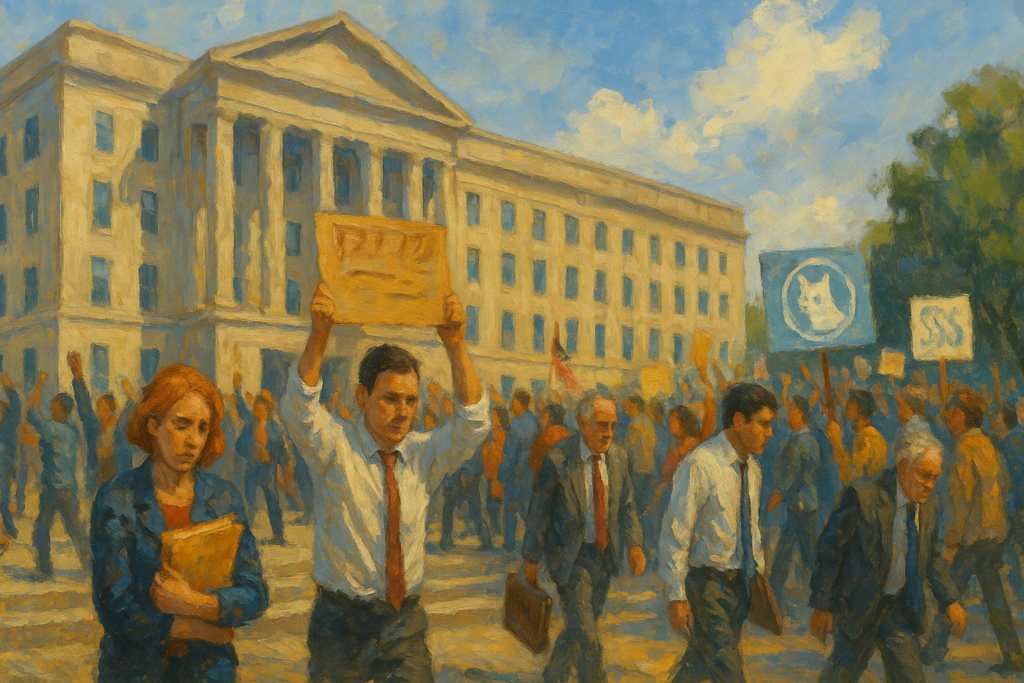
Public resistance grew alongside these changes. Thousands of people protested across the country against Musk’s DOGE‑driven budget cuts, including a rally of more than 1,000 federal workers outside SpaceX’s Washington building led by Rep. Alexandria Ocasio‑Cortez. Separate nationwide protests denounced the administration’s broader actions as undermining democracy and alliances. In the courts, Judge Dale Ho pressed acting Deputy Attorney General Emil Bove on DOJ’s motion to dismiss the Eric Adams indictment, noting that the rationale was policy‑based rather than about the case’s merits. The hearing ended without a decision, leaving open the possibility that charges could be refiled even as key prosecutors had already resigned. Meanwhile, the Associated Press responded to its exclusion from White House events by filing federal lawsuits against the administration and White House officials, arguing that the bans violated First Amendment protections and seeking restoration of access.
Thursday shifted attention to the boundaries of presidential power and political violence. At a White House event, Trump asked supporters whether he should run for a third term and mused about constitutional limits. At CPAC, Steve Bannon promoted a constitutional amendment to allow Trump to serve a third term, backed by a “Third Term Project” think tank. While such a change would require a difficult amendment process, the public discussion chipped away at the perceived inviolability of the two‑term limit established after Franklin Roosevelt’s presidency and codified in the 22nd Amendment. At the same conference, individuals convicted for their roles in the January 6 Capitol attack, including Richard Barnett, appeared as honored guests after being pardoned by Trump on his first day back in office. Proud Boys leader Enrique Tarrio, also pardoned, was later arrested for assaulting a protester near the Capitol. Celebrating and pardoning those who attacked Congress signaled tolerance for political violence and weakened deterrence against future assaults on democratic institutions.
Immigration and budget policy moved in tandem. The Senate passed a budget resolution allocating $175 billion for border security and Trump’s mass deportation plan, while also boosting Pentagon spending. Trump then signed an executive order titled “Ending Taxpayer Subsidization of Open Borders,” directing agencies to align programs so that undocumented immigrants could not receive federal benefits and to report “improper” use to DOJ and DHS. In parallel, Trump endorsed the hard‑line House budget plan that extended tax cuts for the wealthy, added $4.5 trillion to the deficit, and mandated $880 billion in cuts from the Energy & Commerce Committee—effectively targeting Medicaid and other health programs. His endorsement undercut Senate Republicans’ more limited proposal and increased the risk of a shutdown as deadlines approached.
DOGE’s narrative about “waste” faced mounting factual challenges. Fact‑checkers and lawmakers highlighted major errors in DOGE’s claims of canceling $16 billion in wasteful contracts, including one touted $8 billion contract that was actually about $8 million. Congressman Nick Begich amplified false claims that millions of people over 100 were receiving Social Security benefits, and later told constituents he was powerless to stop DOGE cuts that cost Alaska federal jobs. These inflated and false claims were being used to justify deep cuts and data grabs, making accurate information a central battleground in the debate over government spending.
Foreign policy proposals raised alarms about U.S. security and leverage. The administration floated a “deal” to repeal tariffs on China in exchange for purchase promises, despite past failures of similar agreements, and Trump proposed that the U.S. and China each cut military spending in half—a move analysts warned would amount to unilateral U.S. disarmament given China’s opaque off‑budget spending. In parallel, a White House official pressed Ukraine to stop criticizing Trump and accept a $500 billion deal transferring half its mineral wealth to the U.S., echoing earlier mineral‑for‑support proposals that President Zelensky had rejected. These initiatives suggested a foreign policy that traded long‑term security and alliance credibility for short‑term economic or political gains, and that sought economic leverage over a partner at war.
Friday confirmed that the federal workforce purge would continue and that the state’s capacity in key areas would shrink. The administration moved ahead with mass firings across the federal workforce, often citing “poor performance” even for employees with positive reviews. A judge ruled that federal courts lacked jurisdiction to block the firings, directing unions to the labor board instead. Agencies managing public lands, health, and foreign aid reported deep staffing losses, with particular concern about wildfire response and conservation capacity. In science and environmental policy, the administration removed grants and support for research that used the term “climate” and scrubbed climate references from government websites, as part of a broader campaign that had already halted DEI programs and fast‑tracked fossil fuel permits. Defunding and erasing climate research from official channels further hampered evidence‑based policymaking on a central global challenge.
Courts again acted as a partial counterweight on citizenship. A U.S. appeals court denied DOJ’s emergency application to reinstate Trump’s ban on birthright citizenship, reinforcing the earlier Ninth Circuit decision. The rulings kept in place injunctions that preserved citizenship for children born in the U.S. to non‑citizen and non‑permanent resident parents, reaffirming a core constitutional guarantee and limiting the administration’s ability to redefine membership in the political community by executive order.
Other institutions saw their leadership reshaped along ideological lines. Trump fired Air Force General CQ Brown Jr., the first Black chair of the Joint Chiefs of Staff, along with other top military officials, after Defense Secretary Pete Hegseth criticized Brown’s appointment as driven by diversity considerations. The move followed Hegseth’s earlier directive to plan for significant defense budget cuts and fit into a broader campaign against diversity initiatives in the military. In the civilian sphere, the administration proposed cuts to Social Security, Medicare, Medicaid, and food assistance programs, framing them as efforts to eliminate “waste, fraud, and abuse” despite limited evidence. Analysts noted that many of the hardest‑hit communities were in Republican‑dominated regions that rely heavily on these programs, suggesting that the social safety net was being narrowed even where it was most needed. Immigration enforcement leadership was also reshuffled: top ICE officials, including acting director Caleb Vitello, were reassigned or removed over dissatisfaction with deportation numbers, reinforcing a numbers‑driven enforcement culture that prioritized removals over due process and humanitarian considerations.
Taken together, the week’s developments traced a coherent pattern rather than a series of isolated controversies. Mass firings and the dismantling of collective bargaining made the civil service more vulnerable to political direction. Executive orders pulled independent regulators, prosecutors, and watchdogs closer to the White House, while DOGE’s expanding reach into data systems and budgets gave a private‑aligned unit unusual influence over public policy. Immigration crackdowns, social safety net cuts, and the celebration of January 6 offenders all pointed toward a more stratified vision of rights and belonging. At the same time, efforts to control information—through media access, school curricula, federal websites, and climate research—narrowed the space for independent knowledge and public memory. Courts, unions, states, and protesters mounted pockets of resistance, preserving birthright citizenship, temporarily shielding some watchdogs and diversity staff, and challenging censorship and environmental rollbacks. But the overall trajectory was one of a leaner, more politicized state, with fewer internal checks and a more contested boundary between executive power and the constitutional and civic norms that have historically constrained it.