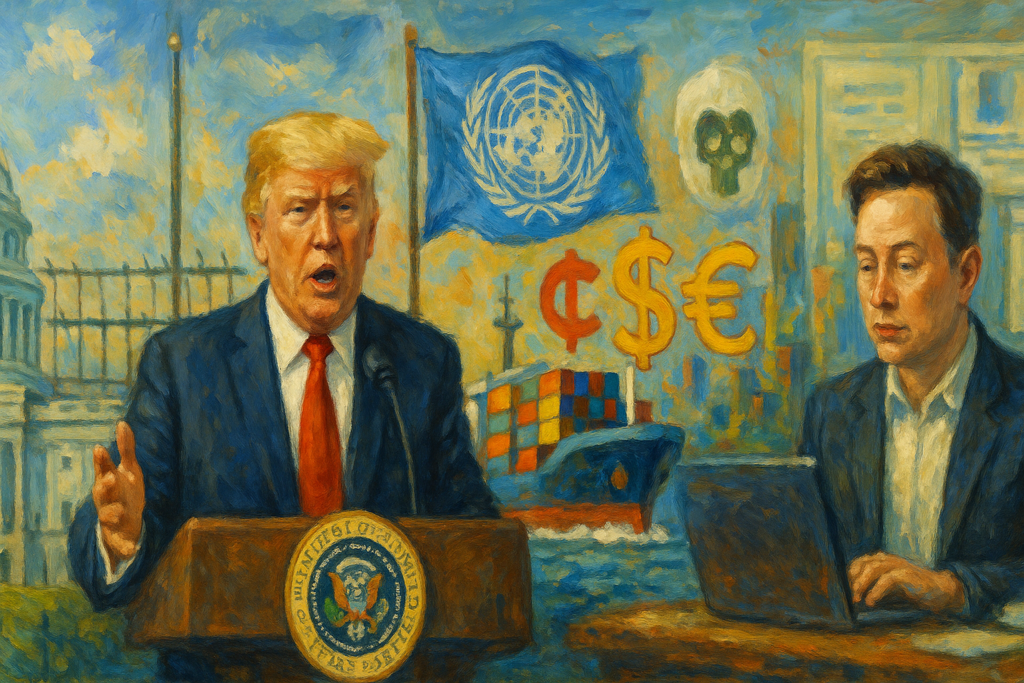
This week’s throughlines
- Musk’s role expanded from workforce disruption to operational control — What began as access to Treasury and personnel systems widened into a cross-agency campaign touching USAID, Education, SBA, NOAA, CMS, Energy, Labor, and air traffic systems, prompting protests, lawsuits, and legislative responses.
- USAID moved from aid freeze to attempted takeover — The foreign-aid freeze quickly became an institutional struggle over USAID’s independence, with online records disappearing, staff locked out, Rubio asserting control, lawmakers denied entry, and unions suing to stop the dismantling.
- Courts became the main brake on executive overreach — Judges repeatedly intervened: blocking the federal funding freeze, pausing the federal worker buyout deadline, stopping retaliation against FBI personnel, protecting trans prisoners, and repeatedly halting the birthright citizenship order.
- Information control widened across agencies and media — The week featured disappearing government webpages, altered archives, pressure on public and private media, and manipulated immigration messaging, showing that control over records and narratives was part of the governing strategy.
- Immigration enforcement broadened from legal status to detention and coercion — The administration targeted legal protections, asylum, birthright citizenship, sanctuary jurisdictions, campus protesters, and migrants sent to Guantanamo, while raids and manipulated ICE messaging spread fear beyond formal policy changes.
Across this week, the central story was a struggle over who wields power inside the American state. The White House used executive orders and emergency authorities to seize control of foreign aid, trade, immigration, and civil‑rights policy, while inviting a private network tied to Elon Musk into the government’s financial and data systems. At the same time, courts, unions, civil‑society groups, and some state governments began to push back, using lawsuits, protests, and procedural tools to slow or reshape these moves. The result was a fast‑moving contest between concentrated executive power—often shared with private allies—and the institutional checks that remain.
Over the weekend, the administration opened a major front overseas by freezing most foreign aid for 90 days and moving to fold the U.S. Agency for International Development into the State Department. Staff at USAID were locked out of their headquarters, their website and social media were taken offline, and plaques were removed from the building. Allies of Elon Musk, working under a loosely defined “efficiency” banner known as DOGE, helped secure the building and branded the agency a “criminal organization.” On the ground, the freeze halted field hospitals, disease‑treatment programs, and other humanitarian work worldwide, signaling that decisions about aid would now run through a smaller circle of political appointees.
At the same time, President Trump invoked emergency powers to impose sweeping tariffs: 25 percent on most imports from Canada and Mexico and 10 percent on Chinese goods, justified on grounds of drugs and migration. Canada, Mexico, and China responded with retaliatory tariffs, trade complaints, and investigations into U.S. firms. Domestic business groups and some senators warned of higher prices and supply‑chain disruptions, while Democrats began drafting legislation to require congressional approval for such emergency tariffs. Trade policy, like foreign aid, was being turned into a unilateral tool, with partners and markets left to react.
Inside the federal machinery, Musk’s DOGE operation moved from rhetoric to access. Over the weekend, Treasury Secretary Scott Bessent granted DOGE “read‑only” access to the federal payment systems that move trillions of dollars each year. At USAID, senior security officials who resisted DOGE’s entry into agency systems were placed on leave. By Sunday, Musk’s associates could see coded payment data and were preparing to expand into other agencies. For a private network tied to a single businessman to gain this kind of visibility into public money and personnel marked a sharp break with traditional safeguards around government systems.
The weekend also brought a coordinated rollback of diversity, equity, and inclusion protections across the federal government. Trump revoked a six‑decade‑old equal‑opportunity order for federal contractors and directed agencies to dismantle DEI programs. Federal workers were told to strip pronouns from email signatures, employee resource groups were disbanded, and institutions such as West Point began shutting down women’s, minority, and LGBTQ+ clubs. In parallel, an executive order targeted transgender people in multiple arenas: purging trans service members from the military, ordering trans prisoners medically detransitioned and moved according to birth sex, and threatening to cut federal funding to hospitals that provided gender‑affirming care to minors. Hospitals quickly began suspending services to avoid losing funds. These were not isolated culture‑war skirmishes but a broad effort to redefine who is protected and welcome in public institutions.
Signals of a coming purge inside law enforcement also appeared. Political appointees at the Justice Department began moving to fire prosecutors who had worked on January 6 cases and to identify FBI agents involved in investigations of Trump and the Capitol attack. Emails ordered lists of such agents early in the week, suggesting that career officials could face retaliation for their prior work. This came on the heels of Trump’s first‑day blanket pardons for more than 1,500 people charged or convicted in connection with January 6, a mass clemency that recast the attack on the transfer of power as something to be forgiven rather than deterred.
On other fronts, the administration reshaped information and immigration policy. The Pentagon announced a “media rotation” that would displace long‑standing outlets like NBC and NPR from its press spaces in favor of ideologically aligned channels such as OANN and Breitbart, narrowing the range of scrutiny over military affairs. Immigration protections were revoked for more than a million people from Cuba, Haiti, Nicaragua, and Venezuela, and Marines arrived at Guantánamo Bay to expand migrant facilities for up to 30,000 detainees. An executive order on campus antisemitism directed agencies to use civil and criminal tools against antisemitic conduct and circulated a fact sheet suggesting deportation of international students who protested Israel, raising concerns that immigration status could be used to police political speech. Yet even amid this flurry, a federal judge quickly halted a broad funding freeze the administration had attempted to impose on grants and loans, calling it likely unconstitutional. The White House rescinded its memo within a day, and subsequent rulings extended the pause, underscoring that the executive could not simply impound funds Congress had appropriated.
By Monday, the weekend’s themes deepened. With USAID staff already locked out, Secretary of State Marco Rubio declared himself acting administrator and confirmed plans to merge the agency into State, cut its workforce, and align spending more tightly with Trump’s agenda. USAID’s Washington headquarters was ordered closed, and employees were told to stay home. The move further reduced independent development expertise and made foreign aid more directly responsive to short‑term political priorities.
On the economic front, Trump signed orders directing Treasury and Commerce to design a U.S. sovereign wealth fund, potentially to buy assets like TikTok, while simultaneously pausing the newly announced tariffs on Canada and Mexico until early March, citing their initial border‑security steps. Tariffs thus became a rolling threat rather than a settled policy, and the prospect of a sovereign wealth fund hinted at new ways for the White House to reward allies and punish critics through investment decisions.
DOGE’s reach expanded sharply on Monday. At the Office of Personnel Management, Musk’s associates gained broad access to HR databases containing medical histories and performance data, installed an unvetted server that controlled key systems, and blocked senior civil servants from monitoring changes. DOGE also accessed Small Business Administration and Education Department systems, including student‑aid data. Using OPM email lists, Musk announced a “deferred resignation” program offering pay through September to employees who agreed to resign, with fine print limiting their legal recourse. In effect, a private team now had both deep data access and a tool to thin the civil service.
Legal and labor channels began to respond. Federal employee unions sued over DOGE’s access to Treasury systems, alleging privacy violations. Judges extended the pause on the broader funding freeze and later blocked the administration’s deadline for workers to accept the buyout. The administration, in turn, proposed to limit DOGE’s Treasury access to two named staffers with read‑only rights, excluding Musk himself. These early rulings did not unwind DOGE’s presence, but they showed that courts and unions could still shape the terms of privatization efforts. Meanwhile, hospitals across multiple states continued suspending gender‑affirming care for minors in response to the January 28 order, leaving patients and families in limbo. Environmental and science rules were also frozen or delayed, including a ban on a toxic solvent and regulations on hazardous waste and PFAS chemicals, while a payment outage at the National Science Foundation temporarily halted research funding until a court ordered funds released. Civil‑society resistance took form as the ACLU sued over an order effectively suspending asylum law, unions filed additional privacy suits, and activists organized protests against cabinet nominees such as budget chief‑in‑waiting Russell Vought.
On Tuesday, the administration widened its use of executive power abroad. Trump signed an order withdrawing the United States from the UN Human Rights Council and suspending funding to UNRWA, the main agency for Palestinian refugees, while ordering a review of participation in UNESCO. In parallel, he proposed relocating Palestinians from Gaza and spoke of U.S. “ownership” of the territory—statements that were more symbolic than operational but that drew condemnation from legal experts and allies. These moves, combined with the earlier aid freeze, signaled a retreat from multilateral human‑rights forums and a willingness to reshape conflict zones through unilateral declarations.
Trade policy continued to swing. After announcing broad tariffs set to start at midnight, Trump delayed them for a month following modest border‑security pledges from Mexico and Canada. Markets reacted sharply, while Canada and Mexico prepared retaliatory measures and China announced its own counter‑tariffs and antitrust probes. Treating tariffs as bargaining chips rather than stable policy injected uncertainty into supply chains and gave the White House outsized leverage over trading partners.
At home, courts emerged as a counterweight on several fronts. A federal judge temporarily blocked the administration from transferring trans women to men’s prisons and cutting off their hormone therapy, finding likely constitutional violations; another judge later issued similar orders, signaling judicial skepticism of blanket policies that endangered a vulnerable group. Judge Loren AliKhan in Washington formally blocked Trump’s attempt to freeze trillions in grants and loans, citing the 1974 law against impoundment and reaffirming Congress’s power of the purse. Multiple federal judges, including a Reagan appointee in Seattle, issued temporary injunctions against Trump’s executive order seeking to end birthright citizenship for children of undocumented immigrants, calling it clearly unconstitutional and warning of irreparable harm. These rulings did not resolve the underlying conflicts, but they drew lines around what could be done by decree.
The justice system itself was being retuned. Trump ordered the attorney general to produce a report on the “weaponization of the federal government,” expected to cover special counsel cases against him, with findings to be delivered to a White House policy aide rather than Congress. The framing of independent prosecutions as political “weaponization” laid groundwork for revisiting or undoing cases involving the president and his allies. Meanwhile, the first military flight of migrants arrived at Guantánamo Bay under a new order allowing up to 30,000 people to be held there while their deportation cases proceeded, extending offshore detention practices that make legal access more difficult.
By Wednesday, the collision between private power and public institutions was visible on the streets. Musk’s DOGE staff appeared at NOAA and the Labor Department, seeking access to weather, economic, and whistleblower data. At the Centers for Medicare and Medicaid Services, unvetted DOGE representatives accessed payment and contracting systems under the banner of “searching for waste,” and at NOAA, climate data reportedly disappeared after a DOGE operative gained system access. At the Energy Department, the secretary overruled counsel to grant a DOGE associate IT access. These incursions raised the risk of data tampering, selective leaks, and policy built on manipulated evidence.
In response, thousands of protesters, joined by more than two dozen Democratic members of Congress, rallied near the Capitol and at the Treasury Department to oppose Musk’s access to taxpayer data and federal payment systems. Lawmakers announced bills with pointed titles aimed at curbing DOGE’s role and barring certain federal contracts. While these proposals faced uncertain prospects, the protests underscored that public and legislative pushback remained one of the few checks on the fusion of private and public power inside the executive branch.
The Justice Department’s internal transformation accelerated. The Senate confirmed Pam Bondi as attorney general over civil‑rights objections. Soon after, DOJ announced it would scale back enforcement of foreign bribery, money‑laundering, and foreign lobbying laws, shut down the Kleptocracy Initiative and the KleptoCapture task force, and disband the FBI’s Foreign Influence Task Force. A new “Weaponization Working Group” was launched to review prosecutions of Trump and January 6 cases. At the same time, Trump signed an order titled “Keeping Men Out of Women’s Sports,” directing agencies to pull federal funds from schools that allowed trans women and girls to compete in women’s sports and to deny visas to trans women athletes seeking to compete in the United States. Another set of orders created a DOJ task force and a White House Faith Office to eradicate what they called “anti‑Christian bias,” instructing agencies to prioritize the concerns of Christian groups. In North Carolina, new laws criminalizing road‑blocking and mask‑wearing at protests took effect, and West Point dissolved a dozen student‑led cultural and professional clubs in response to anti‑DEI directives. California, by contrast, approved tens of millions of dollars to fight federal crackdowns and support immigrants, illustrating how states were beginning to diverge in their responses.
On Thursday, foreign policy and domestic oversight converged again. Trump issued an order imposing sanctions and entry bans on officials of the International Criminal Court in response to investigations involving U.S. and Israeli personnel, declaring a national emergency. A separate memo ordered a review of all federal funding to non‑governmental organizations, creating uncertainty for civil‑society groups at home and abroad. These steps extended the week’s pattern of weakening multilateral accountability mechanisms and tightening executive control over who receives U.S. support.
Inside the government, workers turned to the courts. The American Federation of Government Employees and the American Foreign Service Association filed suit in Washington, arguing that dismantling USAID and freezing its funds without congressional approval was unconstitutional and illegal. Their complaint detailed halted medical and food aid and sought to restore funding and reopen offices, testing whether a president could effectively dismantle a major agency on his own. In the Senate, Republicans confirmed Russell Vought, a key architect of the administration’s broader policy blueprint, as director of the Office of Management and Budget after an all‑night Democratic protest and filibuster attempt. Opponents warned that he would help Trump defy Congress on spending and pursue deep cuts to social programs, raising the stakes of future fights over whether appropriations would be honored.
New revelations about sensitive data handling added to national‑security concerns. A White House order led the CIA to send an unclassified email listing all employees hired in the past two years, including analysts focused on China, to the White House. Separately, reporting showed that a 25‑year‑old engineer with ties to Musk’s companies had direct access to Treasury systems that manage major government payments. These disclosures suggested that both intelligence personnel and financial infrastructure were being exposed in ways adversaries could exploit. Courts continued to push back on the birthright‑citizenship order, with additional rulings reaffirming injunctions and criticizing the administration’s disregard for the rule of law. At the Environmental Protection Agency, more than 160 environmental‑justice employees were placed on paid administrative leave, sharply reducing the agency’s capacity to address pollution burdens in marginalized communities just as other environmental rules were being delayed. And in the realm of elections, North Carolina’s Judge Griffin moved to throw out tens of thousands of votes to overturn a state supreme court race, prompting civic‑group campaigns to alert affected voters, while in Washington, Federal Election Commission chair Ellen Weintraub refused to vacate her post after Trump purported to fire her while the commission was reviewing complaints against him. Both episodes highlighted direct political pressure on institutions meant to referee democratic contests.
By Friday, the week’s patterns were firmly in view. Trump issued an order responding to South Africa’s land‑expropriation law by halting U.S. aid and prioritizing resettlement of Afrikaner refugees, framing the move as a defense of a persecuted minority. Another order directed DOJ to review and roll back gun regulations adopted since 2021 in the name of protecting Second Amendment rights. These actions showed how the administration was using executive power to elevate favored constituencies and reinterpret both foreign and domestic law through ideological lenses.
At the Justice Department, Attorney General Bondi followed through on the earlier restructuring by formally disbanding the FBI’s Foreign Influence Task Force and sharply curtailing enforcement of foreign bribery and money‑laundering laws, limiting certain cases to narrow categories like drug and trafficking offenses. The DOJ’s foreign bribery unit and Kleptocracy Initiative were eliminated, with seized oligarch assets earmarked for detention facilities. Beyond these specific units, DOJ announced it would generally scale back enforcement of complex white‑collar crimes while prioritizing human smuggling and drug cartels. Critics warned that this rebalancing would invite more foreign and elite corruption into U.S. politics and markets at a time when other safeguards were being weakened.
Information control and media pressure also intensified. New reporting showed that Immigration and Customs Enforcement had updated timestamps on old enforcement press releases to make past raids appear current, fueling rumors of mass deportations and heightening fear in immigrant communities. Trump escalated attacks on CBS and 60 Minutes, accusing them of defrauding the public and calling for the show and network to be terminated, while the Federal Communications Commission pursued complaints and investigations into immigration coverage by other outlets. Manipulating official records and threatening broadcasters further eroded the information environment citizens rely on to understand government actions.
Meanwhile, the president’s family deepened their business ventures. Donald Trump Jr. joined a venture‑capital firm focused on conservative companies, Eric and Barron Trump expanded a cryptocurrency platform backed by controversial investors, and Jared Kushner’s Saudi‑funded private‑equity firm continued to pursue projects, including a Trump Tower in Belgrade. Ethics experts warned that these ventures could benefit from, and shape, U.S. policy, blurring the line between public office and private gain at the same time that enforcement against foreign and financial corruption was being scaled back.
Taken together, the week offered a clear picture of a government being reshaped from the top down. Foreign aid and multilateral engagement were pulled closer to the White House, trade and sanctions were wielded as volatile bargaining tools, and core enforcement functions at the Justice Department were redirected away from elite and foreign corruption. A private network tied to Elon Musk gained unprecedented access to federal payment rails and personnel data, while executive orders narrowed civil‑rights protections for immigrants, transgender people, and protesters. Yet courts, unions, state governments, and protesters showed that institutional resistance remains possible, even if its outcomes are uncertain. For democratic life, the stakes lie in how these competing forces—centralized executive authority and the dispersed checks of law, labor, and civil society—will balance in the months ahead.