This week’s throughlines
- Executive power pressed against institutional independence — The administration moved to control or hollow out agencies and quasi-independent bodies, including USPS, Education, USAID, CFPB, and the Inter-American Foundation, often through staffing cuts, restructuring, or direct political pressure.
- Courts repeatedly checked funding freezes, firings, and agency disruption — Federal judges and the Supreme Court repeatedly intervened to preserve congressionally approved spending, reinstate or protect officials, and scrutinize claims that agencies were still functioning lawfully.
- Trade policy became a source of self-created instability — Tariffs on Canada, Mexico, and China were announced, imposed, narrowed, and paused in rapid succession, producing retaliation, market anxiety, and warnings about higher prices and weaker growth.
- Foreign policy shifted toward coercion, selective aid freezes, and a softer line on Russia — The administration pressured Ukraine, paused aid, suspended most aid to South Africa, and deprioritized Russian cyber threats, signaling a broader reordering of alliances and security priorities.
- Pressure on dissent and civil society moved from rhetoric into policy tools — The week included threats against protest on campuses, criminalization rhetoric around immigration-rights advocacy, visa scrutiny based on social media, and direct action against a law firm and universities.
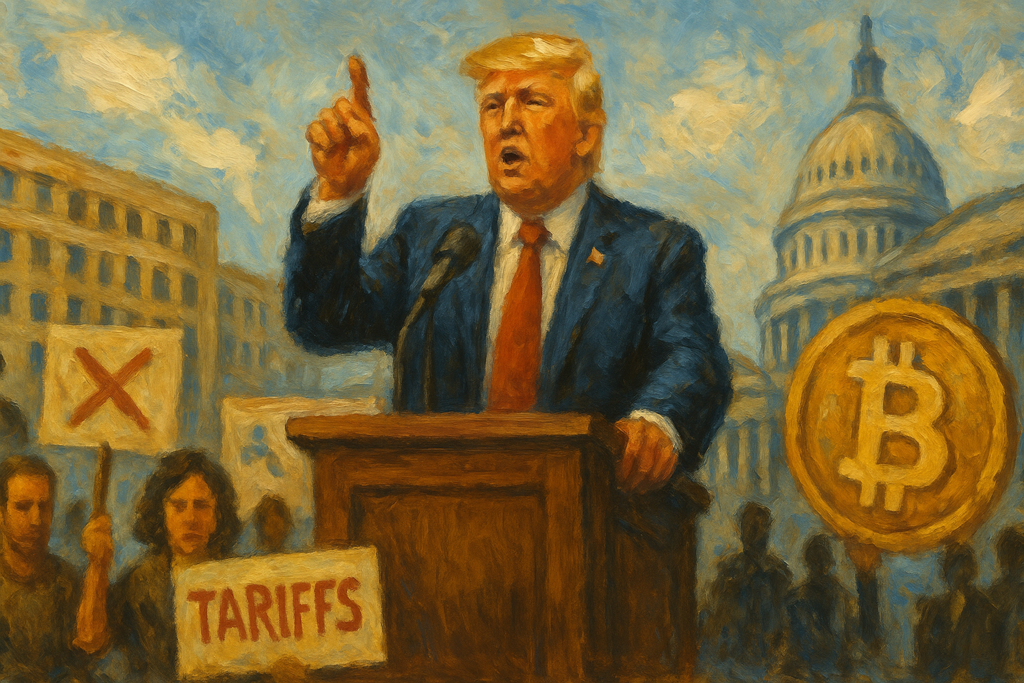
This week unfolded on three intertwined fronts. Inside the federal government, the administration accelerated a coordinated purge of civil servants and watchdogs. In economic policy, it launched a volatile mix of tariffs and crypto initiatives that fused national strategy with donor interests. Abroad, it continued a sharp pivot away from traditional democratic allies, especially Ukraine, while tightening immigration and speech controls at home. Across all three, courts, state governments, and protesters emerged as partial counterweights, even as the space for dissent narrowed, including inside Congress itself.
Over the weekend, the administration set the tone with an executive order declaring English the official language of the federal government and revoking Clinton-era language-access rules. That move narrowed translation and interpretation support for non-English speakers, making it harder for many to navigate federal services. At the same time, the General Services Administration moved to shutter 18F, the in-house digital team that had helped build tools like IRS Direct File, as part of a broader reduction in force. Together, the language order and the dismantling of a key technology unit signaled both who the government would prioritize serving and whose expertise would be sidelined in building public systems.
Resource policy and foreign alignment also shifted over the weekend. Trump ordered an immediate expansion of timber production on federal lands, directing agencies to speed approvals and sidestep environmental safeguards, while launching a national-security investigation into timber and lumber imports. These steps, followed by a broader logging order on Monday, concentrated discretion over vast public lands in the executive branch and framed resource extraction as a security issue. In parallel, the administration stopped describing Russia as a primary cyber threat in international forums and instructed the Cybersecurity and Infrastructure Security Agency (CISA) to deprioritize Russian activity. The U.S. then voted against a United Nations resolution condemning Russia’s aggression in Ukraine, marking a clear break from prior bipartisan positions and foreshadowing deeper changes in both cyber defense and Ukraine policy.
The weekend also saw the executive branch bypass Congress to deepen U.S. involvement in Israel’s war in Gaza. Secretary of State Marco Rubio invoked emergency authorities to send $4 billion in arms to Israel without normal congressional review, while the administration separately approved a nearly $3 billion arms sale that included heavy bombs. These decisions, taken as Israel tightened its blockade on Gaza and the White House backed the move, normalized the use of emergency channels for large arms transfers and further sidelined Congress’s role in overseeing war powers and humanitarian consequences.
On the domestic front, the House passed a budget resolution to begin reconciliation with the Senate, aiming to extend expiring Trump-era tax cuts for high earners. To make the numbers work, the plan envisioned raising the debt ceiling while cutting Medicaid and other low-income benefits. Later in the week, the Congressional Budget Office confirmed that the required savings would almost certainly fall on core health programs, including Medicaid. The budget path thus paired tax relief at the top with looming reductions in safety-net programs, setting up a redistribution of resources that would be felt most acutely by the poor, the elderly, and people with disabilities.
At the same time, the White House previewed a new financial architecture centered on digital assets. Over the weekend it announced plans for a “crypto strategic reserve” holding specific tokens, while the Treasury Department stopped enforcing a key anti–money laundering rule and Trump halted a fraud case against Chinese crypto magnate Justin Sun, a major buyer of Trump-linked coins. These moves foreshadowed formal orders later in the week establishing a Strategic Bitcoin Reserve and a broader digital asset stockpile, and they tied federal policy to markets where the president and his allies had direct financial stakes. The line between public reserves and private enrichment began to blur.
Foreign policy toward Ukraine deteriorated further. Following a contentious Oval Office meeting in which Trump and Vice President JD Vance berated President Volodymyr Zelensky, Trump announced that U.S. aid to Ukraine might be halted entirely. Reuters later reported a pause in congressionally approved aid, framed as a push for a “peaceful resolution.” Protests in the United States and a Norwegian fuel boycott signaled domestic and international backlash. The weekend also brought domestic political maneuvers around democracy itself: the SAVE Act, a voting bill critics warned would disenfranchise millions—especially women who changed their names—moved toward votes in both chambers, while Elon Musk and other billionaires poured millions into a pivotal Wisconsin Supreme Court race and state legislative contests, seeking to shape rulings on abortion, unions, and election law. Meanwhile, thousands protested in Iowa against a bill stripping civil-rights protections from transgender people, and the 50501 movement organized nationwide demonstrations against policies seen as undermining democracy and human rights, adding street-level resistance to the week’s institutional shifts.
By Monday, the civil service purge moved from signals to structure. The administration advanced plans to dissolve the Postal Service’s bipartisan board and place the agency under Commerce Secretary Howard Lutnick, a move that would replace an independent governance model with direct political control. Education Secretary Linda McMahon moved toward dismantling the Department of Education, offering buyouts ahead of a reduction in force. The Social Security Administration announced consolidation of regional offices and at least 7,000 job cuts, and reporting surfaced of hundreds of resignations at the State Department amid a push to “radically shrink” the department and close consulates. These steps targeted agencies that deliver mail, benefits, and diplomacy, shifting them toward political appointees and private interests and weakening neutral capacity.
Within education, the cuts were especially pointed at information. Nearly $1 billion in reductions hit the Department of Education’s research arm, canceling contracts that support the National Center for Education Statistics and other data systems. Another $900 million in research funding tracking student progress was also canceled under the direction of the Office of Domestic Government Efficiency (DOGE). Without reliable national education data, it becomes harder to identify inequities, evaluate reforms, or hold systems accountable for student outcomes, and the groundwork was laid for McMahon’s later move to abolish the department entirely.
The softer line on Russia translated into operational changes on Monday. New reporting detailed that CISA analysts had been told not to track Russian threats to election systems, while Defense Secretary Pete Hegseth ordered U.S. Cyber Command to halt planning and offensive operations against Russia. At the same time, officials at the FBI and CISA working on election protection and disinformation were reportedly being fired or reassigned, and House Intelligence Committee Chair Mike Turner was removed after contradicting the administration’s Russia narrative. Weakening both the operational and oversight arms that monitor Russian activity increased the risk of undetected interference in U.S. elections and infrastructure, and it signaled that dissenting assessments within government would be punished.
Civil rights and equality programs came under renewed attack. Reports surfaced of Trump-era orders placing all federal diversity, equity, and inclusion (DEI) staff on leave and directing agencies to report on private DEI programs, though a judge had blocked immediate implementation. In the states, lawmakers in Oklahoma and Idaho advanced bills to privilege heterosexual marriage and challenge the Supreme Court’s Obergefell decision, while Alabama pursued a case to criminalize helping women travel out of state for abortions. These moves narrowed legal protections for marginalized groups and tested how far state power could reach into private life. In response, the American Bar Association issued a statement condemning rising intimidation of judges by Trump and his allies, and a federal judge ruled that the head of the Office of Special Counsel, which protects whistleblowers, could not be removed before his term ended. These were early institutional lines drawn against political interference with independent adjudicators and watchdogs.
Monday also opened a second front in economic nationalism. Commerce Secretary Lutnick confirmed that tariffs on Canada and Mexico would begin Tuesday, while Trump doubled tariffs on China. Canada responded with 25 percent tariffs on $155 billion of U.S. goods, China imposed new duties on U.S. farm products and blacklisted firms, and Mexico announced its own retaliatory plans. These salvos set the stage for a broader trade war that would rattle markets and prompt rapid, politically driven carve-outs later in the week.
On Tuesday, Trump turned a joint session of Congress into a nationally televised campaign rally. He touted his electoral mandate, defended the new tariffs, and celebrated immigration crackdowns while making multiple false claims about Ukraine aid, Social Security, and school policies. Democrats protested with signs and walkouts. Representative Al Green repeatedly interrupted the speech and was forcibly removed from the chamber on Speaker Mike Johnson’s orders. The episode framed visible dissent as disorder and previewed the use of House discipline later in the week to punish Green, illustrating how legislative norms could be used to constrain opposition to the president inside Congress.
While the cameras focused on the speech, courts and oversight bodies pushed back against the administration’s purge strategy. A federal court issued a temporary injunction halting mass firings of probationary Education Department employees, and the Merit Systems Protection Board ordered the Department of Agriculture to reinstate nearly 6,000 fired probationary staff. The Supreme Court, with Chief Justice John Roberts and Justice Amy Coney Barrett joining the majority, rejected Trump’s attempt to keep nearly $2 billion in foreign aid frozen. District judges extended orders preventing broader funding freezes and required some U.S. Agency for International Development payments to resume. These rulings underscored that statutory protections for civil servants and Congress’s constitutional control over spending still had force, even as the executive tested their limits.
Other agencies were hollowed out more quietly. After Russell Vought was appointed acting head of the Consumer Financial Protection Bureau (CFPB), nearly all staff were placed on indefinite administrative leave, effectively halting supervision and enforcement. An internal email later revealed that staff had been instructed not to resume legally required activities, contradicting the agency’s assurances to a federal court. Judge Amy Berman Jackson ordered a senior official to testify about the bureau’s true status. Disabling a consumer watchdog while misrepresenting its operations to the judiciary not only removed a layer of financial protection for the public but also strained the integrity of court oversight.
The broader purge continued. DOGE-led plans for mass layoffs became more concrete: Education offered buyouts ahead of a reduction in force; Social Security announced office consolidations and thousands of cuts; an internal Veterans Affairs memo revealed plans to fire over 83,000 employees; and a top FBI official in New York was forced out after resisting a purge of agents who had investigated January 6. Senator Elizabeth Warren and colleagues asked the Government Accountability Office to investigate the legality and safety implications of these firings. Even where courts would later intervene, the attempted restructuring itself signaled a long-term effort to weaken professional bureaucracy and oversight.
The administration also escalated pressure on universities and student protesters. On social media, Trump threatened to cut federal funding to colleges that allow what he called “illegal protests” and to expel or arrest student “agitators.” The guest list for his congressional address highlighted victims of crimes by undocumented immigrants and controversies around transgender issues, while Senate Democrats invited fired workers and Medicaid recipients. These choices framed campus dissent and equity work as threats to be punished and tied institutional funding and students’ legal status to their political activity, pressuring universities to police speech.
Meanwhile, the tariff war formally launched. On Tuesday the administration implemented historic 25 percent tariffs on imports from Canada and Mexico and raised duties on Chinese goods to 20 percent. Retailers warned of sharp price increases, and Canada and China announced immediate retaliation. The Atlanta Federal Reserve soon revised its growth forecast from a 2.9 percent expansion to a 2.8 percent contraction, and manufacturing indices showed stagnation tied to higher input costs. The combination of international retaliation and domestic economic indicators made clear that the trade strategy was already reshaping markets and expectations.
By Wednesday, the administration was using symbolic gestures to reinforce its immigration narrative. In follow-up messaging to his address, Trump lauded his clampdown on immigration and asylum and signed an order renaming Texas’s Anahuac National Wildlife Refuge after Jocelyn Nungaray, a 12-year-old killed by alleged undocumented immigrants. The order directed all federal references to adopt the new name, turning a public site into a permanent emblem of the administration’s crime-and-immigration storyline and helping normalize more punitive policies.
Education and social services remained in flux. A leaked draft order showed Trump had directed Secretary McMahon to abolish the Department of Education, though backlash reportedly forced reconsideration. Combined with earlier research cuts and buyouts, the plan would send most responsibilities back to states and private actors, weakening national standards, civil-rights enforcement, and the data needed to track inequities. At the same time, the Merit Systems Protection Board ordered USDA to reinstate thousands of fired employees, and the Centers for Disease Control and Prevention reversed 180 DOGE-driven firings. These partial reversals highlighted that legal guardrails could still bite, but they did not erase the chilling effect of attempted mass firings.
The human impact of the budget and purge strategy became clearer. An internal VA memo detailing plans to fire over 83,000 employees raised alarms that veterans’ care would be gutted and pushed toward privatization. Separate reporting described Social Security staff cuts reminiscent of 1980s reductions that left many eligible people without benefits. Senator Tammy Duckworth and others warned that the VA cuts would devastate services. These developments coincided with the CBO’s confirmation that House Republicans’ budget instructions would require deep Medicaid reductions, underscoring that the drive to extend tax cuts was intertwined with shrinking frontline staff and benefits for vulnerable Americans.
On LGBTQ rights and family autonomy, the week brought both retrenchment and resistance. In Montana, a bipartisan coalition defeated two sweeping anti-trans bills that would have banned drag shows and Pride marches and allowed the state to remove transgender children from their parents. At the federal level, Senate Democrats had just blocked a bill to ban trans athletes from women’s sports. These actions contrasted with ongoing efforts in Oklahoma and Idaho to undermine same-sex marriage and with federal prison policies transferring trans women to men’s facilities. The result was a patchwork in which rights and safety depended heavily on jurisdiction.
Courts continued to shield key areas from abrupt disruption. A federal judge issued a preliminary injunction blocking drastic cuts to medical research funding, preserving ongoing projects. Another court ruled that Trump’s firing of National Labor Relations Board member Gwynne Wilcox was illegal and ordered her reinstated, reinforcing limits on presidential removal of independent board members. In foreign policy, officials announced that the U.S. would stop sharing targeting intelligence with Ukraine and that commercial provider Maxar had cut off satellite imagery, while the administration imposed new restrictions on U.S. satellite data to Ukraine. Coming after aid pauses and the UN vote, these steps signaled a broader downgrading of U.S. support as Russia’s war continued and raised questions for other allies about the reliability of American backing.
Thursday brought the formalization of the administration’s crypto ambitions. Trump signed executive orders establishing a Strategic Bitcoin Reserve and a broader U.S. Digital Asset Stockpile, directing the Treasury and Commerce Departments to manage and expand holdings, including assets seized in forfeiture. A separate order created a national cryptocurrency stockpile. Reporting detailed that crypto czar David Sacks and firms like Ripple, whose tokens were named in the reserve, had deep financial ties to Trump and his allies, and that enforcement had been eased for Justin Sun, a major buyer of Trump-linked coins. Embedding volatile, donor-linked assets into national reserves concentrated financial power in the executive and raised unprecedented conflict-of-interest and market-manipulation risks.
Tariff policy grew more erratic. New executive orders adjusted tariffs on Canadian and Mexican goods under the stated rationale of combating illicit drug flows, but in practice they reduced duties on potash and automotive parts to ease pressure on U.S. carmakers. Later in the week, Trump expanded exemptions for car and truck parts and goods covered by the U.S.-Mexico-Canada Agreement. These rapid shifts highlighted how tariff levers were being used both as security tools and as bargaining chips for favored industries, creating uncertainty for trading partners and domestic firms and inviting lobbying for exemptions rather than predictable rules.
The administration also used legal tools against perceived political enemies in the legal profession. Trump issued an executive order targeting Perkins Coie, a firm linked to Democratic campaigns, by ordering reviews and potential suspensions of its security clearances and federal contracts. A companion order urged agencies to require upfront fees from those suing the administration. Another order suspended clearances for employees of a law firm that had worked for Hillary Clinton and urged contract terminations. Personalizing security and procurement decisions around political grievances threatened independent legal advocacy and made access to the courts more expensive for challengers.
Immigration and speech controls tightened further. Reuters reported that the administration was planning a new travel ban targeting countries such as Afghanistan and Pakistan, echoing the first-term Muslim ban. In parallel, the State Department began revoking student visas for foreigners flagged by artificial intelligence as Hamas supporters based on social media posts, under a January antisemitism order. These measures blended national-origin and belief-based criteria into immigration control, basing entry and stay on algorithmic assessments of political speech and broad country bans, with limited due process.
Universities remained a central battleground. Interim U.S. attorney Ed Martin sent a renewed letter to Georgetown Law threatening that the Justice Department would not hire its students if the school continued DEI efforts, and DOJ opened a Title VII investigation into the University of California system over alleged antisemitic hostile environments tied to Gaza protests. The administration also cut $400 million in federal grants to Columbia University, citing failure to combat antisemitism. These actions, following Trump’s earlier threats to defund campuses that allow protests, used hiring pipelines, civil-rights investigations, and grant funding to pressure universities, risking the transformation of academic governance and protest policing into instruments of federal politics.
Against this backdrop of federal rollback, California moved in the opposite direction on racial equity. Black lawmakers introduced a package of reparations bills based on a state task force’s recommendations, including preferential admissions for descendants of enslaved people, curriculum changes on segregation and slavery, and mandatory racial equity analyses by agencies. These efforts showed that subnational governments could pursue racial justice even as the federal executive dismantled DEI infrastructure. Inside federal agencies, however, information controls tightened: the Social Security Administration banned employees from accessing news websites on work devices, despite staff relying on them for job-related research. This came alongside broader efforts to restrict independent information flows and to delay or curate sensitive reports, such as those on Jeffrey Epstein and on economic data tied to tariffs, making agencies more reliant on internal narratives.
By Friday, the economic and diplomatic consequences of the week’s trade moves were evident. Trump signed an order pausing USMCA tariffs on Canada and Mexico until April 2 and announced expanded exemptions for car and truck parts and other goods, even as he threatened new tariffs on Canadian dairy. These reversals followed a week of market declines and warnings from retailers and manufacturers about price spikes and supply-chain disruption. Rapid swings between sweeping tariffs and selective relief made it difficult for businesses and allies to plan and underscored how trade policy had become a tool of short-term leverage rather than a stable framework.
The State Department’s hollowing-out came into sharper focus. Reports confirmed that about 700 State Department employees, including 450 career diplomats, had resigned in 2025, while senior officials prepared to close a dozen consulates in Western Europe, Brazil, and Turkey. Trump has pushed to “radically shrink” the department and shift its focus from diplomacy and human rights to transactional deals and investment promotion. Losing experienced diplomats and closing consulates reduced U.S. capacity to manage crises, support citizens abroad, and advocate for democratic norms, reinforcing the broader foreign-policy realignment.
Inside Congress, the Al Green episode reached its conclusion. Two days after his removal from the chamber during Trump’s address, the House voted 224–198 to censure Representative Green for disrupting the speech, with ten Democrats joining Republicans. The resolution also proposed stripping him of committee assignments. The censure capped a week in which legislative decorum rules were used to punish visible dissent against the president, sending a message that challenging him in high-visibility settings could carry institutional penalties and narrowing the space for opposition within the legislature itself.
The information and accountability landscape showed both vulnerability and resilience. Newsmax disclosed a $40 million settlement with voting-technology firm Smartmatic over false claims that its machines helped steal the 2020 election, including an option for Smartmatic to buy Newsmax stock. The settlement demonstrated that courts could impose significant costs for election disinformation. On the same day, however, the Justice Department placed two Manhattan prosecutors on leave from a corruption case against New York Mayor Eric Adams, raising concerns about political interference in ongoing investigations. In the fiscal realm, U.S. District Judge John McConnell ruled that Trump lacked authority to freeze congressionally appropriated funds in New York v. Trump, issuing a preliminary injunction that will remain in place while the case proceeds. This followed the Supreme Court’s refusal to keep a separate foreign aid freeze in place and district orders requiring some USAID funds to be released. Repeated rulings against unilateral funding freezes reinforced the principle, rooted in the Impoundment Control Act, that Congress—not the president—controls federal spending.
The Ukraine arc ended the week where it had begun: with mixed signals and eroding commitments. Reporting revealed that the administration was preparing to deport roughly 240,000 Ukrainians who received temporary legal status after fleeing Russia’s invasion, despite strict entry requirements. This plan appeared to contradict Trump’s midweek reversal on deporting Ukrainian asylum seekers and added to a pattern of erratic policies: voting against a UN resolution condemning Russia, pausing aid, cutting off intelligence and satellite imagery, and now moving to revoke humanitarian protections for war-displaced Ukrainians. For allies watching, the message was that U.S. support could be both contingent and reversible.
Taken together, the week’s developments traced a pattern of accumulating pressure on democratic guardrails. Mass layoffs and restructuring plans targeted the neutral civil service, even as courts and merit boards partially reversed them. Tariffs and crypto reserves concentrated economic power in the executive and intertwined public policy with private interests, while foreign policy moves distanced the United States from Ukraine and traditional partners. At the same time, universities, courts, state legislatures, and professional bodies mounted their own forms of resistance—from blocking anti-trans bills in Montana and advancing reparations in California to enforcing the power of the purse and penalizing election lies. The contest between centralizing executive power and these countervailing institutions defined the week and will shape the trajectory of American democracy in the months ahead.