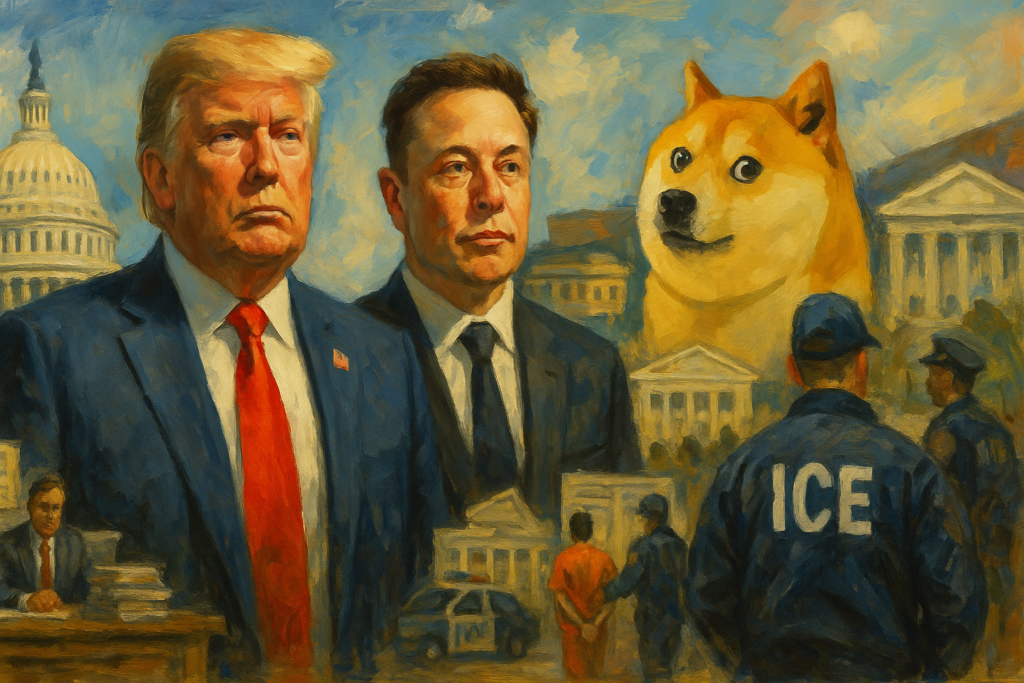
This week’s throughlines
- DOGE moved from cost-cutting rhetoric into direct control fights over agencies, data, and personnel — What began as spending-cut claims widened into attempts to access Treasury and personnel systems, direct hiring and firing, target agencies including CFPB, NOAA, NSF, and Education, and extend influence into the Pentagon.
- Courts became the main brake on executive action, though compliance was uneven — Judges blocked or paused moves affecting USAID staff, Treasury systems, NIH funding, birthright citizenship, whistleblower protections, health information, and foreign aid, while some rulings were followed by signs of delay or defiance.
- Immigration enforcement intensified through funding cuts, lawsuits, raids, and local cooperation — The administration cut immigrant legal services, defended raids, pressed states and cities, sued New York over licensing rules, and benefited from Eric Adams’s move to reopen ICE space at Rikers, while schools and courts pushed back.
- Control over information and public memory became a governing strategy — Federal websites were scrubbed, health resources removed and later restored by court order, AP reporters were punished over language, the NSA began a content purge, and records and historical institutions came under pressure.
- The Justice Department faced a legitimacy crisis over the Eric Adams case — The order to drop corruption charges against the New York mayor, and the stated link to immigration cooperation, triggered resignations, threats, and public evidence of political interference in prosecutorial decisions.
This week moved quickly. The Trump administration and Elon Musk’s newly empowered Department of Government Efficiency pushed deeper into the machinery of the federal state, from science budgets to Pentagon accounts, while courts, state officials, and civil society tried to draw lines. Immigration enforcement spread into new spaces, information was scrubbed or rewritten, and the professional civil service came under direct attack. At nearly every turn, judges and internal dissenters slowed or complicated these efforts, but rarely stopped them outright.
Over the weekend, the administration opened a symbolic front by announcing that Donald Trump was firing the Kennedy Center’s board chair and trustees and appointing himself as chair. The Kennedy Center is a congressionally chartered cultural institution whose governance is normally handled by its own board, not the White House. Trump’s move, broadcast on social media without formal notice to the institution, signaled a willingness to override statutory norms to bring a national arts symbol under personal control.
At the same time, Musk’s Department of Government Efficiency—DOGE, a repurposed version of the U.S. Digital Service—began to show its reach. Officials announced more than $1 billion in early spending cuts, including reductions to National Institutes of Health cancer research and a new NIH policy capping indirect research costs at 15 percent. Budget director Russell Vought outlined plans to starve the Consumer Financial Protection Bureau of funds, effectively dismantling it by budgetary attrition, while DOGE prepared deep cuts at NOAA and other science agencies. These were not legislative debates but administrative decisions, using control over payments and overhead rules to reshape research and consumer protection.
Trump also leaned on executive orders to redirect policy in other domains. One order prioritized asylum for white Afrikaners from South Africa, explicitly favoring a particular ethnic group in refugee policy. Another quietly exempted low-value Chinese imports from his own tariffs, undercutting the public rhetoric of a hard line on trade. A third paused enforcement of the Foreign Corrupt Practices Act, signaling tolerance for U.S. corporate bribery abroad in the name of competitiveness. Together, these orders showed how the White House was using unilateral tools to tilt asylum, trade, and anti-corruption enforcement toward favored constituencies and firms.
Courts, however, began to push back. Federal judges blocked the administration from placing more than 2,000 USAID employees on leave and from shutting the agency down altogether, preserving the foreign aid apparatus while litigation proceeds. Another court granted a restraining order preventing three Venezuelan immigrants from being sent to Guantanamo Bay, and a separate ruling temporarily restored immigrant legal orientation programs that the Justice Department had ordered halted. These decisions kept a major aid agency functioning and preserved basic due process for immigrants, underscoring the judiciary’s role as a check on abrupt executive moves.
On the ground, immigration enforcement hardened. Trump cut funding and issued a stop-work order for a Colorado nonprofit providing free legal services to undocumented immigrants, while heavily armed ICE and SWAT teams raided Denver-area apartments in operations billed as targeting gang members. Only one confirmed gang member was arrested among 30 detainees, heightening fear in immigrant communities and illustrating how broad sweeps can diverge from their stated focus. Trade tensions also escalated as Trump announced 25 percent tariffs on steel and aluminum imports, prompting Chinese retaliation on U.S. energy and farm equipment exports, even as he carved out exemptions for low-value Chinese packages. Meanwhile, early signs of a broader civil service and oversight purge appeared: federal employees, including an FBI agent, went public with accounts of their work amid fears of a purge, and Trump fired the director of the Office of Government Ethics, putting internal watchdogs on notice.
Public and international reaction surfaced quickly. Congressional phone systems were overwhelmed by tens of millions of calls from constituents demanding resistance to efforts to dismantle agencies and access private data. Abroad, more than 300,000 people marched in Munich against the far-right AfD party, which enjoys support from Musk, signaling that the political direction in Washington was being watched and contested beyond U.S. borders.
By Monday, DOGE was formally unleashed as a cross-government downsizing tool. The administration repurposed the U.S. Digital Service into a new entity under Musk’s control, with authority to review operations across agencies, cancel payments, suspend programs, and target employees for firing or leave. DOGE began preparing deep cuts at NOAA, the National Science Foundation, and Social Security, and sought influence over the Office of Personnel Management. This concentrated opaque budget and personnel powers in a lightly accountable unit, allowing sweeping changes to the federal state without normal legislative or public scrutiny.
Trump also signed executive orders targeting the informational and regulatory environment. Health agencies were directed to scrub diversity-related terms from websites and grant proposals, narrowing what public institutions could say about race, gender, and marginalized groups. Another order launched a review of all gun regulations to favor expansive Second Amendment interpretations, and a third reversed federal moves away from single-use plastics by ending paper-straw procurement and restoring plastic straws in federal facilities. These actions used executive authority to reshape public messaging, gun policy, and environmental standards in one stroke.
Courts deepened their oversight of the administration’s funding freezes and DOGE’s data access. Judges blocked DOGE from accessing Treasury payment systems, ordered destruction of any downloaded data, and reiterated that frozen federal funds must be restored. Separate rulings again stopped Trump from shutting down USAID or placing thousands of its workers on leave. Other judges blocked an executive order ending birthright citizenship and ordered the reinstatement of Hampton Dellinger as head of the Office of Special Counsel after his firing, protecting whistleblower oversight. Courts also temporarily blocked cuts to biomedical research overhead and ordered health agencies to restore deleted HIV and contraceptive information. These decisions collectively defended constitutional citizenship, whistleblower protections, and public access to health information against unilateral executive changes.
Even as legal checks accumulated, transparency in other areas narrowed. The Federal Election Commission abruptly canceled an open meeting scheduled for later in the week, reducing public visibility into campaign finance oversight. In parallel, the American Bar Association and five former Treasury secretaries issued warnings that Trump’s funding freezes and impoundments threatened Congress’s constitutional power of the purse. Professional bodies that usually operate quietly were now publicly questioning the legality of executive actions.
Tuesday brought high-profile personnel changes at the top of key institutions. The Senate narrowly confirmed Robert F. Kennedy Jr., a prominent vaccine skeptic, as Secretary of Health and Human Services, and Tulsi Gabbard as Director of National Intelligence. All Democrats opposed the nominations, and Mitch McConnell broke with most Republicans, highlighting internal party tension. Critics questioned both nominees’ qualifications and warned about their past statements on vaccines and foreign adversaries, raising concerns about how health and intelligence policy might shift under their leadership.
Courts continued to shape the policy landscape. Federal judges in Massachusetts and elsewhere blocked the administration’s attempt to impose a 15 percent cap on NIH indirect costs, siding with 22 states and major universities and preserving the financial underpinnings of biomedical research. Other courts issued temporary orders pausing Trump’s directive to strip funding from hospitals providing gender-affirming care to minors, preserving access to medically recommended care for transgender youth while litigation proceeds. Meanwhile, eight former inspectors general filed suit arguing their dismissals were unlawful and violated the Inspector General Act, seeking reinstatement and a declaration that such firings cannot be carried out without cause. The National Treasury Employees Union separately sued OMB director Russell Vought over his directive to shut down the CFPB, arguing that dismantling a congressionally created agency by budget memo exceeded executive authority. These lawsuits tested whether independent oversight offices and regulatory agencies could be dismantled at will.
On immigration, ICE touted more than 8,200 arrests over a ten-day period as part of mass-deportation efforts, heavily promoting the numbers on social media. But the data omitted key details such as arrest locations and criminal histories, making it difficult to assess who was targeted and whether operations matched their stated focus on serious offenders. The lack of transparency raised the risk of rights violations and misled the public about the true nature of those being detained. At the same time, the American Bar Association and former Treasury secretaries formalized their earlier concerns in public statements and op-eds, warning that executive spending freezes and impoundments threatened the rule of law and Congress’s control over federal finances.
On Wednesday, Trump issued an executive order titled “One Voice for America’s Foreign Relations,” directing that all foreign policy implementation occur under the president’s authority. The Secretary of State was tasked with maintaining a workforce aligned with Trump’s agenda, and the order reshaped recruitment, evaluation, and retention standards for the Foreign Service, giving the secretary broad discretion over personnel actions. This move tightened loyalty requirements and politicized diplomatic careers, potentially weakening the independence and expertise of the diplomatic corps.
Locally, the Fremont, California city council passed one of the state’s strictest anti-camping ordinances, banning camping on public property and making it a crime to “aid and abet” homeless encampments. Violations could bring up to six months in jail and a $1,000 fine. Civil rights and community groups opposed the measure, arguing that criminalizing both homelessness and those who assist the unhoused shifted policy from services to punishment and raised serious civil liberties concerns.
New revelations showed Musk’s influence over government data and messaging. Reports indicated that Musk associates at the Office of Personnel Management had been granted sweeping access to federal HR databases containing sensitive personal and medical information on millions of employees. Separately, DOGE’s public site added a partisan “unconstitutionality index” from the Competitive Enterprise Institute, embedding an anti-regulatory frame into an official transparency portal. Combining privileged access to personnel data with ideologically framed public metrics blurred the line between neutral administration and politicized surveillance and propaganda.
In North Carolina, state and local actors mobilized in response to broader trends. A new Progressive Caucus introduced bills to limit immigration enforcement in sensitive locations and organized events highlighting disenfranchised voters and a contested state Supreme Court race. The state Democratic Party announced a rally at the legislature to oppose what it described as anti-democratic bills. Meanwhile, the inspectors general who had been fired pressed their lawsuit seeking reinstatement and protection from political interference, underscoring the internal resistance within oversight institutions.
By Thursday, the campaign to reshape the civil service moved into a more aggressive phase. Working with Musk, the administration initiated mass layoffs across agencies including Education, the Small Business Administration, the CFPB, the General Services Administration, Energy, and Veterans Affairs, and directed the firing of nearly all probationary employees. A deferred resignation program, branded the “Fork in the Road,” offered pay through September for those who agreed to leave. A federal judge in Boston allowed the buyout program to proceed on standing grounds, even as unions and employees continued to challenge its legality. Rapidly hollowing out oversight and service-delivery agencies threatened to degrade government capacity and left remaining staff more vulnerable to political pressure.
Trump signed another executive order giving DOGE operatives formal control over hiring and firing across agencies, with a one-for-four hiring cap. In parallel, he effectively froze much of U.S. government science funding and halted FEMA grants for firefighting and port security equipment, citing efficiency and review needs. Centralizing personnel control while freezing science and emergency funds amplified DOGE’s leverage over both the workforce and critical public goods.
Economic policy also shifted risk onto households and allies. Trump’s “Unleashing American Energy” order defunded home energy rebate programs and paused LIHEAP disbursements, causing $100 surcharges for low-income Alabama customers and prompting warnings from members of Congress about the legality of the move. He signed a memorandum directing development of a “reciprocal” tariff plan and reiterated 25 percent tariffs on steel and aluminum, despite concerns about higher consumer prices and strained alliances. In a separate move, he suggested that payments on some Treasury bonds might be halted due to alleged irregularities under DOGE review, briefly rattling markets, and paused permitting for solar and other renewable projects, including on private land. Questioning the sanctity of U.S. debt and stalling renewable projects injected uncertainty into financial and energy markets.
The Justice Department took a dramatic step in New York City, ordering prosecutors to seek dismissal of a corruption case against Mayor Eric Adams. DOJ leadership cited the need for Adams’s cooperation on deportation efforts and the proximity of the mayoral primary. At least six prosecutors, including the acting U.S. attorney, resigned in protest, likening the episode to a modern “Saturday Night Massacre.” Tying prosecutorial decisions to immigration policy goals undermined the appearance and reality of impartial justice and sent a message about the costs of pursuing corruption cases that conflicted with administration priorities.
Courts again intervened on funding and rights. Federal judges issued temporary orders blocking Trump’s executive order restricting gender-affirming care for people under 19 and ordered the administration to reinstate foreign aid funding that had been impounded without adequate justification. These rulings limited the executive’s ability to use funding as a weapon against vulnerable groups and international commitments. Meanwhile, immigration enforcement pushed into schools and jails: Denver Public Schools filed a federal lawsuit challenging a policy that allows ICE agents access to schools, arguing it diverts resources and depresses attendance, and Mayor Adams announced plans to reestablish an ICE office at Rikers Island, reversing prior sanctuary-oriented policies. Embedding immigration enforcement in educational and correctional settings blurred institutional boundaries and had chilling effects on immigrant communities.
On Friday, DOGE’s reach extended into the national security sphere. Members of Musk’s team met with Defense Department staff at the Pentagon to review spending and identify potential cuts, giving a quasi-private group influence over military budgeting. On the same day, DOGE’s website published classified information about the National Reconnaissance Office’s budgets and personnel, alarming the intelligence community and raising questions about how sensitive data was being handled. The episode highlighted the risks of combining broad data access with weak internal controls.
The administration also escalated its conflict with the press. After earlier barring two Associated Press reporters from events over the outlet’s refusal to use the term “Gulf of America,” the White House announced an indefinite ban on AP journalists from the Oval Office and Air Force One. Officials framed the move as holding the AP accountable for “misinformation,” while the AP called it a violation of press freedom. Using access to the president and Air Force One as leverage against a major news outlet threatened independent reporting and signaled that editorial decisions could carry direct professional penalties.
Energy and fiscal policy continued to collide with federalism. Trump established the National Energy Dominance Council inside the Executive Office to coordinate policies boosting domestic energy production and cutting regulatory barriers, centralizing energy strategy in a pro-production body. At the same time, Pennsylvania’s governor sued the administration to force release of more than $3 billion in withheld federal funds, arguing that the freezes violated Congress’s spending authority. The lawsuit joined a growing list of state challenges to executive impoundments.
Public health and historical memory were also reshaped. Louisiana’s health department announced it would no longer promote mass vaccinations through media campaigns or health fairs, framing immunization as a purely personal choice despite nearby measles outbreaks. In Washington, Trump signed an order halting federal funding to schools and universities with COVID-19 vaccine mandates, though its immediate practical impact was limited. These moves reinforced anti-mandate narratives and risked lower vaccination coverage. Meanwhile, the National Park Service removed all references to transgender people from the Stonewall National Monument website, implementing an executive order that defined sex strictly as male or female. The change erased the documented role of trans women of color in the 1969 uprising that the monument commemorates, narrowing public understanding of LGBTQ history and signaling that certain identities could be written out of the national story.
Across the week, the pattern was consistent: executive orders, budget directives, and personnel moves were used to centralize authority, weaken independent oversight, and reshape what government says and does, while courts, state officials, civil servants, and civic groups mounted legal and institutional resistance. The result was not a one-sided consolidation of power but a contested struggle over the basic terms of governance—who controls public money, who enforces the law, whose stories are told, and how far the executive can go before other institutions push back.