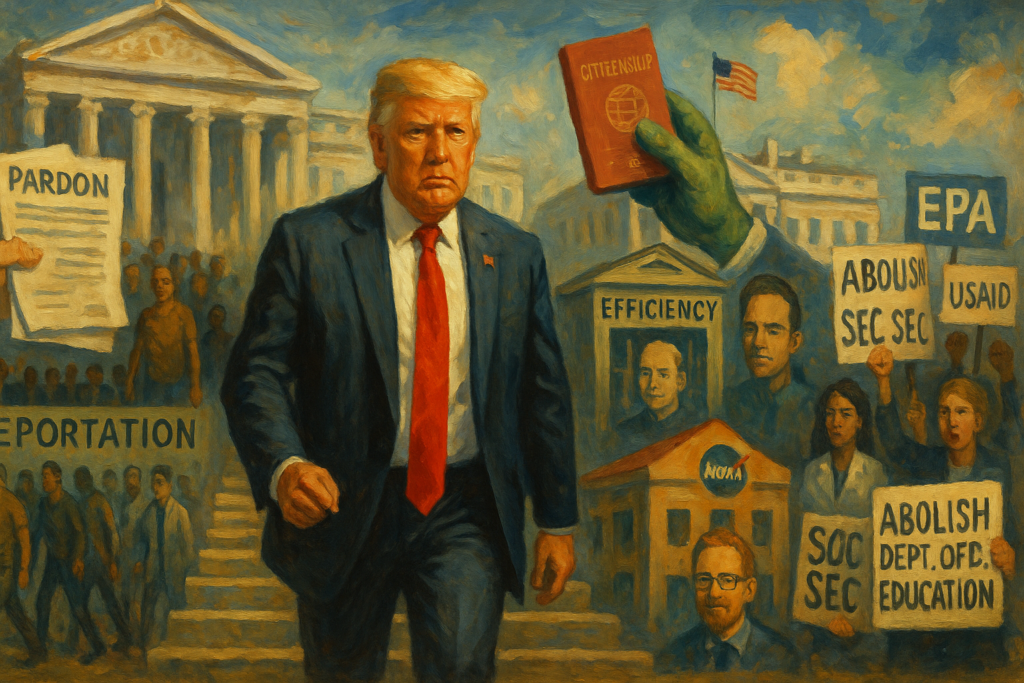
This week’s throughlines
- The federal workforce moved from intimidation to planned restructuring — What began as Musk’s demand that federal workers justify themselves by email expanded into formal OPM and OMB plans for reclassification, layoffs, buyouts, and agency-wide downsizing across government.
- Press access and information control hardened through the week — The AP’s lawsuit over access widened into a broader White House move to control who covers the president, while official and allied messaging increasingly favored loyal outlets, selective disclosures, and spectacle over neutral transparency.
- Immigration policy escalated from rhetoric to enforcement and exclusion — Weekend promises of mass deportation were followed by threats against sanctuary jurisdictions, detention expansion, registration requirements, and new barriers tied to wealth, identity, and legal status.
- Courts repeatedly checked executive actions, but unevenly — Judges blocked data access, refugee restrictions, some funding freezes, and some firings, yet other rulings left press retaliation in place for now and the Supreme Court paused lower-court relief in the USAID fight.
- Political loyalty and retaliation kept reshaping law enforcement and accountability — The week linked pardons for January 6 defendants, a White House-linked Justice Department review group, and retaliatory moves against lawyers and regulators, reinforcing the sense that legal power was being redirected toward allies and enemies.
The week opened with sweeping moves that tested who is held to account for attacking democratic institutions and who is allowed to belong within the polity at all. From mass pardons for January 6 offenders to plans for mass deportations and detention at Guantánamo Bay, the administration used its clemency and immigration powers to redraw lines of inclusion and impunity. At the same time, a new drive to centralize control over the federal bureaucracy and public information—anchored in Elon Musk’s Department of Government Efficiency (DOGE)—began to reshape how the state itself functions, even as courts, unions, educators, and protesters tried to slow or redirect those changes.
Over the weekend, Trump issued mass pardons for Enrique Tarrio and roughly 1,500 people convicted or charged in connection with the January 6 attack on Congress. The move erased many of the legal consequences that had followed the assault on the transfer of power. Some of those pardoned quickly re-entered public life, confronting officers like former D.C. police officer Michael Fanone and vowing to sue the Justice Department over their prosecutions. The signal was not only that past actions would be forgiven, but that those who had been punished could now recast themselves as victims of an overreaching state. Against this backdrop, bomb threats invoking “Emperor Trump” forced the evacuation of the anti-Trump Principles First summit, underscoring how threats of political violence and official leniency toward those who used force in 2021 now moved in tandem.
Immigration policy hardened in parallel. At the Conservative Political Action Conference, Trump promised what he called the largest deportation operation in U.S. history, pairing it with attacks on birthright citizenship and protected status programs. These public vows rested on earlier orders directing the Pentagon and the Department of Homeland Security to prepare a 30,000-bed migrant facility at Guantánamo Bay. Reporting from that site described migrants shackled, held in cages, denied legal calls, and placed in isolation—conditions more associated with wartime detention than civil immigration enforcement. ICE was instructed to deport hundreds of thousands of unaccompanied children, while the White House posted a video of shackled migrants as entertainment content. Together, these actions framed migrants as both a spectacle and a security threat, with military detention and mass child deportations replacing more conventional, court-supervised processes.
Inside the federal workforce, Musk’s influence became concrete. Acting through the Office of Personnel Management and DOGE, he ordered all federal workers to email five weekly accomplishments or be treated as having resigned. The ultimatum bypassed normal civil-service procedures and effectively demanded constant proof of productivity on his terms. Some agencies, including the State Department and the FBI, told staff to ignore the directive, while Health and Human Services Secretary Robert F. Kennedy Jr. instructed his employees to comply. Unions began amending lawsuits to challenge the move under administrative law, arguing that an unelected adviser could not unilaterally redefine resignation. The episode previewed a broader effort to make continued employment contingent on responsiveness to a politically connected outsider rather than to established chains of command.
The Justice Department’s independence also came under strain. Attorney General Pam Bondi created a “weaponization working group” inside DOJ that reported directly to White House policy aide Stephen Miller, tasked with reviewing alleged abuses from the prior administration. At the same time, the administration shut down the National Law Enforcement Accountability Database, which had tracked police misconduct across agencies. The combination of a new unit aligned with White House priorities and the removal of a transparency tool for police behavior shifted the department’s posture away from neutral enforcement and public oversight toward a more politicized, inward-facing structure.
The weekend also brought new federal moves against transgender rights. Trump signed an executive order banning transgender athletes from women’s sports and threatened to cut federal funds from states that refused to enforce it. Maine Governor Janet Mills publicly defied the order, pledging to follow state and federal law as she understood it rather than the new directive. In parallel, the State Department moved toward permanent visa bans on transgender athletes who misstate their birth sex on applications. These steps used both funding and immigration controls to enforce contested gender policies, setting up a clash between federal directives and state-level resistance.
Scientific and development institutions felt early blows. The administration quietly halted National Institutes of Health study-section notices, effectively freezing new medical research funding despite a court order against a funding freeze. USAID’s 4,700 staff were placed on paid leave, foreshadowing deeper cuts to foreign aid. These moves signaled a broader campaign to weaken scientific and development capacity before more formal orders later in the week. At CPAC, Trump framed these and other initiatives with a speech that again claimed the 2024 election was stolen, labeled MSNBC a “threat to democracy,” and announced new tariffs on China, Canada, and Mexico. He previewed sweeping federal workforce cuts and immigration crackdowns, using a partisan stage to delegitimize elections, vilify critical media, and normalize abrupt shifts in economic and administrative policy. Outside, protesters targeted Tesla dealerships over Musk’s behavior and access to government data, and hackers briefly took over Housing and Urban Development building screens with an AI video satirizing Trump and Musk—early signs of public unease with the fusion of corporate and state power.
By Monday, the struggle over data, spending, and information had moved into the courts. Federal judges issued temporary restraining orders preventing the Department of Education and OPM from sharing sensitive personal data with Musk’s efficiency team, citing likely Privacy Act violations. A separate order barred OPM from disclosing personally identifiable information of federal employees to DOGE staff after reports that Musk associates had unusual access to sensitive databases. These rulings showed courts willing to defend privacy against an unelected actor. Yet in the same period, Trump-appointed judges declined to immediately restore the Associated Press’s access to the Oval Office, Air Force One, and briefings after AP refused to adopt the administration’s preferred term “Gulf of America” for the Gulf of Mexico. Accepting the argument that these spaces were more private than public, the courts left retaliatory limits on press access in place, illustrating a more hesitant posture when transparency and media independence were at stake.
Congress advanced its own reshaping of the state through the budget process. The House moved forward a budget framework that paired roughly $4.5 trillion in tax cuts with about $2 trillion in spending reductions, including $800 billion to $1 trillion in Medicaid cuts and trims to Medicare and SNAP. The plan aligned with Trump’s priorities on tax relief and immigration enforcement and passed by narrow margins over unified Democratic opposition and some Republican unease. At the same time, the administration announced elimination of about 2,000 USAID positions and placed nearly all global staff on leave, after a court allowed the move over union objections. A major “organizational restructuring” at the Social Security Administration was unveiled, with reports that up to half of its 57,000 employees could be let go. These steps hollowed out the capacity to deliver foreign aid and core domestic benefits, shifting power over life-and-death services from professional administrators to political appointees.
Immigration policy continued to be reengineered as both a tool of exclusion and a source of revenue. Trump announced a $5 million “Trump Gold Card” that would grant green card privileges and a path to citizenship, explicitly tying legal status to wealth and potential foreign oligarch money. Senator Angus King warned that Trump’s refusal to fund duly enacted programs amounted to a “grossly unconstitutional” power grab, urging Congress to defend its spending authority. Courts carved out limited protections, temporarily blocking ICE from conducting enforcement at certain churches and houses of worship and issuing a preliminary injunction against Trump’s order suspending the refugee admissions system. These rulings preserved sanctuaries and refugee pathways even as the broader system tilted toward mass detention and commodified citizenship.
The White House escalated its confrontation with the press. Press Secretary Karoline Leavitt announced that the administration—not the White House Correspondents’ Association—would decide which outlets and reporters joined the presidential press pool. AP remained barred over its refusal to use “Gulf of America,” and Trump favored far-right journalists at joint press events. This formalized a shift from a press corps selected by peers to one curated by the executive, making it easier to reward friendly coverage and sideline scrutiny. Meanwhile, unions and plaintiffs pressed their advantage in court, using the privacy rulings to argue that DOGE’s reach into millions of personnel and student records violated the law.
On Tuesday, the backlash to Musk’s ultimatum forced a partial retreat. After unions sued and agencies resisted, OPM clarified that failing to respond to the accomplishments email would not count as resignation, even as Musk insisted noncompliance could still lead to firing. More than 20 DOGE staffers resigned, citing ethical concerns about dismantling public services and compromising core systems, and additional civil servants elsewhere left in protest. The resignations underscored the cost of politicizing the bureaucracy: expertise walked out the door, and remaining staff faced heightened uncertainty about who truly controlled their careers.
Immigration enforcement grew harsher even as a premium lane for the wealthy took shape. New reporting from Guantánamo described migrants shackled, caged, denied legal calls, and isolated in facilities repurposed for immigration detention. The administration made biometric registration mandatory for undocumented immigrants 14 and older, embedding mass tracking into daily life for millions. At the same time, Trump continued to promote the $5 million “gold card” offering a path to citizenship. The contrast between punitive detention and biometric surveillance for some, and a purchasable path for others, recast immigration as both a security problem and a revenue stream.
Money and regulation intersected in the crypto sector. Coinbase listed Trump’s $TRUMP meme coin, enabling retail trading in a token largely controlled by Trump and generating tens of millions in fees for him and associates. Shortly after Coinbase and other crypto interests poured money into pro-Trump political committees and hired former campaign staff, the SEC agreed to dismiss its lawsuit against Coinbase without fines or business changes. In parallel, the SEC halted or dropped fraud prosecutions against Justin Sun after he invested heavily in a Trump-backed venture. These decisions suggested that enforcement outcomes could be shaped by political contributions and personal ties rather than by consistent application of securities law.
Transgender exclusion moved from rhetoric to institutional policy. The State Department ordered permanent visa bans on transgender athletes who misrepresent their birth sex, while the Pentagon prepared to remove transgender troops unless they secured waivers. A detailed memo framed gender dysphoria as incompatible with service and set timelines for identifying and discharging affected personnel. These steps narrowed who could represent the country abroad or serve in uniform, testing the durability of equal-protection principles in both immigration and military law. At the same time, teachers’ unions and allied groups sued the Department of Education over threats to cut funds from schools using race-conscious policies, and federal judges issued injunctions blocking freezes of federal loans, grants, and refugee admissions, and ordering the administration to pay foreign aid it had withheld. The Supreme Court would later pause some of that relief, illustrating how lower-court efforts to enforce statutory obligations could be blunted at the top.
Foreign policy and domestic legal strategy converged in unusual ways. Trump ordered Secretary of State Marco Rubio and National Security Advisor Mike Waltz to negotiate an end to the Ukraine war directly with Russian officials, excluding Ukraine and European allies from the talks. The move sidelined the country whose territory and sovereignty were at issue, raising questions about whose interests would shape any eventual settlement. Domestically, Trump suspended security clearances for lawyers representing former special counsel Jack Smith, raising concerns that classification powers were being used to disadvantage legal adversaries rather than to protect national security. Amid these tensions, the Supreme Court ordered a new trial in the decades-old death penalty case of Richard Glossip after finding that prosecutors had withheld exculpatory evidence, a reminder that even in a polarized environment, the Court could still act to correct serious due-process violations.
By Wednesday, the campaign to centralize spending and shrink the bureaucracy had moved from threats to formal orders. Trump signed an executive order expanding DOGE’s authority over all federal payments—contracts, grants, and loans—and launched a 30-day freeze on government credit cards. The freeze halted routine purchases across agencies, from lab supplies to field equipment. The Office of Management and Budget and OPM followed with memos directing agencies to prepare large-scale layoffs and reorganization plans by mid-March. A California judge later ruled that OPM likely lacked authority for mass probationary firings, temporarily blocking some terminations, but the direction of travel was clear: practical control over the federal apparatus was shifting from Congress and career officials to a politically aligned unit centered on Musk.
Science and climate agencies bore the brunt of these changes. The administration announced plans to cut roughly a third of NOAA’s budget and staff, then fired hundreds of NOAA employees, including many hired through diversity pathways. DOGE fired probationary workers at the CDC, NASA, and NOAA, while orders went out to remove diversity, equity, inclusion, and climate references from science-agency websites. Combined with NIH’s earlier grant suspensions and the credit-card freeze, these moves disrupted research on weather, climate, and disease, weakening the state’s ability to forecast storms, track outbreaks, and plan for long-term environmental risk. The cuts also narrowed what the public could see about government priorities by scrubbing key terms from official communications.
Abroad, the tug-of-war over foreign aid intensified. A federal judge ordered the administration to pay billions in foreign aid it had withheld, but Chief Justice John Roberts issued an administrative stay, delaying compliance. On the ground, the earlier aid freeze forced clinics serving Myanmar refugees to close, contributing to preventable deaths. Separately, the administration cut U.S. funding for UNAIDS, weakening global HIV/AIDS efforts. These decisions showed how executive impoundment and high-court stays could abruptly end life-saving programs, even when lower courts tried to enforce statutory funding obligations.
Information control extended beyond the press corps into culture and propaganda. Trump’s takeover of the Kennedy Center board led to the disinvitation of the International Pride Orchestra and a halt to events labeled “anti-American propaganda,” targeting LGBTQ+ and drag performances. The White House released limited Epstein files and briefed pro-Trump influencers such as Jack Posobiec, while Trump shared an AI-generated “Trump Gaza” resort video that glamorized plans to clear Palestinians and redevelop the strip. Washington Post opinion staff resigned after Jeff Bezos narrowed the section’s editorial focus. These moves used control over cultural venues, selective document releases, and AI imagery to shape narratives, narrowing the space for independent art and journalism and recasting controversial policies as entertainment. In the courts, transparency and protest rights were also contested: a North Dakota judge refused to livestream Energy Transfer’s defamation trial against Greenpeace, prompting a petition to the state supreme court, while a federal judge in California temporarily blocked Trump’s mass firings at federal agencies. Former NFL player Chris Kluwe was arrested at a city council meeting after an anti-MAGA speech, raising concerns about local suppression of dissent.
Thursday brought sharper edges to several of these trends. A memo filed in court directed the Pentagon to identify and discharge transgender service members within 60 days, following earlier announcements that trans individuals would no longer be allowed to join. Concurrently, the Pentagon ordered removal of DEI language from military websites and social media, aligning the armed forces with broader anti-DEI directives. In education, New York Governor Kathy Hochul ordered CUNY to remove a Palestinian studies job posting, drawing condemnation from faculty unions as an attack on academic freedom. At the federal level, the Department of Education launched an “End DEI” portal inviting citizens to report diversity practices in public schools, and educator coalitions responded with lawsuits challenging new civil-rights guidelines. These actions used state and federal power to police which subjects could be taught and to crowdsource complaints about diversity efforts, encouraging ideological enforcement in classrooms and on campuses.
The White House consolidated its control over the press pool. It formally announced that it would choose which outlets and reporters joined the presidential press pool, displacing the White House Correspondents’ Association. During an Oval Office meeting with Ukraine’s Volodymyr Zelensky, Western wire services like Reuters and AP were initially excluded while a Russian state news agency reporter was allowed in before being removed after complaints. Controlling who could witness and report on sensitive diplomacy allowed the executive to shape narratives and limit independent scrutiny at will. Meanwhile, the pattern of regulatory leniency for financial backers continued: the SEC and Justin Sun jointly requested—and received—a 60-day stay in his fraud case to explore a resolution shortly after Sun invested $75 million in a Trump-backed venture that funneled over $50 million to Trump. Enforcement against Coinbase was dropped without fines or structural changes after large political donations, and Jared Kushner’s fund continued to manage billions from Saudi and other foreign sources while he remained central to Middle East policy. These developments deepened concerns that regulatory agencies were being captured by those they were meant to police.
Budget politics reshaped how lawmakers engaged with constituents. Following intense anger over proposed Medicaid and safety-net cuts, House Republican leaders advised members to avoid traditional town halls or tightly vet attendees to prevent viral confrontations. This guidance came as both House and Senate advanced budget resolutions emphasizing tax cuts and border spending. Reducing unscripted contact with constituents weakened a key channel of democratic accountability at the very moment when major redistributive policies were on the table. In North Dakota, Greenpeace sought a venue change in its trial against Energy Transfer due to juror ties to the fossil-fuel industry, while Musk publicly smeared a CNN legal analyst as part of a “crime family,” and far-right influencers received Epstein-related documents in a White House briefing. These episodes narrowed the space for informed debate about corporate accountability and elite misconduct.
The week closed on Friday with plans to dismantle core parts of the federal state. Reports surfaced that the White House was preparing an executive order to abolish the U.S. Department of Education, with nominee Linda McMahon openly supporting dismantling the agency. In advance, the department emailed employees offering buyouts of up to $25,000—less than they might receive under a formal reduction in force—and initially retracted, then resent the offer with a tight deadline and a five-year reemployment penalty. The tactic nudged staff into unfavorable exits ahead of a potential abolition, threatening to radically alter federal oversight of education and civil-rights enforcement in schools without extensive public debate.
At the same time, Trump announced plans to cut 65% of the EPA’s budget, potentially eliminating many of its 15,000 jobs, while NOAA confirmed cuts of 800 workers with more possible. A major restructuring at the Social Security Administration could shed up to half its workforce. These moves dovetailed with a broader directive for agencies to identify hundreds of thousands of positions for potential elimination. Stripping staff and budgets from agencies that administer retirement benefits and enforce environmental laws risked service breakdowns and weaker protections for health and climate. On trade, Trump confirmed that tariffs of 25% on products from Mexico and Canada and increased tariffs of 10–20% on Chinese goods would take effect March 4, following a 30-day pause. In response, Canadian consumers began boycotting American products, with surveys showing a large majority planning to replace U.S. goods with alternatives. The tariffs and boycotts underscored how executive trade decisions could quickly reverberate through international markets and public sentiment.
Public resistance adapted to these shifts. The People’s Union USA organized a 24-hour economic boycott urging Americans to avoid spending or to shop only at local businesses and pay cash, protesting cuts to DEI, healthcare, and social services tied to Trump and Musk’s agenda. This followed earlier protests at Tesla dealerships and growing backlash to the House budget plan. Coordinated consumer action and visible protest showed that segments of the public were willing to use economic leverage to oppose policy, even as the structural changes they opposed moved forward. Internationally, the administration terminated U.S. funding for UNAIDS, weakening global HIV/AIDS efforts, while Kushner and Trump allies continued planning a Gaza redevelopment scheme, including a potential White House summit with real estate developers. Trump’s promotion of AI videos depicting a luxury “Trump Gaza” resort after Palestinians are removed highlighted how foreign policy and private development plans were becoming intertwined. On the domestic front, the administration removed online application forms for several income-driven student loan repayment plans and consolidation options, leaving borrowers uncertain about how to adjust payments or seek relief, tightening financial pressure through administrative changes rather than open legislative debate.
Across these seven days, the central story was not a single decision but a pattern: clemency for those who attacked the transfer of power, harsher treatment and surveillance for migrants and marginalized groups, and a concerted effort to pull control over money, personnel, and information into the hands of the White House and its allies. Courts, unions, educators, and protesters mounted partial checks—blocking some data transfers, halting certain firings, preserving refugee admissions, and challenging anti-DEI rules—but these interventions operated within a landscape where key levers of the state were being reconfigured. The week’s developments showed a democracy in which the boundaries between public office and private interest, between neutral administration and political loyalty, and between open information and curated spectacle were all being renegotiated in real time.